

Maidi Intelligence Secures World's First Class III AI Certification for Pathology-Grade Thyroid Nodule Ultrasound Diagnostic Software
After more than a decade of exploration, AI has taken root in every corner of healthcare scenarios. Among these applications, ultrasound AI not only tangibly enhances quality and efficiency but also boasts a wide range of application scenarios.
However, due to high technical barriers, the field remains a blue ocean characterized by limited corporate participation and underdeveloped application scenarios.
Recently,Maide Intelligent Technology (Wuxi) Co., Ltd. (hereinafter referred to as “Maide Intelligent”)Independently DevelopedUltrasound Imaging Software for Assisted Diagnosis of Thyroid Nodules Receives Class III Medical Device Approval, which has bolstered confidence in the field of ultrasound AI.
The software’s most significant breakthrough lies in enabling non-invasive ultrasound to achieve pathology-level diagnostic precision.Clinical test results show that the accuracy of this product in differentiating between benign and malignant thyroid nodules is as high as96%, showing high concordance with histopathological results. It helps reduce unnecessary fine-needle aspiration biopsies and facilitates the shift of diagnostic procedures toward clinical departments.
Through the development of this product, the company has not only successfully revolutionized existing diagnostic and treatment models and addressed core clinical pain points, but also identified an effective path to commercialization.
Undoubtedly, Maide Intelligent has set a benchmark for a large number of ultrasound AI applications that have not yet gained market access.
According to statistical data from the World Health Organization,China Has Over 200 Million Thyroid Disease PatientsDetermining the nature of thyroid nodules is the most critical step in the diagnosis and management of thyroid disorders. Clinically, ultrasound-guided fine-needle aspiration biopsy and pathological examination are routinely employed to diagnose thyroid nodular masses.
Although this method demonstrates high sensitivity and specificity in differentiating between benign and malignant thyroid nodules, it is associated with certain drawbacks, including the risk of infection, inadequate sampling, potential complications, financial burden on patients, and even unnecessary biopsies.
It is precisely for this reason thatUltrasound is gradually becoming the preferred imaging modality for thyroid diseases. It can not only display thyroid size and echogenicity, detect focal lesions and present their characteristics, but also accurately calculate lesion dimensions, identify internal structures and blood flow status within the lesions, while simultaneously assessing diffuse changes in the thyroid gland.
By leveraging ultrasound as the detection modality, using pathology as the gold standard to optimize diagnostic workflows, and employing artificial intelligence to assist in interpretation, ultrasound can achieve pathological-level diagnostic accuracy. This approach reduces the need for unnecessary fine-needle aspirations, thereby addressing the aforementioned pain points. Furthermore, it saves national medical insurance funds, streamlines hospital diagnostic and treatment processes, and brings innovation to the diagnosis and management of thyroid diseases, thereby creating tangible value for hospitals, physicians, and patients alike.
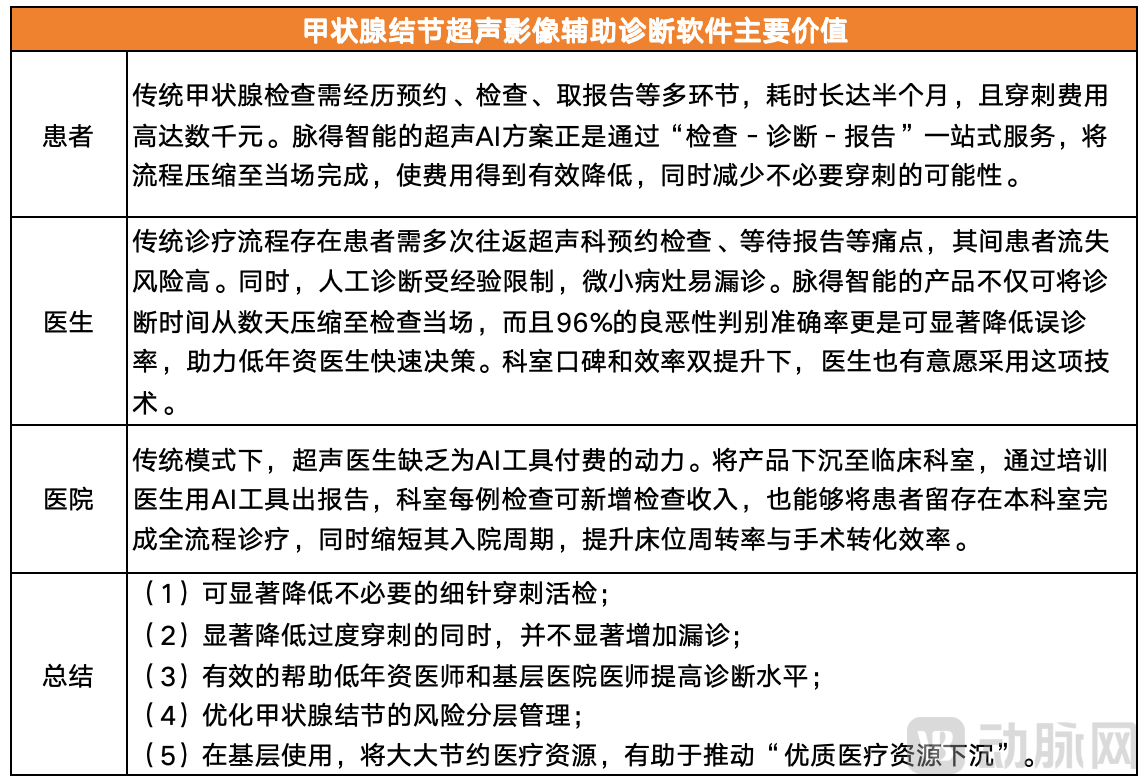
Key Value of Ultrasound Imaging-Assisted Diagnostic Software for Thyroid Nodules
It is reported that the software recently approved for Maide Intelligent focuses on the analysis of thyroid ultrasound grayscale images. It provides alerts for suspected malignancy in thyroid nodules measuring 5 mm or larger, enabling rapid and accurate differentiation between benign and malignant nodules, thereby allowing non-invasive ultrasound diagnosis to achieve pathological-level precision.
This technology addresses the limitations of traditional manual diagnosis in terms of efficiency, consistency, and detection of small lesions. By providing clinicians with efficient and reliable decision support, it reduces the likelihood of unnecessary biopsies, significantly optimizes diagnostic and treatment workflows, and shortens diagnosis time. Furthermore, the product’s strong generalizability and stability enable its use across different types of ultrasound equipment and diverse medical settings, effectively enhancing the quality of primary healthcare services and narrowing regional disparities in medical resources.
However, achieving pathology-level diagnostic accuracy with non-invasive ultrasound is no easy feat.
First, unlike static imaging modalities such as CT, MRI, and DR, ultrasound produces real-time dynamic images, thereby imposing higher requirements on data quality for the training of ultrasound AI models.
Compared to static imaging, which has established standardized acquisition protocols, ultrasound imaging faces inherent challenges of data heterogeneity due to its four-dimensional dynamic nature (three-dimensional anatomical structures plus real-time scanning dimension). Characteristics such as variations in equipment parameters, dependence on physicians’ scanning techniques, and the strong coupling between real-time diagnosis and data acquisition make data collection highly difficult and impose stricter requirements on data accuracy.
Secondly, ultrasound diagnosis requires the real-time acquisition of dynamic images from multiple planes for diagnostic purposes. Compared with the two-dimensional data of static imaging, ultrasound data incorporates a temporal dimension. A large number of non-diagnostic frames are generated during ultrasound examinations. Therefore, it is essential to establish a real-time frame-level value assessment system and precisely identify key diagnostic planes through temporal correlation analysis to achieve effective image-based diagnosis. This poses another significant test for enterprises’ algorithms and related technical capabilities.
For example, in previous classification tasks based on static images, the model’s benign versus malignant classification results for the same lesion were often inconsistent across different video frames due to the difficulty in extracting temporal features of the lesion.
Finally, thyroid ultrasound data encompasses ultrasound images, fine-needle aspiration (FNA) results, and postoperative histopathological findings. Given the multi-source nature of thyroid ultrasound images, a large volume of training data is required. In addition to broad data dimensions, the annotation and review processes are more complex due to stringent requirements for accuracy, standardization, and diversity. Furthermore, novel model training strategies should be designed to address poor generalization performance, enabling the product to accommodate data acquired across different hospitals, devices, and clinical scenarios.
Furthermore, to ensure that the product can adapt to various clinical scenarios, it is necessary to build a thyroid database covering multiple devices and scenarios.
Faced with numerous bottlenecks to overcome, there are currently very few approved ultrasound imaging-assisted diagnostic software products for thyroid nodules on the market.
Fortunately, Maide Intelligence has overcome the aforementioned challenges through breakthroughs in data, technology, and models.
The Maide Intelligent team brings together top global scientists, healthcare industry veterans, and serial entrepreneurs.
The deep integration of industry, academia, and research enabled the team to recognize, from its inception, that ultrasound-assisted diagnostic software for thyroid nodules must be built upon deep learning technologies and AI models. The team believes that only by leveraging standardized ultrasound imaging data, combined with real-world clinical diagnostic scenarios, and incorporating data annotated with pathological gold standards for training, can precise differentiation between benign and malignant thyroid nodules be achieved, thereby providing clinicians with accurate and reliable auxiliary diagnostic results.
Based on this understanding,Maide Intelligence Establishes Ultra-Large-Scale Gold-Standard Database SystemThe system contains tens of millions of gold-standard data records, providing robust data support for its technological research and development. Furthermore, it features rich and diverse data dimensions with multi-omics scale, comprehensively integrating data from 18 clinical specialties and achieving in-depth coverage of three key medical domains: ultrasound, pathology, and genomics. Meanwhile, the population size covered by this database system reaches the tens of millions.
It is precisely based on this database system that Maide Intelligent has successfully developed a series of new technological products benchmarked against the gold standards of clinical guidelines.
After resolving the data issues, Maide Intelligence further broke through the traditional indirect inference model based on TI-RADS grading,Pioneering a Pathology Information-Driven Paradigm for Direct Prediction of Deep Features. By leveraging multiple technical approaches, we achieve multidimensional complementarity between AI-based ultrasound assessment of thyroid nodules and the TI-RADS classification system, thereby establishing a precise mapping between imaging features and pathological outcomes.
Meanwhile, the company has innovatively constructed a large-scale thyroid imaging database using multi-center, multi-device, and multi-scenario data. This database encompasses diverse datasets from different hospitals, imaging equipment, and clinical environments, ensuring the model’s adaptability to various clinical scenarios.
Currently, leveraging ultra-large-scale clinical gold-standard data, the company has successfullyAchieve Horizontal Expansion of Platform-Based Product Applications, establishing an AI-powered ultrasound product portfolio that encompasses clinical decision support and health screening. This includes intelligent thyroid ultrasound, intelligent breast ultrasound, and intelligent early-screening solutions for lymph nodes, prostate, musculoskeletal structures, and the abdomen. Meanwhile, the company has also developedIntelligent Ultrasound Large Model, covering a composite system of image and report quality control, point-of-care (POC) quality control and remote consultation, remote education and scientific research, and AI-assisted diagnosis, thereby achieving diversified application and extension of key core clinical data.
As is well known, in the “marathon” of medical AI, technological breakthroughs and commercial implementation are both indispensable. Today, Maide Intelligence has successfully overcome the challenges of AI commercialization, with its products deployed in over 500 hospitals across China, reaching more than a thousand healthcare institutions, and steadily expanding overseas, achieving rapid revenue growth. The secret to Maide Intelligence’s breakthrough lies within its team.
The core competitiveness of Maide Intelligence stems from its world-class artificial intelligence team.
In the realm of core artificial intelligence technologies, the team has accumulated more than 70 invention patents and published over 100 professional research papers, with significant findings consecutively featured in top-tier academic journals such as The Lancet. Furthermore, the team has participated in major national science and technology special projects and was recognized as a “Winner of the AI Medical Device Innovation Task Force” by the Ministry of Industry and Information Technology (MIIT) and the National Medical Products Administration (NMPA), owing to its leading clinical AI products. Notably, the team’s recent acquisition of the world’s first Class III certification for ultrasound AI, benchmarked against the pathological gold standard, serves as a concrete testament to how its profound “research DNA” empowers clinical practice.
But how can technological advantages truly be translated into market barriers?
The answer lies in the medical ecosystem cultivated over 30 years by the founder and chairman. His team has practical experience across pharmaceuticals, medical devices, diagnostics, and AI services. Decades of expertise have taught the team that products must be rooted in the real-world needs of hospitals.
It is this philosophy that has directly driven Maide Intelligence’s clinical strategy. Since its inception, the company has partnered with West China Hospital to establish a West China Research Base, and has continuously collaborated with top-tier clinical expert teams throughout its development, ensuring that R&D remains closely aligned with frontline clinical needs. The “industry-academia-research-medicine” closed-loop ecosystem cultivated by the entire team has further enabled Maide Intelligence to navigate regulatory pathways more efficiently, particularly in NMPA registration and national medical insurance reimbursement approval. As a result, the company achieved coverage of the top 100 hospitals across China within just two years.
Today, Maide Intelligent’s products have been deployed in over 500 hospitals across China, reaching more than 1,000 healthcare institutions. Its commercial footprint has expanded from the domestic market to overseas regions. In addition to its early strategic industry and channel partnership with GE Healthcare, the company is now collaborating with Huawei to lay out its international market presence, rapidly achieving a commercial breakthrough from zero to hundreds of millions in scale.
Maide Intelligent’s AI-Assisted Diagnostic Software for Thyroid Nodule Ultrasound Imaging undoubtedly provides a clear pathway for breaking through the bottlenecks in imaging AI, setting a benchmark for the numerous ultrasound AI applications yet to gain regulatory approval. Only by targeting unresolved clinical challenges, focusing on creating new clinical value, genuinely improving healthcare standards, and reducing patient costs can medical imaging AI achieve a breakthrough.