

Baichuan Intelligence and Beijing Children's Hospital Launch World's First Pediatric Large Model and Two AI Pediatrician Applications

BAICHUAN AI
AI Medical Technology Researcher

Beijing Children's Hospital Capital Medical University
Grade A Tertiary Comprehensive Pediatric Hospital
On March 20, BAICHUAN AI, Beijing Children’s Hospital, and Xiaoerfang Health jointly released the world’s first large language model for pediatrics—the “Futang·Baichuan” Pediatric Large Model. This model not only encompasses a comprehensive knowledge system covering common pediatric diseases and complex conditions, but also possesses robust clinical reasoning capabilities in pediatrics. Furthermore, it pioneers an evidence-based mode for pediatrics, integrating the best available medical evidence to formulate scientific, personalized diagnosis and treatment plans for pediatric patients, much like a professional pediatrician.
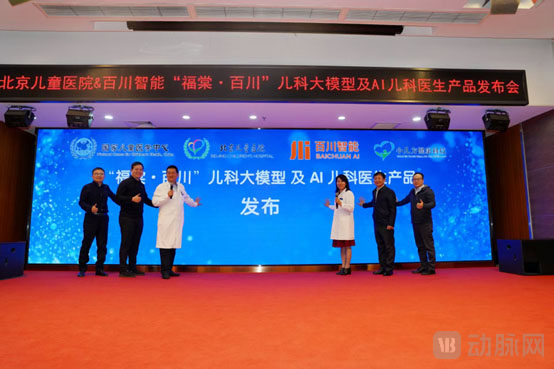
Building on this foundation, and to further enhance pediatric care capabilities at primary healthcare institutions and address the shortage of high-quality pediatric medical resources at the grassroots level, two applications—the “Futang·Baichuan” AI Pediatrician Expert Edition and Primary Care Edition—have been jointly developed. Leveraging the four National Regional Medical Centers under the administration of Beijing Children’s Hospital as strategic hubs, and in coordination with the Beijing Pediatric Medical Consortium, these initiatives will extend their reach to community hospitals in Haidian District and the Beijing Economic-Technological Development Area, as well as to more than 150 county-level hospitals in Hebei Province, thereby actively promoting the grassroots adoption of the “AI Pediatrician.”
Pediatric diseases often involve multisystem issues, making generalist capabilities a critical foundation for large pediatric models. Meanwhile, the unique pathological needs of children, complex and refractory conditions, and rare diseases impose exceptionally high demands on the model’s reasoning abilities in addressing complex medical challenges.
In this regard, Wang Xiaochuan, Founder and CEO of BAICHUAN AI, introduced that the medical-enhanced general large language model developed by BAICHUAN AI is built upon a professional medical dataset comprising trillions of tokens. This dataset encompasses comprehensive medical knowledge, including Chinese and English professional medical papers, clinical guidelines, textbooks, and books. Furthermore, it integrates the clinical expertise of more than 300 renowned pediatric specialists from Beijing Children's Hospital, along with decades of high-quality, de-identified expert medical records. The model has also been strengthened in areas such as evidence-based reasoning, logical inference, memory, dialogue, and multimodal capabilities. When interacting with patients' parents, the model can autonomously conduct multi-turn consultations and communicate with patience. In addressing complex medical issues, it leverages professional and reliable medical knowledge as the basis for reasoning, providing well-substantiated responses through an "evidence-based approach" that presents facts and logical explanations.
It is worth noting that, to enable the model to accurately retrieve literature, BAICHUAN AI has independently built a high-confidence evidence-based medicine knowledge base. This repository comprises more than 40,000 Chinese and English clinical guidelines and expert consensus statements, over 38 million scientific research papers, nearly 170,000 drug package inserts, as well as various off-label medication experiences accumulated by Beijing Children’s Hospital.
To help address the shortage of pediatric medical resources at the grassroots level, BAICHUAN AI, Beijing Children’s Hospital, and Xiaoerfang Health have jointly launched two AI pediatrician products, leveraging the “Futang·Baichuan” Pediatric Large Language Model.
Ni Xin, Director of the National Center for Children's Health and President of Beijing Children's Hospital, stated that the primary care and specialist versions of the "Futang·Baichuan" AI Pediatrician applications will be piloted first in various settings, including national regional medical centers, pediatric medical consortia, county-level Grade IIIA hospitals, and community hospitals. By leveraging cloud-based or localized deployment and adopting a "dual-doctor" model combining real physicians with AI doctors, these applications aim to empower and enhance pediatric diagnostic and treatment capabilities across China.
Among these, the “Futang·Baichuan” AI Pediatrician (Primary Care Edition) is designed for routine diagnosis and treatment of pediatric diseases. Its diagnostic capability for outpatient cases in respiratory and gastrointestinal disorders has reached the level of attending physicians at Beijing Children’s Hospital, holding promise for enhancing the pediatric care proficiency of primary care providers. Taking viral encephalitis in children as an example, delayed treatment of this condition can lead to severe consequences, yet its early symptoms closely resemble those of the common cold, posing significant diagnostic challenges for primary care physicians. The “AI Pediatrician,” with its symptom inquiry function, can generate a preliminary diagnosis of pediatric viral encephalitis and provide recommendations for necessary examinations and tests.
The “Futang·Baichuan” AI Pediatrician Expert Edition focuses on in-hospital multidisciplinary consultation scenarios for complex and rare pediatric cases, as well as inpatient case analysis. As early as early February, it was officially deployed in multidisciplinary expert consultations at Beijing Children’s Hospital, pioneering a dual-physician parallel multidisciplinary consultation model featuring “AI Pediatrician + Multidisciplinary Experts.” The treatment plans it generated demonstrated a 95% concordance rate with the consensus reached by experts at Beijing Children’s Hospital, earning unanimous recognition from the consulting specialists. To date, the AI Pediatrician Expert Edition has participated in more than 10 consultations for complex and rare conditions and has frequently joined grand rounds in pediatrics, helping tens of thousands of physicians across China deepen their understanding of the diagnosis and treatment of pediatric diseases.
To effectively support grassroots hospitals in enhancing their pediatric diagnosis and treatment capabilities, Beijing Children's Hospital has announced collaborations with the Haidian District and Economic-Technological Development Area (EDA) of Beijing, as well as the Health Commission of Hebei Province. Together with BAICHUAN AI and Xiaoerfang Health, they are comprehensively promoting the decentralized application of AI pediatricians, using community hospitals in Beijing's Haidian District and EDA, along with over 150 county-level hospitals in Hebei Province, as pilot sites. This initiative aims to establish a "dual-doctor" model combining "AI Pediatricians + Human Doctors," empowering pediatricians at primary healthcare institutions to significantly improve their clinical decision-making abilities and diagnostic standards to meet the professional benchmarks of the National Center for Children's Health, thereby systematically addressing the industry-wide challenge of uneven distribution of high-quality pediatric medical resources.
The “Futang·Baichuan” Pediatric Large Language Model, jointly released by BAICHUAN AI, Beijing Children’s Hospital, and Xiaoerfang Health, represents both a proactive endeavor in advancing and translating cutting-edge technologies within the field of pediatrics and a valuable exploration by BAICHUAN AI in its “Building Doctors” initiative to enhance pediatric healthcare services. The deployment of two AI-powered pediatrician products in community hospitals across Haidian District and the Economic-Technological Development Area of Beijing, as well as in primary care facilities in Hebei Province, not only alleviates the shortage of pediatricians but also fundamentally improves the quality of primary healthcare through continuous capacity building. This initiative holds significant demonstrative value for the construction of China’s tiered medical system.