

Ant Group Strengthens Medical AI Strategy Post-Haodf Acquisition with 'Three-End Integrated' Ecosystem
In 2025, the urgency across all industries to board the era-defining express train of large language models (LLMs) has become more pronounced than ever before. In the healthcare sector, key stakeholders—including major health enterprises, medical institutions, and regulatory authorities—are racing to integrate DeepSeek, upgrade their existing LLMs, or launch new vertical-specific large language models.
Despite the large scale and rapid growth of medical data, its utilization rate remains low, indicating broad prospects for the development and application of large language models (LLMs) in the healthcare sector. However, the centralized deployment of DeepSeek represents only a key milestone in the phased progress of LLMs. The integration of AI and healthcare is a complex, long-term endeavor, where continuous exploration and iterative refinement are the norm.
Ant Group is a key player continuously ramping up its investments in medical AI. Since 2023, Ant Group has made frequent moves in the medical AI sector: collaborating with the Zhejiang Provincial Health Commission to pioneer the digital health avatar “Anzhen’er,” launching a large medical language model, releasing the “AI Health Manager,” acquiring Haodf Online, and co-creating an AI physician assistant, among other initiatives.
On March 21, 2025, Ant Group’s medical AI initiative took another significant step forward by upgrading and launching its AI product suite tailored for healthcare institutions, physicians, and users. This marks the formal establishment of a “three-end integrated” strategic layout in medical AI, capitalizing on the opportunities presented by large language models.
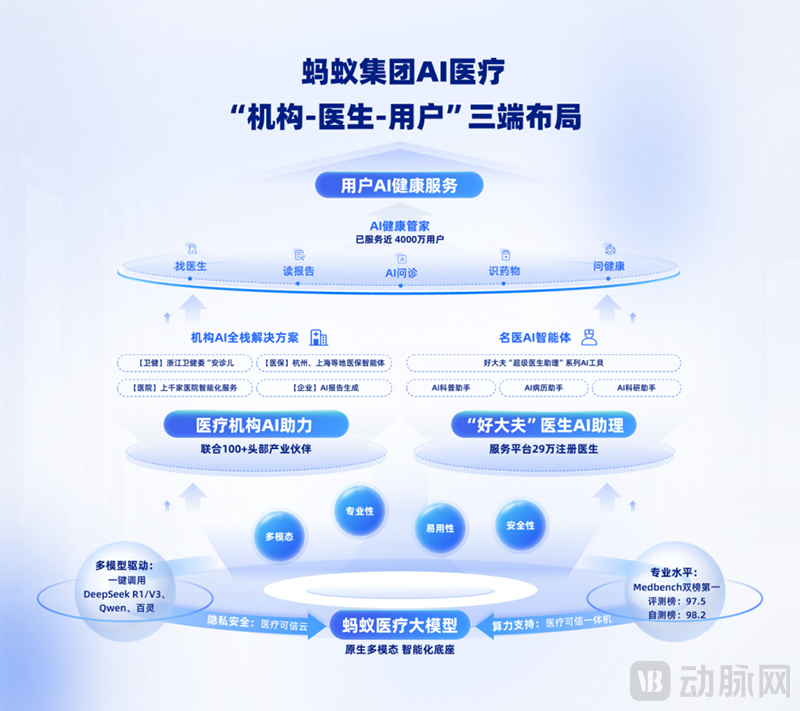
Ant Group’s “Three-End Integration” Strategic Layout for Medical AI
Since 2025, DeepSeek has sparked widespread attention across various industries toward large language models (LLMs). LLMs hold profound significance for the development of artificial intelligence (AI), as they lower the barrier to entry for development and accelerate the deployment of AI across diverse industrial sectors. The 2025 Government Work Report, delivered during the Two Sessions of China’s National People’s Congress and Chinese People’s Political Consultative Conference, also highlighted the need to continuously advance the “AI Plus” initiative and support the extensive application of large language models.
In the medical field, AI sparked its first wave of enthusiasm in China starting in 2016–2017, and has since achieved substantial results, including products such as Class III medical devices for AI-assisted diagnosis.
Since 2024–2025, large language models have ushered in a new wave of AI-driven transformation in the healthcare sector.Especially with the surge in popularity of DeepSeek, stakeholders across various industries have shown unprecedented enthusiasm for integrating large language models.
According to public reports, more than 100 hospitals across China have announced the completion of localized deployments of DeepSeek, integrating it with their internal business systems to varying degrees and applying large language models to clinical diagnosis and treatment, management, and service workflows. Health commissions and medical insurance bureaus in multiple regions are advancing the deployment of DeepSeek, leveraging integrated regional health information or medical insurance data to provide timely and accurate public services to local residents.
Health and wellness enterprises are integrating DeepSeek into their business processes in alignment with their respective domains, thereby enhancing efficiency in R&D, management, and services. Meanwhile, building upon the numerous existing large medical models within the industry, specialized vertical large models tailored to specific healthcare subfields are continuously emerging, including large models for biomedical reasoning, traditional Chinese medicine, and intellectual property related to medical equipment.
Even among healthcare professionals, guides such as “DeepSeek Practical Operation Guide” are widely circulated.It is no exaggeration to say that the healthcare industry has entered an era where large language models are on everyone’s lips.
Integrating DeepSeek or other large language models is not the end goal; what matters more is aligning with the practical application needs of the healthcare industry.
Taking hospitals as an example, the localized deployment of large language models requires high-performance hardware support, imposes stringent requirements on data security risk management, and involves highly complex integration with existing hospital systems and adaptation to clinical workflows. Therefore, healthcare institutions require more efficient, convenient, and secure deployment solutions.
On March 21, Ant Group, in collaboration with industry partners, launched the “Ant Medical Large Model All-in-One Appliance,” a full-stack solution. Healthcare institutions can achieve private deployment of domestically produced computing power, medical large models, and integrated AI training and inference simply by connecting to the Ant Medical Large Model All-in-One Appliance with a single click, while also having the option to select corresponding upper-layer intelligent agent applications.
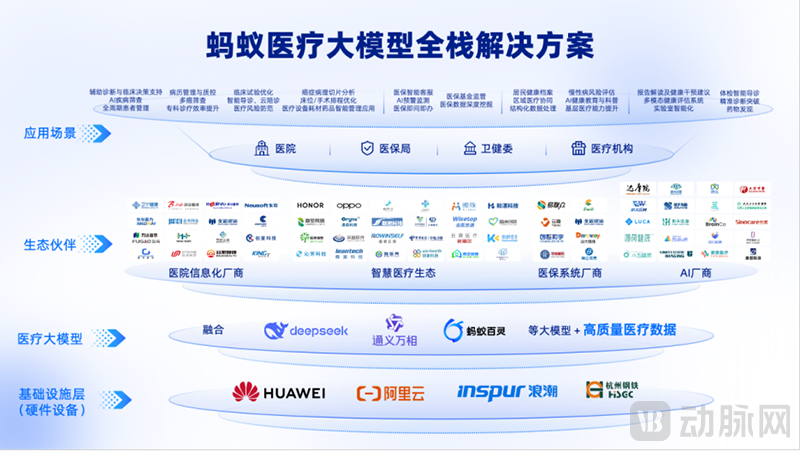
Ant Medical Large Model Full-Stack Solution
In fact, all-in-one large language model appliances have become one of the solutions for rapid deployment in healthcare institutions, and the surge in interest surrounding large language models has spurred the emergence of numerous manufacturers specializing in these integrated systems.
Rather than merely serving as a technology vendor on call, Ant Group is more inclined to delve into the core complexities of various industries. In delivering products or solutions, Ant Group fully leverages the strength of its ecosystem partners, pooling their respective expertise to facilitate the practical implementation of large language models and other AI technologies. According to the information disclosed that day, Ant’s medical AI “circle of friends” includes not only hospital informatics providers such as Winning Health and Neusoft, but also vendors specializing in smart healthcare, medical insurance systems, and AI-assisted diagnosis and treatment, thereby achieving nearly comprehensive coverage of fields related to hospital digitalization.
Within the industry,What sets Ant Group apart is its establishment of an integrated “three-end” medical AI ecosystem, connecting institutions, physicians, and users.On March 21, Ant Group upgraded and released its AI product suite designed for doctors and users.
Targeting physicians, Ant Group has upgraded its AI Doctor Assistant suite of tools in partnership with Haodf Online. In addition to the existing AI Medical Record Assistant and AI Patient Education Assistant, it has introduced an AI Research Assistant, thereby providing more comprehensive support for the clinical, teaching, and research activities of its 290,000 registered physicians.
Launched in September 2024, the “AI Health Assistant” has added support for DeepSeek’s deep thinking mode and a proprietary intelligent thinking mode to cater to users’ diverse conversational needs. It also introduces new features such as health self-assessments and medical checkup report interpretation.
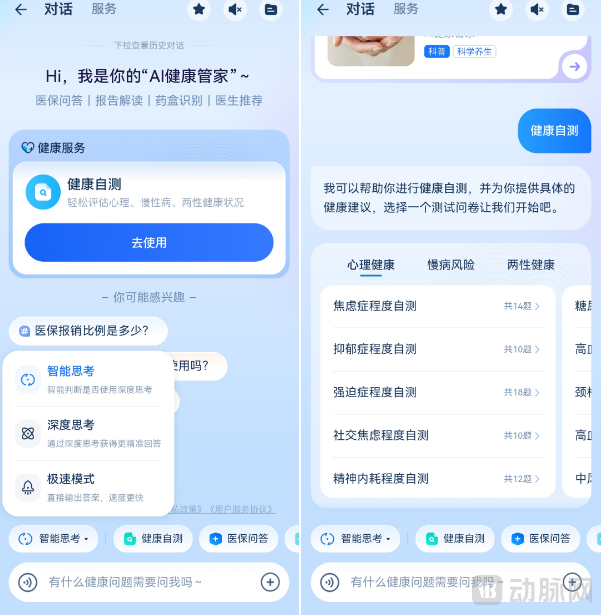
“AI Health Manager” Adds Thinking Mode and Self-Health Assessment Features
Leveraging its “three-end integration” strategy, Ant Group can directly provide AI products or solutions to relevant stakeholders, while also establishing a medical AI ecosystem that connects institutions, physicians, users, payers, and service providers.
For instance, the “Ant Medical Large Model All-in-One Machine” has partnered with over 100 industry collaborators to efficiently integrate computing power, models, and platform application layers. Collaborations with Huawei and Alibaba Cloud enable this solution to feature integrated Chinese-made computing power, tri-modal drive, and unified training and inference. By co-developing solutions with nearly 100 partners in fields such as medical diagnostics, medical equipment, healthcare informatics, and AI imaging, hospitals can deploy relevant applications on demand without disrupting their existing software systems or workflow habits.
Similarly, the “AI Health Steward” has opened agent collaboration to the medical and broader health industries. Currently, it hosts AI agents for over 60 renowned physicians across China, along with multiple agents representing healthcare institutions, medical specialties, health commissions, and medical insurance systems, collectively providing users with hundreds of services.
Healthcare is a slow-moving industry, and the integration of AI into various complex medical scenarios is likewise a long-term process.The much-hyped large language models have only taken their first steps; achieving flexible application of these models in real-world medical scenarios is destined to be a marathon.
Taking question-and-answer interactions as an example, large language models (LLMs) still exhibit issues such as insufficient contextual understanding, redundant responses, and hallucinations. Imagine a scenario where, after a user poses a question, the LLM either provides a barrage of “correct but trivial” information without distinguishing between primary and secondary points, or delivers a response that appears logically coherent on the surface but contains fundamental factual errors. What should users do in such situations?
Large Healthcare AI Models and Applications: Gradual Perfection Through a Spiral Ascent of Technical Capabilities and Scenario Innovation. Ant Group has long recognized this, intensively iterating its AI products and exploring integration into diverse scenarios since 2023.
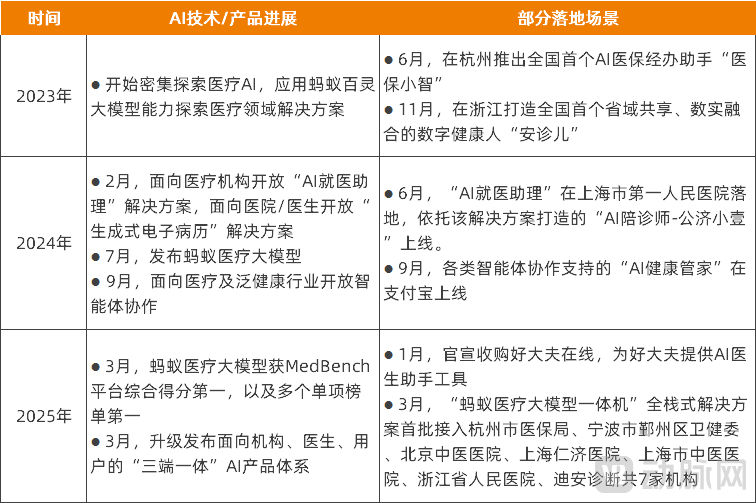
Key Milestones in Ant Group’s Deployment of Medical AI Since 2023, Source: Public Reports
Technologically, Ant Group has continuously strengthened its medical expertise, evolving from the general-purpose Bailin large language model to specialized healthcare-focused large language models.
Previously, Alipay leveraged the capabilities of its Ant Bailin large language model to offer solutions such as “AI Medical Assistant” and “Generative Electronic Medical Records” to healthcare institutions and physicians, thereby building technical expertise in areas including medical knowledge professionalism, safety and controllability, and client-side lightweighting.
In 2024, Ant Group released its medical large language model. Recently, on the MedBench evaluation platform, Ant’s medical large language model ranked first in several individual categories, including medical knowledge question answering, medical language generation, and complex medical reasoning. In terms of overall composite scores, it has also consistently maintained the top position. Furthermore, Ant has recently completed the development of a new-generation medical reasoning model based on reinforcement learning. Following the upgrade of its AI engine, this model not only possesses “medical thinking” reasoning capabilities but also supports multimodal interactions involving images, text, audio, and video.
In terms of application scenarios, Ant Group has been prioritizing solutions for the traditional healthcare industry, leveraging the B2B sector as an entry point to drive the implementation of large language models.
In 2023, the Zhejiang Provincial Health Commission partnered with Ant Group to pioneer “Anzhen’er,” a digital health persona. “Anzhen’er” also represents the first nationwide application of the aforementioned “AI Medical Assistant” solution. With the assistance of “Anzhen’er,” a seamless healthcare experience has emerged: for instance, a patient experiencing eye discomfort visits a hospital and uses voice commands on their mobile phone to inquire about procedures from an AI consultation companion. The AI companion not only provides detailed medical visit recommendations but also proactively offers prompts during subsequent stages such as waiting and examinations, significantly enhancing the overall healthcare experience.
As of now, “Anzhen’er” has covered more than 1,000 public hospitals and served over 30 million patient visits. Building on this foundation, Ant Group has developed a reusable AI solution to help medical institutions across China deploy applications like “Anzhen’er.”
“Every project in the medical field, no matter how small, is extremely time-consuming and labor-intensive. It is difficult to produce a remarkable product without two to three years of effort.” Zhang Junjie, Vice President of Ant Group and General Manager of the Digital Medical Health Division of Alipay, once remarked thus, echoing the sentiments of professionals in the medical technology industry.
From “Internet+” to “AI+”, in the new era of interaction, healthcare services will also usher in new pathways. Everything has just begun, and Ant Group is still on its journey.