

DeepSeek Appliance Is Not the Ultimate Solution for AI in Healthcare: Specialized Models Are Essential for Scientific Rigor

DeepSeek
Large Language Model (LLM) and Related Technology Developers
“The Most Mysterious Martial Arts in Demi-Gods and Semi-Devils”“Minor Formless Art”, which can be regarded as the martial arts version ofAIAlgorithm: It can replicate the ultimate techniques of various schools solely by driving them with internal energy, without needing to understand the essence of the moves. When Jiumozhi used it to imitate the 72 Ultimate Skills of Shaolin, it demonstrated“One Practice, Ten Thousand Methods”its astonishing efficiency, yet ultimately led to disastrous consequences due to its shaky foundations——This is akin to modern healthcareAIThe Two Sides of the Magic Mirror.
Digital Mirror of Xiaowuxiang Gong:DeepSeek Medical All-in-One Machine: A Rhapsody on Efficiency
In the cyber realm of medical AI, major players are immersed in a collective frenzy over structured data. General-purpose large language models like DeepSeek, akin to the "Xiao Wuxiang Gong" (Formless Mimicry) from Jin Yong’s martial arts novels, appear versatile and adaptable across diverse applications. They transform structured data from Hospital Information Systems (HIS), Picture Archiving and Communication Systems (PACS), and electronic medical records into digital capabilities, staging a spectacle of efficiency revolution in over one hundred hospitals across China.
Taking the local deployment of DeepSeek at Beijing Tsinghua Changgung Hospital as an example, 4,000 terminals have been integrated, achieving data interoperability across the medical consortium. Significant benefits are expected in reducing the workload of radiologists, shortening the time required for outpatient medical record entry, improving early cancer detection rates, lowering medication error rates, and decreasing the average length of hospital stay for patients.
In this digital migration, DeepSeek demonstrates three layers of structured capabilities:
• Signal Translation: Converting DICOM Image Pixels into Probability Heatmaps and Encoding Laboratory Indicators into Risk Coefficients
• Text Alchemy: Extracting Diagnostic Paradigms from Millions of Electronic Medical Records to Construct an Association Network for ICD Coding
• Process Topology: Reconstructing Outpatient Pathways with Knowledge Graphs to Optimize the Spatiotemporal Arrangement from Registration to Medication Pickup
At its core, it remains a process of weaving structured digital signals—such as CT values, laboratory indicators, and physician order texts—into more efficient decision-making graphs. Admittedly, the DeepSeek Medical All-in-One Machine serves as a digital embodiment of the Xiaoyao Sect’s supreme martial arts; its stunning performance in doubling outpatient efficiency rivals the intimidating prowess of Jiumozhi’s solo incursion into the Shaolin Temple. However, when confronted with complex and rare diseases, the algorithm-driven “internal energy” may reveal shortcomings due to insufficient accumulation of clinical experience, much like how the Wuxiang Gong, despite its versatility, ultimately fails to capture the true essence of the Yijin Jing.
What is the reason?
Jiumozhi Trap:Professional Disorientation Under the Cult of Efficiency
1. The Complexity of Life Sciences: Breadth ≠ Depth
Although open-source models are powerful, professional discriminative tasks still require annotation by experts; their auxiliary role is limited, and they cannot replace precise diagnosis. They resemble a “nearsighted encyclopedic scholar,” with broad knowledge but lacking depth, failing to meet the extremely high demands for professionalism and accuracy in biological sciences. The complexity of living systems—from gene sequences to protein folding, and from cellular metabolism to organ function—has far exceeded the cognitive boundaries of general-purpose models. In medical scenarios, general-purpose models may mislead patients and cause diagnostic and treatment errors. Particularly for young physicians, overreliance on these models may foster habits of intellectual laziness and even lead to the acquisition of incorrect information, thereby jeopardizing patient safety.
2. The Fatal Hallucinations of Generalist Models
While general-purpose models are broad, their understanding of specific scenarios lacks depth—they may appear coherent on the surface but are riddled with flaws in practice. This is akin to the “Small Formless Art” (Xiao Wu Xiang Gong) in martial arts fiction, which mimics various styles and wins most battles, yet falls short against true masters like the Sweeping Monk. In such encounters, its limitations become apparent, and prolonged forced application leads to significant adverse effects, much like Jiumozhi, whose body rapidly deteriorated from overexertion. Similarly, despite the availability of SAM and numerous image-based medical AI models, experts recognize that data varies significantly across each specialized clinical scenario. These models are not fully compatible and can even be difficult to deploy. The primary reason lies in the fact that medical diagnosis and treatment are not simple binary decisions or straightforward discrimination and generation tasks. The “generalist” nature of these models faces inherent limitations when confronting the complexities of biological science:
Personalized Challenges in Diagnosis:The essence of medicine is “to cure sometimes, to relieve often, and to comfort always.” Patients’ individualized assessments and humanistic care require physicians’ year-after-year clinical accumulation, which is difficult for AI to replace;
Data Reliability and Hallucination Issues:DeepSeek’s pre-training data is sourced from massive general-purpose corpora, with over 30% consisting of non-medical content, including news articles, entertainment gossip, social media posts, and even fictional texts. This “mixed-diet” training approach makes large language models prone to “deviating” when addressing professional queries. AI does not deal in absolute rights or wrongs; its outputs depend entirely on the quality of source data and still require validation by professionals. Let alone the hallucinations inherent in generative large models, which are utterly unacceptable in serious clinical medical settings.
This reveals a harsh reality: any technological breakthrough must guard against the “Jiumozhi Trap”—when the torrential pursuit of efficiency drowns out the cultivation of professional depth, and when algorithmic overconfidence breaches the moat of human physicians’ experience, even the most sophisticated “formless power” may become a double-edged sword that undermines the very essence of healthcare.
Revelations of the Yi Jin Jing:Breaking the Deadlock for Large Biological Models
While DeepSeek’s “Xiao Wu Xiang Gong” is still in the realm of medical textAs VCBeat continues to refine its expertise in the diagnosis and treatment of common diseases and the optimization of outpatient processes, top-tier global laboratories have already launched a “Yi Jin Jing” revolution in life sciences. The core breakthrough of this revolution lies in:Truly disruptive medical AI should not stop at the permutation and combination of medical record texts, but must reconstruct the cognitive framework for understanding the “dark matter” of life.
AlphaFold has achieved a revolutionary breakthrough from target discovery to drug design, providing the “internal energy cultivation method” for countless drugs and becoming the “Yi Jin Jing” of the pharmaceutical world.
The EVO large language model is more inclusive, reconstructing the code of life with Darwinian algorithms, breaking through cross-scale modeling from nanometers to centimeters, and achieving precise mapping from gene mutations to tumor imaging. Its adaptive evolution framework increases drug discovery efficiency by 80-fold, achieves a toxicity prediction accuracy of 95%, and dynamically optimizes personalized treatment plans.
Meanwhile, China’s biomedical sector is witnessing a breakthrough moment for homegrown innovators. GeneLLM™️, a large biological model independently developed by Shenzhen Jindu Biomedical Technology Co., Ltd., has mastered the ultimate essence of the “Yi Jin Jing” (Muscle/Tendon Change Classic): using trillions of base pairs as “meridians” to reconstruct the holistic circulation of life’s dark matter. As China’s first large model dedicated to the foundational layer of AI for biological sciences, it is breaking through three major stages of advancement:
- The Capability Leap from “General-Purpose Models” to “Specialized Expertise”
•Data Dimensions: Integration of Genomics/Transcriptomics/Proteomics/Radiomics
• Precision Breakthrough: Sensitivity >90% and Specificity >99% in Early Screening for Multiple Cancers and Diseases
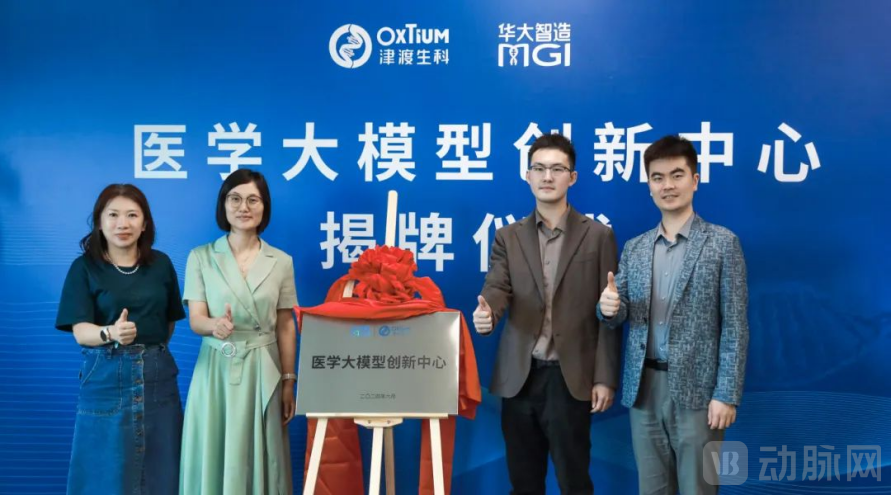
• Industry Penetration: Co-building a Precision Medicine Database for 10,000 Individuals with MGI Tech
- A Paradigm Revolution: From “Imitating Techniques” to “Reshaping Internal Capabilities”
• Breakthrough: Directly Accessing the "Source Code" Layer of Life Systems
• Technical Approach: End-to-end modeling of raw sequencing data (avoiding error accumulation in traditional hierarchical modeling)
•Achievement Example: Precise Mapping of Lodging-Resistance Gene Loci in Rice (88% Prediction Accuracy for Stress-Resistance Traits)
- From "Single-Point Breakthroughs" to "Ecosystem Restructuring": Industrial Dimensional Upgrade
• Platform Architecture: Bioford™ Integrates 132 Vertical Models
• Application Scenarios: Covering the Trillion-Dollar Market from Gene Editing to Biomanufacturing
• Evolution Speed: Three new bio-manufacturing solutions can be added each week
GeneLLM™’s industrial impact is equally impressive. It has already established strategic partnerships with clients such as MGI Tech and Shanghai Oriental Hospital. More than just a foundational large biological model, it serves as the zero point redefining the global value coordinate system for AI in healthcare.
GeneLLM™: Tongjiyin’s “Dual Pulses” Forge the Computing Power “Qi Sea,” Reshaping the Internal Energy Cycle of Scientific Research
Shenzhen Jindu Biomedical Technology Co., Ltd. developed GeneLLM™ with the vision of establishing it as an exceptional “AI scientist” that accompanies every researcher, empowering scientific innovation and accelerating breakthroughs in biological sciences.
GeneLLM™ is not content with superficial process optimization; instead, it delves into the genetic, molecular, and cellular levels to forge more precise tools for biological scientific research. This mirrors the ultimate truth in Jin Yong’s martial arts novels: true masters never rely on flashy but impractical moves, but rather prevail through profound mastery of internal energy.
The localized deployment of the all-in-one inference appliance, powered by GeneLLM™, has completed testing for four standard configurations. The high-performance training-and-inference all-in-one unit features eight A100 GPUs paired with a 72-core CPU. The high-performance desktop all-in-one unit is equipped with a 64-core, 128-thread CPU and two RTX 4090 graphics cards, along with a 15.6-inch HD touchscreen, significantly enhancing fine-tuning efficiency and inference speed while supporting real-time inference for models with up to 1.5 billion parameters. The domestically produced training-and-inference all-in-one units are configured with either a 32-core Kunpeng 920 processor or eight Ascend 300 I/Kunlun GPU P800 accelerators, running on the Ubuntu operating system with domestic databases, thereby meeting the information technology application innovation (Xinchuang) requirements of various research institutes and clinical organizations.
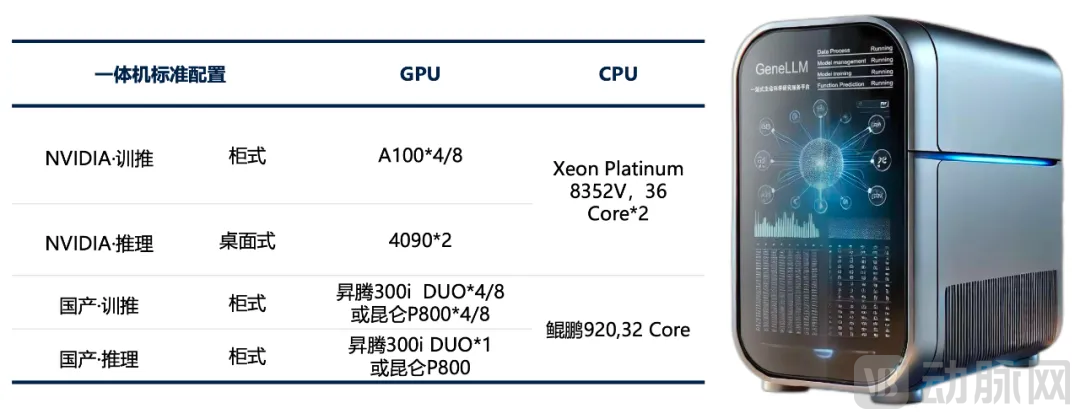
Bioford™ All-in-One Inference Appliance enables scientists to view research results in real time during inference with small-scale sample data, facilitating decision-making and sharing based on the overall research protocol. Meanwhile, the platform supports project-level data confidentiality management, flexibly meeting the collaborative needs of various projects and studies. It can be deployed flexibly in either local or cloud environments, comprehensively empowering scientists in their biological research endeavors.
In this “martial arts revolution” of medical AI, the value coordinates of GeneLLM™ have become clearly visible: it is not merely an iterative tool upgrade, but a systemic innovation in cognitive dimensions. Much like the Yi Jin Jing (Muscle/Tendon Change Classic) to Shaolin martial arts, this biological large model is reshaping the foundational architecture of life sciences—while the Wu Xiang Gong (Formless Technique) is still optimizing “moves,” GeneLLM™ has already reconstructed the quantum entanglement of “internal energy.”
The ultimate showdown for medical AI lies not in outpatient systems, but in the vast cosmos of life’s dark matter. GeneLLM™’s industrial practice demonstrates that only by reaching the “source code layer” of living systems can a qualitative leap from “medical assistant” to “life engineer” be truly achieved. This may well be the ultimate answer for medical AI to break free from the “Jiumozhi Trap.”
About Shenzhen Jindu Biomedical Technology Co., Ltd.
Shenzhen Jindu Biomedical Technology Co., Ltd. is dedicated to providing one-stop AI research solutions for biological sciences. Its independently developed multi-omics large model, GeneLLM™, has completed pre-training with 1.5 billion parameters and 3.45 trillion base sequences. Building on GeneLLM™, Jindu Biotech has created BioFord™, a one-stop scientific service platform focused on six core scenarios: basic scientific research, medical diagnostics, biomanufacturing, biological breeding, environmental monitoring, and disease treatment. The BioFord™ platform features nine biological science model libraries: multi-omics models, protein models, RNA 3D structure models, biomedical text models, biomedical image models, chemistry foundation models, gene editing models, metagenomic models, and time-series prediction models. It provides advanced “AI for BioScience” bioinformatics computing services, cloud-based training and inference services, and all-in-one inference appliances to researchers and industry users. The company has served numerous prestigious domestic institutions, including BGI Group, Baidu PaddlePaddle, the Cancer Hospital of the Chinese Academy of Medical Sciences (Peking Union Medical College), Shanghai Children's Medical Center affiliated with Shanghai Jiao Tong University School of Medicine, and the Chinese Research Academy of Environmental Sciences.
Jindu Life Sciences has established R&D centers in Shenzhen and Beijing. Its founding team, led by four University of Oxford alumni, brings together top scientists and engineers in the fields of artificial intelligence, bioinformatics, and bioengineering, and has published more than 60 papers in core journals such as Nature and Nature Communications.
Guided by the mission of “Exploring the Mysteries of Life with AI Technology,” Jindu Bioscience will continue to push the technological boundaries of AI plus biological sciences, providing innovative momentum for biological science research and industrial applications, and contributing to national technological innovation and industrial upgrading.