Digital Transformation in Dentistry: Industry Conference Offers First-Mover Advantage in Future Opportunities!
As of 2025, China’s dental industry is once again facing intense price wars, with “involution” and slim profit margins becoming the key themes shaping its development.
Faced with significant challenges, players in the dental industry are actively seeking transformation, with a focus on and adoption of digitalization being key.
The reason is that the integration of digitalization into the dental industry can, in theory, break down temporal and spatial barriers, seamlessly connect workflows, promote the standardization of processes and outcomes, and thereby achieve higher efficiency and quality.
Taking dental service providers as an example, long-standing challenges have included high marketing costs, information asymmetry, and difficulties in standardizing medical quality. Through digitalization, these institutions can focus more on improving diagnostic and treatment quality and operational efficiency, achieve standardized operations, thereby enhancing profitability and laying a solid foundation for scalable business growth.
For another example, in clinical diagnosis and treatment, dental models are indispensable for orthodontic examination and diagnosis. In the past, the industry commonly used plaster models, a method that suffered from insufficient accuracy and could cause patient discomfort. The advent of intraoral scanning technology has now resolved these issues, significantly improving the speed and accuracy of model measurements while greatly facilitating model storage and transmission, thereby providing strong support for remote consultations and the design of personalized aligners.
As "smart money," capital flows also underscore the importance of digitalization. Data from the VCBeat Orange Database shows that throughout 2024, there were a total of 46 financing events related to the oral care sector in China’s primary market, involving 43 innovative oral care companies—all of which have strategically embraced digitalization without exception.
Undoubtedly, whether a dental enterprise possesses a "digital DNA" has become a critical factor in its ability to secure financing.
Given the critical importance of digitalization, how should market entrants seize this opportunity? How will industry trends evolve? And where do the collaboration opportunities lie within the sector?
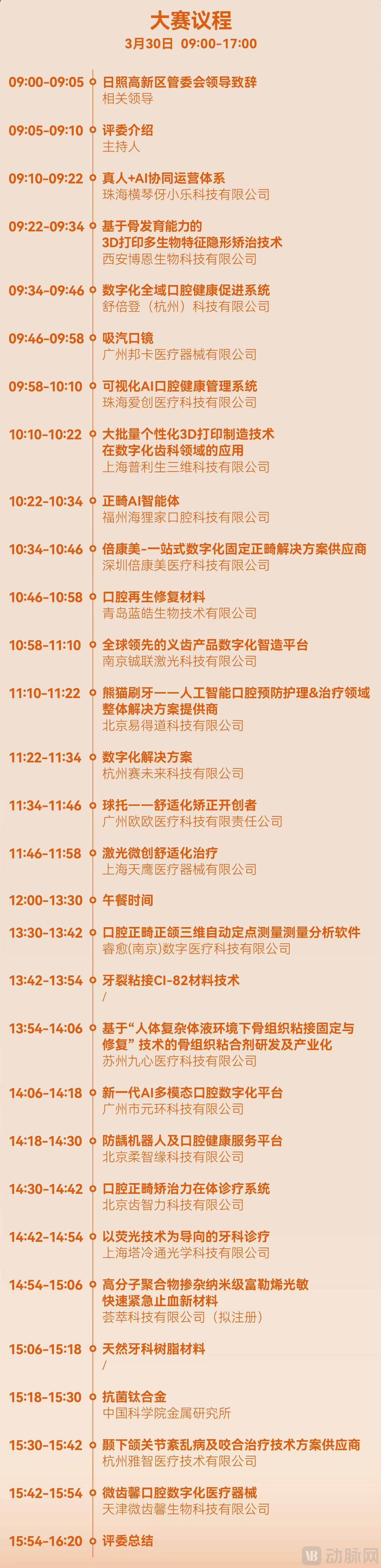
In response to the aforementioned issues, the “2025 Conference on High-Quality Development of the Digital Oral Industry and the Finals of the 1st Digital Oral Innovation Challenge,” scheduled to be held in Rizhao from March 30 to 31, will provide you with the answers!
Why is this so?
First, the guest lineup is sufficiently diverse and high-profile.Confirmed attendees include academic and clinical experts such as Wang Xing, Honorary President of the Chinese Stomatological Association; Zhou Yuanfeng, Deputy Dean of the School of Software at Shandong University and Director of the Center for Smart Healthcare and Precision Orthodontics R&D at Shandong Industrial Technology Research Institute; Liu Zhonghao, Dean of the School of Stomatology at Binzhou Medical University, as well as Party Secretary and President of Yantai Stomatological Hospital; Jin Zuolin, Chairman of the 8th Orthodontics Professional Committee of the Chinese Stomatological Association and Professor in the Department of Orthodontics at the School of Stomatology, Air Force Medical University (formerly the Fourth Military Medical University); and Luo Xiaoping, Professor and Chief Physician at the Affiliated Stomatological Hospital of Nanjing University Medical School.
In addition, prominent figures from the entrepreneurship and investment sectors will be in attendance. The distinguished guests include Li Hongsen, Partner at Nanjing Jinyu Maowu; Xiang Longsheng, CFO and Board Secretary of Hugedent Medical Group; Dama Zijian, Co-founder of Haodeya; Xu Xiaowei, Founder of Mai'er Medical; Gao Jie, Founder of Panda Brushing; Song Longtao, Founding Partner of Chuangjing Capital; Ding Ning, Vice President of Happy Oral Care Medical Group/IDSO; Cheng Xiaolin, Vice President and Chief Medical Officer of Taikang Bybo Dental; Yang Jian, CEO of Shubeideng; Huang Wei, Chairman of Hailijia; Ye Su, Head of the Healthcare Sector Center at Xingzheng Capital; Chen Defu, Chairman of Lanhao Biotechnology; Zhang Chi, CEO of Born Biotech; and Liu Jie, Deputy General Manager of Marketing and Senior Engineer at Prisun.
It is evident that this conference brings together leading figures from government, industry, academia, healthcare, investment, and media, thereby fostering robust exchange and interaction within the oral health sector and enabling in-depth discussions on digitalization.
Furthermore, this conference has gathered a sufficiently rich array of innovative enterprises in dental digitalization.Beyond the renowned dental brands mentioned above, the future forces of China’s digital dentistry innovation officially convened at the finals of the inaugural Digital Dental Innovation Challenge. The directions they are exploring hold significant potential to reshape the development trajectory of the dental industry.
It is reported that the projects advancing to the finals are concentrated on the cutting edge of digitalization in the dental industry, covering both hardware and software such as periodontal equipment, 3D printing materials, dental big data systems, visualization systems for orthodontic forces, and cephalometric landmark measurement systems for orthodontics, thereby spanning the entire process of dental diagnosis and treatment. These projects fully demonstrate the vitality of the digital dental industry and highlight China’s innovative thinking in digital dentistry.
Thus, on-site attendees can not only experience the allure of these projects up close but also establish early connections with them, gaining a head start in grasping industry trends.
Finally, Rizhao, the host city of this conference, is vigorously promoting the digital transformation of the dental industry and has established a robust innovation ecosystem. By coming to Rizhao, attendees can engage in communication and collaboration with local government authorities and leading dental enterprises, while also gaining opportunities to participate in the industry’s ecosystem.
Data offers a glimpse into the tangible outcomes of implementation. Currently, local dental enterprises in Rizhao have obtained approval for nearly 20 Class III medical devices, nearly 30 Class II medical devices, and nearly 30 Class I medical devices, a achievement attributed to Rizhao’s strong emphasis on providing robust services throughout the medical device approval process.
It is worth noting that Rizhao has been continuously strengthening its supporting policies, resources, and services for companies in the oral care industry. On the policy front, to foster the development of the oral healthcare sector, the city has successively issued the "Several Policies of Rizhao High-Tech Zone on Promoting High-Quality Development of the Oral Healthcare Industry" and the "Several Policies of Rizhao High-Tech Zone on Encouraging Innovative R&D in the Medical Device Industry." These measures provide tailored support services for enterprise development, with rewards of up to RMB 7 million for obtaining Class III medical device certifications.
Meanwhile, in the Rizhao High-Tech Industrial Development Zone, a specialized Review and Evaluation Service Center has been established to accelerate the development of the medical device industry. Highly qualified professionals have been assigned to undertake temporary postings at the Fifth Regional Branch of the Shandong Medical Products Administration, the Shandong Center for Technical Review and Evaluation, and the National Medical Products Administration. A comprehensive green channel review mechanism has been implemented, enabling Class II medical devices to obtain certification in as little as three months.
To enhance the competitiveness of the oral health industry, enterprises in Rizhao High-Tech Zone have successively established collaborative R&D partnerships with leading institutions such as West China School of Stomatology, Peking University School of Stomatology, Shanghai Ninth People’s Hospital, and Zhongshan Hospital. Hugle Dental completed construction of Shandong Province’s only provincial-level key laboratory for dental materials in 2022, while Mair Medical established the province’s only provincial-level technological innovation center dedicated to the field of dentistry.
Based on the aforementioned factors, it is evident that Rizhao boasts a fertile ecosystem for innovation, which constitutes a key reason why high-quality innovative dental enterprises frequently emerge in the region.
A rare opportunity awaits you: gain the latest insights from keynote speakers, connect with innovative enterprises and investment firms, experience a vibrant innovation ecosystem, and foster collaborations.


(Scan the QR code to learn more about event details)
Activity Structure: