

Changcheng Pharma Announces FDA and NMPA IND Approvals for POC101, a Broad-Spectrum Oral Anticancer Prodrug, and Launches Proprietary GIBP Prodrug Technology Platform
VCBeat has learned that Changchun Changcheng Pharmaceutical Technology Co., Ltd. (hereinafter referred to as “Changcheng Pharma”) announced,Its lead pipeline candidate, the broad-spectrum anticancer prodrug POC101, successively received Investigational New Drug (IND) approvals from China’s Center for Drug Evaluation (CDE) and the U.S. Food and Drug Administration (FDA), with Phase I clinical trials launched on March 26.
POC101 is a novel Class 1.1 broad-spectrum anticancer drug indicated for the treatment of various solid tumors, including liver cancer, lung cancer (small cell and non-small cell), colorectal cancer, gastric cancer, and pancreatic cancer. Preclinical data demonstrate that POC101 exhibits significant oral antitumor efficacy, with low toxicity, favorable safety, and good tolerability.
Prodrugs, or precursor drugs, exhibit no or minimal biological activity in vitro and require metabolic activation in vivo to become pharmacologically active agents. For a long time, the concept of “prodrugs” has remained largely unknown to the general public.In fact, prodrugs represent a significant avenue for innovation in small-molecule drug development. As of 2022, the FDA had approved 178 prodrugs for marketing, accounting for 9% of all approved small-molecule drugs.
From infectious diseases and cardiovascular disorders to oncology chemotherapy, prodrug development is progressively expanding its therapeutic indications and unlocking drug markets with substantial unmet clinical needs. Meanwhile, Chinese biotech companies specializing in prodrug platforms and pipeline development, represented by Changchun Changcheng Pharmaceutical Technology Co., Ltd., have dedicated years to focused R&D and are now poised to enter a new phase of rapid pipeline advancement.
1What Are Prodrugs?
The concept of prodrugs can be traced back to the mid-20th century. In 1959, Harper first proposed “drug latentiation” based on the phenomenon that Prontosil is metabolized into active sulfonamide in vivo, thereby laying the conceptual foundation for prodrug design. This approach involves chemical modification of bioactive compounds to form new entities that, under the action of enzymes in the body, release the active parent compound to exert its pharmacological effects.
Based on this concept, in prodrug design, the parent drug and the carrier are generally linked by covalent bonds, which can be cleaved in vivo to release the parent drug. This process may involve simple acid or base hydrolysis, or it may consist solely of an enzyme-catalyzed reaction (without a carrier); thus, a distinction is made between carrier-linked prodrugs and bioprecursor prodrugs.
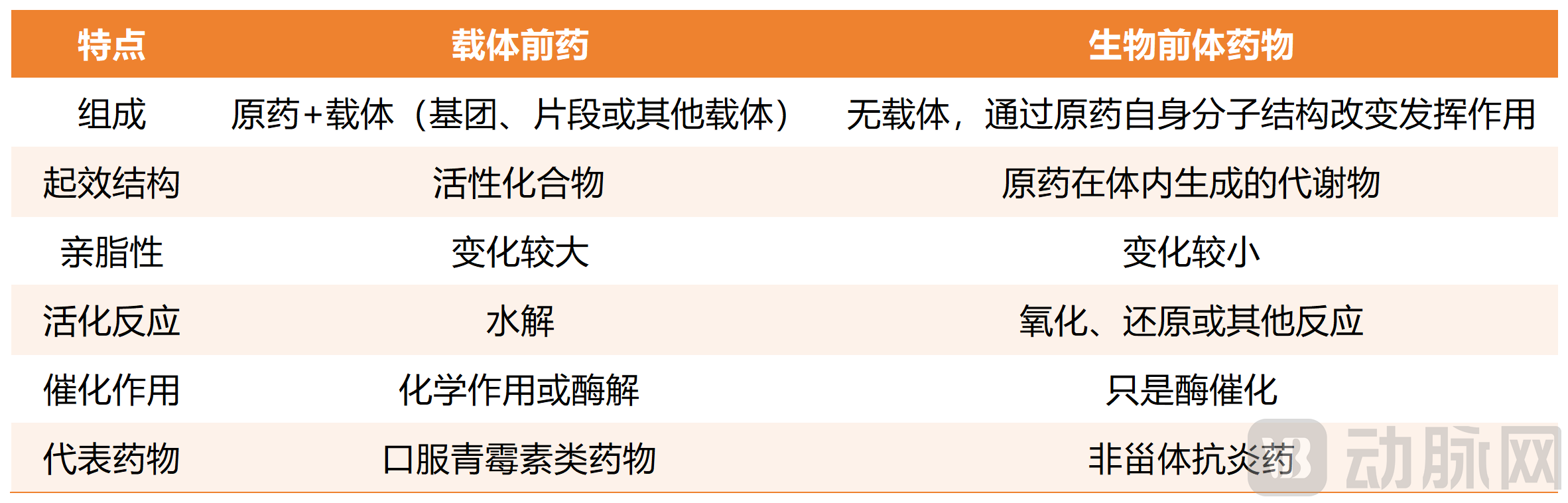
On the one hand, the in vivo conversion process of prodrugsCanEnhancing the bioavailability of active pharmaceutical ingredients, improving targeting specificity, and reducing their toxic side effects, etc.,Further expand commercialization prospects.As with the “miracle flu drug” oral oseltamivir, whose development originated from an inhalation formulationZanamivir。
On the other hand, prodrug technology"Capable of transforming previously undeveloped or difficult-to-apply active substances into clinically applicable drugs", such as sofosbuvir, the world’s first oral medication for hepatitis C and a “miracle drug” with a cure rate approaching 100%, whose active pharmaceutical ingredient (API) was previously considered undruggable.
Prodrugs are widely applied in the innovation and improvement of various drug molecules, focusing on dosage form innovation, pathway optimization, and pharmacodynamic updates. Studies show that among the 178 prodrugs approved by the FDA, 35% aim to enhance permeability, 24% are designed to increase targeted delivery, 15% seek to extend drug half-life, 15% improve solubility, 8% enhance bioavailability, 7% reduce toxicity, and 6% increase drug stability.
In the field of oncology, prodrugs are primarily focused on the innovation of chemotherapy agents.As the most common and widely used cancer treatment, chemotherapy drugs have limited clinical efficacy and are often accompanied by severe adverse reactions due to limitations such as poor water solubility, poor targeting, multidrug resistance, and low tolerated doses. Prodrug development precisely addresses these major pain points, including but not limited to: improving drug lipophilicity and enhancing transmembrane permeability; improving drug water solubility; enhancing the target selectivity of drug delivery; and improving drug safety while reducing adverse reactions.
From an R&D perspective, novel prodrug molecules may alter key factors of the parent drug, such as tissue distribution, efficacy, toxicity, and bioavailability. This requires the R&D team to possess extensive backgrounds in medicinal chemistry and development experience, with a thorough understanding of the pharmacokinetic properties—including absorption, distribution, metabolism, and excretion—of both the parent drug and the prodrug. By optimizing activation reactions and metabolic processes from the outset, teams can overcome clinical application challenges associated with the parent drug.
2Gilead: The Elegant Growth Path of a Small Yet Beautiful Prodrug Biotech
However, for a long time, challenges such as the high complexity of medicinal chemistry design and limited development of in vivo conversion pathways have resulted in a scarcity of biotech companies possessing prodrug technology platforms.Globally, Gilead has carved out a growth path that began with pharmaceuticals, evolving into a “small but beautiful” enterprise.
From an R&D-focused biotech to a top-20 global pharmaceutical company, Gilead’s prodrug research has conquered several key areas: three blockbuster products—sofosbuvir, tenofovir alafenamide (TAF), and remdesivir—have ushered in a new era for small-molecule antiviral therapies worldwide. In its third year on the market, Gilead’s hepatitis C treatment portfolio generated $19.1 billion in revenue, fundamentally transforming the landscape of hepatitis C therapy. Oseltamivir (Tamiflu), originally developed by Gilead and later licensed to Roche, was engineered into an oral prodrug by modifying the molecular polarity of the poorly absorbed parent compound, significantly enhancing drug accessibility and establishing it as a legendary anti-influenza medication.
AlongOptimizing Drug Delivery Mechanisms and Enhancing Clinical AccessibilityIn terms of layout strategy, Gilead extended its prodrug platform technology to the HIV field: in 2001, its first HIV drug, tenofovir (Viread), was approved by the FDA for market launch; in 2003, emtricitabine (Emtriva) received FDA approval. Based on these two molecules, the company subsequently launched a series of combination products, delivering a powerful “one-two-three punch” in HIV treatment characterized by high efficacy, safety, and simplicity. In 2024, Gilead once again introduced a blockbuster prodrug, lenacapavir, which demonstrated 100% efficacy in pivotal Phase III clinical trials for the prevention of HIV infection in women, astonishing the global medical community.
It is not difficult to see that the transformation path Gilead has successfully navigated isUnderstanding the Clinical Application Limitations of Active Pharmaceutical IngredientsandAimingKey Areas of Unmet Need in Pharmaceuticalsdual competitiveness. By conducting structural modifications on existing drugs, prodrug development offers relatively controllable risks. Meanwhile, through multi-faceted innovations in safety, delivery mechanisms, and efficacy, it not only addresses pain points in clinical application but also further expands the market for parent drugs with proven therapeutic effects.
3Changcheng Pharma Launches Proprietary Prodrug Technology Platform; Lead Candidate POC101 Receives IND Approval in China and the U.S.
In recent years, Chinese biotech companies have also achieved significant breakthroughs in prodrug technology. Since its establishment in 2017, Changcheng Pharmaceutical has focused on the development of a prodrug technology platform, launched the GIBP technology platform with independent intellectual property rights, and built a robust pipeline of First-in-Class and Best-in-Class drug candidates.
The Changcheng Pharmaceutical team has been deeply engaged in pharmacology, medicinal chemistry, and other fields for many years, accumulating extensive R&D experience. In 2024, the company completed preclinical studies of POC101, as well as the production, purification, and stability studies of its API (GMP and non-GMP grades), and passed preclinical evaluations including efficacy and toxicology assessments. With the assistance of Tigermed, a leading domestic CRO,Changcheng Pharmaceutical achieved dual IND filings in China and the United States without any deficiency letters, received simultaneous clinical trial approvals, and will commence Phase I clinical studies.
POC101 is a Class 1.1 novel broad-spectrum antineoplastic agent indicated for the treatment of various solid tumors, including liver cancer, lung cancer (small cell and non-small cell), colorectal cancer, gastric cancer, and pancreatic cancer.Compared with the parent drug, the prodrug POC101 demonstrates excellent stability in both blood and the gastrointestinal tract, protecting the parent drug from premature metabolism. Furthermore, an oral formulation of POC101 has been developed, which will significantly improve the accessibility of the parent drug and offer broader indications, enhanced safety and tolerability, superior efficacy, and reduced side effects.
In the future, POC101 also holds potential advantages for combination use with PD-1/PD-L1 inhibitors, immuno-oncology drugs, and conventional chemotherapeutic agents, demonstrating significant promise in the treatment of solid tumors.Given the limited clinical efficacy and severe lack of treatment options for this specific cancer subtype, POC101 is expected to accelerate its clinical development through fast-track and green-channel pathways in later stages, enabling earlier market approval to benefit patients.
Behind the IND approval of the first POC101 lies the rise of Chinese innovative enterprises specializing in prodrug technology, represented by Changcheng Pharmaceutical. Meanwhile, as technologies and teams evolve toward platform-based development, prodrugs are revolutionizing small-molecule drugs at a deeper level and on a broader scale, expanding the horizons of the innovative drug market.
withChangchun Changcheng Pharmaceutical GIBP TechnologyFor example, this platform can enhance the druggability of active pharmaceutical ingredients (APIs) and effectively improve unfavorable properties such as solubility, stability, bioavailability, and targeting. Leveraging the team’s expertise in drug structure design, the platform helps pharmaceutical companies rapidly expand their product pipelines, shorten R&D cycles, increase the success rate of drug development, and reduce the risks associated with new drug development. Starting from this point,Changchun Changcheng Pharmaceutical Technology Co., Ltd. will actively promote R&D collaborations with large pharmaceutical companies.
Return to Prodrug Technology Innovation,Dr. Song Qinhui, CMO of Changcheng Pharmaceutical and Senior Clinical Research ScientistIt points out: “The prodrug technology platform should not only focus on the design of novel drug structures, but also pay greater attention to differentiated designs in terms of indications, routes of administration, and toxic side effects.” Essentially, innovation in prodrug structural design aims to achieve superior clinical efficacy of the parent drug.
Xu Mingyan, Founder and CEO of Changcheng PharmaceuticalIt was stated that, from a market perspective, the approval and launch of more innovative prodrugs via the Class 1 new drug pathway will further expand the pharmaceutical market currently constrained by issues such as toxic side effects and low targeting specificity. This will broaden the patient population eligible for proven active pharmaceutical ingredients (APIs) and enable the utilization of previously undevelopable APIs, thereby ensuring that clinical application needs genuinely feed back into innovative drug R&D. It is hoped that POC101 will be launched as soon as possible to benefit millions of cancer patients and their families.