

Fertility Preservation Tech Surge: Addressing the Needs of 200 Million Reproductive-Age Women
The fertility preservation sector is experiencing a technological explosion.
The Decline in Birth Rates and Pregnancy Intentions Is a Global Challenge, Making Fertility Preservation Urgent.
Building a Fertility-Friendly Society: Systemic Policy Responses Are UnderwayThe Government Work Report this year explicitly called for the formulation of policies to promote childbirth and the distribution of childcare subsidies, leveraging tangible financial support to build a fertility-friendly society. Supporting local policies aimed at fostering such a society are also being rapidly implemented across various regions.
However, the inescapable reality is that female fertility in China is showing an overall downward trend, male sperm quality is declining precipitously, and infertility rates continue to rise. Fertility preservation technology has become a key tool for transcending temporal constraints.
Fertility Preservation Is Also an Essential Need for Women of Childbearing AgeIn Hong Kong, where single women are permitted to freeze their eggs, the egg-freezing industry continues to thrive despite a modest live birth rate. The number of oocytes stored in licensed centers in Hong Kong increased from 5,104 in 2019 to over 20,000 in 2023. According to Jinxin Fertility’s 2024 annual report, its U.S. egg-freezing business experienced rapid growth, with the number of oocyte retrieval cycles increasing by 16.2% year-on-year.
Driven by the dual engines of policy dividend release and surging market demand, China’s fertility preservation industry is entering a golden window of development.
Although demand for fertility preservation is surging, treatment protocols for many conditions that impair fertility have remained unchanged for over a decade, reflecting stagnant development and limited understanding of their pathogenesis. There is an urgent need for novel diagnostic and therapeutic approaches for these diseases, representing a substantial market gap.
Today, fertility-impacting conditions such as polycystic ovary syndrome, endometriosis, and premature ovarian insufficiency (POI) are gradually shifting from being merely recognized to being thoroughly elucidated. Diagnostic and therapeutic approaches for fertility preservation are currently experiencing a period of rapid technological advancement.
Overall, female fertility refers to a woman's ability to produce healthy oocytes, achieve normal fertilization, and carry a fetus to term. It is closely associated with factors such as ovarian reserve, fallopian tube patency, and endometrial receptivity. In a narrower sense, female fertility is defined as ovarian function, encompassing both the quality and quantity of oocytes.
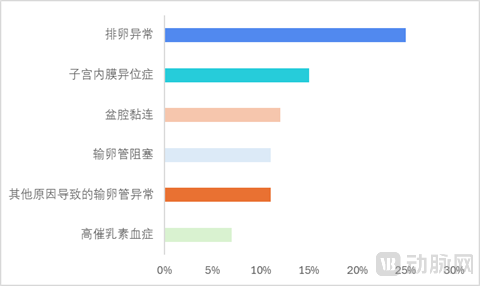
Major Causes of Female InfertilityData Source: Tencent Medical Dictionary
A chief physician in reproductive endocrinology stated, “The most critical aspect of female fertility preservation is the protection of ovarian function. While issues such as fallopian tube patency and poor endometrial receptivity can be addressed through pharmacological and surgical interventions, as well as assisted reproductive technologies like in vitro fertilization (IVF), the decline in ovarian function is typically irreversible.”
Diseases affecting ovarian function are highly prevalent, including polycystic ovary syndrome (PCOS),Endometriosis,Premature Ovarian Insufficiency (POI) and Cancer Therapy. These disease areas present industrial opportunities.
Polycystic ovary syndrome (PCOS) is a common chronic endocrine disorder that affects more than 10% of women of reproductive age worldwide, meaning one in ten such women is affected by PCOS. In the United States, approximately 5 million women are affected by PCOS. PCOS is also the most common cause of anovulatory infertility in women and is associated with metabolic complications such as obesity and abnormalities in glucose and lipid metabolism.
A chief physician in gynecology stated, “In the 1980s, when I was a student, my professor said that polycystic ovary syndrome (PCOS) was so rare that it hardly warranted discussion. Today, however, it has become a common condition.”
However, as the pathogenesis of polycystic ovary syndrome (PCOS) and hyperandrogenism remains unclear, therapeutic options are highly limited and primarily symptomatic, yielding suboptimal outcomes. Current management of PCOS relies on off-label medications or oral contraceptives for regulation; to date, there are no FDA-approved drugs specifically indicated for the treatment of PCOS. A complete cure is currently unattainable.
Clinical Dilemmas Reflect Industrial Opportunities: Breakthroughs in Polycystic Ovary Syndrome Drug Development in Recent Years
One major breakthrough came from a Chinese team: Professor Tang Qiqun’s group at Fudan University published their findings on the use of artemisinin derivatives for treating polycystic ovary syndrome (PCOS) in *Science*. In animal models, these artemisinin derivatives inhibited excessive androgen synthesis in the ovaries and reduced the number of ovarian cysts, highlighting their potential as a novel therapeutic agent for PCOS.
“Blockbuster” GLP-1 also demonstrates potential in treating polycystic ovary syndrome (PCOS). GLP-1 receptor agonists mimic the action of incretins to increase insulin secretion while suppressing appetite, thereby aiding in weight control and improving glucose metabolism. This is of significant importance for addressing obesity and insulin resistance, which are common issues among patients with PCOS.
HBM Alpha Therapeutics, incubated by Harbour BioMed, is developing HAT002, an innovative antibody therapy for polycystic ovary syndrome (PCOS). The antibody therapy HAT002, developed by HBMAT, targets endocrine regulatory pathways shared with congenital adrenal hyperplasia (CAH). Both CAH and PCOS involve dysfunction of the hypothalamic-pituitary-adrenal (HPA) axis. By targeting this pathway, HBMAT aims to regulate hormone levels, thereby alleviating symptoms in patients with PCOS.
Device-based ablation therapy for polycystic ovary syndrome has also garnered attention.Overseas company May Health is attempting to ablate ovarian tissue responsible for excess androgen production via transvaginal radiofrequency or ultrasound-guided procedures. In a feasibility study, 44% of treated women resumed spontaneous ovulation within three months post-procedure, with this proportion increasing to 65% over time following the reintroduction of ovulation-inducing medications. In 2024, May Health raised $25 million in its Series B financing round.
Despite the large patient population and rising incidence of PCOS, potential treatment options remain scarce, even though therapies under investigation are continuously increasing.
In addition to new advances in the treatment of polycystic ovary syndrome, early diagnosis of endometriosis has also seen technological breakthroughs.
Endometriosis is a disease that can also involve the ovaries. Endometriosis (EMS) is a common chronic gynecological disorder, with a prevalence of 5%–10% among women of reproductive age. As the lesions most frequently affect the ovaries, ovarian endometriomas—commonly known as chocolate cysts—can form, directly impairing ovulatory function.
The clinical dilemma of endometriosis lies in the difficulty of early diagnosis. Studies show that 70% of patients with PCOS remain undiagnosed, and more than one-third experience delayed diagnosis.
Laparoscopy is the gold standard for diagnosing endometriosis. However, as an invasive procedure, it carries risks of tissue injury and anesthesia-related complications. This has led to delayed diagnosis of endometriosis; even in developed countries, the diagnostic delay typically ranges from seven to eight years, while in some developing countries, it may exceed ten years.
Early diagnosis still needs to overcome technical bottlenecks at present. Since none of the many markers in peripheral blood and endometrium can accurately diagnose endometriosis, finding reliable biomarkers for early diagnosis of endometriosis is a trend.
Chinese companies are poised to break through this technological bottleneck and achieve a breakthrough in early diagnosis. HeKaiWei Life Sciences has pioneered HerResolve, the world’s first diagnostic product for endometriosis. Requiring only a single tube of peripheral blood sample, HerResolve achieves a diagnostic accuracy as high as 92%. This in vitro diagnostic product has entered the FDA-registered clinical trial phase and is expected to receive approval this year. HerResolve is positioned to become the first non-invasive test for endometriosis to obtain FDA clearance globally.
Given that the etiology of PCOS remains unclear, a complete cure is not yet achievable. In response to this therapeutic challenge, several potential innovative therapies are being developed worldwide.
Organon has a novel therapy in Phase II clinical development: FOR-6219. Organon is a pharmaceutical company focused on women’s health, spun off from Merck & Co. FOR-6219 is characterized by its potential to act locally on target tissues without affecting systemic hormone levels. This potential selective activity allows it to serve as a long-term treatment option for endometriosis.
A Chinese enterprise and Qirui have developed a monoclonal antibody targeting the prolactin receptor (PRLR) for the treatment of moderate-to-severe endometriosis.
Looking ahead, therapeutic breakthroughs for endometriosis will continue to rely on advances in basic science; only by gaining a deeper understanding of its pathogenesis can we develop improved diagnostic and treatment strategies.
In the field of female fertility preservation, the prevention and restoration of iatrogenic fertility damage are gradually becoming a focal point of clinical research. Ruan Xiangyan, a deputy to the National People's Congress, director of the Endocrinology Innovation Center at Beijing Obstetrics and Gynecology Hospital, Capital Medical University, and chief expert, has pointed out that at least one million women lose their fertility each year due to radiotherapy and chemotherapy.
For patients with malignant tumors, as well as non-oncology patients with comorbid autoimmune diseases or hematologic disorders, although chemotherapy and radiotherapy are important therapeutic modalities, they can impair ovarian function, potentially leading to iatrogenic premature ovarian insufficiency (POI), thereby severely affecting patients’ fertility.
For iatrogenic premature ovarian insufficiency, patients may consider oocyte cryopreservation, embryo cryopreservation, and ovarian tissue cryopreservation and transplantation prior to surgery. Compared with cryopreserved oocytes and embryos, ovarian tissue transplantation can restore not only fertility but also hormonal secretory function.
Ovarian cryopreservation involves the extraction of female ovarian tissue for low-temperature frozen storage. When fertility is desired in the future, the cryopreserved ovarian tissue is thawed and transplanted back into the patient’s body. It has been reported that over 10,000 women worldwide have undergone ovarian tissue cryopreservation, with more than 360 patients receiving ovarian tissue transplantation. Following transplantation, 95% of women regained ovarian endocrine function, with an average duration of ovarian function lasting 2 to 5 years. Moreover, more than 200 healthy offspring have been born through this technology.
Surgery may also cause irreversible damage to ovarian function. For example, during the surgical treatment of benign ovarian tumors (such as ovarian endometriomas, teratomas, and cystadenomas), mechanical and electrothermal injuries can not only destroy normal ovarian tissue but also compromise ovarian blood supply, thereby leading to diminished ovarian function.
Furthermore, iatrogenic endometrial injury is also one of the important causes of female infertility.Intrauterine procedures, such as hysteroscopic surgery and induced abortion, are highly likely to damage the endometrium, leading to intrauterine adhesions and endometrial scarring and fibrosis. According to data published in the Chinese Journal of Practical Gynecology and Obstetrics, there have been nearly 9 million induced abortions annually in China over the past five years. Induced abortion may lead to complications such as fallopian tube obstruction, intrauterine adhesions, and endometriosis, and may result in secondary infertility in women. In China, patients undergoing abortion procedures are trending toward younger ages. Reducing the number of abortions requires both scientific contraception and the avoidance of iatrogenic injury.
Currently, the treatment of endometrial injury mainly relies on hysteroscopic adhesiolysis, supplemented by pharmacological interventions such as oral estrogen, or the use of anti-adhesion medical devices, including intrauterine balloons, intrauterine devices (IUDs), and hyaluronic acid hydrogels. However, although these methods can alleviate symptoms to some extent, they are technically complex and fail to fundamentally repair the endometrium or achieve comprehensive restoration of the intrauterine environment.
It is encouraging to note that Xianshi Bio, a domestic enterprise, has achieved breakthrough progress in this field. The company has successfully developed unique decellularized biological matrix microfibers for endometrial repair materials, utilizing advanced decellularization techniques and manufacturing processes. This innovative product has currently entered the clinical trial phase and is expected to be officially launched on the market this year. This not only brings new hope for the treatment of endometrial injury but also provides stronger support for the preservation of female fertility.
Certainly, fertility preservation should not overlook the decline in male fertility, as sperm quality is plummeting. Data from human sperm banks show that the qualified sperm donation rate has been declining year by year, dropping from approximately 40% in 2010 to about 20% currently.
According to a survey by the U.S. Centers for Disease Control and Prevention (CDC), 28% of people choose assisted reproductive technology due to male infertility factors. However, in the field of reproductive health, nearly all innovations are focused on women, while innovations in male reproductive health are relatively scarce, leaving this area largely unexplored.
Reproductive health is a long-neglected market. As global fertility continues to decline, innovative technologies centered on fertility preservation will open up new blue-ocean opportunities.
However, many startups tend to focus on specific niche markets, which may somewhat constrain their scalability and long-term profitability. Judging from the strategic layouts of leading women’s health companies such as Organon and GeneScience Pharmaceuticals, enterprises that provide global lifecycle solutions, gain deep insights into women’s health needs, and demonstrate the ability to expand from niche segments into broader markets are more likely to secure financing.