

Pet Longevity Drug LOY-001 Clears FDA Hurdle: Loyal Paves the Way for First-Ever Anti-Aging Therapy in Dogs

Loyal
Software Solution Provider
Would You Give Your Dog Medication to Extend Its Lifespan?
In February this year, LOY-001, a canine longevity drug developed by the U.S. biotech startup Loyal, announced that it had received conditional approval from the FDA, with expectations for its official market launch in 2026.
This medication is indicated for large-breed dogs and requires a veterinary prescription for purchase in the United States. Relevant clinical data demonstrate that LOY-001 can help dogs achieve a healthier and longer late life.
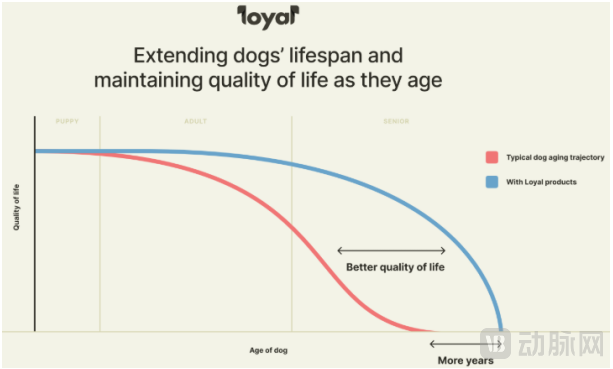
Loyal Demonstrates Its Products Can Extend Lifespan While Ensuring Quality of Life
As the younger generation increasingly cherishes their silent companions, they not only spare no effort in leveraging medical interventions to extend their pets’ lifespans but also prioritize the quality of life during their pets’ senior years, hoping these small animals can remain healthy and happy, enjoying more peaceful moments by their side.
It is precisely for this reason that a growing number of scientists are dedicating themselves to fields such as pet “longevity” and “anti-aging,” aiming to tap into this trillion-dollar market while striving to improve pet health.
Although there are numerous researchers in this field, valuable outcomes remain very limited. After all, there are too many factors affecting animal lifespan; it is necessary not only to differentiate between breeds but also to conduct lengthy clinical trials for validation.
Taking dogs as an example, there are significant differences in lifespan among various breeds. Large breeds such as the English Mastiff, Bullmastiff, and Great Dane have an average lifespan of only 7–8 years. In contrast, small breeds like the Chihuahua, Miniature Poodle, and Yorkshire Terrier have an average lifespan exceeding 12 years, with some individuals living beyond 20 years—nearly twice as long as large breeds.
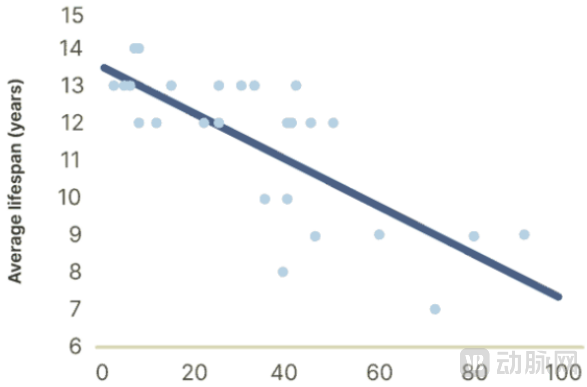
The Potential Link Between Canine Body Weight and Average Lifespan
The biological mechanisms underlying the systematically shorter lifespan of large dog breeds compared to small dog breeds have not yet been fully elucidated in current research, but two mainstream theoretical frameworks have emerged.
The accelerated aging hypothesis posits that increased body size is positively correlated with cellular metabolic rate, suggesting that large-breed dogs may experience more severe oxidative stress damage and telomere shortening. Relevant genomic studies indicate that the DNA methylation epigenetic aging clock in large-breed dogs runs 15%–20% faster than in small-breed dogs, indicating an accelerated aging process at the cellular level.
The vulnerability phenotype hypothesis is derived from the "body size–metabolic demand" paradox (Peto’s paradox), positing that large dogs bear a higher physiological burden in maintaining basal metabolism and organ function. Although their aging-related pathological changes (such as joint degeneration and declined cardiopulmonary function) are similar to those in small dogs, their physiological reserves (e.g., antioxidant enzyme levels and stem cell regenerative capacity) and disease compensatory mechanisms are significantly insufficient, making the same pathological changes more likely to progress to fatal outcomes.
LOY-001, recently approved for Loyal, is designed around the IGF-1 (insulin-like growth factor 1) pathway and integrates both of the aforementioned theories.
IGF-1 (Insulin-like Growth Factor 1), as a hormone that promotes cell growth, plays a dual role in the canine life cycle: its function in promoting cell proliferation is a key driver enabling large dog breeds to achieve rapid growth and development (with juvenile weight gain rates reaching 3–5 times that of small breeds); however, sustained high-level expression in adulthood (plasma concentrations in large dogs are 40%–60% higher than in small dogs) imposes a metabolic burden, overloading cellular repair mechanisms and ultimately accelerating tissue aging.
The innovation of LOY-001 lies in its establishment of a "hormonal homeostasis rebalancing" strategy. Utilizing an adeno-associated virus (AAV) vector engineered through gene-editing technology, LOY-001 enables the sustained release of an IGF-1 receptor antagonist, thereby modulating circulating IGF-1 levels in large-breed dogs to the physiological range observed in small-breed dogs (target range: 120–180 ng/mL). This concentration maintains the levels required for basal metabolism while activating the AMPK energy-sensing pathway, thus optimizing the balance between autophagy and apoptosis.
As there is no established regulatory pathway for life-extending drugs, Loyal spent more than four years demonstrating the efficacy of its anti-aging drug to secure FDA approval, submitting data that included interventional studies of LOY-001 in canine aging models as well as an observational (non-drug) study involving 451 dogs.
Upon approval, LOY-001 will be primarily indicated for dogs aged seven years and older weighing more than 40 pounds, requiring a single injection administered at a veterinary clinic every three to six months. Loyal anticipates that the monthly cost of the drug will be kept under $100.
For pet-owning households in the United States, this price is not prohibitive, yet there remains substantial room for reduction. Consequently, in addition to Loyal, other research institutes and pharmaceutical companies dedicated to extending pet lifespan are continuously advancing through their own distinct pathways.
For instance, the enzyme eNAMPT (extracellular nicotinamide phosphoribosyltransferase) is present in the blood and converts nicotinamide (NA) into nicotinamide mononucleotide (NMN). Shin-ichiro Imai’s team isolated exosomes containing eNAMPT from the blood of young mice and administered them to aged mice with only about two months of life remaining, via intranasal inhalation and intraperitoneal injection, respectively.
Experimental results showed that the average lifespan of aged mice receiving the intervention was significantly extended. Specifically, lifespan increased by 41.4% in the intranasal inhalation group, by 32.5% in the intraperitoneal injection group, and by 29.8% in the combined administration group. Furthermore, the physical functions of the mice were improved, with enhancements observed in indicators such as activity levels, sleep quality, and coat condition compared to pre-intervention baselines, without any adverse reactions or side effects.
Currently, numerous domestic and international enterprises are producing nutrients along this research pathway. For instance, the Canadian company DR.pettLabs has successfully extracted high-purity, high-activity NMN and incorporated it into common nutritional supplements such as coenzyme Q10 for commercial sale, having already completed its global market deployment.
Compared to Loyal, which adheres to rigorous medical logic, the “wellness” path represented by DR.pettLabs is more commercially viable and easier to popularize among pet owners. After all, precise health management can effectively help extend the lifespan of companion animals in today’s context.
Excluding accidental deaths, the natural mortality rate among pets is not particularly high. As they age, the vast majority of pets will develop life-threatening diseases; without timely intervention, they may pass away silently in suffering.
According to a 2019 survey conducted by the Association for Pet Obesity Prevention (APOP) in the United States, 59% of dogs were classified as overweight or obese (37% overweight, 22% obese), and 61% of cats were classified as overweight or obese (27% overweight, 33% obese). Relevant studies in China indicate that approximately 20%–30% of cats and dogs are overweight or obese, reflecting an equally serious situation.
For pet owners, the round and chubby appearance of small animals may be more endearing; however, as with humans, obesity can lead to a range of health issues, including joint wear and coronary heart disease, which in turn significantly impact their lifespan and quality of life.
A retrospective study in the United States examining canine body weight, osteoarthritis, and lifespan analyzed electronic medical records of 131,140 dogs that died between 1998 and 2019 at Banfield Pet Hospital (comprising 1,084 branches).
Relevant data indicate that post-sterilization weight changes affect the prognosis of osteoarthritis (OA); obese dogs have a higher probability of developing OA in old age. Considering the relationship between canine lifespan and body weight, it can be inferred that obesity not only reduces quality of life in later years but also significantly shortens their lifespan.
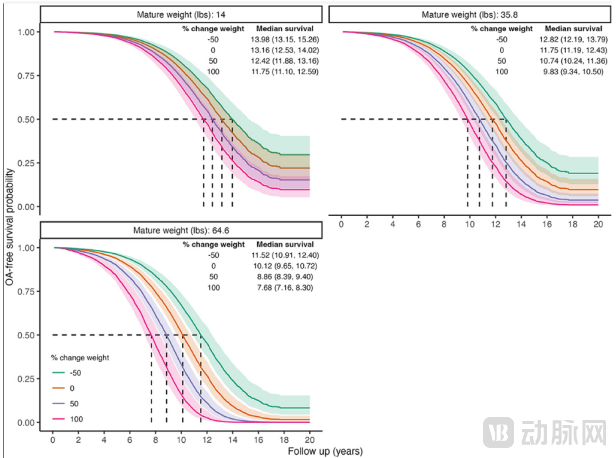
Association Between Percentage Change in Body Weight After Sterilization and Osteoarthritis
Cardiovascular disease is a challenge that nearly every senior dog must face; these conditions not only trigger cardiac arrest but also preclude them from undergoing common procedures requiring anesthesia, such as joint replacement and laparoscopic surgery.
However, if such conditions are detected early and managed with uninterrupted pimobendan therapy, supplemented by cardioprotective agents such as coenzyme Q10, cardiac disease can be managed similarly to chronic diseases, thereby contributing to anti-aging effects.
It is important to note that the aforementioned diseases are all high-prevalence conditions in pets. The markets for original research drugs and health supplements are well-developed, with numerous supplement products containing nutrients such as omega-3, coenzyme Q10, and lecithin saturating the market; many of these products do indeed exhibit anti-aging effects.
However, for less common conditions such as neuritis, no corresponding veterinary drugs have been approved in China at this stage. Pet owners are left with no choice but to resort to human medications like metronidazole, relying on their pets’ own resilience to fight the disease.
Although there are numerous health supplement products on the market with anti-aging effects, pet owners find it difficult to assess product quality due to the wide variety of dog breeds and the lack of a unified evaluation standard system.
This backdrop is highly unfavorable to the development of domestic pet pharmaceutical companies. On one hand, as China’s pet distribution channels mature, late entrants lack advantages in R&D within popular therapeutic areas and must therefore assume risks to carve out alternative pathways.
On the other hand, due to information asymmetry and a lack of regulatory frameworks, pet owners are more inclined to purchase products developed by NMCs such as Zoetis and Boehringer Ingelheim. Even David Sinclair, a former Harvard professor, has been known to sell counterfeit drugs under the guise of longevity supplements. Pets have only one life; in the wake of negative incidents, obscure domestic startups struggle to gain recognition from both distribution channels and consumers.
Nevertheless, the domestic market for pet pharmaceuticals and supplements remains an emerging sector. While large enterprises have established comprehensive distribution channels, their product portfolios are limited, leaving numerous diseases yet to be effectively addressed.
In response to these demands, numerous domestic startups have attempted to break the deadlock by developing differentiated pipelines. Taking Futeng Biologics as an example, the company has simultaneously built a pipeline for innovative pet drugs and one for animal health products. The former establishes technical advantages to build brand image, while the latter serves as a cash-cow business to ensure steady corporate development.
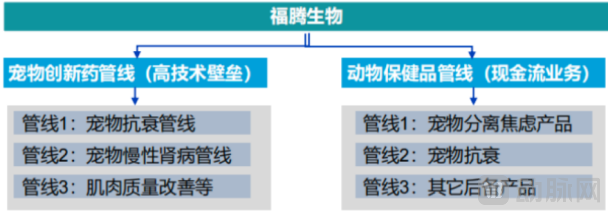
Futeng Bio’s Pipeline Distribution
Furthermore, some overseas companies are attempting to upgrade pharmaceutical manufacturing processes to enter the mainstream pet health supplement sector, with the capability to surpass existing best-selling products in terms of efficacy through technological advancements.
Taking the market entry strategy of Dlove, a premium pet nutrition brand under U.S.-based Regeneron, into China as an example: After entering the Chinese market, the company targeted the conventional heart and bone health supplement segment but introduced innovations in manufacturing processes and formulations.
For instance, the company has introduced nanosphere technology into its pharmacokinetic profile, enabling the product to release slowly over eight hours after administration to animals, thereby enhancing nutrient absorption. Relevant test reports indicate that the adoption of this technology helps pets achieve better nutritional supplementation, leading to longer and healthier lives.
Additionally, with each sale, Dlove simultaneously mails consumers their test reports, which provide detailed information on the product’s testing procedures and results.
For the younger generation of pet owners, detailed and authoritative data may resonate more deeply than mere advertising.
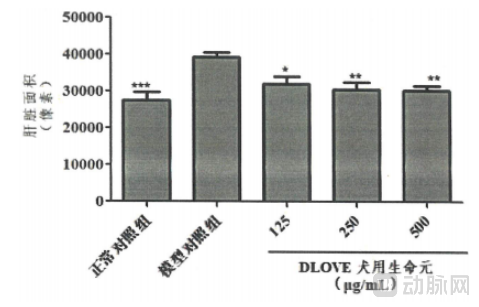
Partial Data from the DLove Canine Vitality Test Report:
Comparison of Zebrafish Liver Area Between Sample-Treated Group and Model Control Group After Sample Processing
Upon the conditional approval of LOY-001, Loyal also discussed in its media briefing the implications of its research for human longevity, which may facilitate the development of related human therapeutics.
Due to the significant challenges in conducting human longevity research, numerous past studies have sought to leverage investigations into lifespan-influencing factors in animals to unravel the secrets hidden within the human aging process.
Now that Loyal has achieved phased results, it has undoubtedly taken a critical step and sparked new interest among scientists worldwide.
With more players entering the field, this sector may accelerate the generation of further breakthroughs. It is hoped that in the near future, both humans and pets will be able to enjoy longer, healthier lives alongside their companions.