

World's First Type 1 Diabetes Specialized Large Model Officially Launched
AI technologies, represented by large language models, are rapidly developing and extending into every aspect of the healthcare sector. From internet-based healthcare and medical imaging analysis to new drug development, these technologies are reshaping one scenario after another.
However, to truly unlock the clinical value of AI, the key lies in bridging the “last mile” between technological logic and medical practice, enabling clinical experts, industry stakeholders, and patient representatives to jointly refine products within real-world diagnostic and treatment scenarios. Without this deeply integrated practical loop spanning industry, academia, research, and application, AI risks becoming an impractical ideal, even if vast amounts of high-quality data have been accumulated.
The world’s first large language model dedicated to type 1 diabetes, released on March 29, bears out this principle.
As a core achievement of the National Science and Technology Innovation 2030 Major Project on “Four Major Chronic Diseases,” this initiative was coordinated and advanced by the Health Commission of Anhui Province. With Professor Weng Jianping, Chair Professor at the University of Science and Technology of China and President of Anhui Medical University, serving as the Chief Scientist, the project brought together industry, academia, research, and clinical institutions—including iFlytek Healthcare and Shenzhen Aibaowei Biotechnology Co., Ltd.—to conduct collaborative research, thereby demonstrating the value of synergistic innovation among industry, academia, research, and healthcare sectors.
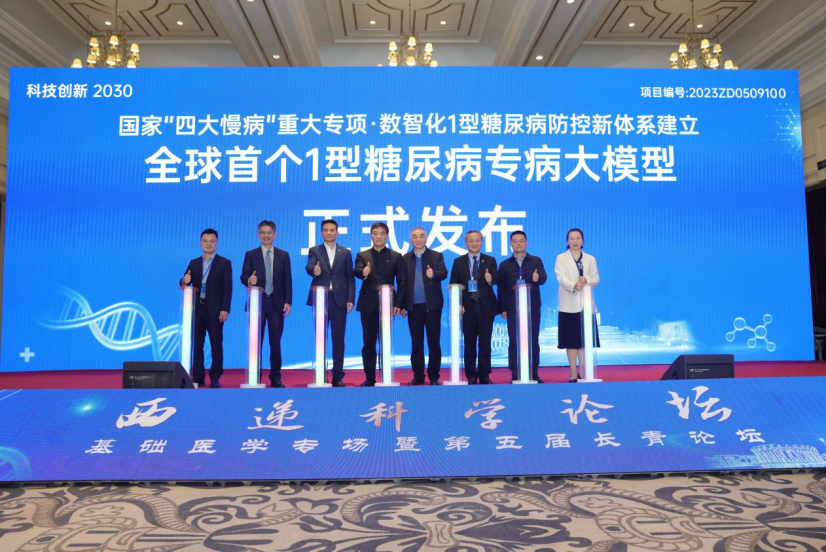
Academician of the Chinese Academy of Sciences and Director of the Department of Cardiology at Zhongshan Hospital, Fudan University, Ge Junbo; Liu Tongzhu, Secretary of the Party Leadership Group of the Anhui Provincial Health Commission; Wang Qi, Secretary of the Party Committee of Anhui Medical University; Tao Xiaodong, President of iFlytek Healthcare, and Lu Xiaoliang, Executive President; Zeng Xifeng, Chairman of Shenzhen Aibaowei Biotechnology Co., Ltd.; and Zheng Xueying, Deputy Director of the USTC-iFlytek Healthcare Joint Laboratory for Digital Health, among other leaders and experts, jointly attended and witnessed this important milestone.
With Multi-Party Collaboration, China’s Medical Large Language Models Are Gradually Returning to the Essence of Medicine and Reaching New Heights.
In response to numerous questions from the audience about why they chose to focus on type 1 diabetes, a relatively “niche” field, Professor Weng Jianping, the project’s principal investigator, revealed the considerations behind this decision.
Since 2008, he and his team have achieved industry-leading results in the field of type 2 diabetes research. However, it was the survival challenges faced by patients with type 1 diabetes that touched him more deeply. He then described the daily lives of type 1 diabetes patients using three sets of data: “They need to perform fingerstick blood tests seven times a day and administer four insulin injections daily; among them, 65% of patients experience severe nocturnal hypoglycemic events, while only 20% are able to achieve their glycemic control targets.” Behind these figures lies the determination and motivation that drove Professor Weng and his team to shift their focus to the field of type 1 diabetes research.
As an autoimmune disease, type 1 diabetes results from abnormal activation of the immune system, leading to severe insulin deficiency in patients and subsequently causing persistent hyperglycemia. This metabolic imbalance not only disrupts systemic physiological functions but also triggers a series of complications, such as ketoacidosis, retinopathy, diabetic nephropathy, and neuropathy. If effective intervention is not implemented in a timely manner, it may even become life-threatening.
In the face of the hidden practical challenges confronting many patients with type 1 diabetes, Professor Weng Jianping led his team in 2010 to decisively pivot toward this “niche” field. Over the course of more than a decade, they enabled algorithmic models to break through traditional diagnostic and therapeutic frameworks, establishing a comprehensive, full-chain digital and intelligent prevention and control system encompassing screening, classification, treatment, and management.
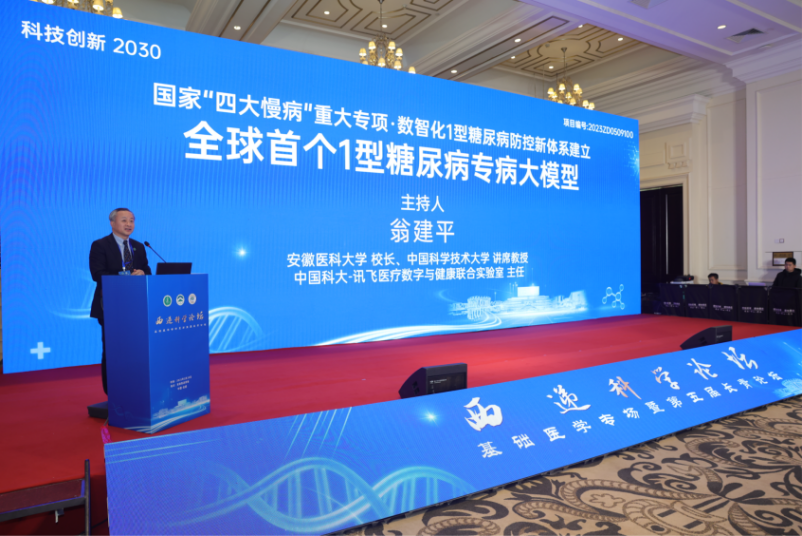
In recent years, large medical models have developed rapidly, pushing the ceiling of AI technology significantly higher in just over two years. However, focusing solely on increasing parameters and computing power merely squeezes out clinical value and room for innovation. Only by returning to the essence of medicine can AI technology create real value in the healthcare sector. As Professor Weng Jianping stated, the emergence of a specialized large model for type 1 diabetes is not a cold technological breakthrough, but a warm embrace of technology and humanity.
It is reported that the projectAddressing Pain Points in the Diagnosis and Treatment of Type 1 Diabetes,Powered by the iFlytek Spark Medical Large Model X1,Combining the extensive resources of the Tangtangquan platform in the specialized field of diabetes, through“Authoritative Knowledge Hub,” “Dynamic Perception Network,” and “Decision Support Engine” jointly developed,Integration of Multimodal Data and Clinical Experience,Building a Full-Chain Digital and Intelligent Prevention and Control System Covering Screening, Subtyping, Treatment, and Management, breaking through the diagnostic and therapeutic paradigm and providing new possibilities for the discovery and management of type 1 diabetes.
Unlike previous medical large language models, this specialized large model for type 1 diabetes innovatively establishes an “Authoritative Knowledge Hub.”, integrated65Clinical Pathways for Specialty Scenarios,135Departmental Clinical Practice Guidelines and20 million copiesReal-world case data. The resulting knowledge system for type 1 diabetes outperforms similar large language models in China, representing not only advancements in algorithms and computing power but also a complete mapping of clinical thinking paradigms into the digital space.
This clinically centered design philosophy is also fully reflected in the technical architecture. In terms of blood glucose monitoring,The model applies the “Dynamic Perception Network Technology”, leveraging AIoT technology to monitor 14-dimensional metabolic parameters in real time, with a sensitivity for detecting abnormal blood glucose levels reaching99.2%, an improvement over traditional methods40%。
Furthermore, the AGP graph analysis, medical knowledge, deep medical reasoning, blood glucose prediction, and multimodal interaction capabilities of the iFlytek Spark Medical Large Model X1 have endowed the Type 1 Diabetes-specific large model with more precise logical and analytical abilities. It can generate personalized plans across eight dimensions—including diet, exercise, and insulin adjustment—based on patient information, thereby advancing diagnosis and treatment into an era of “personalized precision medicine.”
During the subsequent presentation, Director Zheng Xueying explained that when a pregnant woman with type 1 diabetes experienced blood glucose fluctuations at two months of gestation, lying awake all night in anxiety over her fetus’s health, the Type 1 Diabetes Specialty Large Language Model stepped in as an “Intelligent Health Steward.” After collecting the patient’s specific concerns and blood glucose data, the model provided a comprehensive analysis covering genetic risks, key points for pregnancy management, and precautions for prenatal check-ups. By transforming vast amounts of clinical guidelines into personalized solutions, it ensured that healthcare during this critical period was both medically precise and humanely compassionate.
Currently, the specialized large language model for type 1 diabetes demonstrates excellent performance across all stages of the disease lifecycle. By providing effective support through real-time monitoring, personalized treatment recommendations, and intelligent decision-making, it delivers a smart and precise health management experience for patients with type 1 diabetes.In practical tests across 65 core scenarios, including prevention, diagnosis, treatment, follow-up, diet and exercise, and pregnancy, it outperformed both GPT-4o and DeepSeek-R1.
Currently, the field of medical AI has entered a "deep-water zone" and is achieving significant breakthroughs. Many cities, with Anhui Province as a typical representative, have embarked on exploratory journeys, indicating that the clinical medicine community is not only deeply embracing AI technology but also joining forces with industry, academia, and research sectors to tackle key challenges. It is believed that as the specialized large language model for Type 1 diabetes takes root in medical institutions at all levels across China, iFlytek Healthcare and its partners are poised to play a pivotal leading role, paving new pathways for chronic disease management nationwide and even globally, thereby ensuring that the benefits of technological innovation truly reach every patient.