

Is the Spring of Brain-Computer Interfaces Here? First Inclusion in National医保 Sparks Industry Optimism
On March 31, the Hubei Provincial Healthcare Security Administration released China’s first pricing standards for brain-computer interface (BCI) medical services. The National Healthcare Security Administration’s official WeChat account reposted the announcement consecutively, quickly sparking heated discussion within the industry. What does this pricing milestone signify? Is the springtime of BCI technology finally here? VCBeat conducted in-depth discussions with industry experts to explore these questions.
The recent pricing by the Hubei Provincial Healthcare Security Administration effectively implements the “Guidelines for Establishing Pricing Items for Neurological Medical Services (Trial),” issued by the National Healthcare Security Administration in mid-March. The Guidelines added new pricing items such as “fee for implantation of invasive brain-computer interfaces,” “fee for removal of invasive brain-computer interfaces,” and “fee for fitting of non-invasive brain-computer interfaces.”
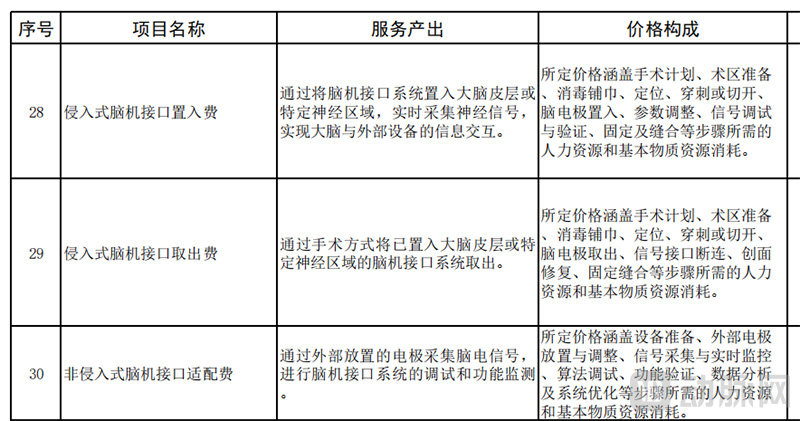
“Guidelines for the Establishment of Medical Service Price Items in Neurology (Trial)” — Items Related to Brain-Computer Interfaces
The Hubei Provincial Healthcare Security Administration promptly aligned with the “Guidelines for Project Initiation of Pricing Items for Nervous System Medical Services (Trial),” implemented the relevant items, and established government-guided prices: CNY 6,552 per procedure for invasive brain-computer interface implantation, CNY 3,139 per procedure for invasive brain-computer interface explantation, and CNY 966 per session for non-invasive brain-computer interface adaptation. Meanwhile, the Hubei Provincial Healthcare Security Administration stipulated that these prices serve as the province-wide maximum price caps, which may not be exceeded but may be reduced without restriction.
According to VCBeat, professionals in the brain-computer interface industry all hold a positive attitude toward this.
Shu Xiaokang, CEO of Niantong Intelligence, stated that the Hubei Provincial Healthcare Security Administration’s recent establishment of pricing for brain-computer interface (BCI)-related medical services came as a huge surprise to companies operating in the BCI sector: “We never anticipated that BCI medical services would be included in the reimbursable fee schedule so quickly. Over the past two days, I have been continuously receiving messages from peers, friends, and investors, which indicates that they certainly see this news as a positive development for the growth of the brain-computer interface industry.”
“Prior to this, we had projected the commercialization pathway for brain-computer interface (BCI) medical devices, generally believing that after obtaining medical device registration certificates, products would still need to coordinate with multiple hospitals to apply for inclusion in the fee schedules, before advancing toward health insurance coverage. This process was expected to take at least three to five years. Unexpectedly, as BCI medical devices have just initiated the registration process, health insurance coverage has already been implemented ahead of schedule. This may represent a highly forward-looking incentive policy.”
“I believe its significance is no less than that of any policy previously released in the field of brain-computer interfaces; it is truly a major initiative capable of driving industrial progress,” Shu Xiaokang remarked highly.
As stated, all medical devices prior to this—including the currently popular AI-assisted diagnostic tools—have achieved commercialization by following the process of standard formulation, registration and certification, and inclusion in the reimbursement catalog. Many innovative medical devices have still not been included in the reimbursement catalog to date. It is indeed extremely rare for brain-computer interface technology to be included in the catalog before standards have even been established.
Chen Wenkai, Co-founder, Director, and Chief Business Officer of Rouling Technology, believes that this represents a significant milestone for the brain-computer interface (BCI) industry and will serve as a bellwether for its development: “First, it signifies policy support and highlights the importance attached to BCI technology. This will inevitably guide clinical practice, fostering greater understanding and acceptance of this new technology among healthcare professionals. Second, following the pilot program in Hubei, other regions may adopt similar measures, thereby expanding the scope of policy coverage. From a corporate perspective, this can accelerate commercialization; from an investor’s standpoint, it provides a clear exit strategy, which will boost confidence across the industry. Furthermore, it indicates that regulatory bodies are shifting their focus from early-stage technical validation to the recognition of clinical value. I consider this a very positive signal.”
Li Xue, founder of Jieti Medical, also spoke highly of this development: “Although the immediate substantive impact may not appear significant at present, I believe that taking a proactive stance in policy formulation is beneficial for the industry’s growth. It demonstrates the government’s expectations for the brain-computer interface (BCI) sector and its determination to actively promote its development. Furthermore, this initiative will heighten market attention toward BCI technology, bolster confidence among stakeholders, and attract greater capital inflow.”
Investor feedback has been equally positive. Fei Jianjiang, Managing Partner at Yuanhe Origin, shared his views with VCBeat: “Yuanhe Origin has consistently maintained its focus on the brain-computer interface (BCI) sector and invested in Jieti Medical in 2023. From an investor’s perspective, the commercialization path for BCI remains long and challenging, necessitating greater support from all sectors. The recent announcement by the Hubei Provincial Healthcare Security Administration of China’s first pricing standards for BCI medical services, marking the first inclusion of BCI services in the national medical insurance system, serves as a highly positive signal for the industry’s development. It has also significantly boosted investor confidence, encouraging more capital to enter this field.”
China has long supported and paid close attention to the brain-computer interface (BCI) industry, with the intensity of this support accelerating significantly since last year.
In January last year, seven Chinese government departments jointly issued the “Implementation Opinions on Promoting Innovation and Development of Future Industries,” which explicitly designated brain-computer interfaces (BCIs) as one of the future industries and outlined key development tasks. Subsequently, in February and July of the same year, China released the “Ethical Guidelines for Brain-Computer Interface Research” and the “Plan for Establishing the Standardization Technical Committee for Brain-Computer Interfaces,” respectively, to guide the standardized and innovative development of the BCI industry from the perspectives of policy and standards. Notably, the “Ethical Guidelines for Brain-Computer Interface Research” defined and categorized terminology within BCI technology, clarifying conceptual ambiguities that may arise during ethical review processes. This document marks China’s first specialized ethical guidance framework dedicated to BCI research.
This January, the two major brain science centers in Beijing and Shanghai, located in the north and south of China respectively, nearly simultaneously formulated their new “five-year plans” for the field of brain-computer interfaces (BCI), namely the Action Plan for Accelerating the Innovative Development of Brain-Computer Interfaces in Beijing (2025–2030) and the Action Plan for Cultivating the Future BCI Industry in Shanghai (2025–2030).
Similarly, in January this year, the “Opinions of the General Office of the State Council on Comprehensively Deepening the Reform of Drug and Medical Device Supervision to Promote High-Quality Development of the Pharmaceutical Industry” explicitly stated that brain-computer interface devices would be granted priority review and approval.
Entering March, the National Healthcare Security Administration’s release of the “Guidelines for Project Initiation of Pricing Items for Neurological Medical Services (Trial)” and the Hubei Provincial Healthcare Security Administration’s implementation of these guidelines have further demonstrated strong policy support for the brain-computer interface industry by establishing pricing standards for brain-computer interface medical services.
However, through the collection of public information and further verification with industry insiders, VCBeat has also found that there are currently no brain-computer interface medical devices approved in the strict sense.
According to the classification in the National Healthcare Security Administration’s “Guidelines for Project Initiation of Pricing Items for Neurological Medical Services (Trial),” brain-computer interfaces (BCIs) are categorized into invasive and non-invasive types. Globally, only a few invasive BCI products have just entered clinical trials, with no actual products approved yet.
Compared with invasive brain-computer interfaces (BCIs), non-invasive BCIs yield electroencephalogram (EEG) signals of significantly inferior quality, necessitating the use of artificial intelligence algorithms to enhance signal quality. Meanwhile, regardless of whether the BCI is invasive or non-invasive, artificial intelligence algorithms are required for decoding. Therefore, strictly speaking, BCI medical devices must necessarily comply with the relevant regulations governing artificial intelligence medical devices.
Chen Wenkai explained to VCBeat that, strictly speaking, no brain-computer interface (BCI) medical devices have yet received regulatory approval: “In the strictest sense, a BCI should involve bidirectional signal transmission. Furthermore, from the perspective of medical device registration, there is currently no standardized category for ‘brain-computer interfaces.’ Companies seeking medical device registration cannot file under such a classification. Consequently, no corresponding BCI medical devices have been approved to date.”
Shu Xiaokang stated that brain-computer interfaces (BCIs) are strongly correlated with artificial intelligence (AI) algorithms: “Strictly speaking, BCIs necessarily involve AI algorithms. Feedback we have received from relevant authorities indicates that BCIs involving AI algorithms fall under the category of Class III medical devices. Therefore, we have conducted research and found that, to date, no BCI medical devices involving AI algorithms have been approved.”
VCBeat’s research also found that China currently has no standards or evaluation guidelines for brain-computer interface medical devices.
As further confirmation, in September last year and February this year, the National Medical Products Administration successively approved the initiation of three medical device industry standard development and revision projects to address urgent regulatory needs: “Terminology and Definitions for Medical Devices Using Brain-Computer Interface Technology,” “Test Methods for Sensing and Response Performance of Implantable Neurostimulators with Closed-Loop Functionality Using Brain-Computer Interface Technology,” and “Quality Requirements and Evaluation Methods for Electroencephalogram Datasets Used in Artificial Intelligence Algorithms for Medical Devices Using Brain-Computer Interface Technology.”
In the article “When Science Fiction Becomes Reality: Are You Ready to Embrace a ‘Cyber Life’?” published under the “Healthcare Insurance Updates” section of the official website of the National Healthcare Security Administration, an interpretation was provided for the “Guidelines for Establishing Pricing Items for Nervous System Medical Services (Trial).” The article stated that “a prospective, standalone pricing item has been specifically established for new brain-computer interface (BCI) technologies, including pricing items such as ‘Fee for Implantation of Invasive Brain-Computer Interface,’ ‘Fee for Removal of Invasive Brain-Computer Interface,’ and ‘Fee for Fitting of Non-Invasive Brain-Computer Interface.’ This signifies that once BCI technology matures, the reimbursement pathway for its rapid entry into clinical application is already in place.”
This also indicates that the pricing of brain-computer interface medical services holds greater forward-looking significance.
Certainly, the inclusion of brain-computer interfaces (BCIs) in medical insurance coverage will inevitably accelerate the refinement of relevant regulatory standards and detailed implementation rules. Chen Wenkai believes that this will lead to a divergence in the competitive landscape of the industry: companies with genuine clinical application value and accumulated clinical data will emerge as beneficiaries, while concept-driven companies may fall behind if they fail to make further progress.
As previously mentioned, in accordance with the definition of AI-based medical devices, future standards for brain-computer interface (BCI) medical devices will most likely require registration as Class III devices, which are subject to stringent clinical trial requirements. However, industry experts have also indicated that products with lower risk profiles may be considered for classification as Class II devices to accelerate the commercial deployment of the technology.
Meanwhile, industry experts have stated that while the Hubei Provincial Healthcare Security Administration has established pricing for brain-computer interface (BCI) medical services, further refinement of the implementation guidelines may be necessary for effective execution. This includes clarifying which indications are covered, which departments and devices are included, and what specific services are encompassed.
Furthermore, current non-invasive brain-computer interfaces (BCIs) primarily focus on three clinical areas: neurological rehabilitation for stroke, staging and treatment of sleep disorders, and diagnosis and treatment of epilepsy. These applications typically involve multiple sessions within a single course of treatment. Consequently, there is significant variation in pricing models—whether charging per individual session (literally “one time”) or per course of treatment (“one time” for the entire course). Charging per session can cover costs, whereas charging per course may fail to do so.
Compared with the tens of thousands of yuan typically charged for conventional invasive brain surgeries, the fees for implantation and removal of invasive brain-computer interfaces are significantly lower if surgical costs are included. Adjustments may need to be considered in the future based on the actual costs of brain surgery.
These areas for refinement in implementation also await further optimization in the future, so as to ensure that the policies are both well-received and highly effective.
As a frontier of interdisciplinary convergence among brain science, neuroscience, materials science, psychology, and computer science, and as an outcome of cross-disciplinary innovative integration, brain-computer interfaces (BCIs) hold immense development potential. However, even on a global scale, BCIs remain in their early stages of development.
The Hubei Provincial Healthcare Security Administration’s pricing of brain-computer interface (BCI) medical services and their inaugural inclusion in the medical insurance scheme have sent a clear signal to the industry. Collaborative efforts among local governments, leading enterprises, and capital markets are likely to accelerate product commercialization, facilitate practical application, achieve breakthroughs in payment mechanisms, and enable replication across multiple regions. This will significantly advance the practical implementation of BCI technology in China, allowing it to realize its clinical potential and deliver value at an earlier stage.
Meanwhile, this may also send a positive signal to other innovative healthcare sectors: it is not impossible to drive industry growth through prospective payment policies for medical innovations that deliver genuine value.
Innovative Healthcare May Be Entering a Springtime of Renewal.