

Medline Industries Files for IPO: The $350 Billion Medical Device Giant Behind 550,000+ Products

Medline
Medical Supplies Manufacturer and Distributor
Medline Industries, the world’s fourth-largest medical device company, is expected to launch its IPO as early as the second quarter of 2025, aiming to raise more than $5 billion. Industry estimates suggest its market capitalization could reach $50 billion (approximately RMB 350 billion) at that time, potentially making it one of the largest IPOs in the healthcare sector in 2025.
According to the “Global Top 100 Medical Device Companies” published by Medical Design and Outsourcing, a leading third-party website for medical devices abroad, Medline achieved revenues of $23.2 billion (approximately RMB 167 billion) in 2023, ranking as the fourth-largest medical device company globally, after Medtronic, Johnson & Johnson, and Siemens Healthineers.
A comparison of the operational performance of domestic medical device companies reveals that leading listed firms generate revenues in the tens of billions of yuan, a figure that pales in comparison to Medline’s annual revenue, which often reaches hundreds of billions. Can China produce a medical device giant comparable to Medline? What insights can Medline’s development trajectory offer for the growth of China’s domestic medical device industry?
Medline was founded in 1966, entering the healthcare industry through surgical gowns and nurse uniforms. In 1972, Medline attempted to accelerate its expansion through an initial public offering (IPO), but due to a sharp decline in stock price and heavy regulatory burdens, it repurchased its shares and returned to private ownership.
Over the following decades, under the leadership of successive generations of the founding family, Medline has continuously expanded its business scale and product portfolio. Its offerings now encompass more than 550,000 items, ranging from surgical gloves to wheelchairs and from face masks to thermometers. The company operates in over 100 countries and regions worldwide and employs more than 38,000 people.
In 2019, Medline ranked ninth globally in revenue and was the only privately held company among the world’s top ten. In 2020, the pandemic drove up consumption of medical supplies, propelling Medline’s revenue to RMB 17.5 billion and lifting its global ranking to sixth place.
2021,Medline was jointly acquired by a consortium of three firms, with the $34 billion acquisition enabling Medline to aggressively expand its product portfolio and build out its supply chain, driving revenue and global ranking to new highs.
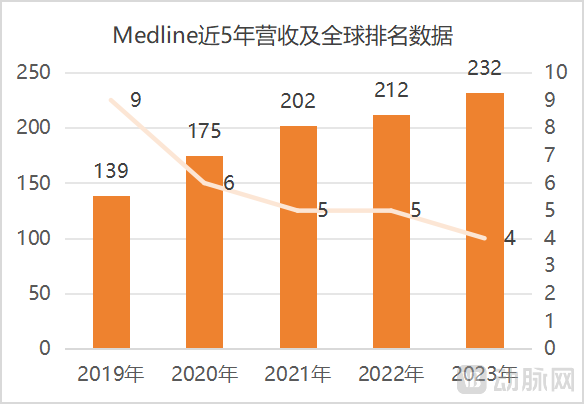
Behind the impressive financial figures lies Medline’s vast production and distribution network for medical supplies, along with a family-led management culture that has endured for 50 years.
1A Diverse Product Portfolio Is the First Barrier
Medline operates in the low-value medical consumables industry, which is characterized by low entry barriers and severe homogenization. Therefore, companies must continuously innovate and upgrade their products, enhancing quality and performance to stand out. To this end, Medline has adopted a two-pronged strategy:
On one hand, we have strengthened independent innovation capabilities to enhance product value-added. For instance, in 2009, the company launched the industry’s first single-layer urinary catheter tray to reduce the risk of infection; in 2011, it introduced the world’s first wheelchair with an antimicrobial protective layer; that same year, the company’s antimicrobial mask became the first FDA-approved antimicrobial mask to be marketed.
On the other hand, it has continuously enriched its product portfolio and strengthened its supply chain layout through acquisitions. In April 2024, Medline acquired Ecolab’s Global Surgical Solutions business from Ecolab, the global leader in infection prevention, for $980 million (approximately RMB 6.8 billion). Ecolab generated over $400 million in sales for this business in 2023. Now, Medline will reap the benefits of this acquisition.
Ecolab’s Core Temp fluid management system is the only open system on the market that employs automated, accurate calculation and tracking of fluid volumes during surgical procedures, helping to maintain patient body temperature, reduce operating room preparation incidents, and lower the risk of fluid-related complications due to miscalculations of blood loss.
In practice, Ecolab and Medline frequently collaborate across hospital departments, with Medline providing front-end products and Ecolab delivering clinical and post-procedural services. Following the acquisition, Medline has incorporated nearly the full spectrum of surgical infection control products into its portfolio.
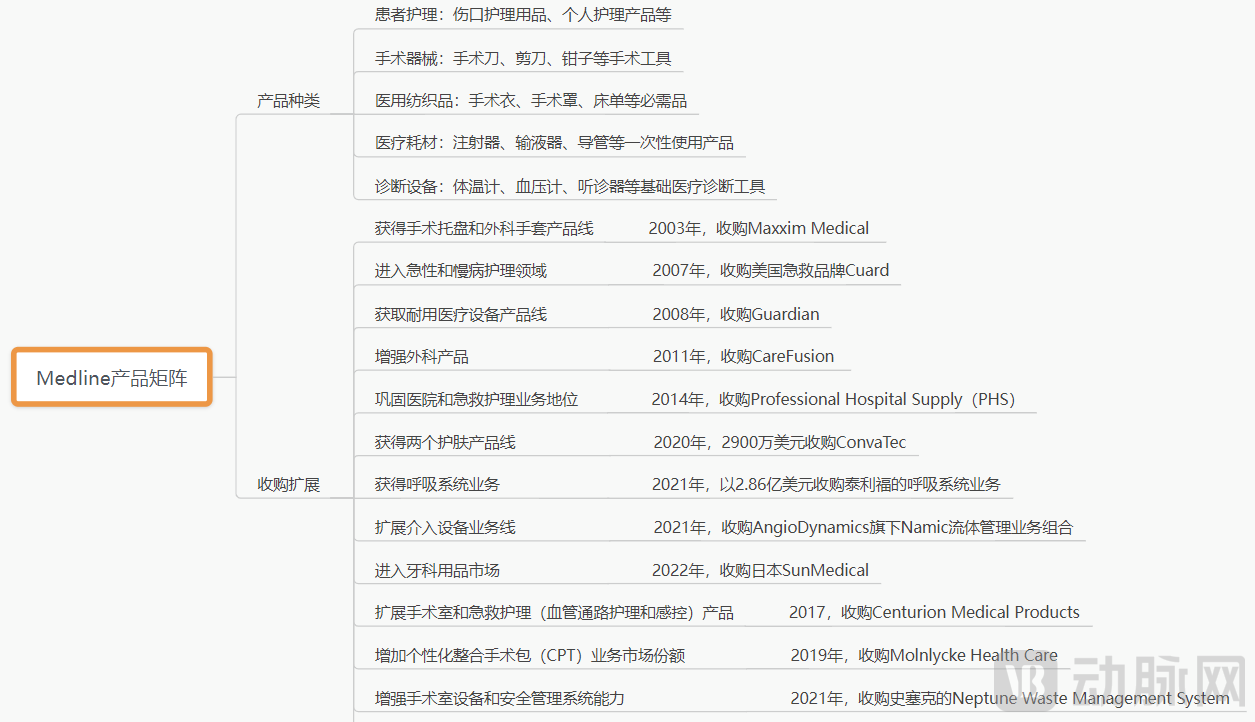
2Complete Supply Chain Production and R&D Capabilities Become Medline’s Core Competitiveness
Medline operates more than 30 manufacturing facilities across seven countries and collaborates with numerous OEM partners worldwide, enabling Medline to fully leverage global resources and advantages to maximize cost efficiency.
Furthermore, the low-value consumables sector features a wide variety of product categories and a fragmented customer base, making distribution capability a key competitive advantage for companies in this space. Medline places strong emphasis on supply chain management and cost control, having established a robust global distribution network with over 50 distribution centers and its own fleet of transportation vehicles.
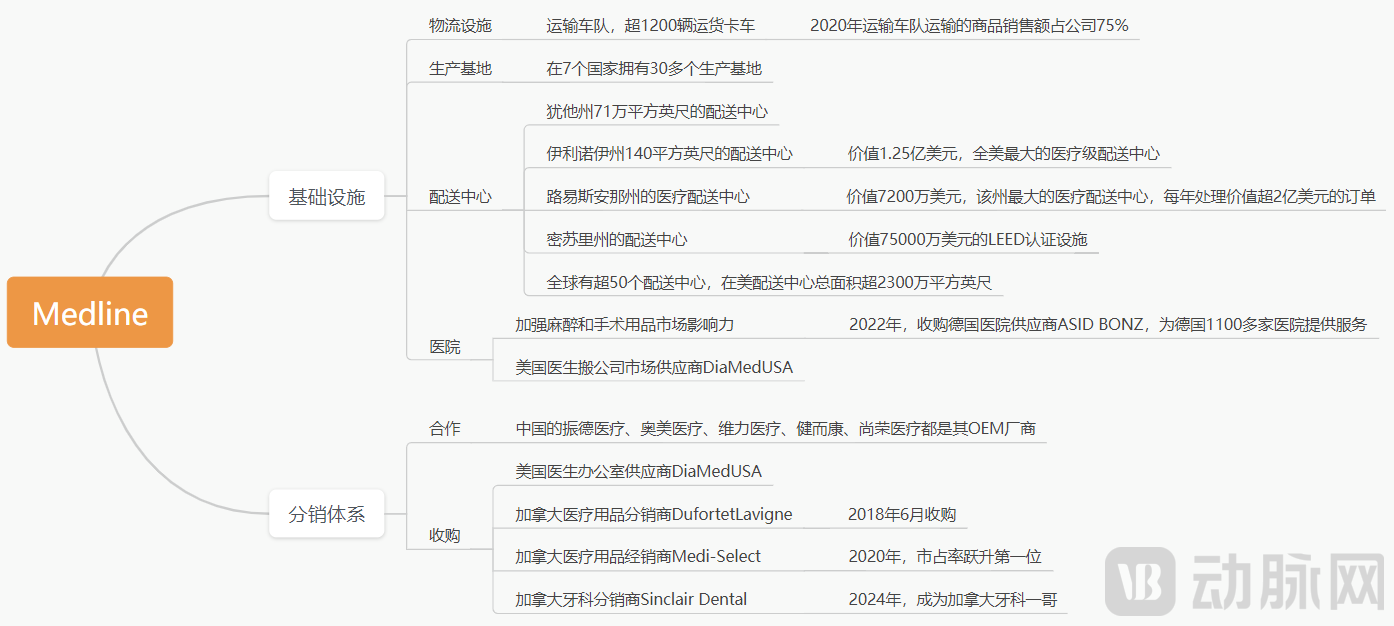
To further consolidate and expand its market position, Medline invested $500 million in 2018 to launch the Healthcare Resilience Initiative (HRI), which included building new distribution centers, enhancing production capacity, and upgrading information systems to improve supply chain efficiency and product delivery capabilities.
3Family Business: A Consistent Lineage in Corporate Management Strategy
Medline is a family-owned enterprise that has built a large corporate partnership led by the family over the past 50-plus years. In 1997, Medline officially entered its fourth generation of management, with cousins Charlie Mills and Andy Mills, along with son-in-law Jim Abrams, taking the helm, thereby establishing a stable “big three” family leadership structure that endures to this day.
The three executives’ similar business backgrounds and their experience at multinational corporations have enabled them to align their management approaches and corporate objectives. Under their leadership, Medline has achieved rapid growth over the past two decades, becoming the fourth-largest medical device company globally.
The Mills family places great emphasis on having a say in corporate management. In the 2021 sale, they successfully preserved the family-led culture. The Mills family remains the largest shareholder, with Medline continuing to be helmed by the fourth generation of family leadership, and the core management team remaining unchanged.
In 2021, a consortium comprising Blackstone, Carlyle, Hellman & Friedman, and Singapore’s GIC acquired a majority stake in Medline for $34 billion. This transaction ranked among the largest leveraged buyouts since 2007, second only to the $44 billion acquisition of U.S. energy giant TXU Corporation by a private equity consortium in 2017.
Amid a Surge in Performance, Why Did Medline Choose to Sell?
From the perspective of the macroeconomic environment, after Biden took office in 2020 and raised tariffs, policy factors caused a rapid increase in costs at the upstream production end, forcing Medline to change its corporate mindset.
China is a key supply market for Medline, with Zhende Medical, Allmed Medical, and Shangrong Medical serving as its major suppliers. In 2020, in addition to the impact of the pandemic, the tariff hikes implemented after President Biden took office led to increased supply chain costs for Medline. During hearings at the Office of the United States Trade Representative, Medline stated that the medical industry could not swiftly switch to alternative supply chains in the short term due to rising tariffs, and that reestablishing alternative production chains in third countries outside China and the United States would be both time-consuming and costly. Consequently, in 2020, Medline lobbied the U.S. government to grant tariff exemptions on 30 categories of medical supplies imported from China, including masks and gloves.
To enhance its market competitiveness, Medline requires substantial capital to strengthen the security of its supply chain. A review of Medline’s acquisition activities mentioned earlier reveals that, since raising significant funds through the sale of equity in 2021, the company has frequently engaged in acquisitions to expand its product portfolio and has built its own production facilities and distribution centers, thereby reinforcing its global supply chain.
Medline’s significant investment in its supply chain is also evident from its senior leadership changes in 2024. On January 1, 2025, a new senior executive appointment at Medline officially took effect, with the former head of brand and the former supply chain management expert promoted to Chief Product Officer and Chief Operating Officer, respectively. These appointments indicate that Medline plans to strengthen its strategic layout in market expansion, operational efficiency, and supply chain management in 2025.
From the perspective of Medline’s sellers, the company has seen a substantial increase in its scale and market value in the post-pandemic era, making it an opportune time for members of the Mills family to reduce their stakes and cash out.
From the buyer’s perspective, Medline is a high-quality private healthcare investment target.. As society ages, healthcare is becoming increasingly important, and scientific technology holds immense development potential in the medical field. Consequently, traditional leading private equity (PE) firms such as Blackstone are continuously increasing their investment in the healthcare sector. For instance, in November 2020, Blackstone launched its inaugural life sciences fund, raising $4.6 billion, which stands as the largest biopharmaceutical fund in history. The opening of Medline’s equity ownership aligns well with the investment preferences of PE firms like Blackstone.
Medline’s successful IPO may also signal a recovery in the medtech market. Prior to this, neuro-medical technology company CeriBell and artificial heart valve manufacturer Anteris Technologies also completed successful listings, further reflecting this trend.
Returning to the initial question: Can China give rise to a super medical supply company like Medline? As it stands, the answer is likely no. Many factors contribute to this outcome; business structure, product forms, and management perspectives have limited the growth and scaling of domestic medical device companies. However, it is encouraging that Chinese medical supply companies are steadily progressing toward becoming global giants.
From a business structure perspective, domestic medical consumables companies are evolving into comprehensive solution providers through organic growth and external mergers and acquisitions.
For exampleZhende MedicalBy establishing a Medical Dressings Research Institute and acquiring companies such as Shanghai Yaaau, Suzhou Medis, and Baoma Medical, the company has strengthened its in-house R&D capabilities and expanded its business scope to cover surgical infection control, ostomy care, sports rehabilitation, and consumables for minimally invasive surgery.Weili MedicalIts business scope has gradually expanded from catheter-based consumables to cover anesthesia, urinary catheterization, urology, nursing care, hemodialysis, and respiratory care.
Regarding the sales system, Chinese low-value consumables companies are in the OEM stage for overseas sales, while domestic sales are beginning to establish their own consumer brands.
Over the past two to three decades, China has absorbed the offshore transfer of the medical consumables industry by leveraging its advantages in labor costs and supply chain infrastructure, gradually fostering a cohort of OEM manufacturers specializing in low-value consumables. WithJianerkangas an example, its export revenue accounted for 83.6%, 71.37%, 82.37%, and 87.46% from 2021 to the first half of 2024. Medline, discussed in this article, is also one of Jianerkang’s customers.
It is worth noting that although Jianerkang maintains relatively stable cooperative relationships in overseas markets, its positioning as a business primarily engaged in OEM export manufacturing means that its revenue remains susceptible to various destabilizing factors. Consequently, Chinese medical consumable companies are actively building their own independent brands to unlock a second growth curve.
Taking Winner Medical as an example, it owns two major proprietary brands: “Winner,” which focuses on wound care and infection prevention, and “Purcotton,” which specializes in pure cotton soft towels and home textile care. In the first three quarters of 2024, its core consumer brand, Purcotton, generated RMB 3.36 billion in revenue, a year-on-year increase of 13.7%, accounting for 55.4% of the company’s total revenue. In terms of channel strategy, Purcotton has adopted a diversified layout, including “traditional third-party e-commerce platforms + interest-based e-commerce platforms + proprietary platforms,” “directly operated stores in first- and second-tier cities + franchise stores in third- and fourth-tier cities,” and “offline experience + online repurchase.”
Furthermore,Allmed MedicalIt has also successively established consumer product business lines, including brands such as “Shangmianji” and “Anzhiai”;Zhende MedicalIt is also building a marketing network covering major global markets.
In terms of R&D systems, Chinese low-value consumables companies are betting on high-end medical consumables.。
AsWinner MedicalIt has carried out industry-academia-research collaborative research on artificial blood vessels and artificial corneas, and expanded its business footprint into high-end wound dressings, injection and puncture devices, and latex products through acquisitions; it also started from low-value consumables such as health protection gloves.Blue Sail Medical, acquired Biosensors International, the world’s fourth-largest R&D, manufacturing, and sales service provider of coronary stents, in 2018. This move not only enabled a strategic leap from low-value consumables to high-value medical devices but also secured an international platform with strong expansion capabilities. According to the prospectus, RMB 420 million of the RMB 720 million raised through Jianerkang’s IPO will be allocated to the construction of projects for high-end medical dressings, nonwoven fabrics, and related products.
With technological advancements, rising healthcare demands, and intensifying market competition, companies in the low-value medical consumables sector must not only strengthen their supply chain layout and drive innovation in new materials, products, and manufacturing processes, but also explore more diversified business models to consolidate their market position and achieve sustainable growth amid fierce competition.