

Petal Bio's First Domestic Agarose-Based Injectable Gel Enters Clinical Trials with Stable Preliminary Feedback
In early 2025, the field of aesthetic injectable fillers witnessed significant advancements:
On January 20, Algeness VL, the first agarose-based injectable filler in China, received official approval. Six days later, domestic products also saw significant progress: Shanghai Huaban Biotechnology Co., Ltd. (hereinafter referred to as “Huaban Biotech”), a company focused on the research and development of agarose materials, announced the completion of its initial financing round worth tens of millions of yuan. Meanwhile, its independently developed “Anroumei” agarose injection gel (AG15) simultaneously entered the clinical registration phase.
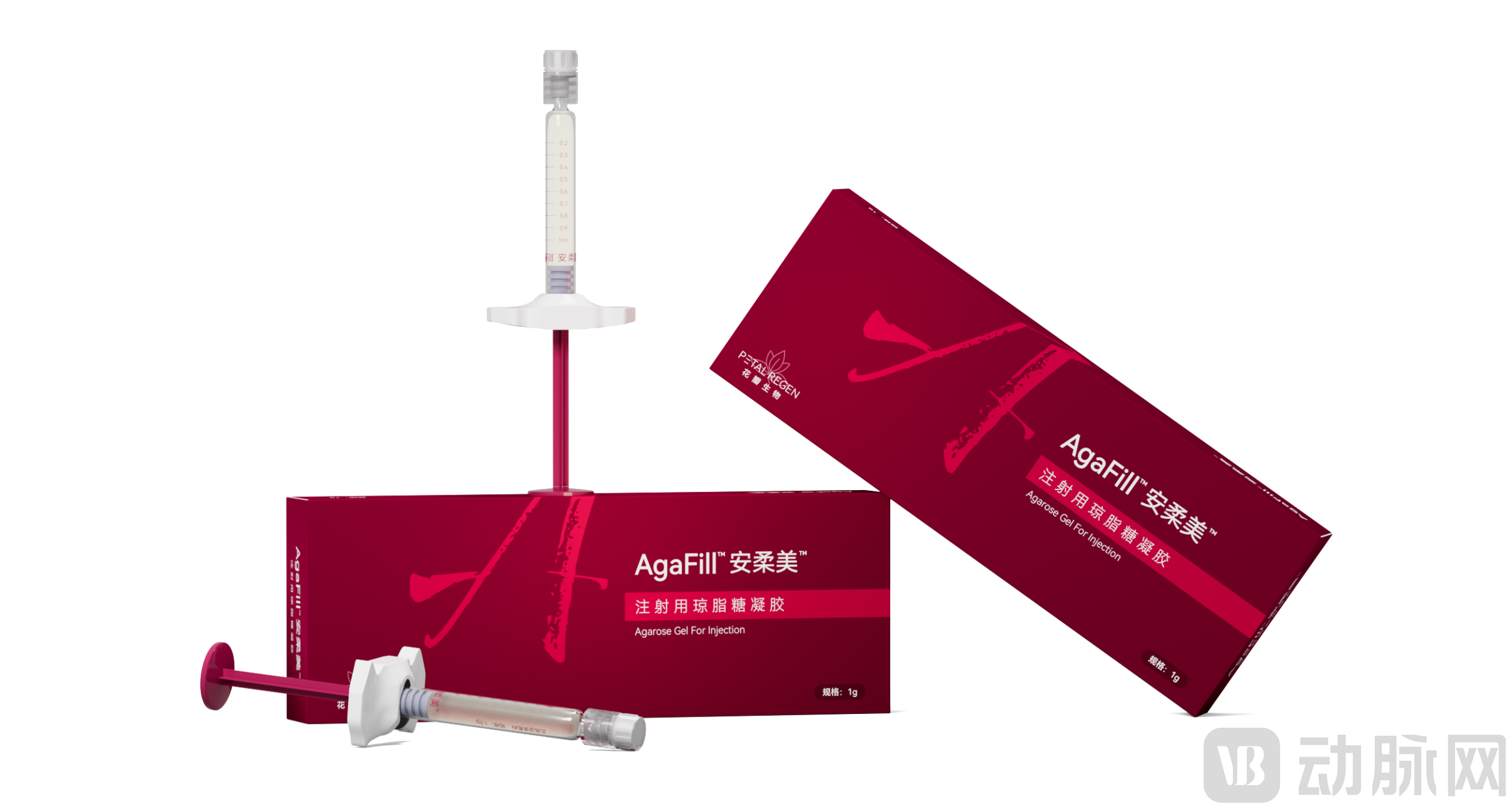
Shanghai Huaban Biotechnology Co., Ltd. is one of the few domestic innovative enterprises focused on the innovative forms and medical applications of agarose materials. It was established in 2023 with joint investment from Beirong Biology, Liaoning Dema, and Wuhan Xiruiyan.
Liu Yandong, Founder and CEO of Huaban Biotechnology, stated that based on current preliminary feedback, the product has demonstrated remarkable stability in terms of injection smoothness, patient satisfaction, and safety. No significant adverse reactions were observed, and there were no instances of tissue rejection or migration.
Agarose is no newcomer to the medical field. This natural polysaccharide, extracted from seaweed, has been widely used in scientific research, food, pharmaceuticals, and other fields due to its excellent biocompatibility, tunable gel properties, and lower risk of immune stimulation, with its safety thoroughly validated.
As research into the industry deepens, agarose’s safety, morphological stability, and metabolically controllable properties have demonstrated significant value in the field of medical aesthetic fillers.
Facial fillers, as a currently popular approach to facial anti-aging, improve facial contours and enhance aesthetic appeal by adding volume to the face. Commonly used filler materials include hyaluronic acid, collagen, and biostimulatory agents. Safety, natural appearance, longevity, and cost (scalability for mass production) are the primary factors influencing the market share of various filler materials.
“In the development of medical aesthetic materials, traditional products such as hyaluronic acid, PLLA (poly-L-lactic acid), and PCL (polycaprolactone) have established a certain market landscape. However, there remains room for breakthroughs in core dimensions such as ‘safety, stability, and controllability of material structure.’ Huaban Biotechnology firmly believes that agarose is the ideal material to achieve this breakthrough, bringing new safety standards and treatment experiences to the industry.”
With manufacturers expanding capacity, consumption upgrading, and market education advancing,Aesthetic Seekers’ Focus Gradually Shifts from “Price” to “Results”, significantly raising the requirements for the compatibility between materials and indications. This consumer trend has also created development opportunities for materials such as agarose, which can more effectively address differentiated indications.
Compared with traditional fillers, agarose exhibits superior morphological stability, is less prone to water absorption and swelling, and features a clear and controllable structure. These characteristics make it a novel filling option for anatomical sites that require structural support but where swelling risks must be avoided. Furthermore, due to its physical degradation properties, agarose undergoes metabolism in vivo primarily through natural physical breakdown rather than relying on specific enzymatic hydrolysis, thereby ensuring predictability and safety for long-term use.
Liu Yandong emphasized, “Agarose offers the industry new breakthroughs in dimensions such as safety and structural controllability; however, it is not a substitute for existing materials but rather forms a differentiated complement, providing diverse options to meet varying market demands for different therapeutic needs and treatment cycles.”
Agarose gels are distinguished from other materials by their tunable stiffness and mechanical properties, which can yield diverse biological outcomes. By adjusting concentration, molecular weight, and formulation, medical products with varying effects can be developed. For instance, the hardness of agarose gels is directly proportional to their concentration; low-concentration gels are softer and suitable for soft-tissue filler applications, while high-concentration gels are harder and meet the requirements for bone contour augmentation.
AG15, an agarose gel product with a specific concentration, is the result of Shanghai Huaban Biotechnology Co., Ltd.'s precise adjustment of agarose concentration, molecular structure, and molding method, following extensive evaluation and preliminary experiments.
As the world’s second and China’s first independently developed agarose-based injectable, AG15 is primarily indicated for soft tissue wrinkle filling in areas such as the face, neck, and hands. Its clinical trial was officially launched on February 19. The trial mainly focuses on the indication of neck wrinkles, while also evaluating the product’s performance across different injection depths and among populations with varying metabolic profiles.
Based on current clinical use and experimental feedback, the effects of AG15 last for more than six months. It demonstrates stable performance in terms of safety, natural appearance, and longevity, with no significant adverse reactions, tissue rejection, or migration observed.
Agarose at specific concentrations offers both favorable injectability and strong tissue support, demonstrating particularly ideal performance in soft tissue layers. From the perspective of clinical application, the agarose gel product AG15 exhibits well-balanced efficacy in mid-face augmentation, contour refinement, and certain superficial filling procedures, making it highly suitable as the inaugural “multi-indication” product to enter the market.
From a broader perspective, this “multi-indication” product can accelerate the collection of clinical feedback from physicians and lay the foundation for Huaban Biotechnology’s future expansion of high-concentration products into deeper or more durable treatment scenarios. Furthermore, Huaban Biotechnology will expand its research into additional indications while simultaneously advancing product registration and commercialization efforts.
To further accelerate the commercialization process of the product,Shanghai Huaban Biotechnology Co., Ltd. has officially signed a strategic cooperation agreement with United LiGe (Beijing) Medical Beauty Investment Chain Group Co., Ltd.The two parties will engage in deep cooperation centered on the innovative R&D, clinical application, and market promotion of agarose gel in the field of facial injections, committed to driving technological upgrades and sustainable ecological development in the medical aesthetics industry. The initial phase focuses on developing a novel agarose gel injectable that combines “immediate results” with “long-term safety,” achieving more natural aesthetic outcomes through safe and stable implantation. The establishment of this collaboration marks a solid step forward in Shanghai Huaban Biotechnology Co., Ltd.’s market expansion strategy and lays a strong foundation for the future clinical promotion of agarose-based materials.
Its favorable material properties make agarose an ideal biological filler in the field of medical aesthetics. Consequently, industry experts regard agarose as poised to become the new benchmark for next-generation injectable fillers.
However, high expectations have not spurred a research and development boom. Currently, the number of enterprises worldwide that continue to invest in R&D for agarose is very limited. Liu Yandong attributes this phenomenon to three major industrialization bottlenecks:
First, the threshold for process innovation is high.Agarose exhibits strong molecular structural stability but poor flowability; achieving "injectability" requires highly innovative formulation and processing strategies to modulate its rheological properties.
Secondly, the current agarose industry chain is still immature,The lack of standardization in raw material control, processing methods, and product stability assessment necessitates that enterprises independently establish end-to-end quality control systems, resulting in prolonged R&D cycles and increased costs.
Third, market education for new agarose materials is insufficient.The medical aesthetics market exhibits a lag in the adoption of new materials, which tests companies’ capabilities in market education and product conversion. It is necessary to collaborate with institutions to conduct large-scale physician training and reconstruct standards for injection techniques and efficacy evaluation.
As a pioneer in injectable medical aesthetics, Shanghai Huaban Biotechnology Co., Ltd. is continuously striving to overcome the challenges facing the industrialization of agarose.。Huaban Biotechnology leverages the property of agarose as a matrix material,Exploring the synergistic effects of agarose with other biomaterials (such as hyaluronic acid [HA], collagen, and composite microspheres) to enhance the flexibility, support capacity, and tissue regeneration capabilities of fillers through the complementary properties of multiple materials. Particularly in the fields of soft-tissue augmentation and tissue repair, combining the stability of agarose with the moisture-retaining properties of HA and the biocompatibility of collagen can achieve more durable and natural-looking augmentation outcomes.
Furthermore, Huaban Biotechnology is also investigating combination formulations of agarose with materials such as hydroxyapatite (HA), poly-L-lactic acid (PLLA), and polycaprolactone (PCL), aiming to balance injectability, structural support, and tissue repair capabilities. In particular, the synergistic application of agarose and hydroxyapatite can enhance filler support while further promoting calcium-induced tissue repair, making it suitable for contour support and bony structure sculpting.
Over the next three years, Shanghai Huaban Biotechnology Co., Ltd. will continuously refine the application scenarios for composite formulations involving agarose and HA fillers, collagen, and other materials, promote the clinical validation and market expansion of “Anroumei” in more specialized fields, and further enhance the market share and brand influence of agarose-based materials.