

Beyond Laparoscopic and Orthopedic: New Surgical Robot Segments Break Through with IPO Filings
The surgical robotics market is poised for a breakthrough in another niche segment.
Based on the surgical site, surgical robots can be classified into laparoscopic surgical robots, orthopedic surgical robots, vascular interventional surgical robots, natural orifice transluminal endoscopic surgical robots, percutaneous puncture surgical robots, neurosurgical robots, ophthalmic surgical robots, oral and maxillofacial surgical robots, and hair transplantation surgical robots.
Previously, laparoscopic and orthopedic surgical robots dominated the surgical robot market.. For example, in terms of registration, according to statistical data from the High-End Medical Device Institute Data Center: approximately 15 domestically produced surgical robots were approved in 2022, including 10 for orthopedics and 3 for laparoscopy, with orthopedic and laparoscopic surgical robots accounting for a combined 86.7%; approximately 26 were approved in 2023, including 10 for orthopedics and 5 for laparoscopy, with the two categories together accounting for 57.7%; approximately 50 were approved in 2024, including 27 for orthopedics and 4 for laparoscopy, with the two categories together accounting for 62%.
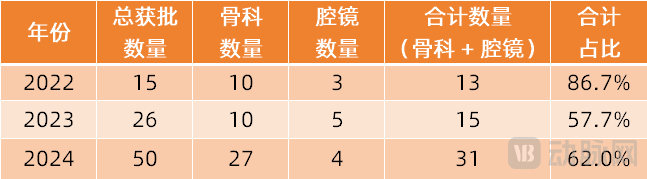
(Approval Status of Surgical Robots, 2022-2024; Data Source: High-End Medical Device Institute Data Center)
In terms of the market, based on 2024 bidding data for surgical robots (excluding undisclosed data), laparoscopic and orthopedic surgical robots ranked first and second, respectively, by sales revenue, with a combined market share of 81%.
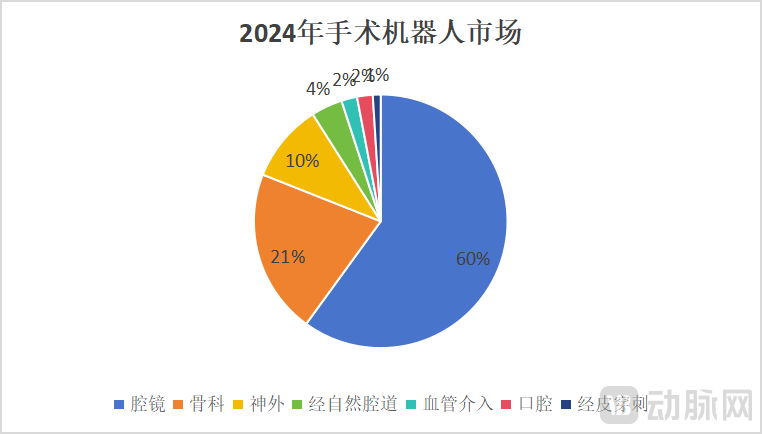
(Market Share of Various Surgical Robots in 2024, Chart by VCBeat)
Today, driven by the widespread adoption of laparoscopic and orthopedic surgical robots, the concept of surgical robotics is gaining accelerated popularity. This trend has also benefited surgical robots in other fields, leading to numerous breakthroughs.。
For example, in March 2025, several surgical robots outside the fields of laparoscopy and orthopedics were approved for market launch, including Weimai Medical’s ETcath Interventional Surgery Assistance System, Zhuoye Medical’s self-developed AI-guided percutaneous puncture surgery navigation robot, the world’s first digestive endoscopic surgical robot under RoboMed, and Pangce Medical’s first domestically produced hair transplantation robot...
Meanwhile, various types of surgical robots have also successfully achieved their first commercial sales. For instance, the Ion Bronchoscopy Robot System (a natural orifice surgical robot) secured its first domestic order in June 2024, with a contract value of RMB 14.9725 million; the R-ONE Coronary Intervention Surgical Robot (a vascular interventional surgical robot) sold five units in December 2024, generating RMB 76 million in revenue for MicroPort...
With successive product approvals and accelerating commercialization, it is undeniable that the surgical robotics market will see breakthroughs in specific niche segments. In the following section, we will analyze the latest advancements in surgical robots across these specialized fields and explore which systems are poised to capitalize on emerging opportunities.
Currently, laparoscopic surgical robots are widely used in clinical practice. In contrast, natural orifice surgical robots started later and have seen limited clinical application.
Classified by surgical approach, natural orifice surgical robots include those accessing via the digestive tract, respiratory tract, and urogenital tract.
Among them, RoboMed’s recently launched EndoFaster is the world’s first digestive endoscopic surgical robot approved by the NMPA. This surgical robot is designed to be used in conjunction with disposable tissue forceps for gastrointestinal endoscopy, and is indicated for grasping and lifting lesion tissues during endoscopic submucosal dissection (ESD).
It is reported that endoscopic submucosal dissection (ESD) is a minimally invasive procedure for treating gastrointestinal lesions under endoscopy, and is used for superficial gastric tumors.Standard TreatmentHowever, ESD procedures are associated with pain points such as a steep learning curve, high technical demands, reliance on physician experience, and blind spots in the visual field, which limit the application and penetration of the ESD technique.
The EndoFaster digestive endoscopic surgical robot, launched by RoboMed, offers solutions to these challenges. Specifically, this surgical robot features a flexible robotic arm design with a diameter of 2.5 mm and four degrees of freedom, enabling better adaptation to narrow lumens. Meanwhile, the master-slave control mode allows precise control over the robotic arm’s movements within the gastrointestinal tract as well as the multi-degree-of-freedom motion of its end-effector. Equipped with an intelligent user interface and intuitive operational feedback, the system enables physicians to achieve proficient operation after only brief training. During endoscopic procedures, the robotic arm facilitates traction and lifting of lesioned tissue from multiple positions and angles.
Multiple clinicians have stated that robotic systems for digestive endoscopic surgery can significantly enhance the precision and stability of endoscopic submucosal dissection (ESD) procedures, reduce operational difficulty, improve the learning curve, and elevate surgical quality.
In addition to RoboMedical, Qiaojeli Medical has also made significant progress. In February 2025, Qiaojeli announced that its independently developed fully flexible endoscopic surgical robot system had completed preclinical testing at the Cleveland Clinic in the United States, with excellent results. These findings are expected to be officially presented at the annual meeting of the American Urological Association in late April.
Additionally,Transbronchial surgical robots have advanced more rapidly, expanding to support a variety of procedures and achieving successful commercialization.For example, Johnson & Johnson’s Monarch robotic system received approval from the National Medical Products Administration (NMPA) in 2023. This product enables physicians to perform diagnostic and therapeutic procedures via the natural bronchial pathway without any external incisions. To date, this surgical robot has assisted in complex procedures such as integrated bronchoscopic lung nodule biopsy combined with microwave ablation, and sublobar resection. With technological advancements, the indications (procedural applications) for surgical robots are expected to expand further.
For another example, the bronchoscopy robot system under Intuitive Fosun completed its first commercial sale in China in June 2024, purchased by the Affiliated Hospital of Xuzhou Medical University for RMB 14.97 million. In 2024, the Polaris Bronchoscopy Navigation Robot launched by Langhe Medical was used to perform new surgical procedures at more than ten hospitals across China, completing 438 procedures and bringing the total number of surgeries performed to over 600.
With the approval and clinical application of multiple natural orifice surgical robots, emerging clinical evidence and intensified corporate marketing efforts are expected to drive rapid growth in the market size. According to data released by Frost & Sullivan, the market size of natural orifice surgical robots in China is projected to reach $130 million in 2026, with a compound annual growth rate (CAGR) of 161% from 2023 to 2026.
Among these, in the natural orifice surgical robot market, RoboMedical’s digestive endoscopic surgical robot is the first of its kind, facing no competitive pressure; the focus lies on market cultivation and clinical promotion. The transbronchial surgical robot market includes Intuitive Fosun, Johnson & Johnson, Longhe Medical, Jingfeng Medical, and MicroPort, among others, presenting a certain degree of competitive pressure. However, this market is still in its early development stage, requiring companies to first cultivate the market and expand its overall size.
Puncture biopsy is a critical method for the surgical diagnosis of tumors, demanding substantial clinical experience from physicians. In conventional puncture procedures, doctors must mentally reconstruct the tumor’s location based on imaging modalities such as CT scans before performing the biopsy, often requiring multiple scans to verify whether the needle tip has accurately reached the target. Historically, due to factors such as patient respiration and tissue movement, the accuracy of puncture biopsies has been generally low, potentially leading to complications.
The advent of percutaneous puncture surgical robots has significantly reduced surgical difficulty and improved puncture precision. It is reported that these robots can localize target anatomical structures using imaging modalities such as MRI, ultrasound, and CT, guide the needle with feedback to reach the target anatomy, and assist in the completion of percutaneous puncture procedures.
Unlike the market for natural orifice surgical robots,The market for percutaneous puncture surgical robots is highly crowded. To date, more than ten companies have launched percutaneous puncture surgical robots, including Yida Jixing, Zhenjiankang, MicroPort, Tuodao Medical, Ganavie Medical, Zhuoye Medical, Broncus Technologies, Raytouch Technology, Vede Precision, Langkai Medical, Aimite, Airui Maidi, and Jingmai Medical.。
Among them, United Imaging, the leading domestic medical imaging company, has also entered this sector. In November 2024, United Imaging Group launched the world’s first uInterv C550 percutaneous interventional surgical robot. Guided by real-time CT imaging, this system enables physicians to continuously monitor the spatial relationships among lesions, targets, critical organs, and puncture instruments throughout the procedure. By precisely controlling the robotic arm, physicians can accurately perform punctures. With this system, physicians can control needle insertion in real time from the control room, thereby reducing the number of needle adjustments, shortening puncture time, and enhancing both surgical efficiency and safety.
Beyond product approval, percutaneous puncture surgical robots are accelerating their adoption and promotion. Taking Zhenjiankang as an example, its Zhenyida Surgical Navigation and Positioning System is the first percutaneous puncture surgical robot approved by the National Medical Products Administration (NMPA). It has been deployed in dozens of hospitals for clinical use, applied to numerous diagnostic and therapeutic procedures involving thoracic and abdominal organs, such as puncture biopsy, surgical localization, precise ablation, and particle implantation. To date, it has facilitated over 2,500 procedures with a 100% success rate.
In recent times, the field of percutaneous puncture surgical robots has developed rapidly, with various new technologies emerging one after another.
For example, the world’s first percutaneous puncture robot utilizing “3D structured light fusion sensing and positioning technology,” launched by Zhuoye Medical, received market approval in March 2025. Equipped with million-point cloud 3D structured light scanning technology, the robot enables non-invasive 3D modeling of the body surface, significantly enhancing precision and efficiency compared to traditional positioning methods. Furthermore, it integrates Zhuoye Medical’s proprietary respiratory motion compensation algorithm, which tracks body surface displacement in real time to ensure the accuracy and stability of the puncture trajectory during surgery. This technology addresses the issue of positioning deviations caused by factors such as patient respiration in conventional puncture procedures.
Meanwhile, this AI-guided percutaneous surgical navigation robot is suitable for minimally invasive interventional procedures such as percutaneous needle biopsy, ablation therapy, and seed implantation for solid tumors in the lungs and abdomen (e.g., lung cancer, liver cancer). For micro-nodules with a diameter ≤10 mm, the robot can enhance positioning accuracy to the sub-millimeter level, thereby improving the diagnosis and treatment outcomes of early-stage tumors.
Furthermore, percutaneous puncture surgical robots are increasingly being integrated with a wider range of medical imaging equipment. For instance, the percutaneous puncture surgical robot developed by Ganaiwei Medical is used in conjunction with large-bore CT scanners, which offer a broader scanning field of view and aperture, to perform pulmonary nodule puncture procedures, thereby further advancing the precise diagnosis and treatment of pulmonary nodules. Additionally, the RC120 puncture surgery navigation and positioning system from Ruichu Technology is employed alongside PET-CT to conduct percutaneous lung biopsy procedures, enabling precise planning of the puncture path and accurate sampling of lesions for biopsy.
Among them, the CR-NAV100 percutaneous puncture surgical robot launched by Ganawei Medical has overcome the limitations of traditional manual puncture through its navigation system, achieving millimeter-level precise positioning, improving puncture success rates, and reducing the risk of complications. To date, this surgical robot has assisted in over 100 cases of robot-assisted pulmonary nodule ablation via puncture at Union Hospital affiliated with Fujian Medical University.
RC120, the percutaneous puncture surgical robot under Ruichu Technology, adopts its globally pioneering “integrated CT imaging and intelligent sensing technology.” This innovation enables efficient utilization of CT data, allowing for rapid preoperative planning of puncture paths based on preoperative CT images without the need for body surface markers or intraoperative registration. By avoiding critical structures such as blood vessels and bronchi, the system enhances surgical precision while making the operational process simpler and more efficient.
Currently, the number of approved products in the percutaneous puncture surgical robot market is gradually increasing, with accelerated market cultivation and clinical promotion. The penetration rate is expected to rise rapidly, leading to a significant expansion in market size. Meanwhile, numerous companies have obtained approvals in this field, resulting in intense market competition.Percutaneous surgical robots with more functions and higher precision, especially those from leading companies that are expected to secure a first-mover advantage, will be more favored by the market.。
Since 2025, more specialized surgical robots have been approved for clinical application in the field of surgical robotics, such as hair transplantation surgical robots, dental implant surgical robots, and vascular interventional surgical robots.
Among them,The Field of Vascular Interventional Surgical Robots Has Seen Significant Advances Recently: For instance, Weimai Medical’s ETcath interventional surgery assistance system has received market approval; the coronary intervention surgical control system developed by Zhongke Hongtai has entered the special review channel for innovative medical devices; and PANVIS-A, the cerebrovascular interventional robot under Aibo Hechuang, has successfully completed installation and performed its first robot-assisted cerebrovascular interventional procedure...
Prior to this, MicroPort’s R-ONE coronary intervention surgical robot had already secured orders for seven units in China in 2024. Bid award data revealed that at the end of 2024, five leading public hospitals in Shanghai, including Zhongshan Hospital Affiliated to Fudan University, centrally procured five units of the R-ONE system, with a total contract value of RMB 76 million.
In addition to the aforementioned companies and their progress, other players in the field of vascular interventional surgical robots—including Allsurgical, ReHeart Medical, Runmai De, Lancet Robotics, and Weiya Medical—are also making steady headway.
In the field of oral surgery robots, Lancet Robotics’ Dencore dental implant navigation system and Baihui Weikang’s dental implant surgical navigation and positioning device both received market approval in March 2025. To date, numerous companies—including Lancet Robotics, Yake Zhihui, Dicare, Shu Zhidao, Keyjia Medical, Baihui Weikang, Fengzhun Robot, Calvin, and Baichitai—have launched dental implant surgical robots, which have already been deployed at scale. With the volume-based procurement of dental implants, the reduction in related service prices, and the resulting increase in the penetration rate of dental implants, the market size for dental implant surgical robots is expected to grow rapidly.
In the field of hair transplant surgical robots, Bangce Medical’s independently developed HAIRO Hair Transplant Robot received market approval in January 2025. To date, Bangce Medical has partnered with institutions such as Zhongzhi Medical Group, Meibei Medical Aesthetics, Damai Micro-needle Hair Transplant, and Anhui Meifu Medical to jointly promote hair transplant robots. Among these partners, Zhongzhi Medical Group and Damai Micro-needle have already purchased and deployed batches of hair transplant robots and have begun performing robot-assisted hair transplant surgeries. With increased content dissemination and targeted traffic investment related to hair transplant robots, the concept is expected to gain wider acceptance more rapidly, leading to swift expansion of this market.
In the field of ophthalmic robotics, Dishui Medical’s “Dishui MicroBlade” ophthalmic surgery assistance system entered the Special Review Channel for Innovative Medical Devices in February 2025. Reportedly, this product is the first ophthalmic surgical robot in China to enter multicenter registration clinical trials. It can increase the success rate of subretinal injections from 85.5% to 100% and is planned to provide a precise delivery tool for gene therapy.
Ophthalmic surgery imposes exceptionally high demands on clinicians, requiring precise manipulation within an extremely confined space. The ideal motion accuracy for surgical instruments is within 10 micrometers; however, the human hand inherently exhibits physiological tremors of approximately 100 micrometers that cannot be overcome. In complex and delicate ophthalmic procedures, this may lead to tearing of incised tissues, adversely affecting postoperative healing and visual recovery. To address these challenges, surgeons can utilize ophthalmic surgical robots to shorten the learning curve, overcome physiological tremors, and perform surgeries with stability and precision.
Today, specialized surgical robots for various fields—including dentistry, hair transplantation, neurosurgery, percutaneous puncture, and natural orifice procedures—have entered the stage of large-scale application. Surgical robots in areas with higher innovation barriers, such as ophthalmology, have also been granted fast-track review status and are expected to receive regulatory approval for market launch soon, enabling their widespread clinical adoption.
In addition to the aforementioned specialized surgical robots, laparoscopic and orthopedic surgical robots are also undergoing continuous iteration. For instance, in the field of orthopedic surgical robots, Changmugu, in collaboration with West China Hospital and Aikang Group, recently launched the world’s first large AI model platform for orthopedics, DeepJoint, and completed its localized deployment and delivery at the Department of Orthopedics of West China Hospital. It is reported that by fully integrating DeepSeek, the DeepJoint platform will reshape intelligent orthopedic diagnosis, surgical planning, andRobotecological landscape.
In the field of endoscopic surgical robots, Ruilong Surgical’s independently developed Haishan-1 endoscopic surgical robot was approved for market launch in March 2025. As China’s first modular surgical robot, it has received approval for full indications across four major specialties: general surgery, urology, gynecology, and thoracic surgery. Featuring a “split-type, modular, and dexterous” design, it overcomes spatial constraints and lowers the threshold for clinical adoption.
Overall, the surgical robotics market continues to see accelerated advancement of various innovative technologies and ongoing expansion of indicated indications, with increasingly tight integration between surgical robots and advanced technologies such as artificial intelligence (AI) and large language models. In the future, surgical robots are expected to become a clinical culmination that integrates diverse cutting-edge technologies, much like smartphones.