

Accelerating Localization of CT X-ray Tubes Amid Anti-Dumping Probe: A Critical Breakthrough in Medical Imaging Core Components
Historic Opportunity for the Localization of Core Components in Medical Imaging Equipment.
Last week, the Ministry of Commerce initiated an anti-dumping investigation into certain imported medical CT X-ray tubes originating from the United States and India. According to the publicly available petition for the anti-dumping investigation filed with the Ministry of Commerce, the prices of CT X-ray tubes imported from the United States and India have been declining year by year. In the mid- to low-end market segments where domestically produced CT X-ray tubes hold a competitive advantage, the price reductions for imported products have been substantial.
For instance, the import price of the 3.5 MHU series products decreased from USD 11,425 per unit in 2022 to USD 10,279 per unit in 2024, representing a cumulative decline of 10.03%; the import price of the 5 MHU series products dropped from USD 26,100 per unit in 2022 to USD 24,000 per unit in 2024, marking a cumulative decrease of 8.05%.
Behind the continuous price reductions of imported products lies the accelerated rise of domestically produced alternatives. CT X-ray tubes have been a key focus for Chinese manufacturers in recent years, with sustained financing activity in this sector since 2020.
The CT X-ray tube is the heart of a CT scanner, influencing image quality and service life, and it is also the most expensive component. On average, each CT scanner requires an X-ray tube replacement every 2–4 years. According to relevant announcements on the China Government Procurement Network, the procurement price for a single CT X-ray tube can reach millions of yuan. The consumable nature of CT X-ray tubes continues to drive growth in this market.
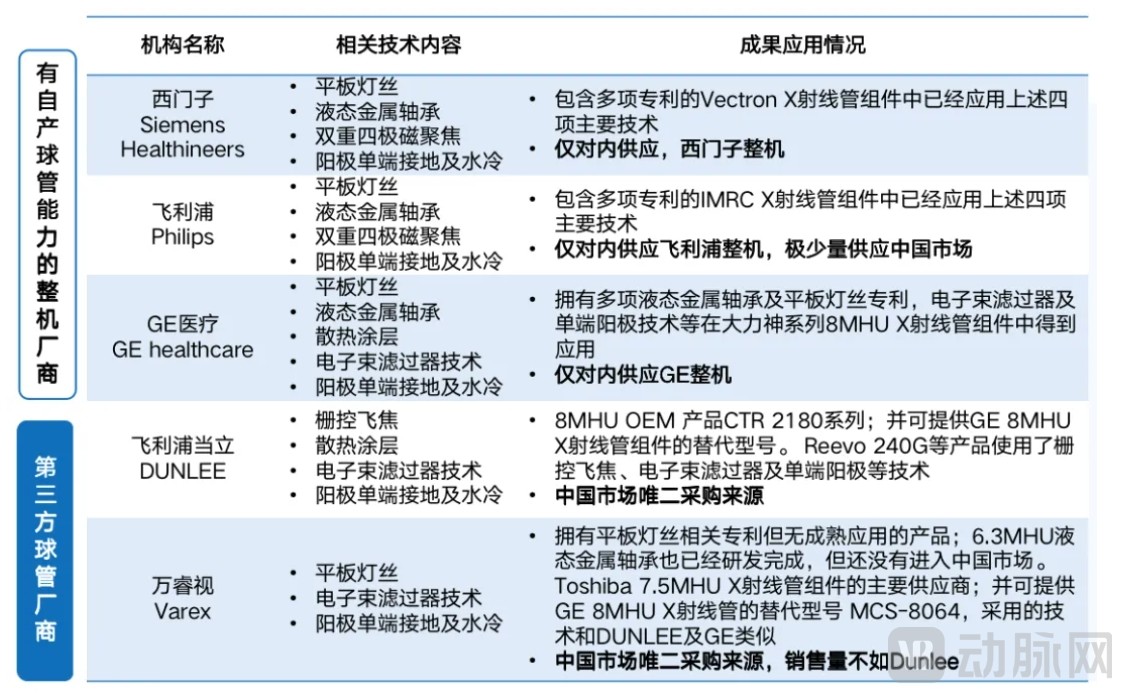
This anti-dumping investigation by the Ministry of Commerce has lifted the veil on the fierce competition in the CT X-ray tube sector. Domestic CT X-ray tube manufacturers are simultaneously facing multifaceted competition from both original equipment manufacturers (OEMs) and third-party suppliers.Original equipment manufacturers (OEMs) such as Siemens and GE develop their own CT X-ray tubes, retaining tight control over these core components. Upstream, two major third-party X-ray tube manufacturers, Dunlee and Varex Imaging, have established strong reputations in the market over many years, creating significant barriers to entry for new competitors.
Breaking through is difficult, but it is not a dead end. Chinese manufacturers have already staged a successful comeback in X-ray detectors, a core upstream component for imaging equipment similar to CT tubes. The key path to this success involved seizing the window of opportunity presented by technological leaps and entering the supply chains of top-tier manufacturers to gain market access. As latecomers competing with Siemens and Philips, these companies ultimately achieved a reversal in global market share.
Can CT X-ray tubes achieve such a turnaround in an increasingly fierce competitive landscape?
An investor in CT X-ray tubes once stated to VCBeat: “Many of China’s technology sectors remain constrained by foreign technological blockades and chokepoints, preventing full autonomy and control. Amid shifting international dynamics, supply chain security faces significant threats, which highlights the opportunity for domestic production of CT X-ray tubes.”
There is substantial demand for CT tube replacements in China. According to estimates by Sunshine Fusion Capital, the domestic market volume for CT tubes will exceed 30,000 units per year in 2025, with maintenance and replacement needs for installed CT equipment accounting for 60% of this total. Data from the Chinese Government Procurement Network, analyzed by VCBeat, reveals a high frequency of CT tube tenders, with winning bids generally priced in the millions of yuan. However, Chinese domestic brands are rarely seen in these bid award announcements.
Winning bidders fall into two categories: one comprises original equipment manufacturers (OEMs) with in-house X-ray tube production capabilities, including Siemens, Philips, and GE Healthcare; the other consists of third-party X-ray tube manufacturers, including Dunlee and Varex.
Data source: Sunshine Capital
Although domestically produced CT X-ray tubes have received regulatory approval, they struggle to penetrate the mainstream market. This is primarily because the tendering and bidding process imposes multiple barriers for domestic manufacturers, while foreign-made CT X-ray tubes are tightly bundled with complete CT systems.
The first major hurdle is the current regulatory framework for medical devices.. During the registration of CT products, the X-ray tube is registered as a critical component of the CT system. However, under current regulations, replacing core structures and components requires an application for change approval, which forces hospitals to purchase only original manufacturer X-ray tubes during procurement.
According to Article 49, Chapter VI of the Measures for the Administration of Medical Device Registration: Where changes occur in the product name, model, specification, structure and composition, intended use, product technical requirements, or manufacturing address of imported medical devices, the registrant shall apply to the original registration authority for a change in licensed items. This means that replacing a CT X-ray tube requires a modification to the product registration certificate; if a third-party manufacturer’s product is adopted, the registrant will not provide assistance with the change application.
In its justification for single-source procurement of CT X-ray tubes, a hospital in Yangzhou stated: “If the X-ray tube on the CT scanner is replaced with one that differs from the model specified in the original registration and certification, without complying with the product change procedures stipulated in the Administrative Measures for Medical Device Registration and Filing, the original registration certificate becomes invalid. Consequently, the hospital would be using a product not registered or certified by the China Food and Drug Administration (CFDA). In the event of adverse incidents, such as medical disputes, this would place the hospital at a significant disadvantage in meeting its burden of proof. Therefore, only original equipment manufacturer (OEM)-compatible X-ray tubes may be procured.”
An industry insider stated, “Policies and regulations have not provided clear guidance on the legality of domestic substitution for X-ray tubes, leading some complete-system manufacturers and foreign tube manufacturers to selectively cite the Measures for the Administration of Medical Device Registration and Filing. This has created obstacles to the market promotion of domestically produced CT X-ray tubes.”
The second major barrier is the repair passwords and system permissions set by original equipment manufacturers (OEMs).Many OEMs have implemented password protections, creating barriers for domestic X-ray tube manufacturers seeking to replace imported components. Even if Chinese companies win bids, they still encounter issues related to passwords and system access rights during replacement and maintenance procedures.
The third major hurdle is a common challenge faced by domestic medical device companies.Hospitals tend to have lower trust in domestically produced products. Furthermore, hospitals often receive warnings and risk notification letters from original equipment manufacturers (OEMs), claiming that the use of Chinese-made X-ray tubes will prevent system debugging and calibration, lead to degraded image quality, and increase the risk of misdiagnosis. This places significant pressure on hospitals when procuring domestically produced X-ray tubes.
Under the compounding pressures, hospitals typically opt to procure original equipment manufacturer (OEM) CT X-ray tubes when making purchasing decisions, which has hindered the market adoption of domestically produced CT X-ray tubes.
The predicament faced by domestic CT tube manufacturers is expected to turn a corner following the implementation of the new "Medical Device Administration Law."
In August 2024, the National Medical Products Administration (NMPA) released the “Draft for Comments of the Medical Device Administration Law of the People’s Republic of China.” This marks the elevation of the Regulations on the Supervision and Administration of Medical Devices to the status of a law. With this transition from administrative regulations to a statutory law, the cost of non-compliance has increased significantly.
Specifically, Article 99 of the Draft for Comments clearly stipulates that medical device user facilities shall conduct inspections, tests, calibrations, servicing, and maintenance on medical devices requiring such regular activities in accordance with the product instructions for use. They shall also promptly analyze and assess the operational status of these medical devices to ensure their safe use.
Medical device user entities shall agree with suppliers on the provider of maintenance, upkeep, and repair services for medical devices. Such maintenance, upkeep, and repair services may be provided by the medical device registrant, filer, or distributor as agreed upon; alternatively, they may be conducted in-house by the medical device user entity or outsourced to qualified and capable third-party service providers.Where a medical device user performs maintenance, upkeep, and repair activities either independently or through entrustment, the medical device registrant, filer, and distributor shall provide the necessary materials and information for such maintenance, upkeep, and repair, including maintenance and repair manuals, software backups, and repair passwords.”
In the future, the implementation of the Medical Device Administration Law of the People's Republic of China is expected to create a fair business environment for domestic CT tube manufacturers, and with policy support, domestically produced CT tubes are poised to seize new development opportunities.
In the short term, the market promotion of domestically produced CT tubes faces obstacles; however, in the long run, competition in the medical device industry remains product-centric, and technological breakthroughs often serve as a strategic opportunity for new entrants to gain a competitive edge.
At present, after nearly a decade of development, China’s medical CT X-ray tube industry has achieved domestic substitution for certain products through independent innovation. In particular, technological breakthroughs and industrialization have been realized in mid- to low-end products, with gradual expansion into the high-end segment.
Domestic CT tube manufacturers have made certain progress in the ball-bearing CT tube market; however, breakthroughs are still needed in high-end, high-power CT tubes. Key components such as anode disks and bearings rely on imported supplies, which are frequently subject to export restrictions.
Breakthroughs in High-End CT X-Ray Tubes: Domestic Companies Still Need to Achieve Independent Production of Core Components Such as Target Disks, Liquid Metal Bearings, and Flat Filaments.
Among these, liquid metal bearings represent a technology mastered by only a few companies worldwide. This technology enhances the heat dissipation performance of X-ray tubes, improves CT operational efficiency, and simultaneously delivers improved image quality and extended CT lifespan.
VCBeat has learned that Chinese companies have achieved breakthroughs in the field of metal bearings for CT X-ray tubes. Zhishu Technology’s liquid metal bearing X-ray tube was approved in 2022, overcoming the challenge of vacuum sealing for liquid metal through innovative technology. Kunshan Yiyuan’s high-end CT X-ray tube with a 7M liquid metal bearing is about to be launched. Chronos has also made breakthroughs in the mass production of liquid bearing CT X-ray tubes.
Domestic manufacturers have also achieved breakthroughs in target discs. The anode target disc is the most expensive single component in high-heat-capacity CT X-ray tubes, accounting for approximately 25%–30% of the total tube cost. Anode target discs are categorized into two types: stationary target discs and rotating target discs. Rotating target discs facilitate heat dissipation through high-speed rotation in conjunction with high-speed bearings, enabling prolonged continuous operation.
VCBeat has previously reported that Chinese company Weirui Technology has achieved independent design and manufacturing of CT tube rotating anode target disks, and has supplied brazed target disks to multiple foreign tube manufacturers, with cumulative shipments exceeding 1,000 units.
Throughout the development of China’s medical device industry, domestic enterprises have faced numerous hardships and obstacles during their initial stages, operating in a competitive environment where they were at a disadvantage, yet they have continued to explore pathways for survival and growth.
Currently, the development paths explored by domestic CT X-ray tube manufacturers in China mainly include the following.
First, collaborate with domestic original equipment manufacturers (OEMs) to develop products using the CDMO model. Conduct product research and development based on the needs of downstream OEM enterprises, jointly exploring new products. Leverage professional expertise to help downstream OEMs shorten R&D cycles and achieve scaled production more rapidly.
Second, entering the supply chains of top-tier overseas manufacturers. As an upstream enterprise, securing contracts with leading overseas CT suppliers helps expand market reach. Most successful domestic upstream core component companies have followed this path. For example, Sirui New Materials broke through key technologies for core components of CT X-ray tubes and became a stable supplier to Siemens Healthineers, subsequently gradually acquiring domestic customers such as Shanghai United Imaging, Kunshan Yiyuan, and Wuxi Maimo.
Third, accelerate resource and technology integration. Acquire technical patents and production capacity through cross-border mergers and acquisitions. For instance, Koronos acquired the U.S.-based DUNLEE factory, along with related equipment and teams, thereby directly obtaining X-ray tube manufacturing processes.
Fourth, we will continue to exert efforts in the high-end X-ray tube sector, building differentiated competitive advantages in product areas such as liquid metal X-ray tubes, high-power industrial X-ray tubes, and digital subtraction angiography (DSA) X-ray tubes.
Drawing on the development path of iRay Technology, a core component supplier for medical imaging equipment, its product launch coincided with a critical period when X-ray equipment was transitioning from film-based systems to DR (Digital Radiography) systems. In terms of development strategy, iRay Technology adopted an “indirect approach,” prioritizing overseas market expansion. Leveraging robust technology and high-quality products, it successfully entered the supply chains of top-tier brands such as Philips and Siemens. After establishing market trust, it gradually penetrated the domestic market, ultimately achieving a remarkable rise in global market share and becoming the world’s third-largest supplier.
The journey toward domestic substitution of core upstream components is a long one, and the Ministry of Commerce’s anti-dumping measures will undoubtedly accelerate the replacement of imported CT X-ray tubes with domestically produced alternatives. This anti-dumping investigation by the Ministry of Commerce has highlighted the fierce competition within China’s CT X-ray tube sector. Price wars, regulatory constraints, and trust biases have emerged as the primary obstacles hindering the development of domestically produced CT X-ray tubes. Only by achieving technological self-reliance, pursuing differentiated innovation, and promoting the localized production of key components can Chinese enterprises achieve genuine surpassing of their international counterparts.
Reference Article:
Ronghui Research | Special Topic on Core Technology Breakthroughs — CT X-ray Tubes: The Critical Pathway for CT Autonomy and the “Core” of a Medical Powerhouse — Sunshine Ronghui Capital
The Fierce Competition Among Domestic CT X-ray Tubes: Who Will Reign Supreme? — MedDeep Insight
MicroRay Tech Achieves Full Localization of CT X-Ray Tubes by Overcoming Barriers Such as In-House Anode Target Disc Manufacturing and Liquid Metal Bearings — VCBeat