

How to Identify Truly 'Useful' Medical Innovations: Beijing Sets a Benchmark
We frequently encounter news about breakthrough therapies, with exciting laboratory data and findings published in many academic journals often creating the illusion that “even the most complex diseases can be cured.” However, over time, the public has come to realize that the news seems to endlessly repeat tales of yet another “innovative miracle,” while very few patients actually benefit from these advances.
Behind this phenomenon may lie the awkward realities and deep-seated contradictions inherent in the process of translating medical innovations into practice—Many research achievements that appear to be breakthroughs often come to an abrupt halt after leaving the laboratory, failing to reach the clinic or change the current state of patient treatment.
Especially now, China’s vitality in life sciences and basic medical research, along with the scale of its paper output, ranks among the top globally. However, a vast amount of these achievements stop at papers, patents, and experimental reports, failing to make the critical leap “from bench to bedside,” and ultimately becoming merely a line of record in academic databases.
The paper may appear impressive, but it does not necessarily translate into practical utility for patients. This is not merely an issue of technological maturity; rather, it stems from a formidable “last mile” gap between innovative breakthroughs in medical research and the stringent demands of clinical practice.
We cannot help but ask,Behind the dazzling array of laboratory achievements, how can we truly translate medical innovations into clinical practice, ensuring that technological advancements benefit every patient awaiting new therapies?
Breaking Through the Constraints of the “Four Highs” to Advance China’s Original Innovative Drugs
In the current era, new drug development faces multifaceted challenges. The development of modern innovative drugs not only requires originality in their mechanisms of action but also must balance clinical safety and efficacy.
At the launch ceremony of the “2025 Beijing-Tianjin-Hebei Innovation in Medical Translation and Industry Promotion Competition” held on April 10, Academician Jiang Jiandong, Member of the Chinese Academy of Engineering and Director of the Institute of Materia Medica, Chinese Academy of Medical Sciences, shared his insights on advancing original innovative drug development in China. He pointed out thatThe “Four Highs” phenomenon—high knowledge density, high technical requirements, long R&D cycles, and substantial economic investment—represents a practical challenge constraining the translation of new drugs from the laboratory to clinical applications and large-scale production.Therefore, drug R&D in China must integrate multidisciplinary resources and fully leverage cutting-edge technologies such as molecular biology, chemistry, and artificial intelligence to enhance the efficiency of drug design and screening.
In his report, Academician Jiang Jiandong also analyzed the development pathway of original drugs in China, believing thatChina boasts a profound heritage in traditional medicine and holds immense potential to achieve breakthroughs in drug innovation by leveraging modern scientific and technological approaches.
In his view, traditional medicine and modern pharmacology are not opposed but can be organically integrated. It is precisely by building on traditional experience, followed by rigorous medicinal chemistry research and pharmacological validation, that original drugs such as ephedrine and artemisinin have been developed. As a typical example of an original Chinese drug, ephedrine was successfully isolated in the early 20th century and, through continuous research and improvement, has become an important medication for treating hypotension, relieving asthma, and other indications. Artemisinin, meanwhile, fully demonstrates how ancient textual records and modern scientific technologies can be leveraged to rapidly develop an effective antimalarial drug; its mechanism involves the activation of drug effects by heme, produced through hemoglobin hydrolysis. This discovery has made a substantial contribution to global public health.
With the advancement of modern biotechnology, chemical technology, computer science, and basic medicine, the mechanisms of action of traditional Chinese medicine, particularly botanical drugs, can be better elucidated.Chinese pharmaceutical R&D professionals, while honoring traditional heritage, have leveraged modern science and technology to boldly break from convention. By harnessing cutting-edge innovations, they have developed safe, effective, and original drugs, achieving a remarkable transformation from natural remedies to high-tech modern therapeutics and delivering tangible benefits to patients worldwide.
Academician Jiang emphasized that to develop original drugs in China, it is essential to adhere to the guiding principle of “reductionism plus systems theory.” The evolution from the “single-target hypothesis” to “negative entropy as the target,” and the transition from traditional empirical approaches to the application of modern big data and artificial intelligence technologies, all require that drug development no longer be confined to single targets. Instead, it should be grounded in systemic regulation, precisely intervening in every link of disease onset and progression.
Future new drug development should emphasize the synergistic effects of multi-target approaches, integrating multifaceted information from blood, tissues, cells, and molecular networks to ultimately realize a novel holistic therapeutic model that combines prevention with treatment and addresses both the root causes and symptoms of disease. This represents a new direction for pharmaceutical innovation in China and globally, and it better meets the substantial unmet clinical needs of the future.
Industry Scale Surpasses Trillion-Yuan Mark as Beijing Builds a “Powerful Magnet” for Global Pharmaceutical Innovation Resources
As the population ages and the disease spectrum shifts, society’s demand for health services and medical resources is growing steadily. It is projected that by 2030, the market size of China’s healthcare industry will exceed RMB 16 trillion. In the face of such vast market potential, traditional models are increasingly unable to meet the rising and diversified demands, making medical innovation a core driver of industrial upgrading and sustained growth.
At the launch ceremony on April 10, Liu Juncai, Director of the Beijing Municipal Health Commission, presented Beijing’s innovative approaches and remarkable achievements in the development of the pharmaceutical and health industry.
Since 2018, Beijing has rolled out three consecutive three-year action plans for collaborative innovation in medicine and health, establishing a “dual-lead” mechanism involving both the industry sector and the industrial sector. It has built a “1+3+X” service system for enterprises, featuring coordination between municipal and district levels and inter-departmental collaboration, with greater emphasis on linking industrial innovation with coordinated efforts among the “three medical” sectors (medical care, health insurance, and pharmaceuticals), thereby promoting seamless integration between the innovation chain and the industrial chain.In 2024, the scale of Beijing's pharmaceutical and health industry reached RMB 1.06 trillion, a year-on-year increase of 8.7%, making it Beijing's third trillion-yuan industrial cluster. Meanwhile, Beijing became the first city in China where the pharmaceutical and health industry exceeded the one-trillion-yuan mark.
By reviewing the numerous initiatives undertaken by Beijing’s pharmaceutical and healthcare industry, we can perhaps identify the source of this strong momentum and understand how Beijing has strengthened and expanded its foundational pharmaceutical and medical device sectors to create a “Beijing Advantage.”
In terms of innovative working mechanisms, Beijing has established a municipal-level joint conference on pharmaceuticals and health, co-led by the science and technology administration and industry regulatory authorities, thereby achieving efficient coordination between technological innovation and the “three medical sectors”—healthcare, drug regulation, and medical insurance.Provides end-to-end services for innovative drugs and medical devices, from early-stage R&D trials to final pricing and hospital inclusion, facilitating robust R&D, accelerated approval, and early clinical adoption.
According to data released at a press conference during the annual Zhongguancun Forum in March this year, Beijing’s pharmaceutical and health industry achieved significant innovative outcomes in 2024: eleven Class III AI medical devices were approved for market launch, ranking first nationwide; nine innovative medical devices received marketing approval, placing second in China; and nine innovative drugs were included in the Breakthrough Therapy Designation program, ranking third nationally. In just the first two months of 2025, seven innovative drug and device products were approved for market launch in Beijing, securing the top position nationwide and achieving a strong start to the year.
To support the high-quality development of innovative pharmaceuticals,In 2024, Beijing Issued “32 Measures” to Promote the Development of Innovative Pharmaceuticalsamong others, it took the lead in shortening the review timeline for supplementary drug applications from 200 days to 60 days and reducing the approval time for clinical drug trials from 60 days to 30 days, thereby cutting the startup time for clinical trials by 7.7 weeks; it also implemented a “white list” system for rare disease drugs and established a green channel for the approval of urgently needed imported drugs and medical devices.
On April 7, 2025, nine Beijing municipal departments jointly issued the "Several Measures of Beijing Municipality to Support the High-Quality Development of Innovative Pharmaceuticals (2025)." The document explicitly outlines multiple key tasks, including further reducing the overall timeline for initiating clinical trials to under 20 weeks; launching the construction of automated, intelligent biobanks focused on key specialized diseases; expanding research and use of marketed drugs for additional clinical indications; ensuring no fewer than 15 newly approved innovative drug and medical device products; supporting cross-border segmented manufacturing by overseas marketing authorization holders; directly incorporating national medical insurance negotiation drugs into the formularies of medical institutions; deploying scenario model development for AI+ pathology and AI+ drug discovery; and establishing a pharmaceutical and health industry fund with a scale of RMB 50 billion.
This is known as"32 Measures" 2.0upgraded wording, joining forces once again at the policy level to support the development of the innovative pharmaceutical industry, continuously stimulate the overall vitality of innovative pharmaceutical enterprises, and propel the trillion-yuan pharmaceutical and health industry to new heights.
Moreover, Beijing has launched a green channel for cross-border data transfers and established an overseas expansion platform for innovative drugs and medical devices, attracting a cohort of foreign-invested enterprises to expand their presence in the city. In 2024, eight renowned pharmaceutical companies, including Pfizer, Merck & Co., and Eli Lilly, set up new innovation entities in Beijing, turning the city into a “powerful magnet” for global pharmaceutical innovation resources.
Application-Oriented: Unearthing Innovative Achievements in New Quality Productive Forces Through Competitions
In 2024, the Beijing Municipal Administrative Center hosted its inaugural Innovation in Medical Translation Competition, themed around medical translation. The event aimed to build key links in the translation ecosystem—connecting technology with demand, clinical practice with solutions, and enterprises with capital—thereby providing support to both supply and demand sides of achievement translation. Ultimately, the competition attracted over 200 innovative projects; 45 advanced to the semifinals, 22 competed in the finals, and nine outstanding projects signed agreements to settle in the Zhongguancun (Tongzhou) Innovative Medical Translation Industrial Park (Yifang Health Valley).
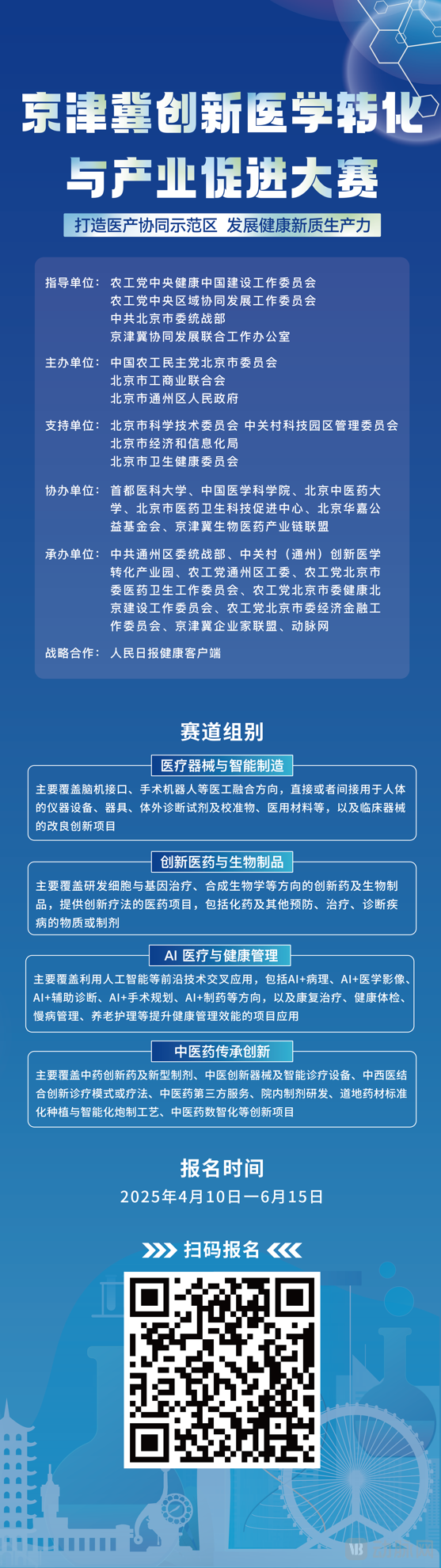
On April 10, 2025, to ensure that every noteworthy innovation in science and technology receives greater attention and more opportunities for implementation, all parties joined forces to comprehensively upgrade the scope of the competition, category settings, awards, and cycle based on the original event. They held the launch ceremony of the “2025 Beijing-Tianjin-Hebei Innovation in Medical Translation and Industry Promotion Competition” under the theme of “Building a Demonstration Zone for Medical-Industrial Collaboration and Developing New Quality Productive Forces in Health.”
The Competition Organizing Committee emphasized,The competition will focus on building a platform for scientific and technological innovation achievements guided by "application.", facilitating the accelerated development of key links in the transformation ecosystem within the Beijing-Tianjin-Hebei region—connecting technology with demand, clinical practice with solutions, and enterprises with capital—and providing professional support to both supply and demand sides of achievement commercialization.
This competition is open to research teams from domestic and international research institutes, clinical institutions, universities, and enterprises. Focusing on four major tracks, it aims to identify innovative scientific and technological achievements that embody the characteristics of new quality productive forces.
(Source: Beijing Tongzhou Release)
To truly realize an “application-oriented” approach and inspire the provision of more platforms for showcasing innovative medical projects and enterprises as well as greater space for their commercialization, the Competition Organizing Committee has fully leveraged the respective strengths of Beijing, Tianjin, and Hebei Province in scientific research, clinical practice, and industry, thereby providing a broader communication platform and more resources for the translation of regional medical achievements, andWinners will receive substantial cash prizes, along with a “reward package” that includes investment and financing matchmaking, intellectual property and policy advisory services, empowerment through medical-engineering cross-disciplinary collaboration and application scenario development, incubation services for medical translation spaces, and media promotion., to deeply empower the acceleration of commercialization and industrial development.
As one of the organizers of this competition, the Beijing Municipal Administrative Center will also establish special research funding to further improve the talent evaluation mechanism of "replacing evaluation with competition". Based on the innovation level, R&D progress and transformation application prospects of the winning projects,Provide customized financial support. Core team members are eligible to directly apply for the “Canal Talents” program, a high-level talent initiative in the Sub-Center, and receive additional points in the evaluation process. Selected candidates will enjoy comprehensive support, including cash awards, housing subsidies, healthcare services, and children’s education.
The competition is now open to entries from the general public (please note that the registration deadline is June 15). The Organizing Committee will convene a panel of experts to conduct semi-final reviews of pre-screened projects from July to September, and will organize on-site presentations and defenses for shortlisted project teams in late September.
Looking back at the question raised at the beginning of this article—how can we truly bring medical innovations into clinical practice and ensure that technology benefits every patient awaiting new therapies? Perhaps this application-oriented innovation competition offers a partial answer. We also look forward to seeing a batch of truly valuable and meaningful medical scientific achievements successfully translated and implemented during the competition finals in a few months.
References:
https://mp.weixin.qq.com/s/M1JSZv-l3USDVzAf99B1SA
https://kw.beijing.gov.cn/xwdt/kcyx/xwdtcyfz/202503/t20250321_4040718.html
https://www.gov.cn/lianbo/difang/202504/content_7017487.htm