

Mylun Medical Launches China's First Additively Manufactured Cranio-Maxillofacial Implant Combining Hydroxyapatite and 3D Printing to Reshape Orthopedics and Aesthetic Medicine
As an innovative material concept, “hydroxyapatite” is making a high-profile entry into the public eye while securing hundreds of millions in financing.
By the end of 2024, Giant Biogene’s bone repair material officially received approval as a Class III medical device. The inorganic component of this material consists of hydroxyapatite particles, which are key to its filling and reparative functions. Earlier, Allergan (a subsidiary of AbbVie) completed registration testing for its product HArmonyCa in China. Reportedly, this product has already obtained EU CE certification and is officially marketed in Hong Kong, China. Its core ingredient is calcium hydroxyapatite (CaHA) microspheres, primarily designed for facial filling and skin tightening and lifting.
During the same period, Moyang Biotech announced that it had secured nearly RMB 100 million in Series B+ financing. Its core product, “Moyan Microcrystal,” an injectable calcium hydroxyapatite facial filler, is poised to obtain China’s first regulatory approval for injectable soft tissue facial fillers in the medical aesthetics sector. Additionally, Lingtong New Materials, a company focused on the research and development of hydroxyapatite microspheres, announced the completion of its angel round financing amounting to several million yuan, aiming to break the long-standing foreign monopoly in this technological field.
It is worth noting that hydroxyapatite is one of the regenerative new materials currently attracting significant attention within the industry. Originally widely used in orthopedics and dentistry, it is now also shining in the field of medical aesthetics regeneration and is expected to spark a new technological revolution.
For Mailun Medical, a developer of regenerative medical devices and composite materials for medical aesthetics, this moment represents a “historic opportunity.” Currently, Mailun Medical is leveraging its advantages in hydroxyapatite raw materials, additive manufacturing technology, and the platform resources of Shanghai Jiao Tong University’s Ninth People’s Hospital to precisely enter the fields of aesthetic plastic surgery and customized orthopedics.
Led by a Professor from Shanghai Ninth People’s Hospital, Entering a Multi-Billion Market
Mylong Medical was co-founded by a team of clinical and materials experts with over 20 years of experience at Shanghai Ninth People's Hospital.
Jinwu Wang, Co-Founder and Chief Scientist, is a Chief Physician and Doctoral Supervisor in the Department of Orthopedics at Shanghai Ninth People’s Hospital, Shanghai Jiao Tong University School of Medicine. He also serves as the Chief Scientist for the National Key R&D Program during the “13th Five-Year Plan” period under the Ministry of Science and Technology, Director of the Innovation and Translation Center for National Major Infrastructure (Shanghai), Director of the 3D Printing Laboratory for National Major Infrastructure (Shanghai), and Expert Member of the Review Panel for Rehabilitation Aids and Orthopedic Products under the National Medical Products Administration (NMPA).
Zhu Jiwen, Co-Founder and General Manager, is a seasoned expert with 33 years of experience in the pharmaceutical and medical device industry. He boasts over two decades of extensive background in medical device management, product development and registration, and quality management, having spearheaded the R&D and registration of medical devices made from polylactic acid (PLA) biodegradable polymer materials. Notably, he served as the project leader for the production of clinical implant samples of the world’s first additively manufactured bio-ceramic artificial bone and participated in the formulation of multiple group standards for additively manufactured medical devices in China.
Zhao Bing, the Chief Expert in Neuro-Maxillofacial Surgery, serves as Chief Physician and Doctoral Supervisor in the Department of Neurosurgery at the Second Affiliated Hospital of Anhui Medical University, and acts as an Invited Reviewer for the Chinese Journal of Neurosurgery. Overall, Mylon Medical’s core team comprises entrepreneurs, top-tier scientists, and clinical experts, a configuration that has laid a solid foundation for the subsequent implementation of its products.
Wang Xuhua, Head of Strategy and Capital at Mylon Medical, told VCBeat that the penetration rate of additive manufacturing technology in the medical device and surgical aesthetic medicine sectors remains extremely low, indicating significant room for development. Currently, medical devices utilizing additive manufacturing include bone joint prostheses and interbody fusion cages. Representative domestic companies such as AK Medical and Double Medical Technology have adopted relatively mature selective laser melting (SLM) metal 3D printing technology. Internationally, in March 2023, Curiteva received FDA 510(k) clearance for its Inspire Porous Cervical Interbody System, which features 3D-printed PEEK material with surface hydroxyapatite (HA) modification. This is the only known report of an implantable medical device manufactured using additive manufacturing with HA-modified PEEK material.
As for the application of additive manufacturing technology in the field of medical aesthetics and plastic surgery, it has not yet been carried out. Driven by the continuous increase in the penetration rate of medical aesthetics and the diversified demand for high-quality medical aesthetic services, the number of users of medical aesthetics and plastic surgery in China has exceeded 23.54 million, with users still maintaining a rapid growth rate of 15.44%.
Behind the expanding market size and unfilled gaps, pain points in demand and business opportunities are two sides of the same coin, awaiting discerning professionals to seize. Additive manufacturing technology has been applied in orthopedics, seemingly meeting clinical needs for bone repair; however, it only addresses pain points in small-segment bone repair, lacking customized solutions for more severe “large-segment bone” defects. In the medical aesthetics sector, such as rhinoplasty, existing artificial bones, although not yet banned in China, are prohibitively expensive and thus not widely adopted. Animal-derived bones, on the other hand, carry risks such as toxicity and immune rejection.
Currently, customized regenerative products for orthopedics and medical aesthetics are becoming mainstream, gradually ushering in the “era of regenerative customization.” Consequently, the market continues to demand innovative products that integrate biomedical materials, regenerative medicine, and additive manufacturing technologies, while simultaneously meeting the clinical needs of orthopedics and the demands of the medical aesthetics consumer base.
“Choice is more important than effort.” This is the product selection philosophy adopted by Mylon Medical after simultaneously evaluating the external environment (including clinical needs, product value, and economic conditions of the chosen sector) and reassessing its internal capabilities (team competence and product strength). Once the product is selected, whether it involves innovative medical devices, novel materials, or aesthetic medicine raw materials, the success of subsequent commercialization hinges on “effort.”
In-house Raw Material Production + Independent Regulatory Compliance: Three Core Technologies Drive Full Industry Chain Coverage
The “effort” required to commercialize a product demands a series of clear-cut business decisions and strong execution capabilities, including the establishment of reasonable short-term and medium-to-long-term sales forecasts and business objectives. Mylon Medical’s “first step” in this direction was to start with raw materials.
Hydroxyapatite (HAP), also known as calcium hydroxyphosphate, is the primary inorganic component of human and animal bones. It can form chemical bonds with host tissues at the interface. HAP exhibits a certain degree of solubility in vivo, releasing beneficial ions such as calcium and phosphorus that participate in metabolic processes. It stimulates or induces tissue regeneration, promotes the repair of defective tissues, and demonstrates bioactivity. Studies have shown that the finer the crystallites of hydroxyapatite, the higher its bioactivity.
This property of hydroxyapatite makes it particularly significant in orthopedics and medical aesthetics, where implantation is required. In addition to its regenerative mechanism, it does not cause adverse reactions in the human body, can reduce inflammatory responses following orthopedic or aesthetic treatments, and ensures safe prognosis; furthermore, its biodegradability minimizes the risks associated with long-term retention in the body. Currently, related product types based on regenerable materials include injectable calcium hydroxyapatite (CaHA) microspheres for aesthetic dermal filling and hydroxyapatite (HAP) bioceramic powders for orthopedic repair implants.
However, in the field of medical aesthetics alone, taking hydroxyapatite microspheres as an example, the hydroxyapatite currently used for the separation and purification of biomacromolecules on the market is mainly produced by a few overseas companies. Although the price of domestically produced hydroxyapatite is less than one-tenth or even 1% of that of imported hydroxyapatite, its separation efficiency and protein binding capacity are both unsatisfactory.
This represents a significant hidden gap in the market, which has become Myron Medical’s strategic focus.
Based on this, Mylon Medical has established cleanroom workshops, developed proprietary equipment, and implemented an ISO 13485 quality management system to ensure that both software and hardware comply with Good Manufacturing Practice (GMP) requirements for medical devices. The company has also developed implant-grade nano-hydroxyapatite bioceramic materials, one of its core technologies. Currently, the company is capable of producing calcium hydroxylapatite (CaHA) microspheres with particle sizes ranging from 25 to 45 μm and varying from low to high density, specifically designed as raw materials for medical aesthetic injections; hydroxyapatite particles sized 20–200 μm for bone repair and internal fixation; and hydroxyapatite coatings with particle sizes of 20–80 μm for joint applications. Furthermore, the hydroxyapatite powder has passed ISO 10993 biological evaluation.
One of Mylon Medical’s core technologies lies in the integration of material modification techniques with additive manufacturing. Ceramic-modified PEEK is achieved through two processes: surface modification and blending modification. Surface modification involves applying a hydroxyapatite (HA) coating to enhance the surface activity of PEEK and improve its tissue adhesion. Blending modification, on the other hand, entails mixing biodegradable polymers, hydroxyapatite (HAP), and PEEK in specific localized regions of the product during production, thereby improving internal bioinductive and conductive properties and facilitating bone tissue ingrowth.
As one of the three core technologies, the multi-material compatible ultra-high-speed CEP additive manufacturing technology enables Myron Medical to leverage its proprietary CEP 3D printing platform to achieve multi-material compatibility and multi-nozzle printing, spanning the two major fields of biomaterials and medical devices, and serving both the medical aesthetics and orthopedics sectors.
Myron Medical told VCBeat that leading medical aesthetics companies have already adopted its products, enabling the company to achieve self-sustainability during its startup phase.
Product spans both serious medical care and consumer healthcare, with outstanding preclinical results
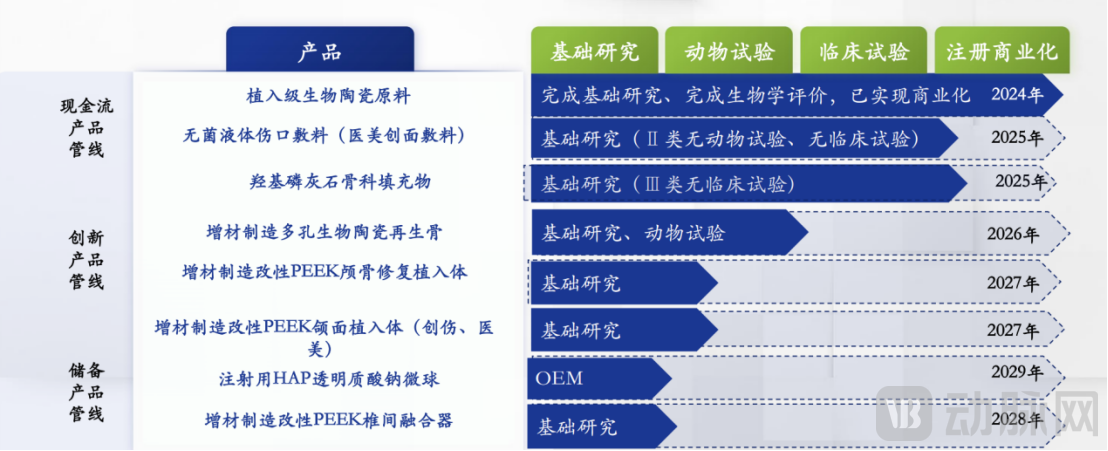
Currently, Mylon Medical positions itself as a provider of customized composite material solutions for tissue regeneration. This positioning is precisely because its core technologies—multi-material compatibility and multi-nozzle ceramic powder printing—support a diversified product portfolio spanning orthopedics and medical aesthetics. The development of this cross-disciplinary technological platform has enabled Mylon Medical to achieve short- and long-term complementarity between biomaterials and medical devices, driven by the dual engines of serious healthcare and consumer healthcare.
Not content with merely supplying raw materials, Mylon Medical has developed innovative products that meet both standardized regulations and customized needs. Leveraging its existing technology platform, Mylon Medical has launched the market’s only additively manufactured cranio-maxillofacial product, with promising prospects for expanding indications; as well as additively manufactured regenerative bone products, which are projected to generate annual revenues exceeding RMB 1 billion post-launch, assuming a 10% market penetration rate.
Notably, advancements in regenerative materials and minimally invasive techniques will propel regenerated cranio-maxillofacial bone into the mainstream. With growing demand for medical aesthetics and comprehensive maxillofacial bone reconstruction, regenerative cranio-maxillofacial products have become essential, unlocking a market potential worth tens of billions.
It is worth noting that additive manufacturing-based medical aesthetic products and orthopedic medical devices are excluded from centralized volume-based procurement (VBP). Furthermore, at the policy level, the development and application of biomedical materials and additive manufacturing technologies have been encouraged by the state. In October 2022, the National Healthcare Security Administration issued a market access policy of “one product, one strategy” for innovative products such as 3D-printed orthopedic consumables, thereby safeguarding, to a certain extent, the revenue potential of additive regenerative products.
“Our additive manufacturing-based bio-ceramic technology for bone regeneration has been validated through preclinical studies, with existing animal trials demonstrating excellent outcomes,” stated Mylon Medical. “We are poised to become the first company in China to obtain Class III medical device certification for an additively manufactured product.” Mylon Medical also has a regenerative aesthetic injectable product based on polyhydroxyalkanoates (PHA) in its pipeline, showing promising application prospects. The company is currently seeking financing to further commercialize its products and solidify its position as a leader in the additive manufacturing industry.