

Zhongke Hongtai's Multi-Channel Vascular Interventional Surgical Robot Enters NMPA Innovation Green Channel
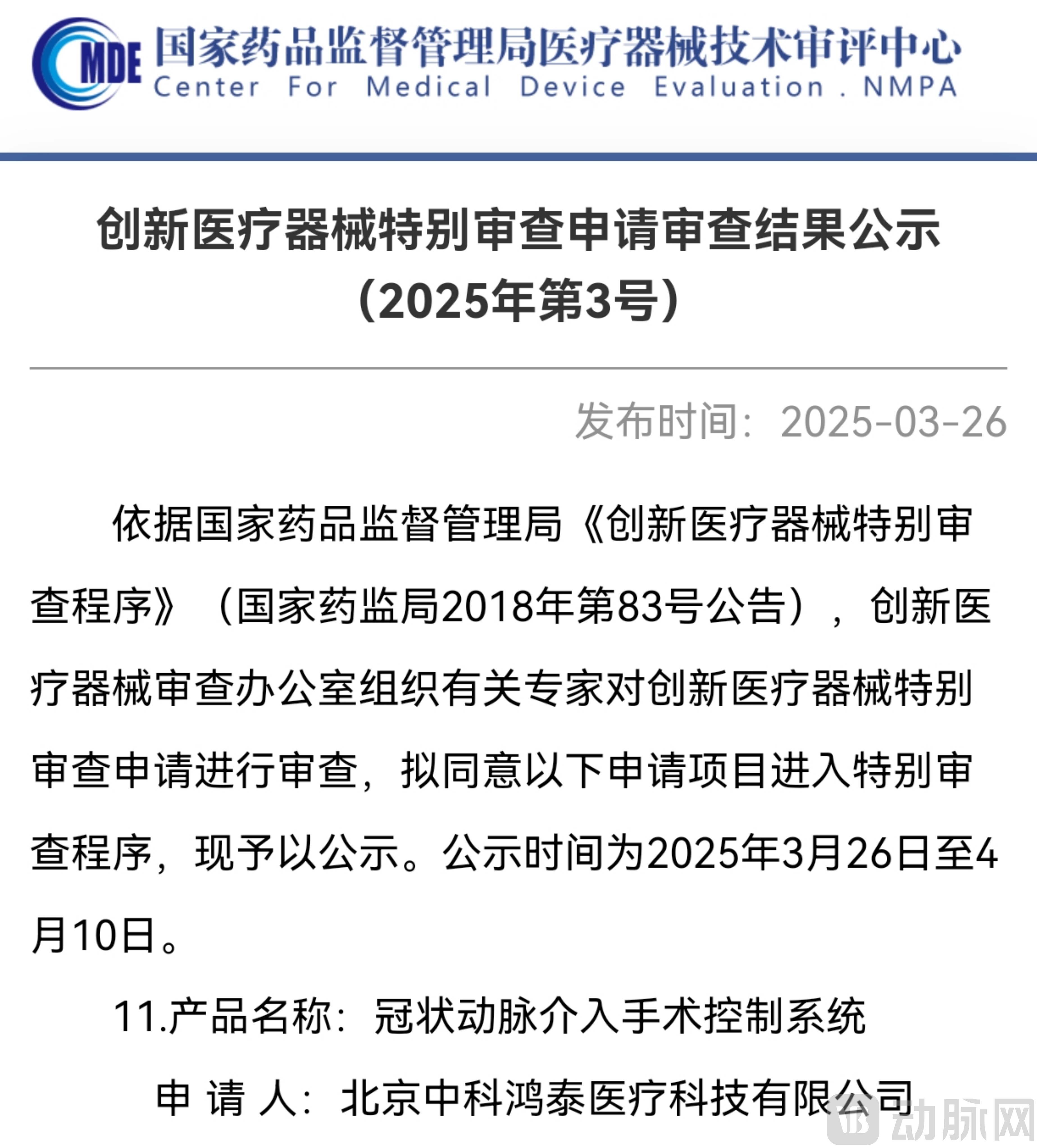
Recently, the vascular interventional surgical robot (product name: Coronary Intervention Surgical Control System), independently developed by Beijing Zhongke Hongtai Medical Technology Co., Ltd. (hereinafter referred to as “Zhongke Hongtai”), has passed the review of the National Medical Products Administration,Officially Entered the Special Review Procedure for Innovative Medical Devices (“Green Channel”)This breakthrough not only signifies that the innovative technology and clinical value of Zhongke Hongtai’s vascular interventional surgical robot have gained high recognition within the industry, but will also accelerate the product’s market launch, propelling vascular interventional surgical robots toward practical clinical application.
This system addresses numerous critical pain points of current vascular interventional surgical robots, such as the inability to simultaneously control multiple interventional devices, limitation to simple procedures, capability restricted to assisting only with angiography or partial steps of interventional surgeries, insufficient compatibility with interventional devices and procedures, lack of force feedback, and operational complexity, thereby achieving significant innovative breakthroughs.
It is reported that,Zhongke Hongtai’s vascular interventional surgical robot is the world’s first pan-vascular interventional surgical robot featuring multi-channel, multi-instrument coordinated delivery, coverage of both simple and complex lesion treatments, closed-loop force sensing and haptic feedback, and full-process assistance for angiography and surgical procedures.
1The founding team hails from the Institute of Automation, Chinese Academy of Sciences, bringing nearly two decades of interdisciplinary research experience in medicine and engineering, along with numerous pioneering research achievements.
The founding team of Zhongke Hongtai hails from the State Key Laboratory of Multimodal Artificial Intelligence Systems at the Institute of Automation, Chinese Academy of Sciences (CASIA). As the national flagship institution for robotics and artificial intelligence research, CASIA has consistently remained at the global forefront in a series of cutting-edge international fields, including medical robotics, humanoid robots, large AI models, and brain-computer interfaces.
Professor Hou Zengguang, Founder, Chairman, and Chief ScientistHe is the leader of the "Medical Robot Cluster," a 2035 Innovation Task of the Institute of Artificial Intelligence, Chinese Academy of Sciences. A recipient of the National Science Fund for Distinguished Young Scholars and an IEEE/CAA Fellow, he currently serves as Vice President of the Asia Pacific Neural Network Society and Vice Chairman of the Chinese Association of Automation. He also serves on the editorial boards of several international journals, including *Neural Networks* and *IEEE Transactions on Cybernetics*. His primary research interests include computational intelligence and intelligent systems, as well as medical robotics. He has received numerous awards, such as the Outstanding Contribution Award from the Asia Pacific Neural Network Society, the Second Prize of the National Natural Science Award, and the First Prize of the Beijing Natural Science Award.
The team has accumulated nearly 20 years of research expertise in the field of vascular interventional surgical robots, pioneering such research in China and achieving multiple groundbreaking results:
● In 2008, collaborated with multiple hospitals and universities across China to undertake the country’s first National 863 Program project in this field;
● Successively undertook major national research projects, including the National Key R&D Program and key projects funded by the National Natural Science Foundation of China;
● Developed China’s first prototype of a vascular interventional surgical robot and secured the first invention patent for the technology;
● Conducted the first animal experiment in China to validate robot-assisted coronary intervention surgery;
● Conducted the world’s first animal experiment of fully autonomous robotic interventional surgery under image navigation;
● Conducted the world’s first 5G-enabled remote complex Culotte dual-stent procedure in an animal experiment;
● Conducted nearly ten robot-assisted clinical validations for human scientific research;
● Conducted the first live-streamed remote coronary intervention surgery at the opening ceremony of a major domestic academic conference on cardiovascular diseases;
2Multidimensional Empowerment from Research, Clinical Practice, Capital, Industry, and Policy Accelerates the Rapid Translation of Innovative Achievements
As a technology transfer enterprise spun off from the Institute of Automation, Chinese Academy of Sciences (CAS), Zhongke Hongtai has secured tens of millions of RMB in angel-round financing from market-oriented investment institutions (Jinke Junchuang Capital) and industrial investors (Beijing Medical Robot Industry Innovation Center). The company’s collaborating clinical experts hail from top-tier medical institutions specializing in interventional medicine, including Fuwai Hospital, Huadong Hospital, Xuanwu Hospital, and Peking Union Medical College Hospital.
Benefiting from the synergistic support of scientific research, clinical practice, capital, industry, and policy, the company has achieved rapid business growth. Its products have currently entered the regulatory clinical trial process and are poised for accelerated approval and market launch under the support of the NMPA’s Innovative Medical Device Special Review Channel. To date, the company has secured over 100 independent intellectual property rights, taken the lead in undertaking the latest round of National Key R&D Program projects, and been featured in a special edition of Nature. It has also received numerous honors and industry recognitions, including the Runner-up Award in the Medical Device Category of the Zhongguancun Frontier Technology Competition and the First Prize in the China Medical Device Innovation and Entrepreneurship Competition. Furthermore, the company has been accredited as a National High-Tech Enterprise and as a “Specialized, Refined, Differential, and Innovative” (SRDI) Small and Medium-sized Enterprise.
3Addressing Clinical Needs and Industry Pain Points: Multiple Original Technologies Lead the Way in Innovation
Leveraging the founding team’s pioneering research in vascular interventional surgical robotics and nearly two decades of technological accumulation, Zhongke Hongtai has independently developed the world’s first multi-channel pan-vascular interventional surgical robot. Compatible with mainstream interventional devices and complex interventional procedures, and equipped with proprietary dedicated consumables, the company is committed to creating an integrated smart catheterization laboratory solution that spans multiple departments, diverse procedural types, and the entire clinical workflow, combining diagnosis and treatment. This innovation aims to simplify complex surgeries, standardize routine procedures, and digitalize and intelligently optimize surgical workflows, thereby facilitating the decentralization of high-quality medical resources and benefiting a broad patient population.
Currently, by developing multiple proprietary technologies, the Zhongke Hongtai vascular interventional surgical robot has achieved significant breakthroughs in surgical safety and precision, coverage of procedural types, physician operational experience, and the integration of surgical robots with AI, all based on a precise understanding of clinical needs and industry pain points.
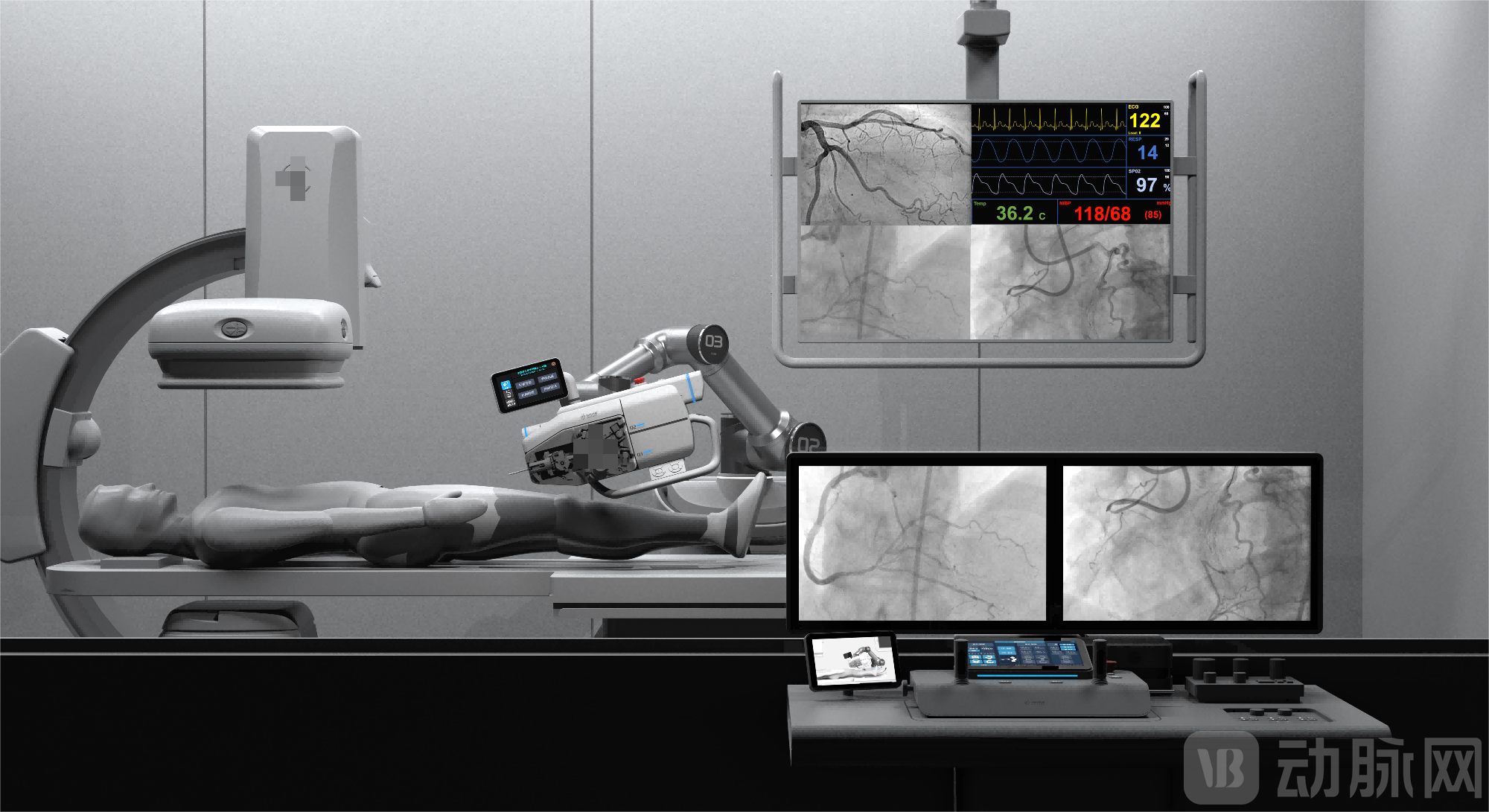
Zhongke Hongtai Vascular Interventional Surgical Robot
Comprehensively Enhance Surgical Precision, Safety, and Scope of Application:
● Supports “pan-vascular” interventional procedures, covering a wide range of techniques: supports coronary, neurovascular, peripheral, and oncological interventions, with gradual expansion into electrophysiology and structural heart disease interventions.
● “Multi”-channel, multi-device coordination: Physicians can simultaneously manipulate two guidewires and two balloon/stent catheters, providing comprehensive coverage for interventional treatment of both simple and complex lesions, significantly reducing the operational difficulty of complex procedures and improving surgical efficiency;
●“Precise” and Agile Control: Featuring a proprietary bionic finger design that fully replicates the simultaneous rotation and push-pull maneuvers of a physician’s fingers, achieving sub-millimeter delivery precision to significantly enhance the accuracy, dexterity, and stability of instrument manipulation; synchronized control of catheters and guidewires by both hands greatly improves delivery efficiency.
● "True" closed-loop force feedback: Precisely senses the interaction forces between instruments and tissues and reproduces them in real time to the surgeon's fingers, enhancing surgical presence during compartmentalized or 5G-enabled remote teleoperation, ensuring the safety of complex procedures while preserving the surgeon's tactile sensation;
Key Focus: Operational Experience and Surgical Efficiency
● “Full”-process assistance: The robot provides end-to-end support, starting from sheath insertion and encompassing catheter delivery, hook-wire engagement, guidewire/balloon/stent delivery, automated angiography, balloon inflation, and stent deployment. The same system supports both diagnostic angiography and interventional procedures, thereby reducing operational complexity for the primary surgeon and assistant, and minimizing medical staff involvement.
● Rapid learning curve: Maximizes compatibility with physicians’ existing workflows, enabling quick proficiency after brief training; users can master all operations after just one or two animal experiments, resulting in a short learning curve.
● High Compatibility: Compatible with various guidewires, catheters, balloon/stent catheters, microcatheters, and intravascular imaging devices; adapts to all mainstream DSA operating tables; setup can be completed by a single person within minutes.
● “Soft” Force Control Adjustment: The 6-DOF robotic arm employs a full force control algorithm, enabling slave-end positioning and intraoperative adjustments via single-hand dragging, thereby reducing surgical time and improving operational efficiency.
Integrating Surgical Robots with AI to Enhance the Digital and Intelligent Level of Surgery and Expand Clinical Boundaries
The Zhongke Hongtai Vascular Interventional Surgical Robot will serve as the surgical control and intelligence hub, integrating multimodal data such as medical imaging, surgical video, voice, and instrument manipulation. By leveraging multimodal large AI models, it continuously learns from the expertise of senior physicians, reduces procedural complexity, and comprehensively enhances the level of intelligence in interventional surgeries.
4About Zhongke Hongtai
Zhongke Hongtai is a technology transfer enterprise incubated and established by the Institute of Automation, Chinese Academy of Sciences. It was founded by a team of scientists led by Hou Zengguang, an internationally renowned expert in the fields of medical robotics and artificial intelligence and a researcher at the Institute of Automation, Chinese Academy of Sciences.
The Company is recognized as a National High-Tech Enterprise and a “Specialized, Refined, Differential, and Innovative” SME. It has received numerous awards, including the Chinese Academy of Sciences Award for Achievement in Transformation of Scientific and Technological Achievements and the First Prize in the China Medical Device Innovation and Entrepreneurship Competition. The Company has taken the lead in undertaking major scientific research projects, such as the National Key R&D Program and the Beijing Municipal Science and Technology Program. It has participated in the formulation of multiple industry standards and group standards, and its achievements have been featured in a special edition of the prestigious international academic journal Nature.