

Medical Aesthetics Ingredient Suppliers Spark an 'Offline Flagship Store Rush'
An increasing number of upstream medical aesthetics companies are beginning to establish offline flagship stores.
In 2024, Comfy, a brand under Giant Biogene, opened its first flagship store in China at Chongqing MixC and launched a brand experience store at CDF Sanya International Duty Free City; Rellet, a brand under Freda Bio, opened its first offline store in China at the Mingshui Ancient City in Jinan; Voolga opened its first offline store in China at Harbin Airport; and UNISKIN, a brand under Yinaibiologics, opened its first directly operated offline store in China in Shanghai...
In addition, leading companies such as Botanee and Bloomage Biotech are also accelerating their expansion into offline direct-sales channels. For instance, AOXMED, the high-end skincare brand under Botanee Group, and Winona, its dermocosmetic skincare brand, have both opened multiple offline flagship or experience stores. Bloomage Biotech’s Biohyalux brand is continuing its expansion: in October 2024, the Biohyalux flagship store opened at Qingdao MixC.
Why Are Upstream Medical Aesthetics Companies Accelerating Their Expansion into Offline Direct-Operated Stores? What Is the Impact of These Channel Shifts? How Does This Current Wave of “First Offline Store” Openings Differ from Previous Beauty Brand Store Expansions?
To date, medical aesthetics companies originally positioned upstream—such as Bloomage Biotech, Giant Biogene, Botanee, Freda Biopharm, and Fu'erjia—have all launched consumer-facing skincare products and brands. For instance, Bloomage Biotech has developed functional skincare products featuring hyaluronic acid as their key selling point, introducing brands such as Biohyalux, Medrepair, BM Active, and QuadHA. Similarly, Giant Biogene has developed skin care products centered on recombinant collagen, launching brands like Comfy and Collgene.
As the industry continues to evolve, the sales channels of upstream medical aesthetics companies are undergoing continuous changes. Initially, these upstream enterprises primarily targeted B-end markets such as medical aesthetics institutions. Later, they gradually expanded online to directly reach C-end consumers, adopting a dual-channel strategy. To date, upstream medical aesthetics companies have begun establishing offline flagship stores, thereby creating a diversified channel layout.
In the past few years, launched by these upstream medical aesthetics companiesEmerging beauty brands rapidly leverage top-tier livestreamers and e-commerce channelsImplementation"From 0 to 1". For example, in 2018, QuadHA, a high-end brand incubated and launched by Bloomage Biotech, rose to instant fame through Li Jiaqi and e-commerce platforms such as Taobao and Tmall.
Specifically, QuadHA made its debut on Li Jiaqi’s livestream channel in 2020, achieving not only explosive sales but also significant brand breakthrough beyond its core audience. Subsequently, the brand’s sales revenue surged: in 2021, QuadHA generated approximately RMB 980 million in revenue, becoming another skincare brand under Bloomage Biotech to reach the RMB 1 billion milestone. Notably, its sales during Li Jiaqi’s 2021 Singles’ Day (Double 11) livestream session amounted to around RMB 334 million, accounting for approximately 34% of its total annual sales.
Not only QuadHA, but all four skincare brands under Bloomage Biotech have appeared in the live-streaming rooms of top influencers such as Li Jiaqi and Viya during major promotional events like Double 11 and 618, achieving explosive sales and expanding their brand reach beyond traditional consumer segments.
Additionally, Botanee achieved explosive sales through its collaboration with Li Jiaqi. During the 2021 Double 11 Shopping Festival, four products from Winona, Botanee’s dermocosmetic skincare brand, were featured in Li Jiaqi’s live-streaming room. Among them, the freeze-dried mask alone generated RMB 71.4602 million in sales, accounting for half of Winona’s annual sales of this product. On the first day of pre-sales for the 2022 Double 11 Shopping Festival, the gross merchandise value (GMV) of Winona products sold in partnership with Li Jiaqi exceeded RMB 1 billion.
Giant Biogene’s Comfy brand has made multiple appearances in Viya’s livestream room. During the 2021 Singles’ Day pre-sale period, Comfy ranked among the top five brands by sales volume in Viya’s livestream. On Singles’ Day itself, promoted by Viya, Comfy achieved a cumulative gross merchandise value (GMV) exceeding RMB 100 million within just 13 minutes.
With the support of top-tier influencers and e-commerce channels, emerging brands launched by upstream medical aesthetics companies can often rapidly boost sales volume and build brand awareness. However,This has also led to "dependence on top-tier live-streamers.". If emerging brands fail to re-enter the livestreaming rooms of top-tier influencers, or if their collaborating top-tier influencers become embroiled in public relations controversies, the revenue of related products will decline sharply. For instance, Florasis, which was deeply tied to Li Jiaqi, saw its sales plummet following his controversial remark, “Where is it expensive?”
Meanwhile, the collaboration fees for top-tier live-streamers are also rising, making it increasingly difficult for emerging brandsSignificant Increase in Online Promotion Expenses,Profit Margins Continue to Decline. For example, from 2019 to 2022, Bloomage Biotech’s skincare business experienced a surge driven by top-tier live-streaming influencers. This was accompanied by a concurrent spike in sales expenses and a significant decline in net profit margin.
From 2019 to 2022, Bloomage Biotech’s gross profit margin remained stable at 80%, while its net profit margin declined steadily from 31% to 15.12%. The significant drop in net profit margin was primarily driven by selling expenses. During the same period, Bloomage Biotech’s selling expenses amounted to RMB 521 million, RMB 1.099 billion, RMB 2.436 billion, and RMB 3.049 billion, respectively, representing an approximately six-fold increase in 2022 compared to 2019. Notably, online promotion service fees surged from RMB 104 million in 2019 to RMB 1.722 billion in 2022, a cumulative increase of roughly 17 times, with their share of total selling expenses rising from 19.98% to 56.48%.
Today, upstream medical aesthetics companies that once benefited from the boom in live-streaming e-commerce are facing challenges such as increasingly expensive traffic, rising online customer acquisition costs, and live-streaming sales falling short of expectations. In its 2023 annual report, Botanee noted that the sales performance of its Double 11 online promotional campaigns failed to meet expectations due to an increase in per-customer acquisition costs for self-operated stores across various online platforms.
For upstream companies in the medical aesthetics industry, leveraging top-tier live-streamers can facilitate rapid user acquisition and scale expansion in the early stages. However, as brands mature, they must pursue diversified channel development to break through growth ceilings.
Amid the influence of multiple factors, an increasing number of upstream medical aesthetics brands are turning their attention to offline channels.。
Since 2021, upstream medical aesthetics brands have begun attempting to overcome their “reliance on live-streamers” by expanding offline channels.
For example, Bloomage Biotech’s Biohyalux brand has entered nearly 1,000 Watsons stores across China, as well as high-end new retail physical chains such as Yanli and Hema Fresh; QuadHA has opened offline counters in shopping malls including Intime, Wanda Plaza, and The MixC; Botanee’s brand Winona has seen a significant surge in sales through OTC channels and has entered leading chain beauty retail channels such as Sam’s Club, Watsons, China Duty Free (CDF), Yanli, and The Colorist.
Among them, Freda Biotechnology launched its “Offline Channel Benchmark Leadership Strategy” in 2023. As of October 2024, Freda Biotechnology had entered a cumulative total of over 13,802 stores. In addition to CS channels (cosmetics stores) and trendy boutiques, it operates 500 single-brand stores.
In October 2024, Freda Biopharm announced a comprehensive upgrade of its offline business strategy to2025 Online-Offline Integrated Growth Strategy,By leveraging the “5+N” technology matrix, multi-brand operations for brand development, and the integration of diverse business formats through the dual-beauty model of “life beauty + medical aesthetics,” supported by an industry-wide framework rooted in the shared origins of cosmetics and pharmaceuticals and technology-driven skincare, we aim to achieve online-offline integration with extensive market penetration and comprehensive coverage, striving to surpass RMB 1 billion in offline sales scale.
It is worth mentioning that,In addition to department stores, supermarkets and hypermarkets, counters, small beauty product collection stores, pharmacies, etc.Traditional OfflineChannel, Medical AestheticsUpstream EnterprisesAt this stage, the company is also accelerating the development of offline flagship stores, specialty stores, and experience centers.。
In June 2024, Comfy, the flagship brand under Giant Biogene, opened its first nationwide flagship store. Previously, it had launched its first standard store in China at Wangfujing Department Store in Xi’an in November 2023. To date, Comfy has established approximately 18 stores in shopping malls across key cities such as Xi’an, Chongqing, Chengdu, and Sanya, featuring various store formats including flagship and standard stores, while continuously refining its offline operational strategies.
In September 2024, Rellet, a brand under Freda Biopharm, opened its first offline store in China. The flagship store is located in the Mingshui Ancient City in Jinan, Shandong Province, incorporating numerous ancient cultural elements to create a strong traditional Chinese aesthetic. It is reported that Rellet is exploring a new consumer model integrating shopping, leisure, and cultural experiences. Meanwhile, Dr. Alva, another brand under Freda Biopharm, is accelerating its offline expansion, with the number of its directly operated and franchised stores exceeding 500.
In addition, Voolga’s first offline store in China opened at Harbin Airport; AOXMED, the premium brand under Botanee, launched its first nationwide offline counter at Beijing Hansheng Department Store; Uniskin, a brand under Yinai Biotechnology, opened its first directly operated offline store in Shanghai; and Bloomage Biotech’s self-developed personalized customization store workstation was deployed at the Runbaiyan flagship store in Qingdao.
According to the analysis, the establishment and implementation of offline flagship stores have driven sales and revenue growth for various brands.For example, Giant Biogene generated RMB 5.538 billion in revenue in 2024, a year-on-year increase of 57.2%. Of this,Offline direct sales channels reached RMB 170 million, a year-on-year increase of 92%.。
Previous financial reports indicate that Giant Biogene’s offline direct sales channels in 2023 primarily consisted of chain pharmacies, cosmetics chain stores, and other offline direct customers. In 2024, sales revenue from these offline direct channels surged. This growth was driven, on one hand, by Giant Biogene’s establishment of flagship stores, standard stores, and experience centers for its Comfy brand, which expanded sales touchpoints and boosted revenue; on the other hand, it resulted from an increase in the number of stores and product coverage among direct clients such as offline chain retailers.
For another example, under Freda BiopharmRellet and Dr. Alva Achieved Cumulative Offline Sales of Nearly RMB 300 Million in 2024。
It is foreseeable that as the first batch of upstream medical aesthetics companies reap the benefits from their offline flagship store channels, an increasing number of enterprises are expected to follow suit.
For the sales of beauty products, offline channels include department stores, shopping malls, cosmetics stores, beauty salons, pharmacies, and flagship stores.
Compared to other offline channels,Offline flagship stores play an irreplaceable role.Specifically, fashion department stores and beauty product collection stores primarily operate on a self-service shopping model, whereas traditional retail malls and specialty cosmetics stores rely mainly on sales assistants. These channels boast a large number of widely distributed outlets and carry a diverse range of brands, including international luxury brands, popular Japanese and Korean brands, and domestic Chinese brands. In contrast, the beauty salon and pharmacy channels leverage advantages such as professionalism, credibility, and expert endorsements, making them more effective in selling cosmeceuticals and skin management products.Offline flagship stores are brand-operated channels under direct brand management, enabling a more comprehensive presentation of the brand image, product portfolio, professional services, and brand philosophy.。
For example, the first flagship store opened by Comfy, a brand under Giant Biogene, features a white-and-blue color scheme in its interior design, complemented by bio-elements such as recombinant collagen, to create an atmosphere that is professional, technological, artistic, and futuristic, thereby better showcasing the brand image. The store also displays various best-selling products from the brand’s online channels, providing a comprehensive presentation of its product portfolio and brand philosophy.
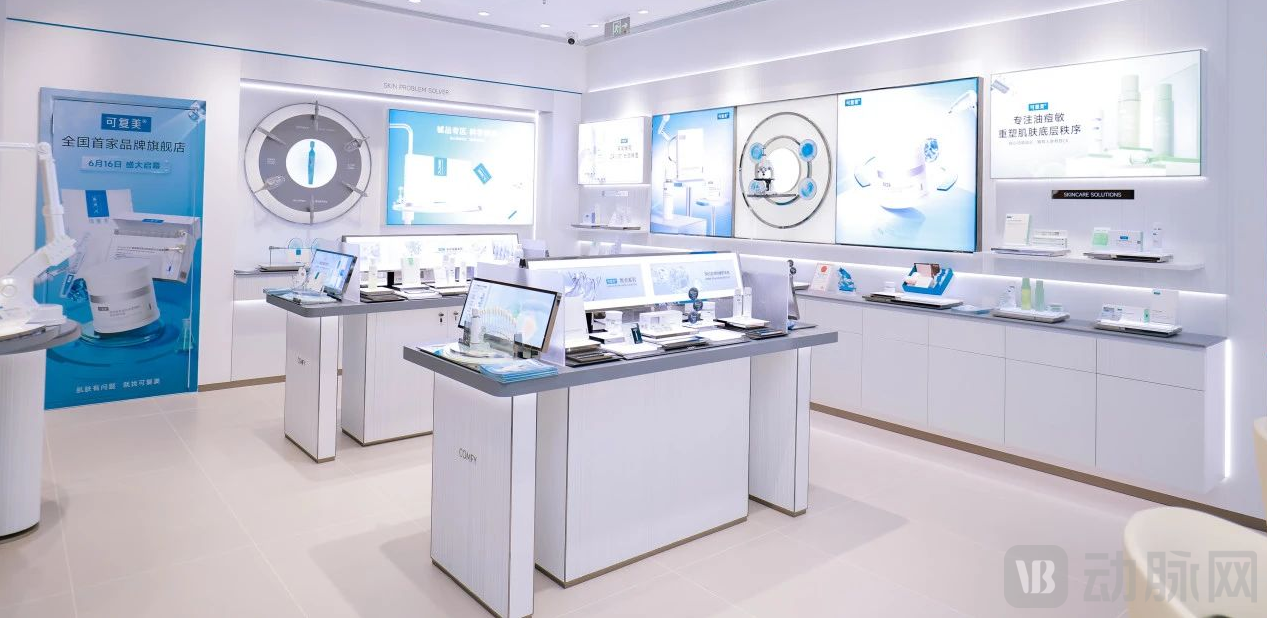
(On-site photo of the Kefumei Flagship Store)
Additionally, offline flagship stores offer unique advantages over online e-commerce channels. In these physical locations, brands can provide product trials, professional skin assessments, and personalized consultation services. Face-to-face interactions and the immediate gratification afforded by the offline experience enhance consumer trust and brand recognition.
Offline flagship stores of brands such as Rellet, Runbaiyan, and Comfy often provide skincare experience zones, professional beauty treatment rooms, skin analysis, and skincare consultation services. Consumers can try products and receive one-on-one facial treatments. Furthermore, staff explanations and offline interactions help enhance consumer brand awareness, increase brand appeal, drive sales, and strengthen consumer satisfaction and loyalty.
To date, companies such as Bloomage Biotech, Giant Biogene, Freda Biopharm, Fu Er Jia, and Botanee have all launched offline flagship stores for their cosmetics brands. However, the strategic approach and rationale behind opening physical retail outlets differ between upstream medical aesthetics enterprises and traditional cosmetics brands like Proya.
Specifically, traditional beauty brands open offline stores with a channel-oriented mindset, whereas upstream medical aesthetics companies establish offline flagship stores with a brand-oriented mindset. Compared to the extensive offline presence of traditional beauty brands, the number of offline flagship or directly operated stores run by upstream medical aesthetics enterprises remains relatively small, exerting limited influence across various distribution channels.
Meanwhile, offline stores opened by traditional beauty brands primarily serve as sales channels; in contrast, offline flagship stores established by upstream medical aesthetics brands not only facilitate product sales but also play a more significant role in brand promotion, capturing online traffic, and driving customer acquisition to online platforms.
For example, brands such as Comfy, Rellet, and Fu'erjia have expanded their brand influence through initiatives like flagship store launches, enhancing brand awareness and favorability to drive sales and revenue growth.
Currently, an increasing number of upstream medical aesthetics brands have evolved from focusing primarily on online channels to becoming mature brands with integrated online and offline distribution. This transition is expected to further enhance the competitiveness of beauty brands under upstream medical aesthetics companies and unlock new avenues for growth.