Alibaba's DAMO PANDA AI Model Receives FDA Breakthrough Device Designation for Pancreatic Cancer Early Screening
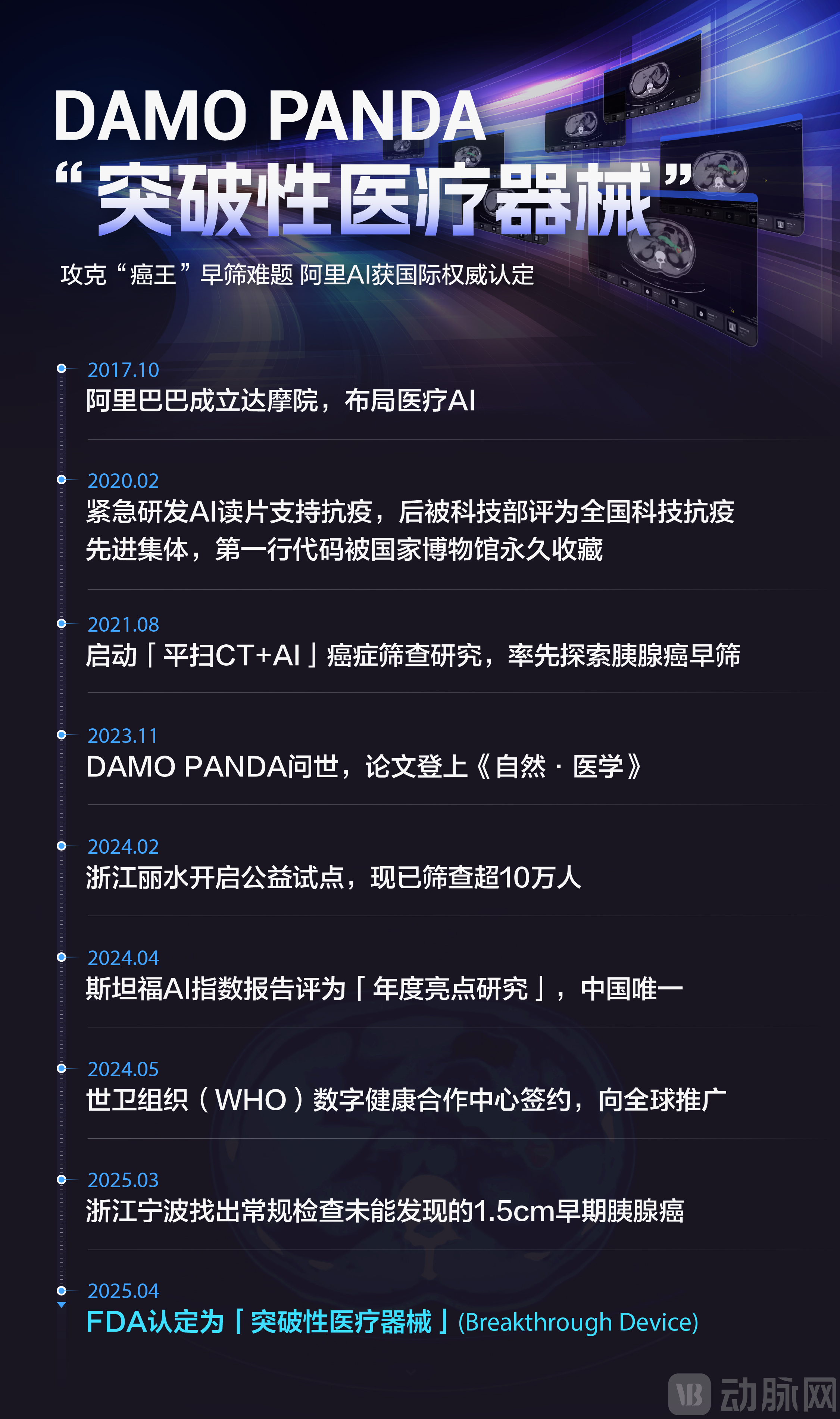
April 17 News: Alibaba’s AI Model DAMO PANDA Granted “Breakthrough Device” Designation by the FDA. DAMO PANDA is an AI model for pancreatic cancer screening developed by Alibaba’s DAMO Academy. It can accurately identify subtle lesions in non-contrast CT scans, overcoming the international challenge of early pancreatic cancer screening. This marks the first time a leading Chinese technology company has received this prestigious recognition.
Since 2016, the U.S. Food and Drug Administration (FDA) has established the “Breakthrough Device Designation” (BDD) to address serious diseases that threaten human health and to encourage the development of innovative medical technologies. For devices granted this designation, the FDA accelerates the review process to ensure that patients and healthcare institutions can access the most advanced diagnostic and therapeutic tools as soon as possible.
DAMO Academy pioneered the “non-contrast CT + AI” pancreatic cancer screening technology, which leverages AI to detect subtle lesions in non-contrast CT images that are difficult for the human eye to discern. In collaboration with multiple leading medical institutions worldwide, it developed DAMO PANDA, achieving the first large-scale early screening for pancreatic cancer globally, with sensitivity and specificity reaching 92.9% and 99.9%, respectively. The related study was published in the prestigious international journal Nature Medicine, which hailed it as “poised to usher in a golden age of imaging AI for cancer screening.”
Pancreatic cancer is known as the “king of cancers” and is the malignant tumor with the highest mortality rate. One of the primary reasons for this is the extremely low rate of early diagnosis, with over 80% of patients diagnosed at an advanced stage. Globally, the incidence of pancreatic cancer is showing a rapid upward trend and affecting younger populations. Early screening and diagnosis will not only significantly improve patient survival rates but also reduce their economic burden and suffering.
DAMO PANDA enhances the detection rate of early-stage pancreatic cancer through a non-invasive approach, making it particularly suitable for “opportunistic screening” scenarios where patients undergo non-contrast CT scans during routine health check-ups or clinical visits for other conditions. In May 2024, DAMO Academy was invited to share this technological achievement at the United Nations AI for Good Summit and entered into a collaboration with the WHO Collaborating Centre on Digital Health, aiming to support more developing countries in their fight against cancer.
Currently, DAMO PANDA is undergoing pilot research trials at multiple sites across China. For instance, Ningbo University Affiliated People’s Hospital has screened over 40,000 individuals, with the AI system identifying two cases of early-stage pancreatic cancer that were missed by routine examinations. In one of these cases, the lesion measured only 1.5 cm, and the patient subsequently underwent surgical treatment. Alibaba’s DAMO Academy will collaborate with medical industry partners, such as Ankon Technologies, to further promote this AI model both domestically and internationally.
It is reported that the DAMO Academy has prioritized medical AI since its inception and was recognized by the Ministry of Science and Technology as an Advanced Collective in National Scientific and Technological Epidemic Prevention and Control. The Academy has actively explored “multi-disease screening from a single scan,” which involves identifying multiple cancers and other diseases through a single non-contrast CT scan. It has achieved a series of research breakthroughs in high-incidence cancers such as pancreatic, esophageal, gastric, colorectal, and liver cancers; chronic conditions including osteoporosis and fatty liver disease; and acute conditions such as aortic syndromes. Related findings have been published in leading international journals, including Nature Medicine and Nature Communications, as well as presented at top academic conferences such as CVPR, MICCAI, and IPMI.