

ShanghaiTech's Zhong Guisheng Team Develops ARBITER: A Novel In Vivo Transcriptional Enhancer Reconstruction Platform for Precision Gene Therapy of Hereditary Deafness
On April 21, the research group led by Professor Zhong Guisheng at the iHuman Institute of ShanghaiTech University published a study titled “Deciphering enhancers of hearing loss genes for efficient and targeted gene therapy of hereditary deafness” in the international academic journal Neuron. The team proposed and validated an innovative in vivo transcriptional enhancer reconstruction technique called ARBITER (AAV reporter-based in vivo transcriptional enhancer reconstruction). This breakthrough not only opens new avenues for basic cochlear research but also demonstrates significant potential in elucidating the underlying mechanisms of gene expression regulation and advancing precision gene therapy for hereditary deafness.
Whether for basic scientific research or clinical therapy, achieving precise, targeted regulation of disease-related genes within complex microenvironments such as the cochlea has long remained a major challenge in the field of hereditary hearing loss treatment. The ARBITER system, uniquely developed by Zhong Guisheng’s team, combines viral vectors with high-throughput in vivo enhancer screening to successfully identify and optimize specific enhancers for core deafness-related genes, including Slc26a5. The study revealed that these conserved non-coding sequence enhancers act as precise “conductors,” capable of specifically driving high-level expression of critical proteins in outer hair cells, thereby providing a molecular “switch” for restoring sensory cell function.
The most significant highlight of this technology lies in its ability to achieve targeted delivery and precise expression of different types of hair cells within the cochlea, effectively overcoming previous challenges associated with viral delivery, such as off-target effects, safety concerns, and high dosage requirements. ARBITER not only efficiently identifies key enhancers, such as Slc26a5 and Atoh1, but also demonstrates broad applicability, providing a novel technical foundation for targeted expression in outer hair cells and other cochlear cells. This advancement greatly enriches our understanding of gene regulatory mechanisms in the inner ear and holds promising prospects for future applications in treating various types of hearing loss and even other genetic disorders.
This study not only validated the conservation and cross-species efficacy of reconstructed enhancers in model animals such as tree shrews, but also significantly restored hearing function in deaf mice by optimizing enhancer sequences and delivery tools. Its characteristics of low dosage and high specificity are expected to substantially reduce treatment risks and costs, benefiting hearing-impaired patients worldwide.
The establishment of the ARBITER system not only marks a significant breakthrough in basic cochlear research but also brings tangible therapeutic hope to patients with hereditary deafness. Demonstrating superior advantages in innovation, rigor, and clinical potential, it opens up an entirely new pathway for gene therapy targeting hereditary deafness. Furthermore, it provides a viable strategy for extending gene therapy applications to support cells, diverse genetic backgrounds, and more complex disease models. In addition, the ARBITER approach facilitates a deeper understanding of the regulatory interactions between non-coding sequences and transcription factors, thereby opening a new window for research into human development and disease.
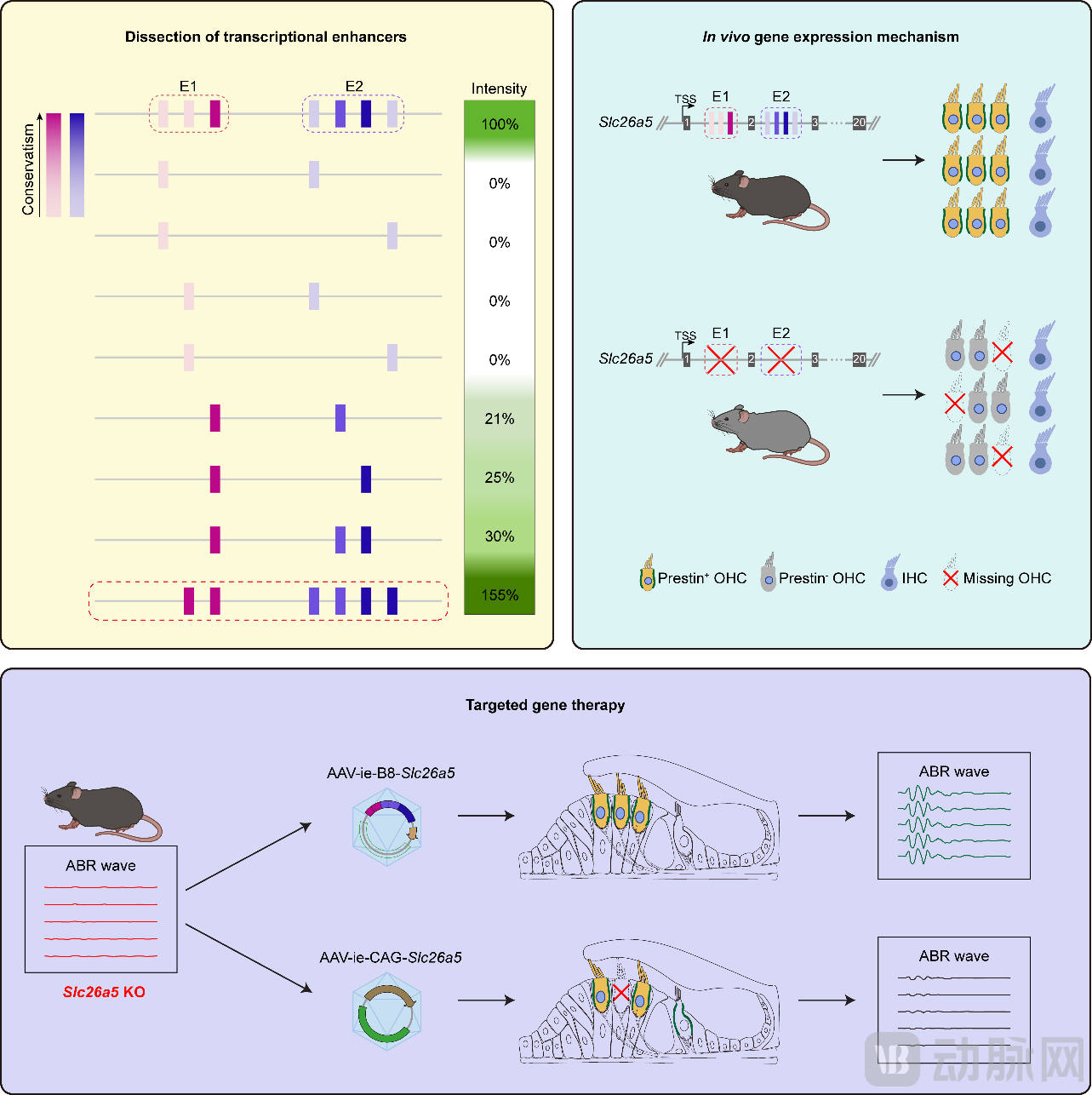
The ARBITER system was utilized to dissect and reconstitute the regulatory enhancers of Slc26a5. The critical role of these enhancers in gene regulation was validated using in vivo knockout mouse models. Ultimately, the engineered cell-specific enhancers were employed for precise gene delivery, successfully restoring hearing in mice with hereditary deafness.
Si-Meng Zhao, Associate Researcher at the iHuman Institute of ShanghaiTech University; Qiuxiang Yang, a Ph.D. candidate (Class of 2021) in the School of Life Science and Technology; and Zehua Yu, a Ph.D. candidate (Class of 2022) in the same school, are co-first authors of this paper. Gui-Sheng Zhong, Principal Investigator at the iHuman Institute and Tenured Associate Professor in the School of Life Science and Technology, and Si-Meng Zhao are co-corresponding authors. The tree shrew model research was supported by Dr. Yong-Gang Yao, Principal Investigator at the Kunming Institute of Zoology, Chinese Academy of Sciences. This study also benefited from the guidance of Dr. Yong-Gang Yao. Zhao-Bo Lin and Han-Hui Ma, both Tenured Associate Professors in the School of Life Science and Technology at ShanghaiTech University, provided key suggestions for the design and implementation of the project. ShanghaiTech University is the primary affiliated institution.
A study published in *Neuron* by Professor Zhong Guisheng’s team at the iHuman Institute of ShanghaiTech University demonstrates the breakthrough potential of the ARBITER system. This significant work not only holds promise for gene therapy for hearing loss but also offers valuable insights for treating other tissue-related diseases. By precisely screening conserved non-coding elements (CNEs), ARBITER drives high-level expression of Slc26a5 in cochlear hair cells, significantly restoring hearing in deaf mice and providing an efficient tool for gene therapy for hearing loss. Its systematic approach reveals the combinatorial rules of CNEs, setting a new benchmark for inner ear gene therapy and surpassing the current instability associated with OTOF treatments. Meanwhile, the application of ARBITER can be explored in supporting cells (such as GJB2-expressing cells) to broaden the scope of hearing loss treatment; computational models can be integrated to optimize CNE screening and accelerate enhancer development; and the regulatory mechanisms between CNEs and transcription factors can be investigated to deepen our understanding of inner ear development. ARBITER not only aids in the treatment of auditory disorders but also provides new tools for inner ear biology. Its low-dose, high-specificity strategy is expected to reduce treatment costs, benefit hearing-impaired patients worldwide, and promote industrialization.
One of the challenges in gene therapy for otology is how to accurately deliver mutated genes or gene-editing tools into the cells within the cochlea that are most affected by genetic mutations. The cell types in the cochlea impacted by genetic mutations, leading to hearing loss in patients, include several highly differentiated cells such as hair cells (HCs) and supporting cells (SCs). A key scientific question is how to use viral vectors, such as adeno-associated virus (AAV), to precisely infect these cells and efficiently express exogenous genes in the target cells.
The study published in Neuron by Zhao Simeng and colleagues has brought breakthrough progress to cochlear gene therapy through the ARBITER system. I highly recognize the innovation and universality of this system in rapidly deciphering deafness gene enhancers, particularly in its application to the identification and optimization of enhancers for Atoh1, Slc26a5, and Myo7a, which provides key tools for specific expression in outer hair cells (OHCs) and hair cells (HCs). This achievement deepens our understanding of gene regulatory mechanisms during cochlear development and lays an important foundation for safe gene therapy for hereditary deafness. ARBITER can be used for enhancer screening in other cochlear cell types (such as supporting cells, SCs) to cover a broader range of deafness etiologies and improve the comprehensiveness of treatment. Meanwhile, applying optimized enhancers to more complex deafness models to verify their efficacy under different genetic backgrounds will accelerate the process of clinical translation. We look forward to the imminent practical application of this system in clinical trials for deafness gene therapy, advancing the technical level of deafness gene therapy to the realm of cell specificity and bringing greater benefits to patients.
Cell type-specific AAV vectors are a key determinant of the success or failure of gene therapy. In their research paper titled “Deciphering enhancers of hearing loss genes for efficient and targeted gene therapy of hereditary deafness,” published in the journal Neuron, Professor Guisheng Zhong’s group at the iHuman Institute of ShanghaiTech University presents a groundbreaking technical platform—ARBITER (AAV reporter-based in vivo transcriptional enhancer reconstruction). By integrating ATAC-seq data from hair cells previously released by our group and other auditory research teams, and combining in vivo enhancer screening with AAV vector technology, this system successfully deciphers the specific regulatory “code” governing gene expression in different cochlear cell subtypes, thereby providing a novel tool for the precision treatment of hereditary deafness. The core innovations of ARBITER are reflected in the following aspects:
1. Achieving highly efficient, cell-type-specific targeting: By validating the function of the Slc26a5 enhancer (E1+E2) in vivo, ARBITER enables highly specific and efficient transduction of cochlear outer hair cells, overcoming the bottleneck of traditional AAV gene therapy in terms of targeting precision. Such precision is particularly critical in the auditory system, which features a complex structure and diverse cell types.
2. Demonstrating the translational potential of cross-species validation: The study validated the conservation of enhancer sequences and their in vivo safety in a tree shrew model, laying a solid foundation for future clinical translation to humans and highlighting the broad adaptability and forward-looking nature of this technology.
3. Optimizing Enhancers to Enhance Clinical Application Potential: By splitting and recombining original enhancer sequences, the research team constructed novel “artificial enhancers” with superior performance. These enhancements not only significantly improved gene expression efficiency but also markedly reduced the required AAV dosage while ensuring therapeutic efficacy, thereby providing a new paradigm for low-dose, high-efficiency, and safe gene therapy. Although certain technical modules used in ARBITER (such as AAV delivery or enhancer screening) have been previously reported, this study systematically constructed and demonstrated a complete cell-specific AAV screening platform, greatly advancing technological development in this field. In the future, this platform is expected to be expanded for gene therapy design targeting other cell types within the cochlea. Furthermore, outer hair cells are among the most sensitive cell types in the cochlea to hereditary mutations and ototoxic damage. The highly efficient Slc26a5 enhancer developed in this study holds promise for further application in the treatment of other outer hair cell-related genetic disorders, such as hearing impairment associated with KCNQ4 mutations.
We look forward to the team further expanding the application boundaries of the ARBITER platform in the future, continuing to bring breakthrough treatment solutions to hearing-impaired patients worldwide.