

After Nearly $10 Billion Invested, Has the Next Blockbuster Emerged in the $100 Billion 'Golden Target' Lp(a) Space?
Cardiovascular disease has long been a golden track for multinational corporations (MNCs). Currently, a new drug target is quietly generating a surge of high-value business development (BD) deals.
On March 25, Hengrui licensed the overseas rights to its Lp(a) small-molecule inhibitor to Merck & Co. for a total transaction value of $1.97 billion, including an upfront payment of $200 million, setting a new record. This oral small-molecule lipoprotein(a) inhibitor is currently undergoing Phase II clinical trials in China. Approximately six months earlier, in October 2024, CSPC Pharmaceutical Group reached a licensing deal with AstraZeneca for an Lp(a) small-molecule drug, with a total transaction value of $2.02 billion.
Unlike previous heavy bets on oligonucleotide therapeutics, multinational corporations (MNCs) entering the field this time have opted for small-molecule drugs, which had previously garnered less attention. Although lipoprotein(a) [Lp(a)] therapies developed on oligonucleotide technology platforms have not yet been approved for market launch, late-entrant MNCs are left with no choice but to pursue a strategy of overtaking on the curve. This underscores the intense competition in the cardiovascular novel drug development arena.
1. A Decade-Long Battle Among Industry Giants
Lp(a) Novel Drugs Did Not Suddenly Become Expensive.Nearly a decade has passed since Amgen first made a substantial investment to acquire Arrowhead’s Lp(a) pipeline.
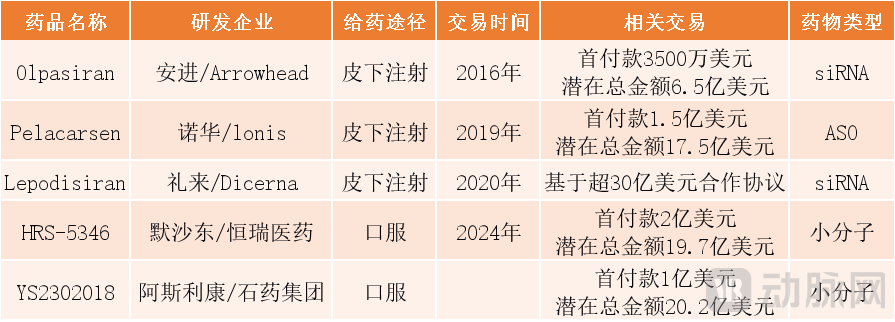 Selected Transactions Involving Novel Lp(a)-Targeted Therapeutics | Data Source: Arterial Orange Database
In September 2016, Amgen licensed Olpasiran from Arrowhead Pharmaceuticals. At the time, the deal, which included a $35 million upfront payment, a $21.5 million equity investment, and up to $617 million in subsequent milestone and option payments, did not attract significant attention. Currently, Olpasiran is undergoing global, multicenter Phase III clinical trials to evaluate its ability to reduce the incidence of cardiovascular events such as myocardial infarction and stroke, with results expected to be announced in 2026. In the Phase II clinical trial completed in 2023, patients in the highest dose group who received a single 225 mg injection of Olpasiran every 24 weeks experienced a reduction in Lp(a) levels of more than 95%, with the effect lasting for 48 weeks.
Currently, Olpasiran has become one of the three most prominent Lp(a) pipeline candidates globally, although its development progress slightly lags behind Novartis’s Pelacarsen. In 2019, Novartis reached an agreement with Ionis to obtain exclusive licensing rights for Pelacarsen. Under this deal, Novartis raised the upfront payment for the Lp(a) pipeline to $150 million, with potential milestone payments reaching up to $1.6 billion.
The following year, Eli Lilly also entered the field, further driving up the transaction valuations for Lp(a) pipelines. Under the agreement between Eli Lilly and Dicerna, the two parties will jointly develop RNAi therapies, with a focus on cardiovascular, metabolic, and neurodegenerative diseases. This collaboration, valued at over $3 billion, centers on Dicerna’s Lp(a) candidate, lepodisiran, as one of the key assets, granting Eli Lilly global development and commercialization rights.
During the previous wave of acquisition sprees, multinational corporations (MNCs) frequently offered high prices for Lp(a) pipelines. If the two small-molecule pipeline deals involving Merck & Co. and AstraZeneca are included, MNCs have already poured nearly $10 billion into this high-stakes gamble before Lp(a) drugs have even seen the dawn of commercialization.
The underlying reasons are obvious.
On one hand, the field of cardiovascular disease is a prolific source of blockbuster drugs.For instance, early-generation Lipitor, the best-selling drug in history, generated over $140 billion in cumulative revenue for Pfizer before its patent expired in 2011. Meanwhile, Leqvio, the first small interfering RNA (siRNA) therapy approved for cardiovascular disease, has seen rapid sales growth since its launch in 2021. Its sales increased by 100% year-over-year in 2023, propelling it into blockbuster status in 2024.
Compared with other popular therapeutic areas such as oncology and autoimmune diseases, cardiovascular disease (CVD) drugs hold distinct advantages in the market. For instance, they have a broad patient base for monotherapy; Lipitor’s indications cover the entire spectrum of management, from dyslipidemia to cardiovascular events. Even after patent expiration and the launch of multiple generics, Lipitor continues to command a significant market share. Furthermore, CVD medications often exhibit sustained market longevity, as antihypertensive and lipid-lowering drugs typically require lifelong adherence. Norvasc, one of the most prescribed antihypertensive drugs globally, has maintained strong sales years after its patent expired. For multinational corporations (MNCs), securing a blockbuster CVD drug serves as a ballast for revenue growth during the period of patent exclusivity.
On the other hand, the cardiovascular disease drug sector has seen major BD deals.Even before the surge of interest in Lp(a), the race to develop pipelines targeting PCSK9 frequently saw blockbuster deals worth billions of dollars. In 2012, Amgen acquired Iceland-based DeCode Genetics, gaining its cardiovascular disease-related genetic research assets, including early discovery technologies for the PCSK9 target. This $415 million transaction laid the foundation for Amgen’s development of Repatha®, which was approved in 2015 as one of the first marketed PCSK9 inhibitors.
Subsequently, in 2019, Novartis acquired The Medicines Company for $9.7 billion, obtaining its core asset, inclisiran, which was later approved and marketed as Leqvio. In 2021, AstraZeneca acquired Ionis’ PCSK9 antisense oligonucleotide AZD8233, indicated for hypercholesterolemia, with an upfront payment of $200 million and milestone payments totaling up to $2.5 billion; it has the potential to become the first oral PCSK9 inhibitor.
Today, in the arena of industry giants, Lp(a) has also become a formidable force to be reckoned with.
2. Small Nucleic Acid Drugs Break Through the Siege
Lp(a), or lipoprotein(a), is a lipoprotein produced by the liver, and elevated levels are considered an independent risk factor for cardiovascular events such as coronary artery disease, heart attack, and stroke. Data indicate that approximately 20% of the global population has elevated Lp(a) levels (≥50 mg/dL).
Currently, there are no approved specific therapies worldwide for elevated lipoprotein(a) [Lp(a)] levels. Studies have shown that PCSK9 inhibitors, which are used to lower low-density lipoprotein (LDL) cholesterol, can reduce Lp(a) levels to some extent, but the reduction is only approximately 20%–35%. Some clinical experts have stated that Lp(a) levels in the blood must be reduced by at least 50% for patients to achieve clinical benefit. Meanwhile, statins, the traditional cornerstone of lipid-lowering therapy, may cause a slight increase in Lp(a) levels while lowering other lipids.
However, drug development targeting Lp(a) is by no means easy.Due to a series of complex biological characteristics, Lp(a) is a challenging therapeutic target. On one hand, Lp(a) consists of low-density lipoprotein-like particles covalently bound to apolipoprotein(a) [apo(a)]. Apo(a) shares high homology with plasminogen and may interfere with the fibrinolytic system, thereby increasing the risk of thrombosis and inflammation. This necessitates that drugs targeting Lp(a) must specifically inhibit apo(a) without affecting plasminogen function, so as to avoid the risk of bleeding. On the other hand, Lp(a) is primarily synthesized in the liver, and its levels are largely determined by genetics, making it impossible to develop new drug models based on the traditional logic of lipid-lowering therapies.
It was not until small nucleic acid technologies matured in terms of druggability that early pathways emerged for the development of novel therapeutics targeting lipoprotein(a) [Lp(a)]. Currently, the most advanced candidate in global development is pelacarsen, which Novartis acquired from Ionis Pharmaceuticals in 2021. The drug has entered Phase III clinical trials, with data readouts expected in 2026. Previously, Novartis had announced that it would release the Phase III clinical data for pelacarsen in 2025. Some industry experts speculate that the delay in releasing the latest clinical data may be attributed to the drug’s greater-than-expected efficacy in reducing cardiovascular events, thereby extending the time required to reach the primary endpoints in the trial design.
Pelacarsen is an antisense oligonucleotide (ASO) drug that inhibits the expression of apolipoprotein(a) [Apo(a)] protein and blocks lipoprotein(a) [Lp(a)] production by targeting and cleaving Apo(a) mRNA. According to previously released Phase II clinical data, Pelacarsen reduced patients’ Lp(a) levels by approximately 80%, with a monthly dosage of 80 mg lowering Lp(a) levels to below 50 mg/dL in 98% of patients. Pelacarsen has long been regarded as the first Lp(a)-lowering therapy poised for regulatory approval.
Furthermore, lepodisiran, one of the three leading investigational Lp(a)-lowering agents, has recently released impressive clinical data. At the end of last month, The New England Journal of Medicine published the clinical trial results for the long-acting lipid-lowering drug lepodisiran, demonstrating that a single injection reduced patients’ Lp(a) levels by approximately 94%, with effects lasting at least six months. Unlike pelacarsen, lepodisiran is a small interfering RNA (siRNA) therapeutic that blocks the synthesis of apolipoprotein(a) at the translational level through a “gene silencing” mechanism. While lepodisiran shares a similar mechanism of action with Amgen’s olpasiran, it exhibits superior durability.
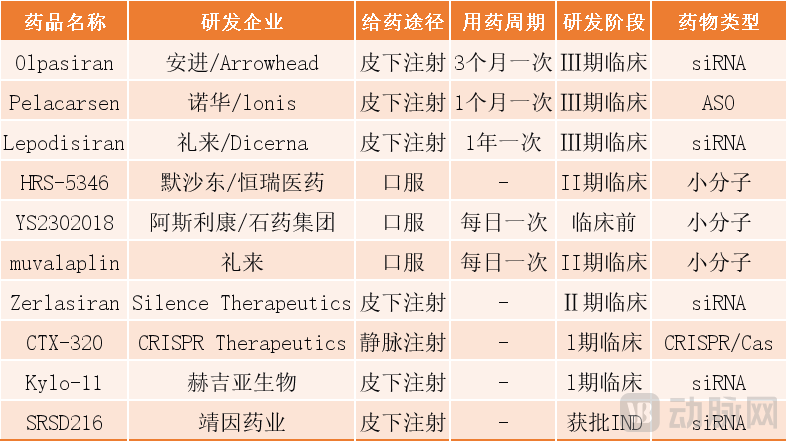 Progress of Investigational New Drugs Targeting Lp(a) | Data Source: Artery Orange Database
In addition, biotech companies are increasingly advancing their independently developed small nucleic acid drugs targeting lipoprotein(a) [Lp(a)]. Among these, Zerlasiran, an siRNA therapy developed by Silence Therapeutics, has completed Phase IIa clinical trials and is now entering Phase IIb. According to Phase IIa clinical data, patients in the 300 mg dose group experienced a median reduction of 89% in Lp(a) levels after receiving Zerlasiran once every 16 weeks, with this effect sustained for 48 weeks. Zerlasiran has thus become the most advanced Lp(a)-targeting small nucleic acid drug independently developed by a biotech company. In China, beyond frequent reports of leading small nucleic acid drug developers such as Ribo Life Science and BoWang Biotherapeutics laying out pipelines targeting Lp(a), Hejia Biopharma and Jingyin Pharmaceutical have already achieved clinical progress with their Lp(a) small nucleic acid drug candidates.
3. The Squeeze on Oral Dosage Forms
From the perspective of many practitioners, the development of novel Lp(a) drugs,"Currently on the trajectory of GLP-1 development, we are also moving toward a highly lucrative commercial future."
In a sense, the commercialization logic of novel Lp(a) drugs and GLP-1 drugs does share similarities.For instance, in terms of application scenarios, both serve the long-term management of chronic diseases, targeting several types of chronic conditions with extremely high prevalence in human society. Furthermore, regarding their development trajectories, both Lp(a) novel drugs and GLP-1 medications have undergone an iterative process from short-acting to long-acting formulations and are currently breaking through technical bottlenecks in oral dosage forms, thereby expanding coverage to patient populations with lower adherence.
Perhaps it is precisely under this logic that oral Lp(a) novel drugs are regarded as the future of drug development in this category, with late-entering multinational corporations (MNCs) willing to offer higher valuations for these pipelines with greater growth potential. In the two business development (BD) transactions completed over the past six months, oral Lp(a) novel drug pipelines have demonstrated a clear trend toward earlier development stages and higher valuations.
Among these, HRS-5346, which set a new record for Hansoh Pharmaceutical’s BD transactions, only entered Phase II clinical trials in 2024, with no latest progress disclosed yet. At this point, it has been less than two years since Hansoh first submitted the clinical trial application for HRS-5346. Meanwhile, YS2302018, licensed by CSPC Pharmaceutical Group to AstraZeneca, may be at an even earlier stage of development. According to publicly available information, this drug is still in preclinical research.
Similar to the development of GLP-1 drugs, the development of oral formulations for Lp(a) also presents greater challenges.
First, targeting the synthesis of apo(a) protein is extremely difficult.Typically, small molecules that inhibit apo(a) synthesis require intervention in the protein translation or secretion pathways within hepatocytes; however, such targets often lack selectivity, leading to systemic toxicity.Second, even if an apo(a) inhibitor is synthesized, its effect on blocking Lp(a) assembly remains very limited.Previously, Merck released Phase I clinical data for the small-molecule inhibitor muvalaplin, which achieved a maximum reduction of only 65% in Lp(a) levels by inhibiting the binding of apo(a) to low-density lipoprotein (LDL). This effect is substantially weaker than the Lp(a)-lowering efficacy demonstrated by oligonucleotide therapies. A key reason for this limitation is that small molecules struggle to completely block the highly efficient intracellular assembly process.Furthermore, liver-targeted delivery of small-molecule Lp(a) also presents challenges.Lp(a) is primarily synthesized in the liver; however, orally administered small molecules must reach hepatocytes via the first-pass effect. This process also requires overcoming barriers to hepatocyte-specific uptake, thereby significantly reducing delivery efficiency.
At present, Eli Lilly’s muvalaplin remains the oral Lp(a)-lowering lipid-lowering agent with the most advanced global development progress, having entered Phase III clinical trials. According to previously released Phase II clinical data, muvalaplin at a 60-mg dose reduced patients’ Lp(a) levels by 81.7%.
Certainly, compared with GLP-1 drugs, the commercialization of novel Lp(a) therapeutics also faces unique challenges. One pressing issue is that testing for Lp(a) levels, as a relatively new biomarker in clinical cardiovascular disease management, has not yet been widely adopted in practice. This limited adoption stems from both the lack of available diagnostic tools and the insufficient comprehensive understanding of Lp(a) among physicians and patients. The former gap can be addressed in the short term given current medical engineering capabilities, whereas building broader awareness and understanding is a considerably longer process. Furthermore, although studies have demonstrated an association between elevated Lp(a) levels and the incidence of cardiovascular events, this correlation has not yet been quantified with specific threshold values, which further hinders the widespread clinical adoption of novel Lp(a) therapies.
After nearly a decade of intense efforts, the development of novel Lp(a) therapeutics has finally shown promise. However, there is still a long road ahead before these new agents truly transform clinical practice in the diagnosis and treatment of cardiovascular disease.