

Bohai Kangyuan Submits IPO Prospectus for China's First MOCA-Based CVD Treatment Device Offering Reduced Pain and Lower Nerve Injury Risk
As the most common peripheral vascular disease, chronic venous disease (CVD) is a collective term for a series of symptoms and signs caused by impaired venous return and elevated pressure in the lower extremities due to structural or functional abnormalities of the superficial and deep veins. Specific conditions include varicose veins of the lower extremities, primary deep venous valve insufficiency of the lower extremities, iliac vein compression syndrome, and post-thrombotic syndrome of the lower extremities.
The prevalence of CVD currently exceeds 50%.The 2025 Chinese Expert Consensus on the Diagnosis and Treatment of Chronic Venous Disease in the Elderly further points out that “the incidence of CVD increases with age, with a mean age of onset of 53.4 years. Epidemiological surveys conducted by the International Union of Phlebology have shown that the prevalence of CVD is 63.9% among individuals around 50 years of age who experience lower extremity discomfort.” It is noteworthy that the elderly population faces not only an increased overall incidence but also greater severity of disease. Currently, the prevalence of venous leg ulcers in individuals aged 65 years and older is 3 to 5 times that of the general population, reaching 3%–5%. Furthermore, due to the coexistence of other cardiovascular and cerebrovascular diseases, treatment in the elderly population is relatively more challenging.
Amid the accelerating aging of the population and the trend of diseases affecting younger individuals, early intervention for cardiovascular disease (CVD) has become particularly crucial. Current common treatment modalities include pharmacological therapy, compression therapy, and surgical intervention.
The most widely recognized surgical treatment is for varicose veins.As of this March, Beijing Bohai Kangyuan Medical Device Co., Ltd. (hereinafter referred to as "Bohai Kangyuan") panlvin®The ablation catheter has received approval from the National Medical Products Administration (NMPA) (Registration Certificate No.: Guo Xie Zhu Zhun 20253010666), marking the introduction of the first varicose vein treatment device based on mechanochemical ablation (MOCA) technology in the field of varicose vein therapy.
This means that patients will soon have access to varicose vein treatments with less pain and a lower risk of nerve injury, while the competitive landscape among companies in the varicose vein treatment sector will undergo accelerated restructuring.
In traditional surgical treatment of varicose veins, high ligation combined with phlebectomy is commonly employed. On one hand, high ligation of the main trunk of the great saphenous vein or small saphenous vein blocks abnormal channels for reflux from superficial to deep veins in the lower extremities, thereby reducing venous regurgitation. On the other hand, stab avulsion phlebectomy is used to segmentally remove or extract varicose veins, eliminating varicose vein clusters, improving venous circulation in the lower limbs, alleviating symptoms, and reducing the risk of complications.
However, this surgical approach is associated with significant operative trauma, a propensity for scarring, and a high risk of recurrence.
Thermal Ablation Closure Has Emerged as a Viable Option. Currently, thermal ablation closure techniques include radiofrequency endovenous ablation closure, laser endovenous ablation closure, and microwave endovenous ablation closure. By using radiofrequency, laser, or microwave catheters to generate heat within the venous lumen, these procedures achieve lumen closure, thereby treating chronic venous disease (CVD) symptoms caused by superficial or perforating vein reflux. With advancing technological maturity, thermal ablation closure is progressing toward lower operating temperatures, improved deliverability, and higher occlusion rates.
In light of the potential injuries associated with thermal ablation closure, non-thermal ablation closure has garnered industry attention due to its reduced intraoperative pain and lower risk of nerve injury. It primarily includes cyanoacrylate adhesive closure systems (CAC), foam sclerotherapy, and mechanochemical ablation (MOCA).However, the efficacy and safety of CAC still require further clinical investigation, while foam sclerotherapy offers rapid results but is prone to recurrence. MOCA has recently demonstrated treatment success rates comparable to thermal ablation, with a lower incidence of complications.
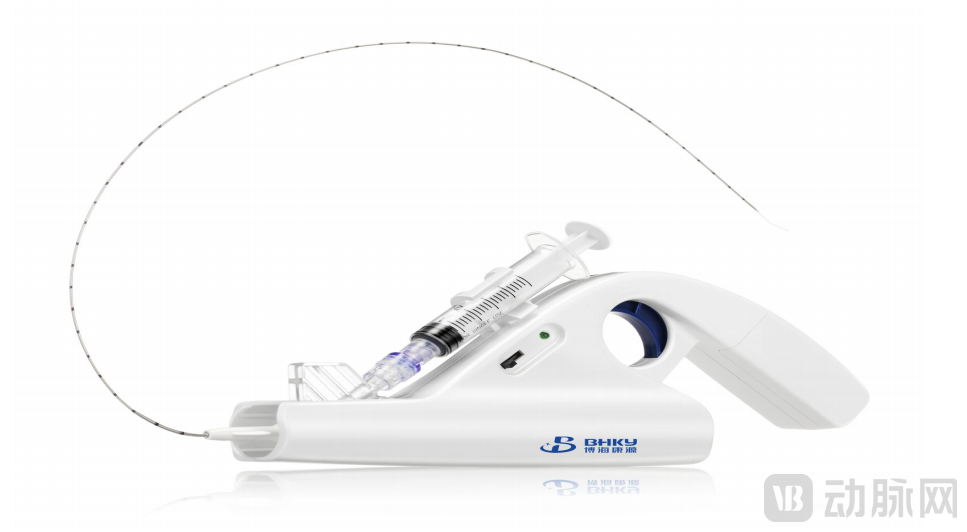 Bohai Kangyuan’s Disposable Endovenous Closure Catheter. The product consists of a motorized handpiece, a catheter assembly, and a syringe. The catheter assembly includes a rotatable guidewire and the catheter, and the motorized handpiece contains a 9V dry battery.
Bohai Kangyuan's Approvedpanlvin®The system employs MOCA technology, which mechanically damages the vascular intima using a high-speed rotating guidewire within the catheter (with rotational speeds reaching up to 3,900 rpm), while simultaneously injecting a sclerosing agent. This achieves dual "physical + chemical" occlusion, causing varicose veins in the lower extremities to undergo shrinkage and fibrosis, thereby closing the vessels.Unlike conventional radiofrequency or laser ablation, Bohai Kangyuan’s varicose vein treatment product based on MOCA technology does not require heating the catheter to temperatures above 120°C or administering tumescent anesthesia, thereby effectively reducing the risks of thermal injury and complications associated with tumescent anesthesia, offering a favorable safety profile.
Currently,ClariVein is the only MOCA therapy available in the United States. With Bohai Kangyuan obtaining NMPA approval, China now has the potential to utilize MOCA technology products for the treatment of varicose veins.
From a clinical perspective, MOCA technology products offer certain advantages: In terms of pain metrics, the postoperative Visual Analog Scale (VAS) score for MOCA is only 1–2 (whereas traditional thermal ablation results in scores of 4–5; VAS is used for pain assessment, with higher scores indicating more intense pain); regarding recovery time, patients can leave the hospital after a 20-minute procedure and resume physical activity within three days (compared to 1–2 weeks for traditional surgical methods); in terms of indications, international standards classify varicose veins into six stages (C0–C6), and Bohai Kangyuan’s product covers C2–C6 lesions, being simultaneously suitable for treating both the great saphenous vein and infragenicular small veins.
In fact, MOCA technology has long been widely used overseas. Relevant data indicate that it has been applied in more than 130,000 cases. The American Vein and Lymph Society (AVLS) explicitly recommends MOCA technology for the treatment of lower extremity superficial venous insufficiency with reflux, including pathologies involving the great saphenous vein (GSV), small saphenous vein (SSV), anterior/posterior accessory saphenous veins (AASV/PASV), and tributary veins.
Minimally invasive, suture-free, devoid of thermal injury, and associated with mild intraoperative pain, it holds significant appeal for female and younger patients. Meanwhile, it is relatively more user-friendly for healthcare institutions and physicians in clinical practice.
For physicians, it further simplifies clinical procedures. While thermal ablation closure requires complex maneuvers, MOCA technology significantly streamlines the process. As one physician noted, “Previously, radiofrequency ablation required repeated power adjustments; now, we only need to control the catheter withdrawal speed.” Furthermore, the learning curve for physicians is substantially reduced, enabling even primary-care hospitals to rapidly implement this treatment.
For medical institutions, this significantly reduces cost expenditures and improves surgical turnover rates. According to statistics from Bohai Kangyuan, hospitals previously needed to invest between RMB 200,000 and RMB 800,000 in equipment to purchase related hardware. By adopting Bohai Kangyuan’s products, costs are substantially reduced. Furthermore, as the time required for each surgery is shortened by approximately 40%, the annual surgical volume can increase by nearly twofold.
It offers certain advantages over thermal ablation closure and is more user-friendly for both physicians and patients,This also suggests that the field of varicose vein treatment may be poised for a shift in its therapeutic landscape.
Securing the first approval for MOCA-based varicose vein treatment is attributable to Bohai Kangyuan’s market acumen and its team of technical talent.
On one hand, Bohai Kangyuan has recognized the growing and robust demand for varicose vein treatment. ClariVein received FDA approval for the treatment of varicose veins in 2008. Its strong market performance in the United States over more than a decade has confirmed the substantial demand. In China, however, this remains a blue-ocean market. On the other hand, Bohai Kangyuan entered this field as early as 2016 and overcame key technical challenges. In addition to its early strategic layout and investment, Bohai Kangyuan leveraged its experienced professional technical team to resolve numerous issues related to the high-speed rotation of the guidewire in the product, and in 2021, it secured the patent for “An Intravenous Endoluminal Closure Microcatheter Treatment Device.”
As the product hits the market, Bohai Kangyuan is also accelerating its promotion for market application.Currently, Bohai Kangyuan is conducting multi-center clinical studies with several leading hospitals in China to further validate the product’s efficacy and safety. Given that there are no comparable products currently available in the domestic market, Bohai Kangyuan is leveraging various content platforms and professional academic conferences to enhance market awareness, particularly among clinicians. Additionally, Bohai Kangyuan is collaborating with high-quality distributors and agents to further expand its presence in the Chinese market.
Bohai Kangyuan also stated that, with further promotion in public hospitals, it cannot rule out expanding into other markets in the future.
“Previously, only one company worldwide had mastered MOCA technology. After a decade of R&D, Bohai Kangyuan has achieved a breakthrough in the precision coupling technology for catheters and guidewires, reducing costs by 40% and creating room for healthcare insurance cost containment,” added the founder of Bohai Kangyuan. “We are not pursuing ‘import substitution’; rather, we are targeting unmet clinical needs. MOCA is just the beginning.”
References:
1. Shi Zhenyu, Wu Danming. Progress in the Diagnosis and Treatment of Chronic Venous Disease. Chinese Journal of Bases and Clinics in General Surgery, 2025 (Online First).
2. Zhao Yu, Zhao Jichun, Zhang Lan, Huang Jianhua, Guo Pingfan, Wang Tao, Li Yongjun, Wang Haiyang, Chen Quan; Branch of Peripheral Vascular Disease Management, Chinese Association of Gerontology and Geriatrics. Chinese Expert Consensus on the Diagnosis and Treatment of Chronic Venous Disease in the Elderly [J]. Chinese Journal of General Surgery.