

Domestic Non-Invasive Ventilators Surge with 30% National Subsidy Amid Tariff Headwinds
In the dormant sleep health market, a home-use medical device has become a bestseller on e-commerce platforms.
Benefiting from the national subsidy of up to 30%, sales of home non-invasive ventilators on e-commerce platforms have surged. The Chairman of Yiheweiye (whose ventilator brand is BMC Medical; the company has already initiated the process to unify its corporate name and stock abbreviation as “BMC Medical”) stated in an interview that the national subsidy policy has significantly boosted ventilator sales.
Previously, the penetration rate of home ventilators in China was less than 1%. National subsidies have served as a catalyst for the home non-invasive ventilator market. As public awareness of home non-invasive ventilators has deepened, this market has demonstrated remarkable growth. In its semi-annual report, Yuwell Medical also stated that its home ventilator product business achieved robust growth.
The home ventilator market is expanding, with domestic companies capturing a larger share. According to Frost & Sullivan data, the domestic market share of the Chinese leader BMC Medical was only 6.1% in 2019, rising to 30.6% by 2023.
In the past, due to the limited capacity of the domestic market, leading Chinese manufacturers of home ventilators generated higher revenue from overseas markets than from China. According to data from China Customs, the export value of non-invasive ventilators reached RMB 2.717 billion in 2024. However, against the backdrop of changing tariff policies, growth in the domestic market offers greater certainty.
“The Dormant” Home Non-Invasive Ventilator Market: How Can Domestic Companies Sustain Overseas Growth and Tap into the Undervalued Domestic Market?
Home non-invasive ventilators are primarily indicated for two major conditions: obstructive sleep apnea-hypopnea syndrome (OSAHS) and chronic obstructive pulmonary disease (COPD). Individuals with OSA face a significantly increased risk of developing various chronic diseases, such as hypertension. In fact, hypertension and OSA frequently coexist, and the medical community widely recognizes OSA as an independent risk factor for hypertension. Patients with moderate-to-severe OSA can effectively improve their sleep quality by using non-invasive ventilators, thereby enhancing their daytime alertness and mental state.
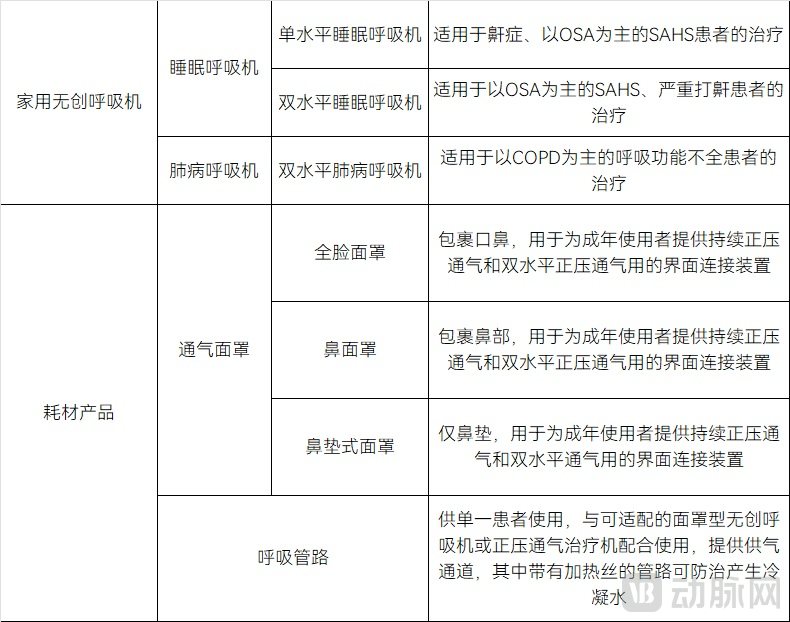
Major Products and Applications in the Home Ventilator Market
Since the advent of home ventilators, they have cumulatively improved the quality of life for hundreds of millions of people worldwide. However, in China, the penetration rate of home ventilators has remained low due to factors such as insufficient disease awareness and exclusion from medical insurance coverage. In contrast, the penetration rate of ventilators among the population with sleep apnea in the United States is approximately 40%, whereas the current penetration rate in China is only around 0.2%–0.3%.
So, what is the actual scale of the domestic home ventilator market in China?
Industry insiders stated, “The major brands in the global home ventilator market include ResMed, BMC Medical, and Philips. The domestic home ventilator market in China is valued at approximately RMB 1.3 billion, exhibiting a high growth rate. The market landscape is relatively concentrated, dominated by mainstream mid-to-high-end brands.”
In terms of market landscape, according to data from China Customs, the import value of home non-invasive ventilators reached RMB 875 million in 2024. It can be estimated that imported brands account for more than 60% of the home ventilator market share. Among domestic manufacturers, the industry leader BMT holds a market share of approximately 30%.
Different Ventilator Brands in the Domestic Market Have Formed a Differentiated Competitive LandscapeDomestic ventilator products are categorized into high-, mid-, and low-end product lines based on price. Products priced at RMB 7,000 per unit or above are predominantly imported brands such as ResMed and Philips Respironics. Mid-range products, priced between RMB 4,000 and RMB 5,000 per unit, are mainly offered by leading domestic manufacturers like BMC Medical and Yuwell. The segment below RMB 3,000 per unit is highly competitive and dominated by small- and medium-sized manufacturers.
The high-end market offers high profit margins but presents high entry barriers, requiring strong brand influence and technological moats.
Domestic manufacturers have not yet fully penetrated the high-end market, primarily because their products still lag behind premium offerings, although this gap is relatively small. The disparity is mainly reflected in algorithmic control. The core technologies of ventilators are divided into hardware and algorithmic software. While a mature global supply chain has been established for hardware, algorithms typically rely on in-house development.
Non-invasive ventilators process data from built-in pressure and flow sensors via algorithms, and combine this with other relevant parameters to control the speed of a dedicated turbine blower. Using air filtered through the intake, they generate one continuous positive pressure (in CPAP non-invasive ventilators) or two levels of positive pressure (in BiLevel non-invasive ventilators), which are delivered to the patient’s mouth and nose, and ultimately to the lungs, via tubing and a mask connected to the outlet.
Algorithms can only obtain precise usage data and achieve higher accuracy by collecting extensive clinical acquisition data and processing large sample sizes. Imported brands have deeper accumulation in algorithm development. As the strength of domestic enterprises continues to grow, they will also enter the high-end market in the future.
Although the market size of home ventilators in China is not yet large, its potential is gradually being unleashed. Disease awareness, price barriers, and sales channels are all showing positive trends.
In terms of disease awareness, the OSA detection feature of smartwatches has provided strong support for the promotion of home-use ventilators.
ResMed’s 2025 Global Sleep Report reveals that 78% of respondents in China use sleep monitors, smartwatches, mobile applications, or diaries to track their sleep. Currently, smartwatches from brands such as Apple, Huawei, and Samsung have introduced features for detecting sleep apnea. As smart wearable devices become increasingly prevalent in monitoring blood oxygen levels and obstructive sleep apnea (OSA), they have significantly heightened user awareness of sleep quality and this condition. This trend is expected to accelerate the penetration rate of the ventilator market in China and globally, thereby further expanding the market potential for ventilators both domestically and worldwide.
New e-commerce channels have also driven performance growth.In the past, the domestic market for home non-invasive ventilators relied primarily on distribution channels, with products reaching retail endpoints through multi-tiered distributors. In recent years, however, e-commerce channels have experienced rapid growth and strong performance, while the growth rate of traditional distribution channels has slowed. Nevertheless, e-commerce channels face challenges such as platform revenue-sharing arrangements and price erosion driven by promotional activities, which compress corporate gross margins. These dynamics place higher demands on brand influence and operational capabilities.
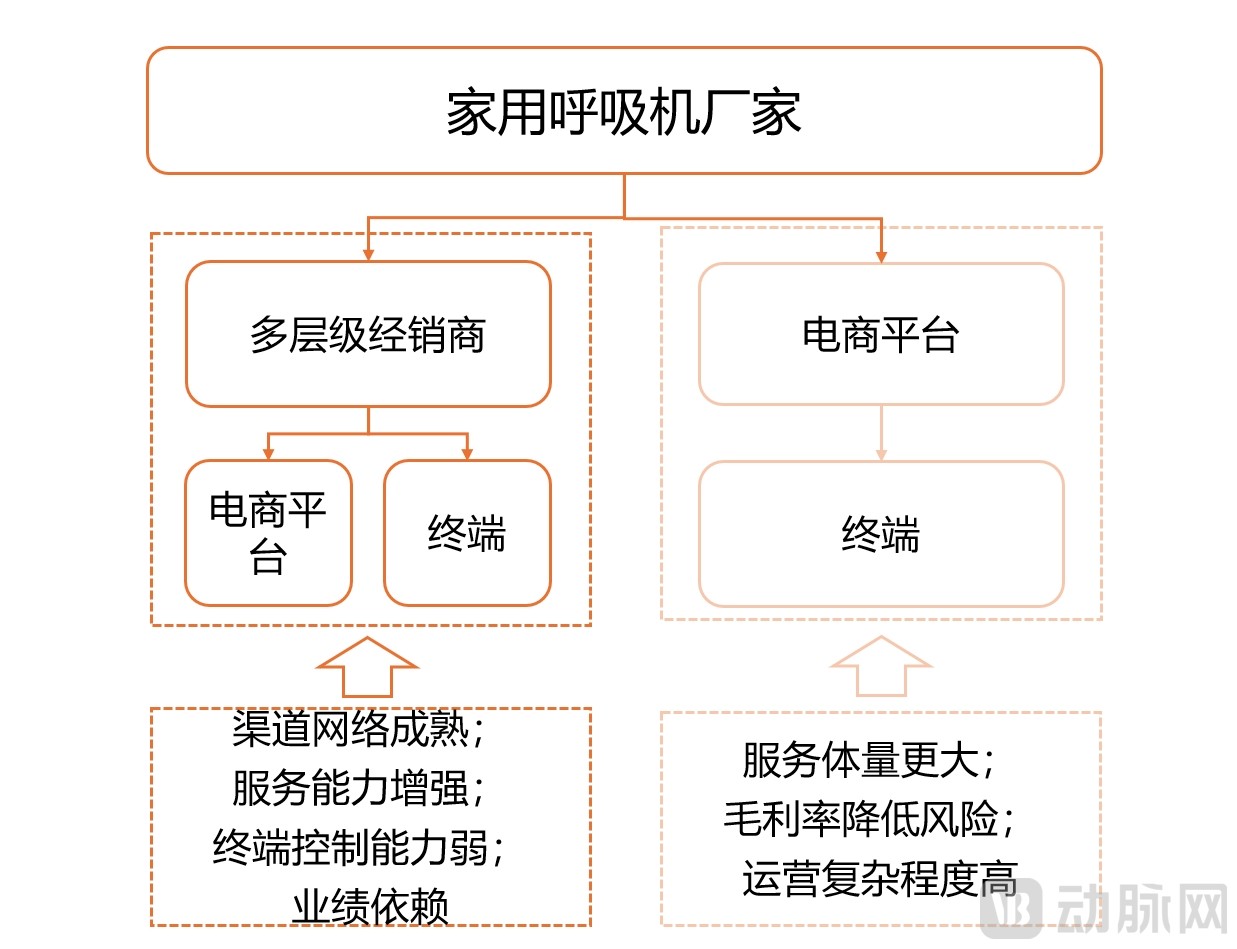
Comparison of Different Sales Models for Home Ventilators
“National Subsidy” policies have lowered the price threshold for purchases, providing a boost to the growth of the home ventilator market.Under the “national subsidy” policy, household ventilators are eligible for a state subsidy of up to 30%. The Chairman of BMC Medical has noted that since the second half of last year, top-level policy initiatives aimed at boosting domestic demand—such as the “national subsidy” and “consumer goods trade-in” programs—have significantly driven the sales volume of the company’s products in the Chinese market.
Taking the BMC Medical G3B20A, a high-end bilevel ventilator, as an example, its price on e-commerce platforms has dropped to just over 2,000 yuan after national subsidies, while another single-level ventilator is priced at under 2,000 yuan, significantly lowering the barrier to purchase for users.
In the long term, the underlying drivers of growth in the home ventilator market stem from a large existing patient population and the trend of population aging. The number of patients with chronic obstructive pulmonary disease (COPD) in China exceeds 100 million, with nearly one million annual deaths—a figure far surpassing that of lung cancer. Meanwhile, the number of patients with moderate-to-severe obstructive sleep apnea (OSA) has also exceeded 70 million. As population aging continues to intensify, demand for ventilators will continue to rise, leading to a gradual expansion of market capacity.
Domestic market potential is gradually being unleashed, while overseas markets are under pressure due to tariff policies.
The export market for domestic home-use ventilators is substantial. According to data from China Customs, the export value of non-invasive ventilators from China reached RMB 2.71 billion in 2024. Among these, BMC Medical, a leading exporter, reported overseas revenue of RMB 542 million in 2024.
The U.S. market is the primary export destination for domestic home ventilators. The increase in U.S. tariffs on Chinese goods to 145% will undoubtedly raise the cost of selling Chinese-made products in the United States.
The 30% national subsidy has driven growth in the domestic market, enhancing Chinese companies’ resilience against tariff shocks and offsetting their impact. Meanwhile, to address geopolitical risks, domestic enterprises have made advance preparations and are responding to these challenges through three major pathways.
First, increase investment in other markets, such as Europe, the Middle East, and Canada.Taking BMC Medical as an example, the Canadian market is poised to become a new growth driver. As BMC Medical’s exclusive distributor in the North American market, React Health has collaborated with BMC Medical for over 15 years. Against the backdrop of shifting U.S. tariff policies, both parties have decided to jointly expand into the Canadian market. It is estimated that the Canadian market will offer an annual incremental opportunity of approximately 150,000 ventilators.
An industry insider stated, “Expanding into other markets primarily tests a distributor’s accumulated resources and understanding of market demand. In some European countries, it may even be necessary to establish local overseas subsidiaries.”
Second, establishing overseas manufacturing facilities to mitigate the impact of geopolitical risks.For example, Meihao Medical, a key supplier of components for ResMed ventilators, relocated part of its production lines to Malaysia in 2023 to mitigate geopolitical risks. Similarly, BMC Medical is also considering establishing overseas manufacturing facilities to better expand into the U.S. market and further enhance its competitive edge.
3. Strengthening Dominance over Core Components, driving the development of upstream enterprises through domestic substitution. As strategic competition between China and the United States intensifies, supply chain autonomy and controllability have become core competencies for globalized enterprises. The localization of core components also contributes to cost control.
The core components of home non-invasive ventilators include micro-turbine blowers, flow sensors, and pressure sensors. Since the COVID-19 pandemic, the localization rate of these core ventilator components has increased significantly.
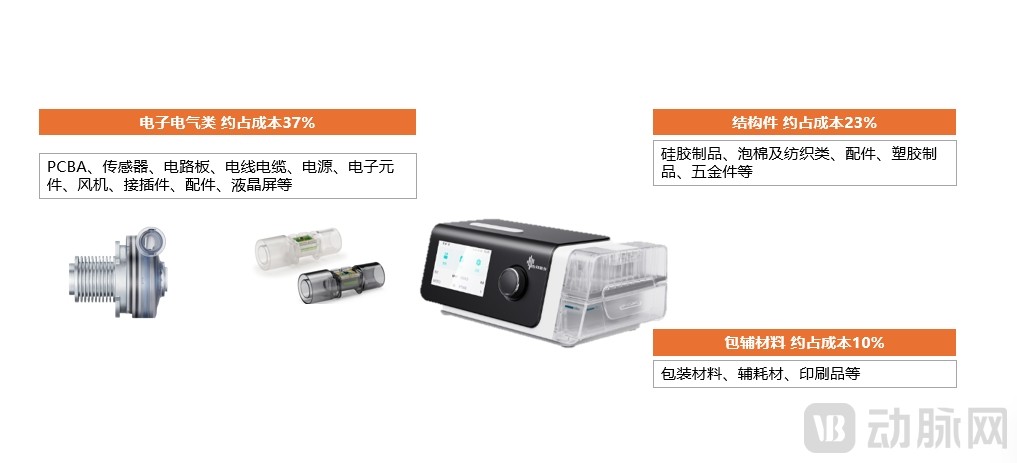
Core Components of Home VentilatorsData Source: BMC Medical IPO Prospectus, Southwest Securities
BMC Medical stated that the localization of core components has been basically achieved, ensuring a secure and controllable domestic supply chain, with significant advantages in technological autonomy and cost efficiency.
The localization of core components has also spurred the rise of a cohort of Chinese component manufacturers, propelling them into the ranks of key global suppliers for home ventilator parts.
Taking the ventilator’s turbine blower as an example, the pressurization and depressurization frequencies of the ventilator must synchronize with the patient’s breathing pattern to ensure comfort. Consequently, stringent requirements are imposed on the ventilator’s dynamic response. As a core component of the ventilator, the blower must also rapidly, flexibly, and stably switch between the high pressure required during inspiration and the low pressure required during expiration.
Sleep applications also require blowers to operate with low noise. There are also high demands for the operational lifespan of blowers; as home ventilators become increasingly compact, stricter requirements are imposed on blower size. However, due to the high precision machining and complex manufacturing processes involved, this market has long been dominated by European manufacturers.
Global suppliers of ventilator blowers include Germany’s EBM-Papst and Switzerland’s Micronel. The Swiss company Micronel long held a monopoly on the high-end global market for ventilator blowers, with one key reason being its products’ long service life and stable performance.
During the pandemic, driven by a surge in demand and insufficient overseas supply, Beifeng Technology, a Chinese manufacturer of ventilator blowers, rose to prominence and secured orders from multiple companies, including Mindray and Aeonmed.Currently, Beifeng Technology’s medical ventilator turbine blowers hold a 90% market share in China. In 2023, the company achieved sales revenue of RMB 130 million, representing a year-on-year increase of 20%.
BMC Medical also invested in Dedaxing Drive, a manufacturer of turbo blowers.Dedaxing Drive specializes in the production and customization of specialized brushless DC motors, precision coreless brushed motors, micro motors, and DC geared motors. In the field of ventilator turbine blowers, it has developed high-precision, low-noise ventilator turbine blowers. Currently, Dedaxing Drive’s major clients in the medical sector include Medtronic, BD, and BMC Medical.
In the sensor sector, domestically produced products have already gained the capability to achieve import substitution. The cost proportion of MEMS sensors in complete ventilator systems is not high, typically amounting to only tens of yuan. For a long time, the global supply leader for flow sensors in home-use ventilators has been the Swiss company SENSIRION AG. However, it is encouraging that Chinese enterprises have begun to make breakthroughs in this core component field.For example, the thermal flow meter chip developed by Suzhou Rongqi Sensor Co., Ltd. has successfully become the sole domestic supplier for a well-known Chinese ventilator brand.。
Domestic manufacturers of home ventilators hold a low share of the high-end segment in both domestic and international markets. Drawing on the overseas expansion path of Mindray, a leading Chinese manufacturer of medical ventilators that has successfully gone global, Chinese companies must achieve technological breakthroughs in the high-end market to raise the ceiling for growth. Simultaneously, they should strengthen brand image, deepen user awareness, and enhance market penetration in the domestic market to leverage economies of scale for cost advantages, while building a digital ecosystem and pursuing localized deep-dive strategies in overseas markets. This dual-engine approach will drive sustained growth.
With the domestic supply chain for home ventilators achieving self-sufficiency and controllability, the medical device manufacturing sector is upgrading towards intelligent manufacturing. On May 9, VCBeat and Enshe Family Office will jointly host a Medical Device Design and Manufacturing Conference in Suzhou, featuring offline exchanges to thoroughly discuss R&D and manufacturing of medical devices in China under new opportunities. Everyone is welcome to scan the QR code to register.

References:
Dialogue with Chen Xiao, Chief Marketing Officer of BMC Medical: The Ventilator Industry Unlocks a “Home Scenario” Second Growth Curve — China Business News
BMC Medical 2024 Annual Report
Domestic Ventilators’ Overseas Expansion Gains Momentum — Southwest Securities
Focus on 2025 CMEF | Dialogue with Zhuang Zhi, Chairman of BME: Greater Certainty in the Domestic Market in 2025 — 21st Century Business Herald