

Soaring Gold Prices and the Impact on Medical-Grade Precious Metal Raw Material Costs
On April 22, gold prices surpassed the $3,500 per ounce mark, hitting a record high. Meanwhile, domestic gold jewelry prices also exceeded RMB 1,000 per gram; for instance, the listed price for Zhou Liufu’s 99.99% pure gold jewelry rose to RMB 1,102 per gram, while pure gold jewelry from brands such as Chow Tai Fook reached RMB 1,082 per gram.
Although gold prices dipped slightly on April 23, they remain at historically high levels. In 2024, gold prices rose by approximately 27% cumulatively. Since the beginning of this year, gold prices have surged by another 27%.
Additionally, prices for precious metals such as silver, ruthenium, and rhodium also rose. For instance, the international spot price of silver increased from $28.94 per troy ounce at the end of 2024 to $33.56 per troy ounce on April 25, representing a gain of approximately 11.75%; ruthenium rose by about 28.93%, while rhodium increased by approximately20.59%。Prices of precious metals such as platinum, palladium, iridium, and osmium remained stable.
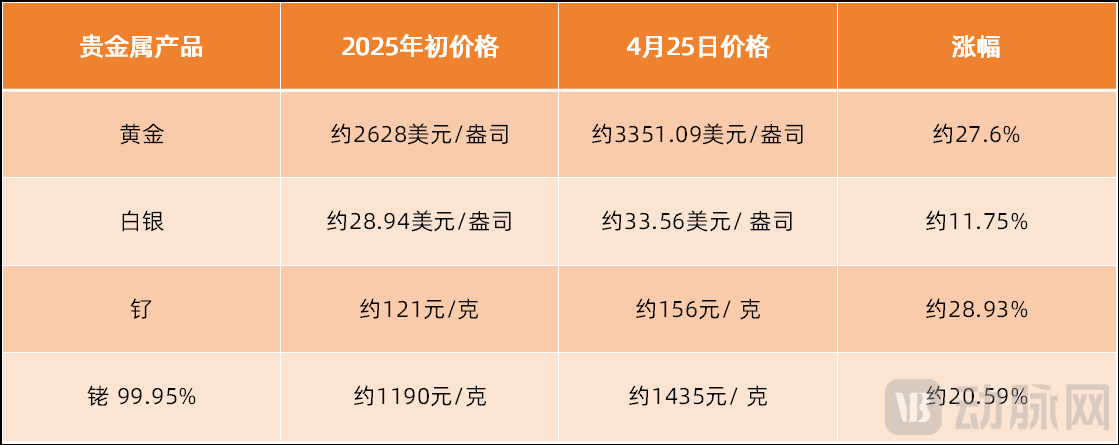
(Market data, compiled by VCBeat)
Gold, silver, ruthenium, rhodium, palladium, osmium, iridium, platinum,These eight metallic elements are collectively referred to as precious metals., with high value. Among them, ruthenium, rhodium, palladium, osmium, iridium, platinumCollectively known as platinum group metals。
Beyond asset investment and jewelry manufacturing, precious metals are extensively utilized in modern industry due to their superior physical and chemical properties, including high electrical and thermal conductivity, excellent workability, stability, and corrosion resistance. They constitute a highly specialized and indispensable class of materials within the industrial system.
Taking the medical field as an example, precious metals can be used in pharmaceuticals and also serve as raw materials for medical devices. In terms of pharmaceuticals, precious metal-based drugs mainly include platinum-based anticancer drugs, gold-based drugs for treating rheumatoid arthritis, and silver-based drugs for combating microbial infections. The 2023 annual report released by Sino-Platinum Metals shows:Global annual sales of platinum-based anticancer drugs have reached $20 billion, with mainland China accounting for approximately RMB 15 billion.。
In the field of medical devices, precious metal materials for medical use can serve as key components such as radiopaque markers, electrodes, and lead wires for vascular interventional medical devices, as well as core materials in dentistry, in vitro diagnostics, and electronic components. Data released by Sino-Platinum Metals indicates that the global demand for precious metals in the healthcare sector was 20 tons in 2022, while China’s demand was only 0.8 tons.
What are the specific applications of precious metal materials in the medical field? What is the current market landscape? How does the recent rise in precious metal raw material prices impact related enterprises?
Medical precious metal materials include gold, silver, platinum group metals, and their alloys. Different metals possess distinct properties and applications. The following discussion explores these materials according to different categories of precious metals.
Gold, with its excellent electrical conductivity, corrosion resistance, and ductility, has become a key material for manufacturing high-precision electronic components, semiconductors, and circuit boards.
Generally, companies primarily apply gold plating to electronic components to add a gold layer. This gold layer can significantly reduce the contact resistance of electrical components, thereby improving signal transmission efficiency and stability. Additionally, the gold layer enhances the corrosion resistance of electronic components, reducing wear and corrosion during use and extending their service life. Similarly,Gold plating is also widely used for electronic components in medical devices.。
For example, the intracardiac echocardiography (ICE) product launched by Tingsheng Technology employs a gold-plating process for its core component, the transducer, to enhance stability. Intracardiac echocardiography involves mounting a miniature transducer at the tip of a catheter, which is advanced via the femoral vein into the cardiac chambers. The transducer emits acoustic waves, and the received echoes are processed by a computer to generate ultrasound images. This technology provides high-resolution, real-time visualization of internal cardiac anatomical structures as well as other intracardiac catheters and devices, enabling real-time monitoring of hemodynamic status. Unlike conventional ultrasound techniques, intracardiac echocardiography offers advantages such as superior image quality, strong real-time performance, and nearly 360-degree observability.
Additionally,In the medical field, goldAlsoCommonly used to manufacture upstream core components of medical devices。
For example, a gold solder ring is a biocompatible brazing material used forElectrical Feedthroughform a seal in.Electrical feedthroughs are critical components of implantable medical devices such as cardiac pacemakers, defibrillators, and neurostimulators., used to achieve electrical coupling between electronic components and external devices, i.e., electrical feedthroughs ensure the stability and reliability of conductive paths or multiple conductive paths from the outer surface of the device to the interior of the device housing through hermetic sealing.
Previously, gold was also used in dentistry and pharmaceuticals. However, with the emergence and application of new materials, its use in dentistry has declined significantly, being gradually replaced by resins, zirconia, and other materials. In the pharmaceutical sector, auranofin (containing approximately 29% gold), used to treat rheumatoid arthritis, is no longer manufactured in China and has not received import approval.
Compared with gold, platinum, iridium, palladium, and rhodium have wider applications in the medical field.
First, platinum has become the material of choice for pacemakers、Defibrillator、Ablation CatheterWait for medical treatmentInstrumentsIdeal Electrode Materials。
Taking a cardiac pacemaker as an example, its pacing lead electrodes must be implanted into the body to transmit signals. This requiresPacingThe materials used for catheter electrodes must exhibit excellent biocompatibility, superior toughness, resistance to aging, and corrosion resistance. Platinum possesses these required characteristics and is therefore considered an irreplaceable electrode material in electrolysis and sensors.Currently, the pacing electrode materials for most cardiac pacemakers are platinum, iridium-platinum alloy, cobalt-chromium-nickel alloy, and carbon.
Meanwhile, the electrodes on electrophysiology catheters and radiofrequency ablation catheters are also predominantly made of platinum and its alloys. After these electrodes are advanced through the arteries into the heart, they record electrical activity and deliver electrical pulses to assess cardiac response. Currently, electrophysiology catheters are single-use devices; however, the precious metal materials at their distal tips retain significant value, thusSpurred the emergence of the catheter retrieval business. Numerous companies in the market are engaged in the recycling of electrophysiology and radiofrequency ablation catheters, with recycling prices primarily based on the content of precious metals contained in the catheter tips; these recycled materials are subsequently refined to recover platinum, palladium, and iridium.
Platinum and its alloy materials are also widely used in vascular interventional devices.. For example, the material used in the Promus PREMIER stent previously launched by Boston Scientific isPlatinum-Chromium AlloyCompared with stents made of other metallic materials, platinum-chromium alloy stents offer advantages such as high radiopacity, excellent conformability, strong radial support, low elastic recoil, and outstanding fatigue resistance.
Medtronic has also launchedPlatinum Edition Intracranial Thrombectomy StentSolitaire Platinum. The functional segment of this stent features 12 additional platinum radiopaque markers, enabling physicians to directly and precisely locate the stent position. This facilitates accurate stent deployment and enhances the efficacy of the thrombectomy stent. Furthermore, the stent offers full-length visibility, providing physicians with comprehensive information, such as the accuracy of stent positioning and the completeness of engagement between the stent and the thrombus.
Platinum is alsoNeurointerventional Product: Coilsone of the primary metallic materials. The NUMEN Coil Embolization System, launched by MicroPort NeuroTech, incorporates platinum-tungsten wire in its material composition. By utilizing ultra-fine platinum-tungsten wire combined with a unique three-dimensional structure, the product achieves an ultra-soft design that reduces pressure on the aneurysm wall, thereby enhancing the safety of embolization and making it suitable for the treatment of aneurysms of various shapes. Financial report data indicates that in 2024, the global sales volume of MicroPort NeuroTech’s NUMEN Coils maintained rapid growth.
Furthermore, platinum and its alloys are also used in the medical device industry to manufacture guidewires, embolization coils, cochlear implants, radiopaque markers, and radiopaque bands.
PlatinumIt is also applied in the pharmaceutical field.。In 2023, Sino-Platinum Metals’ wholly-owned subsidiary, Kunming Guiyan Chemistry Co., Ltd., invested RMB 120 million in the construction ofPlatinum-Based Anticancer Drug Active Pharmaceutical IngredientsIndustrialization projects to further address the shortcomings in active pharmaceutical ingredients (APIs) within the precious metal materials sector, extending downstream processing from drug intermediates.
In June 2024, Guiyang Chemical made another move by investing RMB 100 million to establish a wholly-owned subsidiary.Guiyan Chemical PharmaceuticalsTechnology (Yunnan) Co., Ltd. Relying on the construction of the “Industrialization Project for Platinum-Based Anticancer Drug Active Pharmaceutical Ingredients (APIs),” the company will extend its downstream processing capabilities for precursor products of precious metal-based anticancer drug APIs, thereby addressing the company’s shortcomings in the precious metal API industry and striving to become a mainstream domestic supplier. Meanwhile, it will continue toPromoting the R&D and Incubation Transformation of Novel Noble Metal-Based Anticancer Drugs, establish a precious metal active pharmaceutical ingredient (API) base covering production and R&D, and expand the company’s applications in the life and health industry.
Secondly,Iridium asOne of the Platinum Group Metals,Characterized by a high melting point, high density, strong corrosion resistance, and high catalytic activity, it is widely used in fields such as alloys, pharmaceuticals, chemical engineering, and electronics.. For example, iridium is used as an electrode material and catalyst due to its physical properties. Previously, iridium was also used in the production of syringe needles; however, with the rise of materials such as stainless steel, its application in needles has been replaced.
Compared with platinum, iridium exhibits superior radiopacity and is therefore widely used in radiopaque catheter components, such as marker bands. Marker bands are commonly employed in interventional catheters to assist clinicians in accurately determining catheter positioning.
Finally, RhodiumYesA hard, wear-resistant noble metal that is difficult to process. In the medical field, rhodium can be used for the production ofX-ray Tube. The X-ray tube consists of a cathode filament, an anode target, and a high-voltage electric field, with the anode target typically made of materials such as rhodium and molybdenum.
According to interviews, multiple companies stated: “The use of precious metals in medical device products is minimal. The impact of the recent rise in raw material prices for precious metals on product costs is negligible.”
For a long time, the market for medical-grade precious metal materials has been dominated by multinational giants such as Johnson Matthey (UK), Umicore (Belgium), Heraeus (Germany), and Tanaka (Japan).
According toData from the China Nonferrous Metals Industry Association, in 2022, the market size of precious metals in China reached 1.2 trillion yuan, with new material applications accounting for over 40%, and in high-end fieldsImport dependency exceeds 60%. Additional data shows that the import dependency for core components such as platinum-iridium electrode coatings and flexible catheter sheaths exceeds 90%.
The precious metal materials industry is both technology-intensive and capital-intensive. Industry giants such as Johnson Matthey, Umicore, Heraeus, and Tanaka started early and have a long development history, having captured the majority of market share by leveraging their technological and capital advantages.
Among them, Johnson Matthey’s medical business has been acquired by the European private equity firm Montagu and is now operated under the entity Medical Device Components LLC (hereinafter referred to as “MDC”). It is understood that MDC specializes in providing high-qualityPrecious Metal Precision Machined Components, ImplantationNickel-Titanium Alloyas well as advanced coating and surface solutions. Its manufactured components can be applied in orthopedics, endoscopy, cardiology, neurology, electrophysiology, structural heart disease, cardiac rhythm management, and other fields.
For example, MDC supplies electrodes, markers, tip coils, and other components for neurostimulator products; MDC collaborates with leading cochlear implant manufacturers to provide platinum parts and platinum wires, enabling the annual production of over 30,000 next-generation cochlear implants; MDC offers a variety of precious metal components for electrophysiology catheters and partners with top-tier companies in the electrophysiology field to jointly develop precision micromechanical devices.Irrigated Tip Electrode、Ring Electrode、Marker Bandand othersPrecious Metal Components。
COINING is a U.S.-headquartered company founded in 1965. It manufactures various high-quality metal stamped parts and preformed solder preforms for the electronics industry, with production capabilities for numerous brazing and soldering alloys. Commonly used materials include gold, silver, lead, tin, and zinc, and custom alloys with specialized compositions are also available. In May 2024, COINING launched gold solder preforms designed for high-performance medical electronic devices.。
China’s research on precious metal materials started relatively late, resulting in weaker competitive advantages and a lower market share. This is because the precious metal materials industry has certain barriers and entry thresholds.
Technologically, products in the precious metals manufacturing industry feature high technical content and complex production processes. For instance, for components such as medical electrodes, sensors, and radiopaque markers, the purity of the relevant precious metals and their alloys must reach 99.99% (4N) ultra-high purity; otherwise, it may lead to adverse consequences such as device malfunction, patient discomfort, reduced device service life, and decreased reliability.
Furthermore, the core upstream components of medical devices are characterized by their miniature size and intricate structures, which pose significant challenges for manufacturing and performance characterization. This necessitates that relevant enterprises possess advanced precision manufacturing processes and technical capabilities, such as nanoscale metal deposition technology.
In addition, the manufacturing of precious metal materials requires substantial capital investment for equipment procurement and plant construction. Furthermore, the high cost of raw materials such as gold, silver, and platinum necessitates significant expenditure during the research, development, and production phases. These factors collectively establish high financial barriers to entry in the precious metal materials manufacturing industry.
After years of development, domestic enterprises have made significant progress, with a number of companies quietly achieving breakthroughs.
Sino-Platinum Metals is a high-tech enterprise group integrating R&D, manufacturing, recycling, and supply services for new materials based on rare and precious metals. As the leading enterprise in China’s new precious metal materials industry, it provides globally leading comprehensive solutions featuring precious metals and advanced materials for the medical sector.
In 2018, Sino-Platinum Metals established a project team to actively position itself in the life and health industry, focusing on the research and development of key biomedical precious metal materials and components with independent intellectual property rights. After years of dedicated efforts, Sino-Platinum Metals successfully broke the monopoly by developing products for high-end medical device applications, including those used in cardiovascular and cerebrovascular treatments, minimally invasive interventions, electrophysiology, and active implants.XianImaging rings, electrode rings, thin-walled tubes, precision ribbon materials, micromachined componentsand other key materials and components.
Currently, Sino-Platinum Metals has already been involved in vascular stentsAchieved import substitution in areas such as required development materials, becoming the first in ChinaA manufacturer of medical-grade precious metal materials that has broken foreign monopolies and achieved commercial application. Currently, Sino-Platinum Metals is advancing the construction of production lines for contrast media, electrophysiology materials, precious metal guidewires, and liquid shape memory alloys.
Muxing Biotech is another Chinese enterprise that has established a presence in the field of precious metal materials. With years of dedicated expertise in sensors, precision ceramics, and new material development, the company has accumulated specialized technical capabilities in precious metal materials, sensors, and ceramics. In 2021, Muxing Biotech successfully developed and manufactured platinum-iridium radiopaque markers and brain electrode guide wires.
The newly launched platinum-iridium guidewire is a brain electrode signal wire designed for signal transmission. The raw material of the platinum-iridium guidewire is ETFE-coated platinum-iridium alloy wire, with ETFE-506 as the coating material. This material offers stable signal transmission, high performance, low electrical resistance, and high reliability, while meeting biocompatibility requirements.
Muxing Biotech’s other product, the platinum-iridium radiopaque marker ring, is a marker ring used as an X-ray radiopaque marker for the distal working zone in interventional therapy. Made of platinum-iridium alloy, it exhibits extremely stable chemical, mechanical, and electrical properties, along with characteristics such as high strength, high elasticity, and low contact resistance.
Furthermore, domestic companies such as Yueqian Laser, Jiema Life, and Jiuzhou Bona have all launched medical-grade precious metal material products.
Nowadays, new materials are emerging in the medical industry. While some medical-grade precious metal materials continue to expand their applications, others are being replaced by newer alternatives. However, as the market imposes higher and more diverse requirements on medical-grade precious metal materials, relevant companies are increasing their R&D investments. This will provide the healthcare sector with more high-quality medical-grade precious metal materials and components, thereby accelerating the development of the medical device and pharmaceutical industries.