

High Growth Fades? Myopia Control Blockbuster Faces a Critical Turning Point
Autek China
Rigid Gas-Permeable Contact Lens Manufacturer
Haohai Biological Technology
Medical Biomaterials R&D and Manufacturer
Myopia Prevention and Control Demand Surges, Yet Orthokeratology Lenses Show Signs of Decline.
According to the latest performance data from three major listed companies—Autek China, Haohai Biological Technology, and Aier Eye Hospital Group—sales revenue from orthokeratology lenses has either experienced negative growth or seen a sharp decline in growth rate. In response to the current market conditions, some companies have begun to lower the ex-factory prices of their products.
In recent years, orthokeratology lenses were virtually the most prominent single medical device product in the field of myopia control and prevention. Early domestically launched products also benefited from rising market penetration rates and the dividends of import substitution. Today,The high-growth period, during which a select few players dominated the market, is coming to an end. With the proliferation of competing brands and the impact from other myopia control products, the orthokeratology sector is poised for significant transformation.
Over the past year, orthokeratology lenses from the three major listed companies have collectively bid farewell to a period of high growth.
In 2024, Autek China’s orthokeratology lens revenue reached RMB 236 million, representing a year-on-year increase of 8.03%. This marks a continued significant deceleration in growth compared with the rates of 62.09% and 26.03% recorded in 2022 and 2023, respectively. Haohai Biological Technology’s “Hengtai Hiline” orthokeratology lens, a mature product launched in 2011, was significantly impacted, resulting in a decline in revenue for 2024. The sales growth of two newer products with higher oxygen permeability, “MyOK” and “Tongxiang,” only served to offset the decline in sales of the older product. Meanwhile, Autek China’s rigid gas permeable contact lenses, dominated by orthokeratology lenses, experienced negative growth, with sales revenue amounting to RMB 762 million, a year-on-year decrease of 6.73%.
An Overview of the Myopia Prevention and Control Market: Orthokeratology Lenses Face a Downtrend Due to Multiple Factors.
Currently, myopia control methods are becoming increasingly diverse, with the emergence of products such as defocus spectacle lenses, defocus soft contact lenses, and low-concentration atropine. Particularly against the backdrop of consumption downgrading, defocus spectacle lenses have gained widespread popularity due to their simpler fitting process, more affordable pricing, and lower usage costs.Diverse and more convenient myopia control methods are squeezing the market share of orthokeratology lenses.
In this context, prices for orthokeratology lenses have begun to decline.For instance, in its Q1 2025 report, Aierbode disclosed that it had reduced the ex-factory price of orthokeratology lenses due to increasingly fierce competition in the myopia control market, leading to a diminished contribution of this product to the company’s performance growth. Autek China also noted in its financial report that reductions in both ex-factory and retail prices have led to lower gross margins, indicating that the rigid gas permeable contact lens industry is currently facing a development bottleneck.
Of course, the more direct reason for the intensifying competition is the increase in the number of participants in the orthokeratology lens market.
In recent years,Brands of orthokeratology lenses have sprung up like mushrooms after rain, with the number of companies growing from a handful to over 20, intensifying market competition. To date, 24 orthokeratology lens products have been approved in China, with three products approved in the first four months of 2025 alone.
Regarding imported products, in addition to brands that entered the Chinese market earlier, such as Euclid, Lucid, CRT, and AlphaCor, France’s DRL and Israel’s Ora-Muye were newly added in 2025. On the domestic front, beyond products from three listed companies, brands such as Aikangfei and Shidajia have rapidly secured a market presence, while a batch of new domestic brands, including Jingmou and Aikeni, have been successively launched. In April 2025, Autek China’s next-generation orthokeratology lens product received regulatory approval.
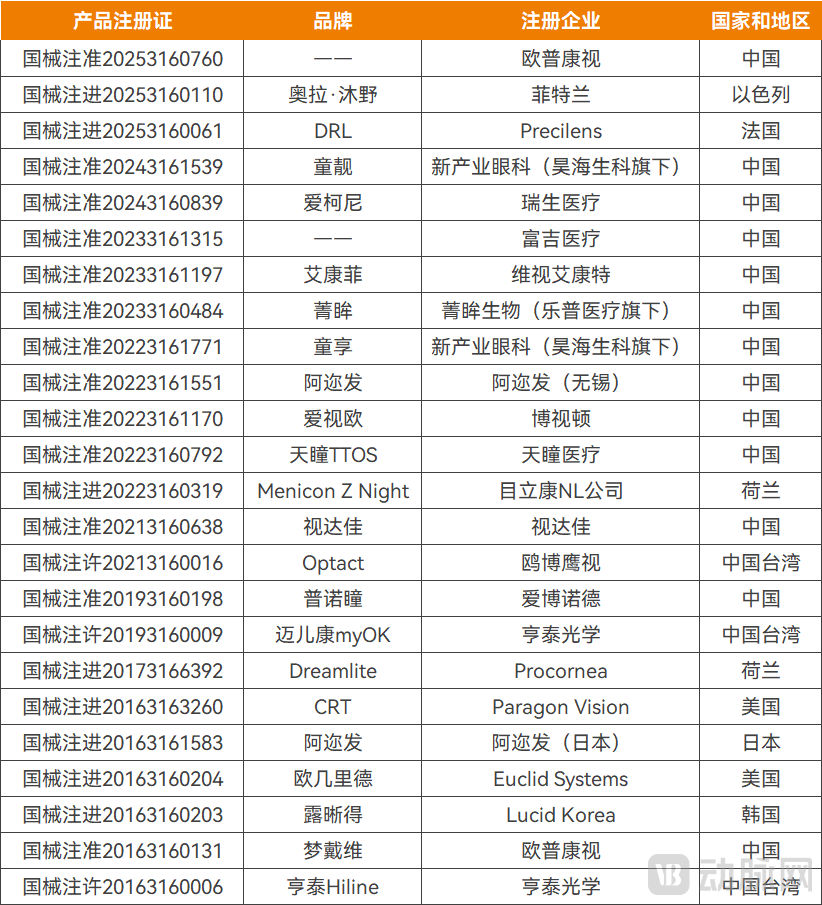
Approved Orthokeratology Lens Products, Data Source: High-End Medical Device Institute Data Center, Corporate Public Information (“—” indicates that relevant public information is not yet available)
Meanwhile, new orthokeratology lens products from companies such as Autek China, Gao Shi Medical, Haohai Biological Technology, Lepu Medical, Liming Vision Care, Shiji Kangtai, Well Sight, and Yande Le are still under development.The number of products will continue to grow.
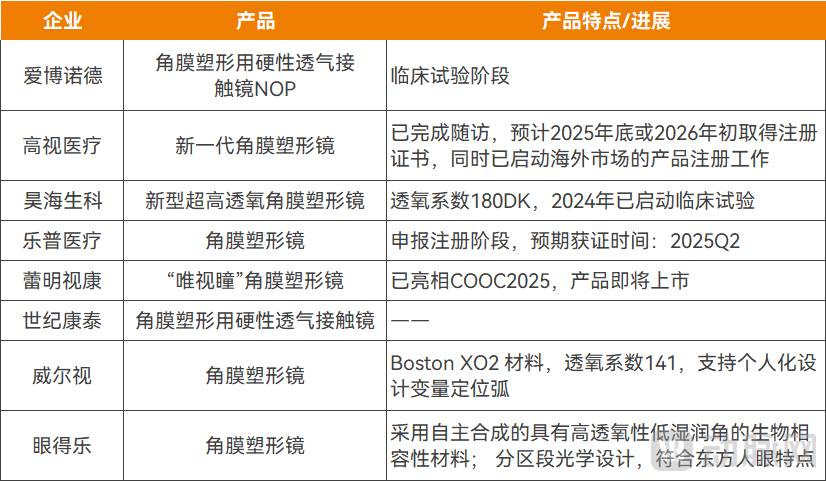
Orthokeratology Lens Products in the R&D Phase, Source: Corporate Financial Reports or Official Websites and Social Media Accounts
For popular imported brands such as Alpha and Euclid, localization has become imperative to achieve cost reduction and efficiency improvement.
Among them, following the commencement of operations at the Alpha Wuxi factory, the domestically produced Alpha orthokeratology lenses were launched in April 2024. Euclid is also advancing its localization efforts, having disclosed clinical trial data for its domestically manufactured orthokeratology lenses at the 2025 COOC conference.
Previously, the delivery lead time for imported orthokeratology lenses ranged from one month to 40 days, whereas domestically produced lenses took approximately one week. Given the rapid progression of myopia in children, prolonged waiting periods for lens pickup may result in significant changes in visual acuity and corneal status. The shift from imported to domestically produced lenses not only better aligns with the admission requirements of public medical institutions and mitigates the definite impacts of tariff wars, but also substantially shortens the delivery cycle, enabling competition on efficiency with increasingly influential domestic brands.
In short,The current orthokeratology lens market has formed a landscape of intense competition within the same product category, while simultaneously vying for market share against other myopia control products.
Correction Range of Marketed Orthokeratology LensesMostWithin -4.00 D of myopia, with astigmatism up to 1.50 D; a few products can also meet higher requirements for myopia or astigmatism.
From another perspective,The growing number of orthokeratology lens brands is undoubtedly beneficial for both physicians and patients. Different products offer enhanced complementarity in terms of functionality, pricing, and other dimensions, providing more options for physicians and patients.
Hu Lan, Deputy Director of the Myopia Control and Pediatric Eye Disease Center at Shenyang He Eye Hospital, introduced that some brands have launched personalized designs, such as aspheric design, small optical zone, and customized defocus amount design. These features allow for the adjustment of lens parameters to meet the myopia control needs of different patients or to enhance control efficacy. Doctors will comprehensively consider factors such as the patient’s corneal topography, refractive error, age, and myopia progression trend to select brands with high parameter compatibility and superior control outcomes. “For instance, custom-designed products are recommended for younger children with rapid myopia progression. Additionally, based on comfort feedback from previous patients, products with higher comfort levels are prioritized for children who are highly sensitive and have low tolerance for foreign body sensation.”
Furthermore, major brands have established their respective price positioning.Among currently marketed products, the end-user price per pair of orthokeratology lenses ranges from approximately RMB 5,000 to RMB 15,000. This wide price spectrum offers patients greater choice, provided that the lenses are properly fitted to their individual parameters.
Amid intensifying competition, establishing differentiated advantages based on core product functionalities has become key for enterprises to further enhance their competitiveness.
First, iterating on materials to further enhance safety by increasing the oxygen permeability coefficient is one of the directions for strengthening product competitiveness.
Safety and efficacy are the two core elements of orthokeratology lenses. Regarding efficacy, Wang Su, co-founder of Remax Capital and Fitland Medical, noted that the myopia control effects of current mainstream products are becoming increasingly similar, with even smaller differences for individual users. Orthokeratology lenses should not follow a path of homogenization; instead, evaluation should shift from single metrics to diversified, multidimensional assessments. In addition to myopia control efficacy, attention must be paid to comfort, safety, dry eye, and the ocular surface microenvironment. Among these, how to further improve ocular surface safety and reduce dry eye issues is becoming increasingly important.
Since the cornea requires oxygen to maintain its transparency, corneal hypoxia can lead to ocular conditions such as eye redness, dry eye syndrome, corneal edema, and corneal ulcers. Therefore, the oxygen permeability (Dk value) of the material is a critical factor for the safe use of orthokeratology lenses.
According to the regulations of the National Medical Products Administration, the minimum oxygen permeability (Dk) value for orthokeratology lens materials is 90.Among previously marketed orthokeratology lenses, the oxygen permeability (Dk) values mostly ranged from 100 to 140. The Menicon Z Night orthokeratology lens, launched in 2023, utilizes Menicon’s proprietary ZOMA material, achieving a Dk value of 163. By 2025, oxygen permeability has entered the “180+” era.
In March 2025, Fitland’s Ora Muyue was launched, featuring an oxygen permeability (Dk) value as high as 180. Clinical trial data demonstrated that, owing to its design incorporating high-oxygen-permeability materials, enhanced peripheral tear exchange, and a deepened central tear reservoir, the product exhibits outstanding performance in oxygen transmissibility, ocular surface safety, and alleviation of dry eye symptoms in children.
In April 2025, Autek China’s new-generation orthokeratology lens received regulatory approval. This product was developed based on Autek China’s proprietary novel material, OVCTEK 200, and features an oxygen permeability (DK) value of 185. To further enhance its competitiveness, Autek China has also completed the development of its third-generation rigid gas-permeable lens material, OVCTEK FX (tentative name), as well as the registration testing for the FX-type orthokeratology lens. The company aims to complete full patient enrollment for the clinical trials of this orthokeratology lens within 2025.
Haohai Biological Technology’s novel ultra-high oxygen permeability orthokeratology lens under development has also achieved a DK value of 180, with clinical trials for this product initiated in August 2024.
Secondly, digital fitting methods are employed to enhance the efficiency of eyeglass dispensing, with fitting parameters supported by visualization and data.
In the traditional fitting process, patients undergo a series of ophthalmic examinations, after which the hospital selects appropriate trial lenses based on the examination data for trial wear. The final parameters are then determined and orders placed according to the trial wear outcomes. Currently, multiple products support digital fitting, enabling lens prescription without trial wear. Digital fitting analyzes corneal morphology and determines fitting parameters based on comprehensive diagnostic data, such as the patient’s refractive error and corneal topography. This approach reduces human error, improves efficiency, and better avoids the risk of cross-infection associated with multiple patients using the same trial lenses.
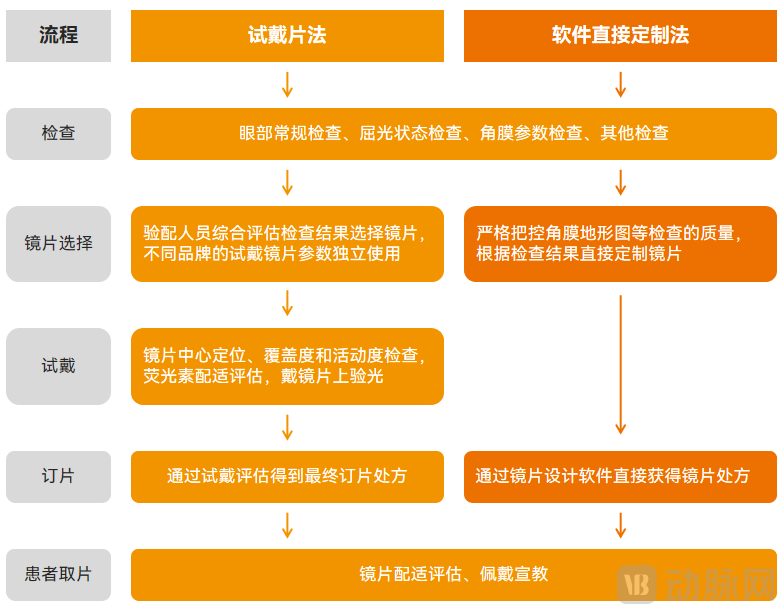
Methods for Fitting Orthokeratology Lenses. Data sources: "Technical Operation Specifications for Fitting Orthokeratology Lenses (2024 Edition)" and interviews.
Public information indicates that brands such as Shidajia, Menicon Z Night, Tongxiang, Aikangfei, Jingmou, and Aikeni all support digital fitting.
Wang Su stated that digital fitting does not completely replace manual fitting, but rather diversifies the fitting methods. “Different medical terminals have varying needs; some prioritize efficiency, while others value service. The choice can be made based on actual circumstances.”
It is understood that orthokeratology lenses from brands such as Fitland’s Ora Muyu and Beixilun Laboratory’s DRL Night offer two fitting methods: digital fitting and trial lens fitting.
Finally, there is still room for improvement in orthokeratology lenses regarding the expansion of indications and meeting personalized fitting needs.
In Hu Lan’s view, most domestically produced lenses still adopt traditional designs, offering limited adaptability for complex cases involving high corneal astigmatism, significant asymmetry, or a predisposition to keratoconus. Currently, their use is restricted to children aged eight and above, resulting in limited capacity to address the trend of myopia onset at younger ages. Therefore, there remains room for improvement in orthokeratology lenses regarding personalization and indications.
She believes that, in addition to the clinical need for products with higher oxygen permeability, there is a desire for further optimization of lens design to achieve personalized and refined customization; upgrading AI fitting software algorithms to reduce the lens replacement rate; and researching hybrid designs for cases involving young children, ultra-high myopia, and complex ocular surface conditions, thereby expanding the scope of correction. “Furthermore, foreign studies have indicated that embedding sensors within orthokeratology lenses can enable real-time monitoring of corneal status, tear film condition, and wearing time, allowing for a more precise assessment of safety and efficacy through data. As technological conditions mature in the future, this may also become a direction for product iteration.”
The market for myopia prevention and control demonstrates significant growth certainty. Policy support, rising myopia prevalence among children and adolescents, advancements in myopia management technologies, iterative upgrades in optometric product materials, and the empowerment of digital tools will all drive market expansion.On May 9, VCBeat will host the “Forum on Digital and Intelligent Upgrading and Innovation in Myopia Prevention and Control” in Suzhou, to share the latest research advances, new monitoring technologies, and technological breakthroughs in myopia prevention and control. You are welcome to scan the QR code below to register:

For orthokeratology lenses, 2025 will witness another critical milestone—two years have passed since the implementation of local centralized procurement, and the next steps in this procurement process will become another significant factor influencing the market landscape.
In 2023, Hebei Province led the Sanming Procurement Alliance in conducting centralized procurement for orthokeratology lenses, covering five provinces and regions as well as members of the Sanming Alliance. Products from five companies were selected, with price reductions of approximately 20%–30%.How will contract renewals proceed after the conclusion of the first cycle of this volume-based procurement (VBP) initiative? Will the scope of VBP be expanded, procurement volumes increased, or even extended to full national coverage? Only time will provide the answers.However, it is certain that competition in the orthokeratology lens market has become more robust compared to the previous two years, and the level of product competition is one of the criteria for initiating centralized procurement.
Under the combined influence of multiple factors, Wang Su believes that the orthokeratology lens market will trend toward upgrading and iteration, with survival of the fittest. Products featuring innovative technologies, breakthrough designs, and new business models will drive industry advancement. As new products launch and technologies evolve, the industry will undergo structural adjustments, with market opportunities increasingly reflected in these structural shifts. “However, orthokeratology lenses and defocus spectacle lenses should not be viewed as competitive substitutes, but rather as complementary components used in combination.In the future, myopia control products will evolve from a single-product model to a comprehensive solution-based model. By offering orthokeratology lenses, defocus spectacle lenses, defocus rigid gas permeable (RGP) lenses, defocus soft contact lenses, and visual function diagnostic training, along with integrated services, this approach will help physicians provide truly personalized and sustained myopia management plans for patients through product upgrades and combinations, without significantly increasing patient out-of-pocket expenses.”
Currently, some companies have capitalized on this trend and are expanding toward comprehensive solutions.
For example, Feitelan has deployed a series of myopia prevention and control products, including myopia management lenses (defocus lenses), orthokeratology lenses, visual diagnosis, and training systems. Ruisheng Medical’s optometry product portfolio includes scleral lenses and defocus lenses, in addition to orthokeratology lenses. Century Kangtai’s optometry product line covers rigid gas permeable (RGP) lenses, scleral lenses, multi-zone micro-perforated defocus lenses, and orthokeratology lenses. After launching orthokeratology lenses, Tiantong Medical introduced high-order aberration defocus lenses. Weiershi has developed a range of products, including orthokeratology lenses, scleral lenses, portable corneal topographers, and intelligent AI fitting systems. VisiAicont has established a product line comprising orthokeratology lenses, defocus lenses, and silicone hydrogel multifocal soft contact lenses.
Among several listed companies, Autek China launched defocus spectacle lenses and is developing defocus soft contact lenses following the market introduction of its orthokeratology lenses. Despite the growth rate of orthokeratology lenses slowing to 8.03% in 2024, the overall revenue from myopia control products increased by 20.79%, driven by an enriched product portfolio. In addition to a series of diagnostic equipment, High Vision Medical’s optometry product lineup includes defocus lenses and rigid gas permeable (RGP) contact lenses. Autek China is also diversifying its product offerings, forming a comprehensive matrix of myopia control products that includes soft defocus contact lenses and defocus spectacle lenses.
From standalone products to comprehensive solutions for myopia control and prevention, multiple products can share market channels, thereby reducing overall sales costs. However, it is undeniable thatIn other product categories, the market landscape has also begun to take shape, with leading enterprises and well-known brands securing certain market positions. Taking defocus lenses as an example, the market features not only several influential imported brands but also strategic deployments by major domestic optical companies.
Even as companies involved in orthokeratology lenses evolve from offering single products to providing comprehensive solutions, they must build sufficiently strong core advantages in their key products to establish a solid market presence.