

Imbria Pharmaceuticals Secures $57.5M Series B Financing to Advance Ninerafaxstat in Phase 2b Trial for nHCM

Imbria
Developer of Cardiometabolic Disorder Treatments
Imbria Pharmaceuticals, a developer of treatments for cardiometabolic disorders, recently announced the completion of a $57.5 million Series B financing round (approximately RMB 419 million).
This funding round was led by Deep Track Capital, with participation from prominent investors including AN Ventures, Catalio Capital Management, and Cytokinetics. Existing shareholders RA Capital Management and SV Health Investors also increased their investments, further bolstering Imbria’s growth.
Why Does Imbria, a Biopharmaceutical Company Focused on Innovative Therapies for Cardiometabolic Diseases, Attract Capital Investment?
1Serial Healthcare Entrepreneurs + Scientific Team with Over 30 Years of Experience
Imbria, founded in 2018 and headquartered in Boston, USA, was established by a team of physicians with both clinical experience and scientific research expertise. The company focuses on translating cell metabolism research into innovative therapies, developing clinical inhibitors to restore patients’ energy metabolism capabilities, thereby addressing unmet therapeutic needs in the field of cardiometabolic diseases.
Dr. Alvin Shih, the current CEO of Imbria, brings extensive experience in the biopharmaceutical industry: he has served as CEO of biopharmaceutical companies such as Catamaran Bio, Disarm Therapeutics, and Enzyvant Therapeutics, and previously held the position of Chief Operating Officer at Pfizer’s Rare Disease Division.
Additionally, Chief Medical Officer Jai Patel has over 30 years of experience in the field of cardiovascular and metabolic therapies. Prior to joining Imbria, he served as Chief Medical Officer at Enterome (focused on the development of microbiome-driven innovative drugs) and NephroGenex (focused on the development of therapeutics for kidney diseases).
Arash Yavari, Chief Scientific Officer, also serves as a Senior Clinical Drug Development Consultant at Weatherden, a London-based biotechnology advisory firm, and is a University Research Lecturer and Principal Investigator in the Department of Medicine at Radcliffe. He has been supporting Imbria’s clinical development since 2019.
The management team and scientists bring extensive medical expertise, providing the team with a clear understanding of the healthcare industry and market. This enables them to focus on drug development and create unique value for the market. The team’s high caliber and professionalism are more likely to inspire investor confidence and drive investment decisions.
Dr. Shih stated that this Series B financing will accelerate the Phase 2b clinical trial of the core drug Ninerafaxstat, which aims to validate its therapeutic potential for energy metabolism disorders in patients with non-obstructive hypertrophic cardiomyopathy (nHCM), bringing hope for a breakthrough in this disease area where no approved therapies currently exist.
2Targeted Novel Drug Developed for 3-KAT, a Key Enzyme in Fatty Acid Oxidation
Imbria’s flagship pipeline product is Ninerafaxstat. This novel cardiac mitochondrial modulator and partial fatty acid oxidation (pFOX) inhibitor has completed Phase 2 clinical trials and demonstrated favorable safety and tolerability in both Phase 1 and Phase 2 studies.
As the only organ in the human body that works ceaselessly, the heart must generate 6 kilograms of adenosine triphosphate (ATP) daily to maintain its pumping function and cellular vitality, an energy consumption ten times that of skeletal muscle. As the cellular energy currency, ATP releases energy through hydrolysis to drive myocardial contraction, and its regeneration efficiency directly determines cardiac function.
Under normal physiological conditions, cardiomyocytes can utilize various substrates to generate energy, with fatty acid oxidation being one of the primary energy-producing pathways. This oxidative process is complex and involves multiple enzymes. Among them, 3-ketoacyl-CoA thiolase (3-KAT) is the final enzyme in the mitochondrial β-oxidation pathway of long-chain fatty acids, functioning in the last step of fatty acid β-oxidation.
Specifically, it catalyzes the cleavage of 3-ketoacyl-CoA molecules to generate one molecule of acetyl-CoA and an acyl-CoA that is two carbon atoms shorter than the original fatty acid. This reaction is a key step in the fatty acid β-oxidation cycle. Through repeated cycles, long-chain fatty acids are progressively degraded into acetyl-CoA, which then enters the tricarboxylic acid (TCA) cycle for complete oxidation, producing substantial amounts of ATP to supply energy to cardiomyocytes.
However, in certain cardiovascular disease states, abnormalities in fatty acid oxidation within cardiomyocytes can lead to an imbalance in myocardial energy metabolism, which may serve as a significant contributor to disease progression. Therefore, regulation of this process is necessary, and pFOX inhibitors represent a key therapeutic approach for achieving such regulation.
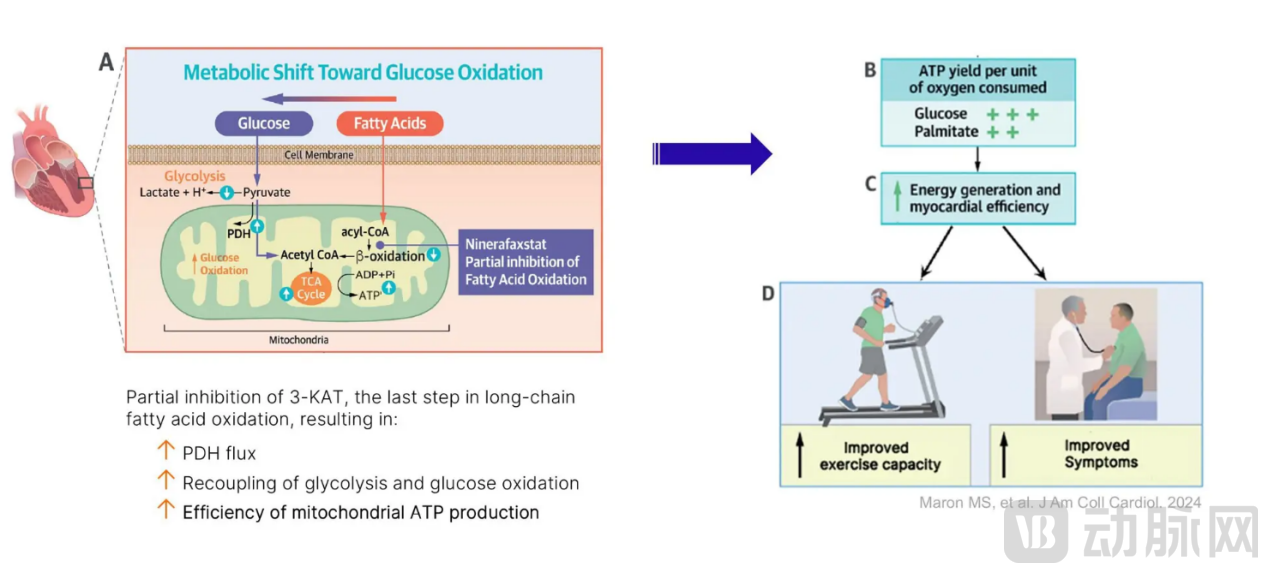 Mechanism of Action of Ninerafaxstat
Ninerafaxstat shares structural similarity with 3-ketoacyl-CoA, the substrate of 3-ketoacyl-CoA thiolase (3-KAT). It competitively binds to the active site of 3-KAT, thereby specifically inhibiting its enzymatic activity and partially suppressing fatty acid oxidation. Upon inhibition of fatty acid oxidation, cardiomyocytes significantly increase their uptake and utilization of glucose, leading to enhanced intracellular oxidative metabolism of glucose.
During this process, inhibition of fatty acid oxidation reduces acetyl-CoA production and correspondingly alters its subsequent flux into the tricarboxylic acid cycle; enhanced glucose oxidative metabolism leads to changes in corresponding metabolic intermediates, thereby optimizing overall metabolic flux within cardiomyocytes.
Glucose oxidation requires less oxygen per mole of ATP generated than fatty acid oxidation. Ninerafaxstat promotes glucose oxidation in cardiomyocytes for energy production, enabling the generation of more ATP under conditions of equal oxygen consumption, thereby enhancing myocardial metabolic efficiency and providing cardiomyocytes with a more ample energy supply.
Simply put, Ninerafaxstat regulates mitochondrial energy metabolism in cardiomyocytes by selectively inhibiting 3-KAT, a key enzyme. This metabolic shift not only enhances ATP production efficiency but also strengthens cardiac function, effectively restoring myocardial energy homeostasis and alleviating symptoms in patients with cardiovascular disease, thereby offering new hope.
Meanwhile, unlike other drugs that modulate myocardial energy metabolism—many of which act on multiple steps of fatty acid metabolism, thereby easily affecting systemic metabolism and causing side effects—Ninerafaxstat selectively inhibits only the final step of fatty acid β-oxidation. This mechanism allows for appropriate regulation of fatty acid metabolism without excessively compromising energy supply, while also promoting glucose utilization by cardiomyocytes. Such a targeted mode of action minimizes interference with the metabolism of other organs. In clinical trials, Ninerafaxstat has demonstrated greater efficacy than conventional therapies in improving cardiac function and exercise tolerance in patients with cardiovascular disease.
3Targeting Three Major Unmet Needs in Cardiovascular Disease: Outstanding Phase II Clinical Trial Data for the Sole Pipeline Candidate
Currently, Ninerafaxstat precisely targets three cardiovascular disease areas with significant unmet needs: non-obstructive hypertrophic cardiomyopathy (nHCM), stable angina, and early-stage heart failure with preserved ejection fraction (pre-HFpEF):
1. Non-obstructive Hypertrophic Cardiomyopathy (nHCM)
Hypertrophic Cardiomyopathy (HCM) is the most common inherited heart disease, with an estimated prevalence of 1:200 to 1:500 in the general population. It is characterized by abnormal thickening of the myocardium, which can lead to various complications. This energy deficit significantly impacts cardiac function, impairing ventricular relaxation and filling, and resulting in symptoms such as dyspnea and reduced exercise capacity.
Non-obstructive hypertrophic cardiomyopathy (nHCM) accounts for one-third of patients with hypertrophic cardiomyopathy (HCM). Its pathological core is disordered myocardial energy metabolism, leading to diastolic dysfunction and microcirculatory impairment. Patients with nHCM experience a high burden of heart failure symptoms and are at risk for adverse disease complications, with approximately 40% progressing to severe heart failure within five years.
In the randomized, double-blind, Phase II clinical trial IMPROVE-HCM targeting symptomatic non-obstructive hypertrophic cardiomyopathy (nHCM), Ninerafaxstat demonstrated breakthrough efficacy. AsThe World's First Mitochondrial Metabolic Modulator Targeting the Heart, the drug achieved positive topline results.
nHCM is a rare disease with no currently approved therapies, while Ninerafaxstat is the first investigational drug to demonstrate improvement in functional endpoints assessed by cardiopulmonary exercise testing (CPET) in patients with nHCM. Its Phase 2 trial provided functional measurements via CPET as well as patient symptom data, which may directly support advancement into Phase 3 clinical development.
2. Stable Angina
Based on available data, the overall prevalence of stable angina in the adult population in the United States is approximately 4%, with about 500,000 new cases diagnosed annually. Stable angina is characterized by recurrent symptoms resulting from reversible imbalances between myocardial oxygen supply and demand, typically manifesting as pain or pressure in the anterior chest, which may be accompanied by fatigue and weakness, thereby affecting patients' health.
Traditional pharmacological management of angina employs a combination of beta-blockers, calcium channel antagonists, and nitrates to reduce heart rate and systolic blood pressure, thereby achieving hemodynamic improvement. However, this approach is limited by a high incidence of adverse reactions and the inability of existing drugs to correct metabolic disturbances in ischemic myocardium, which leads to reduced ATP production.
Therefore, as a first-in-class therapy targeting cardiomyocyte energy metabolism, Ninerafaxstat can improve ischemic tolerance through a dual mechanism. In Phase 2 trials, the safety and anti-ischemic effects of an 8-week regimen of Ninerafaxstat are also being evaluated in patients with stable angina and chronic coronary syndrome, holding promise for providing more precise treatment options for patients.
3. Early Heart Failure with Preserved Ejection Fraction (pre-HFpEF)
Heart failure is a clinical syndrome characterized by the heart's inability to pump blood sufficiently to meet the body's metabolic demands. With the aging of the global population, the incidence of heart failure continues to rise, becoming an increasingly serious health issue. Currently, the number of patients with heart failure with preserved ejection fraction (HFpEF) worldwide has exceeded 30 million, accounting for 56% of all heart failure cases, and energy metabolism defects are a significant factor contributing to disease progression.
Ninerafaxstat has been granted Breakthrough Therapy Designation by the FDA for the treatment of patients with heart failure with preserved ejection fraction (HFpEF) and metabolic abnormalities. Part 2 of its Phase 2 trial evaluated the effects of Ninerafaxstat on cardiac energetics, diastolic function, functional capacity, and heart failure symptoms. Compared with placebo, 12 weeks of treatment with Ninerafaxstat demonstrated statistically significant improvements in cardiopulmonary exercise testing (CPET) measures and patient-reported symptom improvement.
Previously, there were no targeted and effective treatments for these three diseases. Moreover, cardiometabolic disorders are characterized by chronic and irreversible pathological features, significantly impacting patients’ quality of life and overall health. Imbria’s Ninerafaxstat fills this therapeutic gap, offering patients a novel and effective treatment option.
4Blockbuster Drug + Investment Firm: Can Imbria Break the Single-Pipeline Dilemma and Achieve a Market Breakthrough?
Imbria has emerged as a star player in the cardiometabolic therapy sector, driven by the superior performance of its core drug, ninerafaxstat, in Phase 2 clinical trials. These breakthrough data are garnering favor and strategic attention from the capital markets.
As an international venture capital firm specializing in biopharmaceuticals and medical technology, Deep Track Capital centers its investment strategy on clinical-stage innovative therapies, with a particular focus on companies demonstrating breakthrough scientific validation and commercialization potential. As the lead investor in this financing round, it will provide multifaceted support to Imbria.
First is the integration of R&D resources. Deep Track Capital focuses primarily on the therapeutic areas of cardiometabolic diseases, central nervous system (CNS) disorders, and rare diseases, with a preference for supporting the development of innovative drugs that demonstrate clear advantages in clinical data. Its portfolio company, Carmot Therapeutics, specializes in the research and development of innovative therapies for metabolic diseases, cancer, and inflammation; Attovia Therapeutics concentrates on immunomediated diseases and tumor biologics. Both companies have accumulated substantial clinical data and technological achievements in their respective fields.
Through this strategic investment, Deep Track Capital will leverage its extensive R&D resources, professional team, and industry collaboration network from prior investments to comprehensively support Imbria in advancing its research and development efforts, thereby delivering more effective and innovative therapeutic solutions to patients.
Second, commercial synergy and collaboration. Deep Track Capital has long been deeply engaged in the life sciences sector, with extensive investments in rare diseases and metabolic disorders. As a significant shareholder in companies such as Dynavax Technologies Corp. (holding approximately 14.34%) and Sorrento Therapeutics (holding approximately 6.37%), Deep Track Capital has accumulated substantial experience in commercial operations and built an extensive network of industry resources.
Against this backdrop of professional expertise and accumulated resources, Deep Track Capital’s support for Imbria will undoubtedly accelerate the global clinical development of Ninerafaxstat, thereby jointly addressing challenges in the treatment of rare diseases and metabolic disorders, while also driving Imbria’s commercial breakthroughs and enhancing its market competitiveness.
Now that Ninerafaxstat has completed three Phase 2 clinical trials, the continued advancement of its clinical development serves as a significant boost of confidence for the vast population of patients with cardiometabolic diseases. With a promising flagship product and ample R&D funding, Imbria is experiencing robust growth and is well-positioned to capture a substantial market share.
However, amid intensifying competition in the pharmaceutical industry, Imbria still faces challenges. As a small biotech company, Imbria currently relies on a single product pipeline; should Ninerafaxstat encounter obstacles in subsequent development, regulatory approval, or market commercialization, the company’s revenue and growth would be directly impacted.
Compared with pharmaceutical companies that have diversified product portfolios, Imbria is at a disadvantage in terms of risk resistance. To maintain its market competitiveness, the core strategy must focus on developing cutting-edge technologies, enriching its product pipeline, and continuously delivering high-quality products to address patients’ needs.