

Baiyiyuan Bio Secures Tens of Millions in Strategic Financing to Accelerate ECM Material R&D and Market Expansion

BAIYIYUAN BIOTECH
Developer of Biomedical Materials
CMS
Professional Drug Developer
This article is republished with authorization from 36Kr.
Regenerative Medicine CompaniesBAIYIYUAN BIOTECHRecently secured tens of millions of RMB in financing. This round of financing was led by a listed companyCMSExclusive Investment: Funds Raised Will Be Primarily Used for New Product R&D, Market Expansion, and Production Line Upgrades.Mumian CapitalServed as the Chief Financial Advisor for long-term strategy, facilitating a comprehensive equity and product strategic partnership between BAIYIYUAN BIOTECH and CMS.
BAIYIYUAN BIOTECH was established in 2011, specializing in the research and development and production of novel biomedical material products represented by extracellular matrix (ECM) for tissue repair, wound healing, and regenerative medical aesthetics. The company has established a R&D center and a GMP-compliant industrialization base in Shanghai, and obtained High-Tech Enterprise certification in 2019.
Currently, the company focuses primarily on animal-derived tissue regeneration materials based on porcine small intestinal submucosa extracellular matrix (SIS-ECM), continuously expanding its ECM material portfolio across multiple systems, including AAM, to build its proprietary technology platform and product matrix. According to reports, the company’s flagship SIS-ECM is mainly derived from the submucosal layer of porcine small intestine. It exhibits excellent biocompatibility and is rich in collagen and growth factors, capable of inducing cell inward migration, adhesion, growth, and proliferation, thereby playing a significant role in the self-repair and regenerative reconstruction of tissue defects.
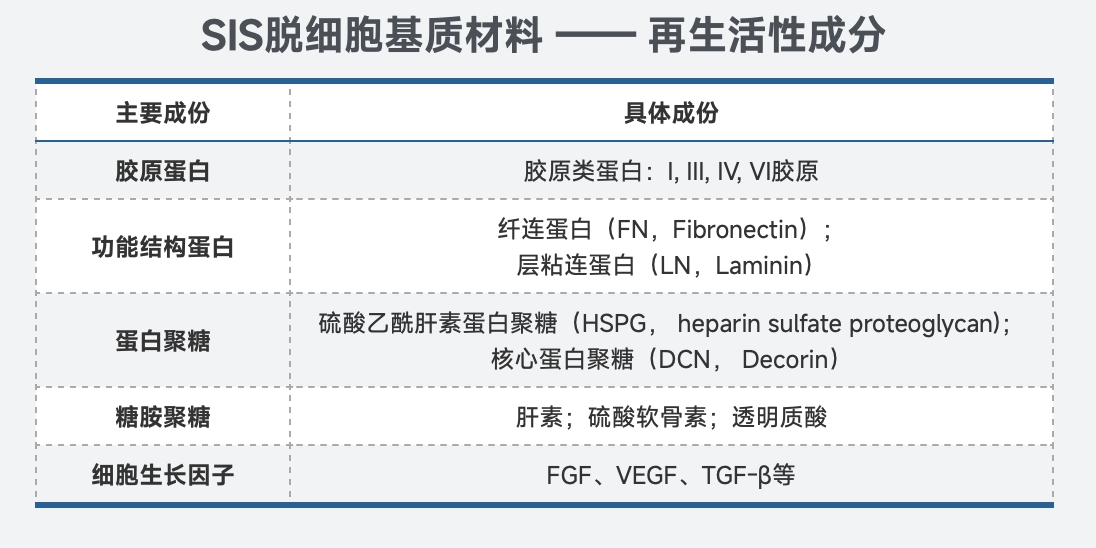
Image source: BAIYIYUAN BIOTECH official website
Dr. Han Baiyi, the company’s founder and chairman, explained that the decision to opt for animal-derived materials, rather than the currently more popular humanized ECM or synthetic biomimetic ECM approaches, was primarily driven by the following considerations. First, from a manufacturing perspective, processes such as decellularization, purification, and sterilization for animal-derived materials are well-established, resulting in products that are less prone to immune rejection while effectively preserving the integrity of the extracellular matrix (ECM). Second, from an application standpoint, animal-derived ECM has already achieved substantial adoption in traditional critical care medical fields, enjoying higher levels of regulatory and market acceptance. Additionally, regarding supply chain stability, animal-derived materials offer relatively stable and secure sources of raw materials.
In light of these considerations, Baiyiyuan Biotech has established two proprietary technology platforms: SIS-ECM (porcine small intestinal submucosa extracellular matrix) and AAM-ECM (acellular adipose matrix). Based on these platforms, the company has developed two core products: an absorbable biological membrane (Baijiangu®) and a dural/spinal meningeal biological patch (Baijianmo®).
The former is primarily used in guided bone regeneration (GBR) for dental implant therapy, where its relatively durable barrier function and regenerative induction capabilities provide an ideal microenvironment for bone regeneration, thereby reducing the incidence of postoperative complications. The latter is designed for neurosurgical applications, suitable for dural repair and reconstruction to lower the risk of postoperative infection. Clinical data provided by BAIYIYUAN BIOTECH show that, compared with similar imported products, Baijiangu® absorbable biological membrane demonstrates a bone volume loss rate of approximately 3–5% within the same period following GBR procedures, whereas imported products exhibit a loss rate of around 10%.
It is reported that both products have entered the commercialization stage and have been listed on provincial procurement platforms across 24 provinces in China. In 2024, their first full year of sales, they generated revenue exceeding RMB 10 million.
Notably, in addition to its applications in traditional medical fields, Baiyiyuan Biotech is also developing ECM-based materials for medical aesthetic fillers and skin boosters. The SIS-ECM filler product is nearing the completion of clinical development, with the product registration application expected to be submitted this year.
The application of ECM materials in the field of medical aesthetics for anti-aging has been a research and development hotspot in the medical industry in recent years. In the past, the “evolution” of medical aesthetic materials basically went through several stages: filling (physical support and filling), nourishment (supplementing nutrients via the mesoderm), and stimulation (such as polymers like PLLA [Sculptra] and PCL+CMC stimulating collagen progenitor cell regeneration). The industry generally believes that the future direction of development will undoubtedly be “regeneration,” meaning that it will no longer involve simple supplementation, but rather utilize biomedical engineering technologies to “achieve repair and regeneration of defective tissues.”
The core value of ECM materials lies in their structural and functional similarity to the human cellular microenvironment, which leverages the body’s innate repair capacity to enable tissue and organ regeneration. “Collagen stimulators such as PLLA primarily exert their effects through inflammatory responses, making them more prone to complications like nodule formation. This is why they are often criticized for causing issues such as granulomas and excessive facial fullness. In contrast, ECM materials trigger normal cellular activity upon entering the body, leading to the production of ‘normal,’ functional collagen,” explained Shen Chenye, COO of Baiyiyuan Biotech.
“In the past, our ECM materials have already been applied in the field of serious medical care. As we expand into the medical aesthetics sector, our core focus remains leveraging our advantages in material science to ‘implant’ this favorable cellular growth environment into the human body. We are not limited by specific indications, but rather by the ultimate efficacy achieved by the product,” stated Dr. Han Baiyi.
From a market perspective, although there are numerous precedents for the application of ECM materials in the medical aesthetics sector overseas due to regulatory differences, large-scale adoption in mainland China may still be some way off.
In response, BAIYIYUAN BIOTECH stated that while ECM materials “may represent a novel application in the medical aesthetics sector,” their use in traditional, serious medical care is already widespread. “Market awareness is gradually increasing, and the core issue going forward will primarily hinge on the regulatory authorities’ stance and pace of review and approval. In this regard, BAIYIYUAN BIOTECH has previously obtained approvals for two products, giving us considerable experience in securing regulatory clearance. We believe that ECM materials will soon enter the medical aesthetics market,” said Shen Chenye.