

Trump's 'Most Favored Nation' Drug Pricing Policy: Limited Impact on Chinese Innovative Pharma
Beijing Time, May 12, 2025, 21:00,U.S. President Trump Formally Issues “Most Favored Nation Policy” via Executive Order, Mandating That U.S. Prescription Drug Prices Be Aligned with the “Lowest Global Price,” with Drug Prices Expected to Drop Immediately by 30% to 80%。
In fact, this is not the first time Trump has taken aim at U.S. drug prices. As early as 2020, during his first term, Trump introduced the “Most Favored Nation” (MFN) policy, which sought to ensure that the drug prices paid by Medicare would not exceed the lowest prices in other developed countries, with a phased implementation plan over three years. However, this promise was not fulfilled; U.S. pharmaceutical companies subsequently filed lawsuits alleging improper rulemaking procedures, ultimately leading to the policy being halted by a federal court.
Trump was not resigned to this. After assuming office for his second term, he initially extended certain provisions of the Biden administration’s Inflation Reduction Act (IRA), allowing Medicare to negotiate drug prices directly with pharmaceutical companies. In recent weeks, Trump has taken a series of additional actions targeting drug prices, including urging House Republicans to mandate lower drug prices for medications covered under Medicaid. Late last night (Beijing time), Trump formally reinstated the “Most Favored Nation” policy through an executive order.Commit to ensuring that U.S. prescription drug prices do not exceed the lowest price paid by any other country.。
The reason Trump is so insistent is that, in his view,The United States Has Long Been the Sole “Sucker” Shouldering the High R&D Costs of Global Innovative Drugs. According to the 2024 report issued by the Office of the Assistant Secretary for Planning and Evaluation (ASPE) under the U.S. Department of Health and Human Services (HHS),In 2022, the prices of all drugs (brand-name and generic) in the United States were nearly three times the average prices in 33 comparator countries.For every $1 spent on prescription drugs in other countries, U.S. consumers pay $2.78. Ultimately, all these exorbitant costs are borne by the U.S. healthcare system, which is one of the core reasons why its healthcare expenditures remain persistently high.
In this regard,Trump considers the “Most-Favored-Nation Policy” to be one of the most important and influential policies he has ever implemented.. The policy also triggered an immediate and strong reaction in the Chinese stock market. It is reported that on the Shanghai and Shenzhen stock exchanges, the share prices of Baili Tianheng, Zeltis Pharma, and Salubris declined to varying degrees; innovative drug stocks listed in Hong Kong also fell in response—during trading, shares of CStone Pharmaceuticals, Ascentage Pharma, Laekna Therapeutics, Alphamab Oncology, Bio-Thera Solutions, Ascletis Pharma, Eddingpharm, and Yiming Biopharma dropped by more than 8% at one point.
This is only short-term feedback,From a longer-term perspective, will mandatory price cuts in the US ultimately be a tailwind or a headwind for China’s innovative drugs?This warrants in-depth investigation.
The benefits far outweigh the risks
In the past year or two, business development (BD) deals for innovative drugs in China have been exceptionally active, with U.S. pharmaceutical companies emerging as the largest payers. According to research reports, Chinese pharmaceutical companies completed a total of 94 license-out transactions in 2024, among which up to 44 were directly related to U.S. pharmaceutical companies, accounting for 47%.
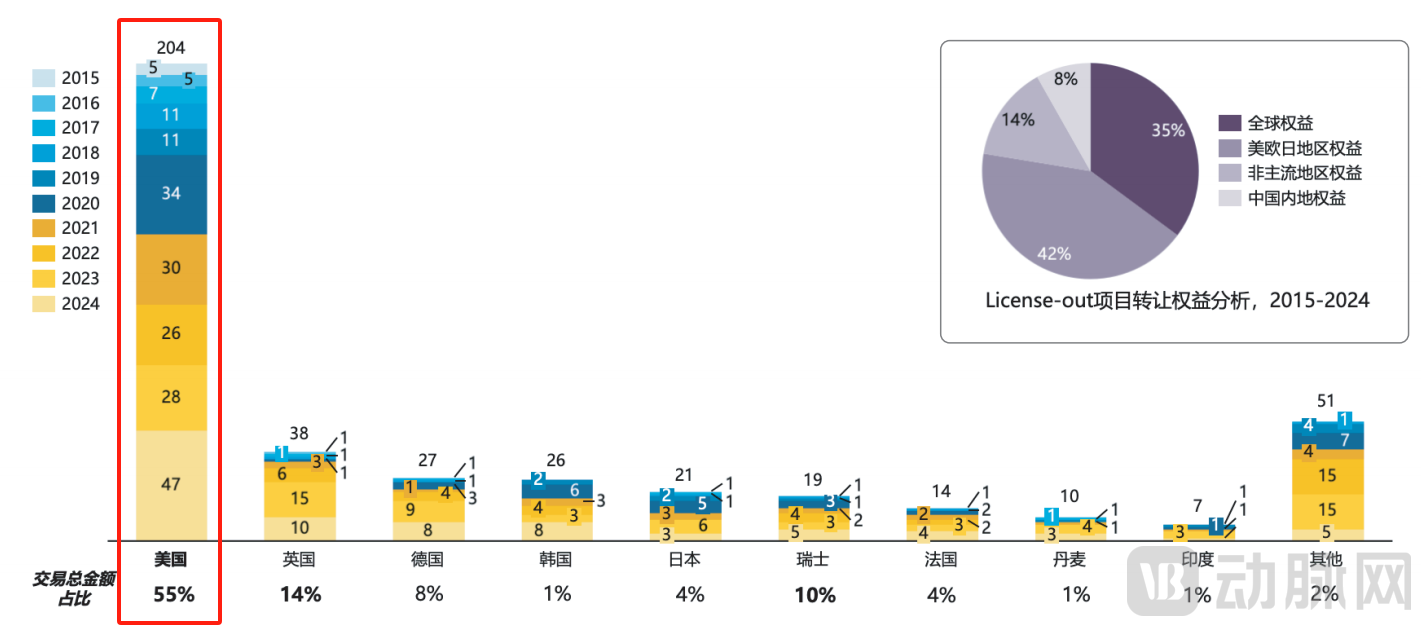 Distribution of License-out Transaction Transferees and Transferred Rights Among Chinese Pharmaceutical Companies, 2015–2024
(Source: PharmaCube NextPharma® Database)
Therefore, if the “Most-Favored-Nation (MFN) policy” is implemented, the overall revenue of U.S. pharmaceutical companies will be significantly compressed, leading to further implementation of cost reduction and efficiency enhancement measures. This means thatIn future in-licensing of innovative drugs from BD China, US pharmaceutical companies may adopt a more cautious approach, placing greater emphasis on profit margins when evaluating projects and prioritizing high-margin products or differentiated therapies with stronger pricing appeal.. Additionally, during the transaction process,U.S. pharmaceutical companies may further significantly compress the revenue expectations of Chinese pharmaceutical companies from licensing deals, such as by reducing upfront payments, milestone payments, or sales royalty rates.。
From the perspective of many industry professionals, this is an objective reality that is bound to exist. However, it is important to emphasize thatThis primarily affects large-value transactions., for BD deals with an upfront payment of only tens of millions of dollars, this will not hinder the transaction process; instead, it will, to some extent, facilitate it.
In this regard, Li Rui, a partner at Niukou Capital, remarked, “Following the significant price reductions,”To control “in-licensing costs,” U.S. pharmaceutical companies may increasingly turn their attention to innovative drugs from China, as the Chinese innovative drug pipeline is arguably the most cost-effective, highest-quality, and fastest-to-develop globally, fully meeting the business development (BD) needs of U.S. pharma firms.. Conversely, some small biotech firms in Europe and the United States may face widespread closures, as their generally high R&D costs make them more likely to be abandoned by U.S. pharmaceutical companies.”
Second, U.S. pharmaceutical companies will inevitably compress costs across the entire pharmaceutical supply chain. Discounts in the wholesale and retail processes from manufacturers may be recouped, and R&D costs will also be significantly reduced. This means thatThe R&D Status of Emerging Markets Such as China Will Rise Significantly. Driven by the same cost-containment logic, clinical trials for innovative drugs in China benefit from lower costs, faster patient enrollment, and higher R&D efficiency,Therefore, U.S. pharmaceutical companies may establish more R&D centers and manufacturing facilities in China, which could bring certain benefits to the domestic CXO sector.。
Under such market conditions, a new “NewCo” model is emerging: the “Hybrid NewCo.” In fact, compared to the currently mainstream “American NewCo” model—which involves fully licensing Chinese innovative drug rights to the U.S. and conducting clinical development there—the “Hybrid NewCo” clearly offers greater cost-effectiveness under the new market logic.
Specifically, according to Li Rui, a partner at Button Capital, “Unlike the traditional American NewCo model,The most distinctive feature of Hybrid NewCo is that its clinical trials are primarily conducted in China, complemented by a management team predominantly composed of Chinese professionals, which will significantly reduce R&D costs.“This means that Hybrid NewCo requires less capital, resulting in lower investment costs for investors, thereby increasing the certainty of profits for all NewCo shareholders in future transactions and delivering higher returns.”
Then, at the pricing level, because the “Most-Favored-Nation Policy” requires that U.S. prescription drug prices must not exceed the lowest price paid by any other country,China is, in fact, one of the markets with the lowest prices globally for U.S. pharmaceutical companies., for instance, the prices of several blockbuster drugs in the Chinese market, such as Merck’s liver cancer drug and AstraZeneca’s lung cancer drug, have fallen to their lowest global levels. Therefore, to balance revenue,U.S. pharmaceutical companies may abandon their long-standing “low-margin, high-volume” strategy in the Chinese market and opt for moderate price increases.。
However, this is not entirely a “bad thing,” as it will further accelerate the substitution process with domestically produced innovative drugs. Consequently, more capital will flow into the innovative drug sector, significantly improving R&D efficiency and thereby markedly enhancing the global competitiveness of Chinese innovative drugs.
Furthermore, from the perspective of global active pharmaceutical ingredient (API) production, China's API manufacturing capacity accounts for 30% of the global total. Moreover, based on factors such as raw materials, labor, process efficiency, supply chain management, and the policy environment,Lower Costs, Higher Quality: Chinese API Sector Poised for Greater Benefits。
Finally, it is worth mentioning the potential overseas expansion opportunities presented by generic drugs and biosimilars.. It is reported that Trump’s “Most-Favored-Nation Policy” includes provisions to reexamine the balance between pharmaceutical patent protection and generic drug access, accelerate the approval processes for generic drugs and biosimilars, and thereby increase market competition to achieve a significant reduction in drug prices. This implies that new development opportunities will emerge for generic drugs and biosimilars in the United States.
Looking at the Chinese market in reverse, the substantial supply-demand gap may present new overseas expansion opportunities for Chinese manufacturers of generic drugs and biosimilars, particularly in high-demand sectors such as monoclonal antibodies, GLP-1 receptor agonists, and biosimilar insulins. However, it is worth noting that as generics and biosimilars from the United States enter the market on a large scale, quality standards will continue to rise, potentially significantly compressing profit margins. This trend imposes stricter requirements on Chinese-made generics and biosimilars in terms of cost control.
Overall, while the release of Trump’s “Most-Favored-Nation Policy” may have some adverse effects on China’s innovative drugs in certain aspects, the benefits still outweigh the drawbacks on the whole. In this regard, a senior investor told VCBeat, “This is, in effect, providing China’s innovative drug sector with unprecedented development opportunities.”。
Let the Bullets Fly for a While
Following the release of the “Most-Favored-Nation Policy,” domestic pharmaceutical companies have been engaged in intense discussions on how to respond next; however, in the view of some seasoned experts,It is too early to act now.。
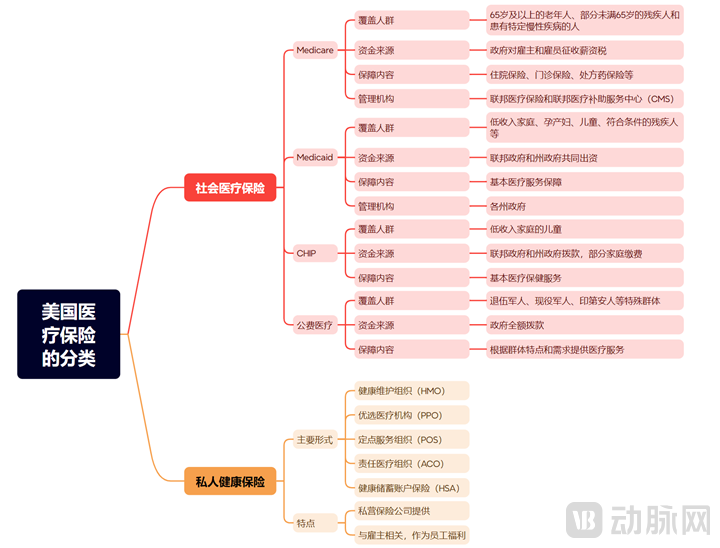
Classification of U.S. Health Insurance: Social Health Insurance and Commercial Health Insurance (Image source: 13 Actuaries)
From the perspective of the source of price reductions, ““The Most Favored Nation Policy” can control the drug prices paid by the government under medical insurance.such as Medicare Parts A, B, and D, 340B, and Medicaid,Together, they account for approximately 48% of the U.S. market.. Meanwhile, another large uncontrolled segment is dominated by commercial health insurance, covering more than 200 million Americans; this means that“The Most-Favored-Nation Policy” can actually only affect half of the drug price market, with the other half still left to market-based pricing.。
On the other hand, consideration is given to the feasibility and extent of policy implementation. First,“Most-favored-nation policy” is unlikely to result in actual commercial deployment; rather, it should be viewed as one of the Trump administration’s political maneuvers., much like the recently highly publicized “U.S.-China tariff war,” which may ultimately prove to be a farce that fizzles out. In fact, “much ado about nothing” has long been a habitual tactic of the Trump administration, and it remains uncertain how much of its rhetoric will actually be fulfilled.
Secondly,The 30% to 80% drug price reduction cited in the “Most-Favored-Nation Policy” is overly exaggerated.After all, the United States is the world’s largest pharmaceutical market. In 2023, U.S. healthcare expenditure reached $4.9 trillion, accounting for 17.6% of its GDP. Therefore, significant price reductions would inevitably have a substantial impact on its market economy, further exacerbating its global debt burden. For the United States, such a move would entail costs outweighing the benefits.
Finally, from the perspective of vested interests, the pharmaceutical industry has always been one of the most untouchable domains for the U.S. government, as it is underpinned by a vast chain of economic interests involving pharmaceutical companies, insurance providers, and even some of the world’s top financial conglomerates. Consequently, the introduction of the “Most-Favored-Nation policy” triggered widespread opposition in the U.S. market. For instance, Alex Schriver, Senior Vice President of the Pharmaceutical Research and Manufacturers of America (PhRMA), heavily criticized Trump, stating, “As we face intensifying competition from China, policymakers should focus on fixing the flaws in the U.S. system rather than importing failed policies from abroad..” In addition, well-known blogger Ed Klassens also bluntly claimed that “This Is Just Another Lie from the Trump Administration”. This means that the subsequent advancement of the “most-favored-nation policy” will be extremely difficult.
Therefore, many industry experts believe that the full implementation of the “Most-Favored-Nation (MFN) Policy” in the U.S. market is highly unlikely. Even if, against all odds, it were ultimately implemented, the overall price reduction for pharmaceuticals would likely range from only 1% to 10%, rather than seeing substantial declines. Thus,For domestically developed innovative drugs, adopting a wait-and-see approach is currently the best strategy.。
However, it is also important to recognize that both the previously intense “U.S.-China Tariff War” and the currently high-profile “Most-Favored-Nation Policy” are, in essence, sending a key message to domestically produced innovative drugs:To “survive” in the current turbulent global market, it is essential to demonstrate one’s value through new differentiators, such as globally leading R&D progress, clinical data that benchmark favorably against global standards, or significantly higher global sales. This has always been the enduring market logic for innovative drugs.。
1. “Trump Reinstates ‘Most Favored Nation Drug Pricing Order’: What Is the Impact on Chinese Biopharmaceutical Companies Expanding into the U.S. Market?” — Dabao Yao Wen;
2. “Major Boon for the Pharmaceutical Industry, Treated as a Ghost Story” — Gazelle Society;
3. “‘Immediate 30% to 80% Drop’: Trump Suddenly Posts That the U.S. Will Save Trillions of Dollars! Shares of Japan’s Three Major Giants Plunge, Shaking the Entire Industry? Insiders Weigh In” — National Business Daily.