

Shangke Bio: Deepening Expertise in Biocatalysis and Synthetic Biology with Integrated R&D, Manufacturing, and Commercialization Platforms
Currently, the integration of synthetic biology with traditional chemical engineering is driving a revolutionary transformation in synthesis processes. Among these advancements, biocatalysis represents a significant innovation in compound synthesis. By leveraging natural enzymes and engineered novel enzymes as catalysts, enterprises can achieve more efficient and environmentally friendly chemical reactions.
These enzymes are being extensively applied in fields such as pharmaceutical intermediates, cosmetics, food, agriculture, and textiles, creating a vast blue-ocean market. According to market research by Cognitive Market Research, the global biocatalysis market size was $81.5422 billion in 2024 and is projected to expand at a compound annual growth rate (CAGR) of 5.5% from 2024 to 2031. The Asia-Pacific region accounts for approximately 23% of global market revenue, with a market size of about $18.755 billion in 2024 and a CAGR of 7.5% from 2024 to 2031.
Taking the application of biocatalysis in the pharmaceutical industry as an example. In recent years, R&D and production models emphasizing “cost reduction and efficiency enhancement” and “green and environmentally friendly practices” have been frequently discussed in the pharmaceutical sector. Among these, biocatalysis technology has demonstrated outstanding performance in helping the industry reduce costs and improve efficiency. In the pharmaceutical field, enzyme catalysis technology has been applied to drug synthesis, particularly in the synthesis of complex natural products and drug molecules, where the high selectivity and specificity of enzymes exhibit unique advantages.
Overseas, leading multinational corporations (MNCs) such as AstraZeneca, Eli Lilly, GSK, Johnson & Johnson, Merck, and Pfizer have long been implementing green chemistry research in the pharmaceutical industry. Meanwhile, domestic companies are also making rapid strides in this field, with Shangke Biological Medicine (Shanghai) Co., Ltd. (hereinafter referred to as “Shangke Bio”) standing out as a representative enterprise.
Achieved break-even within three years of transformation,
Achieved a complete closed-loop from product R&D to commercialization
Shangke Biopharma, established in 2007, specializes in the development and application of bioenzymes, biocatalysis technologies, and synthetic biology. The company boasts platforms for bioenzyme development, drug synthesis process development, and drug quality research, staffed by experienced scientists. It has gained significant recognition and competitiveness in key fields such as biocatalysis, chemo-enzymatic synthesis processes, development of pharmaceutical intermediates and active pharmaceutical ingredients (APIs), fermentation and protein purification, and synthetic biology.
As one of the earliest companies in China to strategically position itself in enzyme catalysis and among the first batch to commercialize this technology, Shangke Biological has experienced numerous critical milestones in both industry development and corporate growth, with three being particularly significant.
The first point is the change in the company's positioning.At its inception, Shangke Biological Medicine’s core business was providing CRO services, such as enzyme development, to downstream enterprises. Starting in 2012, the company transformed from a service-only provider into a full-chain enterprise integrating product development, manufacturing, and sales. Notably, Shangke Biological Medicine decided to undergo this transformation in 2012 and achieved break-even within three years, by 2015.
The second point is the establishment of Zhejiang Shangke Biology and its reverse acquisition of Shanghai Shangke Biology.After Shanghai Shangke Biological decided to transform from a service-oriented enterprise into a product-plus-service enterprise, it did not actually have its own production base. Based on the need for an industrialized production base, in 2017, Zhejiang Shangke BiologicalSetLi, and used this entity as the parent company to execute a reverse merger with Shanghai Shangke Biological. Furthermore, in line with its development needs, Shangke Biological subsequently acquired Supor Pharmaceutical and Hangkang Pharmaceutical, thereby establishing a complete closed-loop business ecosystem encompassing R&D, manufacturing, formulation, and sales.
The third point is that Zhejiang Shangke Biotechnology's new factory began production in 2023.It is reported that Zhejiang Shangke Biotechnology has made a total investment of RMB 1 billion, covering an area of 230 mu, with its facilities constructed in strict accordance with GMP standards. The base comprises five API workshops, two fermentation workshops, one food-grade raw material workshop, three formulation workshops, two multi-purpose API workshops, and one oncology API workshop. It is equipped with over 40 fermentation units and more than 200 pieces of chemical equipment, and commenced operations at the end of 2023.
Clearly, the aforementioned milestones in Shangke Biological Medicine’s development have all revolved around its industrial transformation and the associated needs.
Regarding the firm’s unwavering decision to pivot, Dr. Zhu Wei, co-founder of Shangke Biological Medicine, explained, “If Shangke Biological Medicine had remained focused on the CXO sector, where many leading companies have already emerged in China, it would have been difficult to achieve further breakthroughs. Furthermore,”“Enzyme development services are inherently non-recurring in nature; companies must secure subsequent orders immediately after completing one project to generate substantial sales revenue. Therefore, based on our industry analysis and future projections, our team has decided to leverage enzymatic technologies for product development. This approach not only offers cost advantages but also enables the generation of recurring revenue streams through product sales.”
Three Major Technical Platforms: Chemistry, Biology, and Quality
Integration of Services and Production
After years of development, Shangke Biological Medicine has established multiple technical platforms to support its product manufacturing and service provision. Its core technical platforms primarily include three major areas—biology, chemistry, and quality—along with a GMP production platform.
Biotechnology PlatformThis platform, equipped with comprehensive R&D capabilities spanning from upstream strain construction to downstream separation and purification, can be utilized for the development of synthetic biology technologies, enzyme development and applications, and enzyme production. Leveraging this platform, Shangke Biological Medicine offers a one-stop service portfolio ranging from CRO to CMO, including library construction, strain engineering, enzyme screening, optimization of biotransformation processes, enzyme evolution, enzyme immobilization, and commercial-scale enzyme manufacturing. To date, Shangke Biological Medicine has cumulatively developed over 60 series of enzyme products, comprising more than 10,000 individual enzymes.
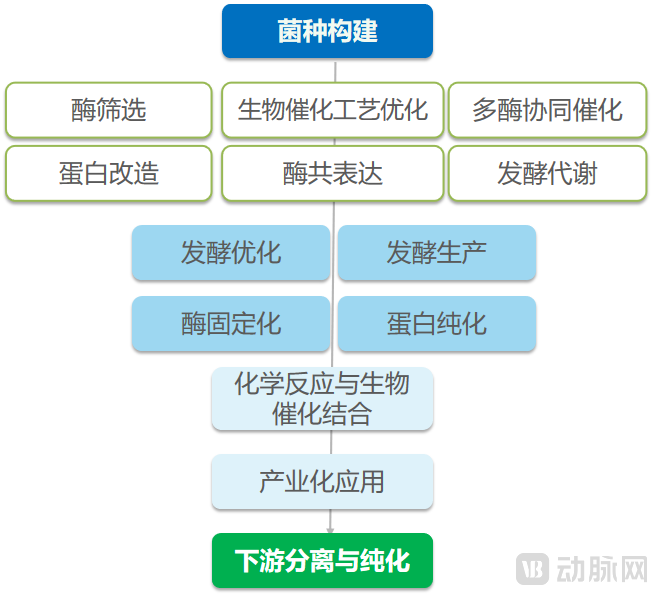
The R&D capabilities of Shangke Biotechnology's biotechnology platform,
Image source: Shangke Biological
Chemical Technology PlatformCapable of synthesizing various small-molecule chemicals, including pharmaceutical intermediates, active pharmaceutical ingredients (APIs), and small molecules for foods for special medical purposes. Dr. Zhu Wei emphasized, ““In China, there are many teams capable of chemical synthesis and many skilled in enzyme development; however, only a few can innovatively integrate enzymatic catalysis with chemical synthesis.”Shangke Biologics is one of the few such teams. Leveraging this platform, Shangke Biologics provides technical services for small-molecule drugs, ranging from route design to synthesis process development and optimization; one-stop custom development and manufacturing services for small-molecule APIs from preclinical to commercial stages; and CMO services from non-GMP to GMP compliance.
Quality Technology PlatformInternally, it is responsible for quality research and quality control of the company’s products; externally, it provides analytical testing services. Since 2011, Shangke Biological Medicine (Shanghai) Co., Ltd. has undertaken, managed, and operated the “R&D Public Service Platform of Shanghai International Medical Zone.” All instruments available on this platform are open to external users, providing many enterprises within the park and even from other provinces with services ranging from structural identification to analytical method development, as well as protein purification and impurity isolation and purification services.
GMP Production Platform Capable of Manufacturing Biological Enzymes, Intermediates, Active Pharmaceutical Ingredients (Including Peptide Drugs), Food-Grade Raw Materials, and Pharmaceutical Formulations.
Leveraging its core technology platforms, Shangke Biological has evolved into a science and technology innovation enterprise integrating research and development, manufacturing, and sales. It not only provides high-quality products to customers but also offers premium technical development and manufacturing services to the industry. To date, Shangke Biological has become one of the leading global suppliers of NMN, NAD, NADH, NADP, and NADPH, as well as a major global supplier of intermediates for drugs such as ibrutinib, crizotinib, and glipans. The company has established cooperative relationships with over 1,000 domestic and international clients, including Novartis, Lonza, Sanofi, Cipla, Sandoz, Teva Pharmaceutical, Alkem Laboratories, and FIS.
NMN Raw Material Novel Food Application
Has entered the EFSA risk assessment phase
Regarding the development of the bioenzyme sector, Dr. Zhu Wei stated, “The industry still faces numerous bottlenecks at this stage.”
For example, many enzymes currently used are derived from natural sources and can only tolerate relatively low substrate concentrations. Consequently, their stability, selectivity, and tolerance often need to be enhanced through engineering. However, the current enzyme engineering cycle is lengthy, ranging from as short as three months to as long as two years. This prolonged development timeline increases companies’ R&D investment and hinders the industrial application and advancement of enzyme products.
For another example, immobilized enzyme technology is currently the most commonly used method in industry for enzyme engineering. However, this technology also has its bottlenecks. Dr. Zhu Wei told VCBeat, “Not all enzymes can be modified using immobilization techniques. Some enzymes experience a significant reduction in activity, or even lose their activity entirely, after immobilization, rendering them unsuitable for industrial applications.”
Furthermore, a subset of enzymes faces the critical challenge of being theoretically capable of catalyzing reactions but practically unviable for industrial-scale application. This bottleneck fundamentally stems from the need to optimize and iterate existing enzyme engineering methodologies.
Addressing the common bottlenecks across these industries, Dr. Zhu Wei candidly stated, “There are no clear short-term solutions or shortcuts to alleviate these pain points. We can only rely on our years of industrial accumulation to gradually optimize and resolve these bottlenecks.”
Dr. Zhu Wei further told VCBeat, “Regarding the first issue, Shangke Biological Medicine has accumulated over a decade of industry experience, with an enzyme engineering cycle of approximately three to six months. Although this timeline is not short, we achieve a high success rate in enzyme modification. In response to the second issue, Shangke Biological Medicine has established a specialized team for enzyme immobilization screening to continuously improve the success rate of enzyme immobilization. To address the pain point that enzymatic catalysis often struggles to achieve industrial-scale application, Shangke Biological Medicine chooses to collaborate with external research institutions, leveraging their R&D capabilities to overcome these challenges.”
By adhering to an approach that avoids shortcuts and addresses industry challenges one by one, Shangke Biological has gradually established a leading position in the industry over years of development, achieving milestone accomplishments recognized globally.
In May 2022, Shangke Biological’s NMN (β-nicotinamide mononucleotide) raw material successfully obtained approval from the U.S. FDA as a New Dietary Ingredient (NDI). Notably, Shangke Biological is the first manufacturer worldwide to secure FDA NDI approval for NMN raw materials. In 2024, Shangke Biological submitted a Novel Food application for its NMN raw material to the European Union and passed the initial review by the European Food Safety Authority (EFSA) within the same year. This February, official information released by the European Commission indicated that the Novel Food application for Shangke Biological’s NMN raw material has formally entered EFSA’s risk assessment phase, with the evaluation deadline expected to be September 2025.
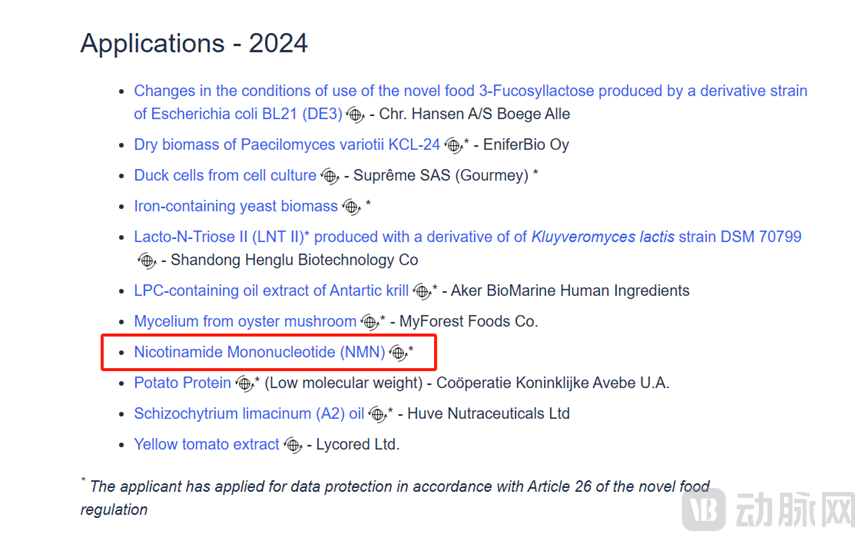
Shangke Biological’s Novel Food application for NMN raw materials has officially entered the risk assessment phase at EFSA,
Image source: Official website of the European Commission
NMN is a naturally occurring molecule involved in numerous human energy metabolism processes, holding immense market potential. Studies have shown that NMN offers significant benefits, including anti-aging effects and promotion of cardiovascular health, making it one of the most sought-after active ingredients in the current functional food ingredient market. Shangke Biological was the first to develop enzymatic technology for NMN production, achieving large-scale manufacturing under a GMP-compliant system. Its product appears as a white crystalline powder with a purity of ≥99.9%, demonstrating significant advantages in efficacy and stability compared to similar raw materials. Currently, Shangke Biological’s NMN raw material has completed multiple GLP toxicology tests, ensuring a higher level of safety.
Regarding future development, Dr. Zhu Wei stated, “Shangke Biological Medicine will continue to focus on the biopharmaceutical sector, leveraging chemical technologies and enzyme engineering to develop a broader portfolio of enzyme products. Meanwhile, we will maintain exchanges and collaborations with leading global enterprises to undertake more CXO services. In the future, Shangke Biological Medicine will continue to integrate services with manufacturing, contributing to the development of the green biopharmaceutical industry.”