

From Exoskeletons to Humanoid Robots: The Medical Industry Steps into the Forefront of Embodied Intelligence

Fourier
Intelligent Robot Developer
Much like the fervor surrounding smart wearable devices in their heyday, embodied intelligence—represented by humanoid robots—is sweeping across industries at a visibly rapid pace.
Since “embodied intelligence” was included in the Government Work Report for the first time this year, upstream and downstream segments of the industry chain have accelerated their collaboration within just a few months. Governments, medical institutions, and research institutes in many regions have established partnerships with industry players, spontaneously initiating explorations into embodied intelligence.
Under these circumstances, numerous research institutions have expressed optimism about the prospects of embodied intelligence. Witnessing the success of large medical models, the industry expects that embodied intelligence will also surpass traditional technologies to more effectively empower the healthcare sector.
Indeed, technological breakthroughs in large models, generative AI (GenAI), and core components such as frameless torque motors and harmonic reducers have pushed embodied intelligence to a new inflection point. However, for tech companies to establish a firm foothold in the healthcare sector with these technologies, the technologies themselves must be innovative and cutting-edge, while also ensuring that products can be seamlessly integrated into existing medical workflows and are highly adapted to specific clinical scenarios.
Fourier, as one of the earliest enterprises to deeply cultivate intelligent robotics technology, is also engaged in this exploration of integrating frontier technologies with application scenarios.
In 2015, when the intelligent robotics industry was still in its early stages of development, Fourier entered this sector. At that time, the company chose rehabilitation robotics as its starting point and targeted exoskeleton robots as its first key product to develop.
Frankly speaking, at that time, entering this track was not a choice that maximized benefits, whether in terms of market demand or technological maturity, but Fourier still carried “Empowering Human Life with Robotic Technology” ideal, gradually building a product system covering upper and lower limbs, single-joint and multi-joint rehabilitation training, becoming the first robot team in China to commercialize exoskeleton robots in the field of medical rehabilitation.
This yearFourier’s 10th Anniversary Celebration & The 1st Embodied AI Ecosystem SummitIn China, when confronted with the soul-searching question, “What kind of company does Fourier ultimately aspire to be?” Gu Jie, Founder and CEO, provided his answer: “We aim to build robots that are the most adept at interaction and the most human-centric.”
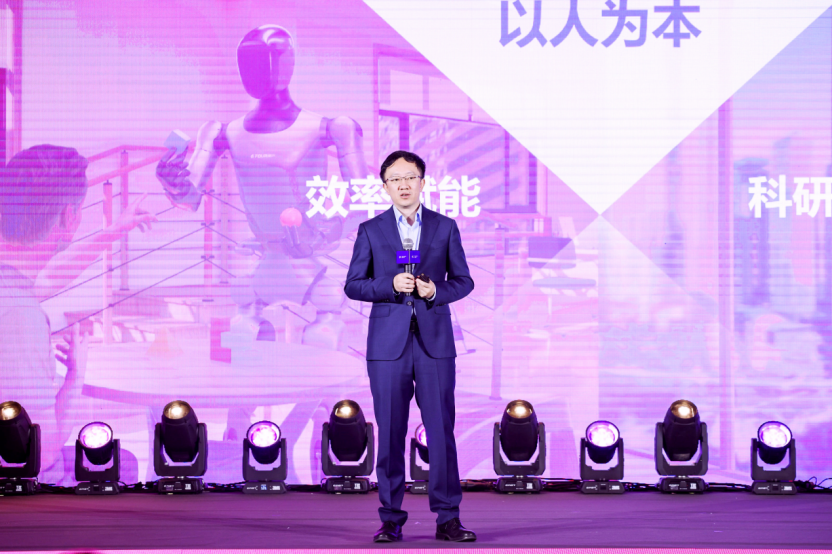
Gu Jie, Founder and CEO of Fourier
“As a technology-driven enterprise, Fourier is deeply rooted in the field of rehabilitation and medical care, consistently prioritizing technological innovation and product commercialization. With ‘innovation as the foundation, reliability and accessibility’ as its product DNA, Fourier achieves deep integration of embodied intelligence and AI technologies into the healthcare system, extending even to grassroots communities and penetrating household scenarios. Centered on its core mission of ‘empowering human life,’ Fourier will spare no effort in developing robotic products that truly empower human life.”
Under the guidance of this strategic direction,Fourier has launched a humanoid robot R&D project while continuing to innovate and iterate on its existing product portfolio.
In 2023, Fourier officially launched its first general-purpose humanoid robot product.GR-1This robot features a life-sized design mimicking an adult human, standing 1.65 meters tall and weighing 55 kilograms. It possesses degrees of freedom in major human joints and demonstrates stable mobility. Crucially, from the initial product design phase, Fourier Intelligence established seamless human-robot interaction as its core development focus.
Since then, the R&D process has been fully accelerated. On one hand, the company continues to deepen its independent research and development and iteration of core components such as actuators, dexterous hands, and sensors; on the other hand, it continuously enhances the functionality of its robotic bodies and enriches its product line based on real-world application data and customer feedback.
Second-generation product launched in 2024GR-2, achieving breakthroughs in hardware design, development frameworks, and commercialization pathways to meet the application needs of developers across various fields and diverse scenarios. In the first half of 2025, Fourier sequentially released open-source datasets and its first open-source robot productFourier N1, responding to the development needs of the industry and developer community, and accelerating industrial iteration.
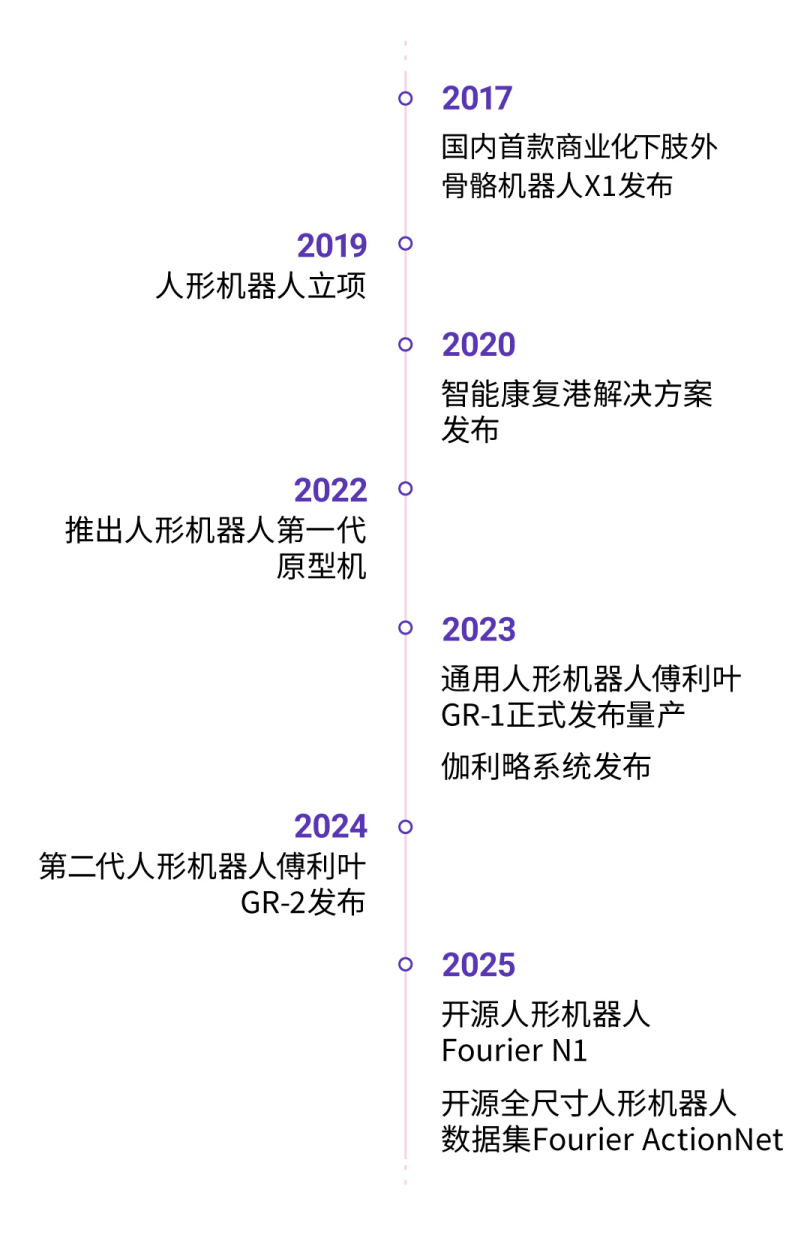
Over the past decade, Fourier’s products, business layout, and business model have all undergone multidimensional iterations. A closer look at the nuances of the company’s development reveals one constant: Fourier’s unwavering commitment to exploring innovative integration of technology and application scenarios.
In Gu Jie’s view, technological innovation and real-world application are inherently twin siblings. Products lacking innovative support lose their distinctiveness and competitive barriers, while technologies without practical implementation fail to deliver value or achieve sustainable development. Therefore, it is crucial to contemplate the deployment pathways for embodied AI and the methods to maximize the realization of technological value.
After a decade of accumulation, the Fourier team has come to recognize that while robots may take diverse forms across scenarios such as guided tours and consultations, rehabilitation, elderly care, and companionship, the human-centric philosophy remains the core principle throughout. This means that in terms of interactive performance, robots must possess perceptual capabilities to sense the environment, human needs, and surrounding emotions, then leverage current large-model AI technologies for cognitive processing, and finally deliver appropriate responses.
How should this be implemented specifically from a technical perspective?
First, "warm" interactions. Build robots that are understandable, adaptive, and companionable, integrating multimodal, personalized, and empathetic agent capabilities—including speech recognition, facial expression and motion capture, haptic feedback, and emotion recognition—enabling robots to interpret language, expressions, movements, and even emotions, while providing timely, appropriately calibrated responses. Meanwhile, adhere to user-friendly hardware and software product design, fostering harmonious coexistence between robots and humans in shared environments;
Second, a more “vivid” understanding and more “proactive” execution. By establishing a full-stack technological closed loop encompassing robotic perception, comprehension, and decision-making, we enable robots to perceive and understand the world in a more vivid and multidimensional manner, and to interact with and serve humans more proactively. Meanwhile, we provide AI with a hardware embodiment featuring stable motion control capabilities, thereby lowering the threshold for physical human-robot interaction in real-world environments.
Third, professional reliability and long-term partnership. From hardware manufacturing and medical-grade quality validation to long-term durability, Fourier Intelligence consistently adheres to the highest standards, with safety, reliability, and long-term companionship as the core objectives across all stages.
It is precisely this human-centric core philosophy, combined with Fourier’s years of technical accumulation in force feedback, algorithms, and human-computer interaction, as well as its ongoing joint R&D efforts with top-tier institutions and technology companies such as the Chicago Rehabilitation Center, NVIDIA, SenseTime, and ETH Zurich, that has accelerated the deployment of embodied intelligence technologies into real-world scenarios.
Today, Fourier’s intelligent rehabilitation products have been deployed in over 3,000 medical institutions, with nearly 300 departmental case studies spanning prefecture-level cities, communities, and township health centers across China. Meanwhile, the products are exported to more than 60 countries and regions worldwide, cumulatively serving over one million patients.
At this Embodied AI Ecosystem Summit, Fourier took a significant step forward by holding the unveiling ceremony for the “Embodied Intelligence Rehabilitation Hub” with Shanghai International Medical Center, and signing strategic cooperation agreements with Tongji University and the National-Local Joint Innovation Center for Humanoid Robots.
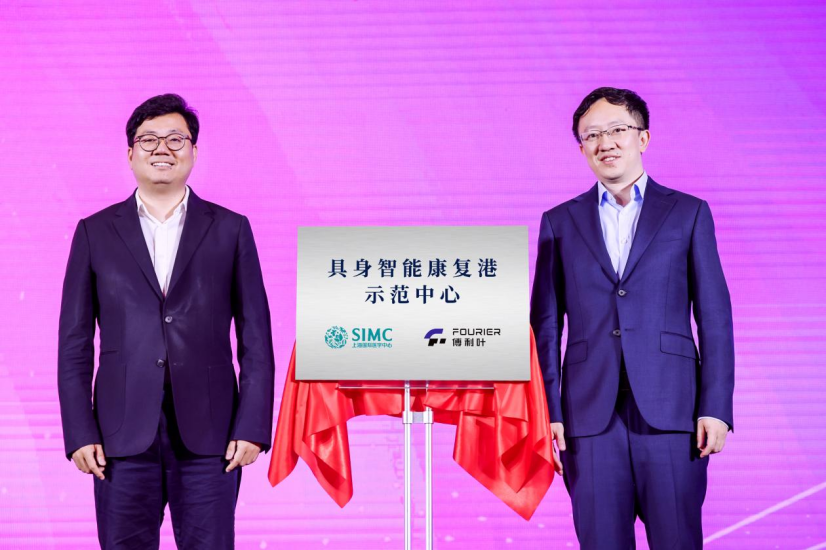
Fourier and Shanghai International Medical Center Held the Unveiling Ceremony for the “Embodied Intelligence Rehabilitation Port”
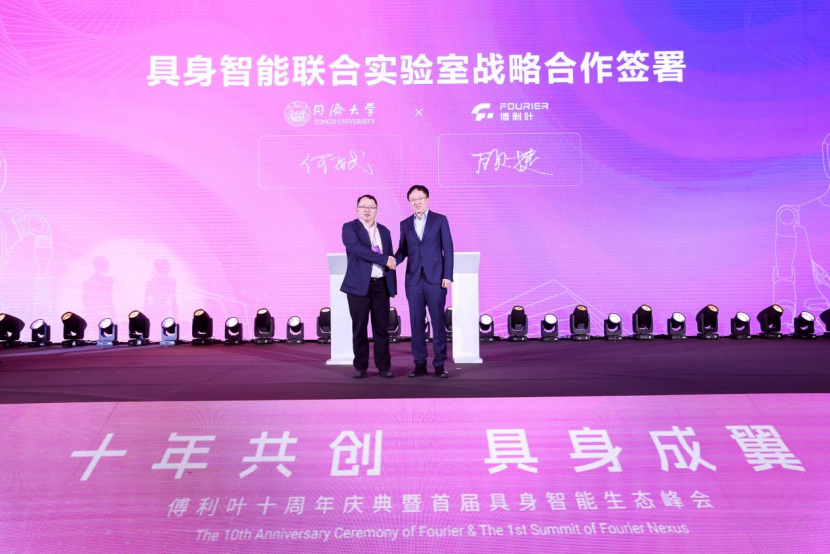
Fourier Signs Strategic Cooperation Agreement with Tongji University

Fourier Signs Strategic Cooperation Agreement with the National-Local Joint Humanoid Robot Innovation Center
Embodied intelligence drives AI to extend into physical space through perception and action, enabling it to interact with real-world environments and promoting the integration of intelligent technologies with the physical world. Its commercialization and application scenarios are similar to those in the field of large language models, with healthcare and elder care representing promising areas for embodied intelligence.
In the health and wellness sector, this technology has garnered significant attention over the past two years due to its substantial value in narrowing gaps in professional service standards, facilitating the implementation of high-quality solutions, enhancing the elderly care experience, balancing resource allocation, and strengthening primary healthcare capabilities through telemedicine. Among various applications, humanoid robots have emerged as a focal point of research and development, leveraging their generalization capabilities, model-driven data insights, and robust execution prowess to expand the scope of potential use cases.
Although the industry currently faces challenges in core technical areas ranging from foundational models, data technologies, and data acquisition to algorithm applications and motion control, a review of the entire Embodied AI Ecosystem Summit reveals that the clinical potential and technological breakthroughs of embodied intelligence in medical and elderly care scenarios are being continuously realized by innovative enterprises. Furthermore, with the accelerated advancement of industrial collaboration, these advancements are gradually translating into practical applications.