

Chinese-developed Liposomal Irinotecan Secures Over $100 Million Upfront in U.S. Licensing Deal with Cipla
CSPC
Innovative Drug Research and Development, Manufacturer

Cipla
Pharmaceutical Manufacturer
On May 15, 2025, it was announced that CSPC had entered into an exclusive licensing agreement with Cipla for the commercialization of irinotecan liposome injection in the United States.
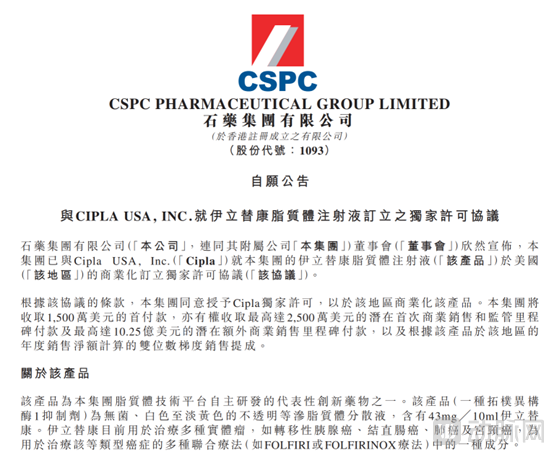
Under the terms of the agreement, CSPC has agreed to grant Cipla an exclusive license to commercialize the product in the territory. CSPC will receive an upfront payment of $15 million (approximately RMB 100 million) and is entitled to potential first commercial sales and regulatory milestone payments of up to $25 million, as well as potential additional commercial sales milestone payments of up to $1.025 billion, plus double-digit tiered royalties based on the annual net sales of the product in the territory.
The agreement terms indicate that Irinotecan Liposome Injection is one of the representative innovative drugs independently developed by CSPC on its liposome technology platform. Irinotecan Liposome Injection is a topoisomerase I inhibitor, presented as a sterile, white to pale yellow, opaque, isotonic liposomal dispersion containing 43 mg/10 mL of irinotecan. Irinotecan is currently used to treat various solid tumors, such as metastatic colorectal cancer, lung cancer, and cervical cancer, serving as a component in various combination therapies for these types of cancer (e.g., FOLFIRI or FOLFIRINOX regimens).
Domestic Liposomes Launch a Surprise Attack on the "King of Cancers"
On September 15, 2023, CSPC announced that its investigational irinotecan hydrochloride liposome injection had been approved for marketing. It is indicated in combination with 5-fluorouracil (5-FU) and leucovorin (LV) for patients with metastatic pancreatic cancer who have progressed following gemcitabine-based therapy. This marks the first domestically produced irinotecan hydrochloride liposome injection to receive marketing approval in China.
Notably, the approved therapy has demonstrated significant survival benefits in Asian populations. In 2020, it was upgraded to a Grade I recommendation with Category 1A evidence in the guidelines of the Chinese Society of Clinical Oncology (CSCO), making it the therapy with the highest level of recommendation and evidence for second-line treatment of pancreatic cancer.
CSPC’s irinotecan hydrochloride liposome is a topoisomerase inhibitor. This liposomal formulation is designed to prevent the premature conversion of irinotecan into its active metabolite, SN-38, thereby helping irinotecan remain in systemic circulation for a longer duration, increasing drug deposition and exposure within tumors, and enhancing the inhibition of tumor growth. The relevant patent is WO-2005107712.
It is reported that this mechanism of action has been evaluated and validated in clinical studies. Results from the global, multicenter, randomized, phase III NAPOLI-1 trial published in The Lancet, and its Asian subgroup analysis published in Cancer Science, demonstrated that for patients with metastatic pancreatic cancer who had previously failed gemcitabine-based chemotherapy, liposomal irinotecan combined with 5-FU/LV significantly improved overall survival (OS). The adverse events were safe and manageable, with a more pronounced survival benefit observed in the Asian population.
In other words, CSPC’s products employ a novel drug-loading technology that outperforms the traditional ammonium sulfate gradient method, achieving higher drug-loading capacity. Meanwhile, CSPC has independently developed the key excipients required for this new drug-loading technology, thereby resolving excipient supply issues, reducing costs, enhancing competitive advantages, and further enriching CSPC’s portfolio of high-end formulations.
On December 18 of the same year, CSPC announced that it had submitted a New Drug Application (NDA) to the U.S. Food and Drug Administration (FDA) for irinotecan liposome injection, indicated for the treatment of patients with metastatic pancreatic cancer who have progressed following gemcitabine-based therapy. This marks the Group’s first NDA submission in the United States for a complex liposomal-encapsulated anticancer chemotherapeutic agent.
In fact, amid declining profits for generic drugs, high risks in new drug development, and continuously diminishing returns on investment, improved new drugs with a highly favorable cost-benefit ratio have gained favor. Among these, liposomes are currently highly versatile nanoparticles widely used in drug delivery, owing to their biocompatibility, appropriate size, and the presence of both hydrophobic and aqueous layers capable of loading drugs.
The market size of improved new drugs in China will continue to grow steadily. According to the PharmCube database, CSPC has rapidly increased its share in China's liposome market in recent years, accounting for approximately half of the national liposome market share by 2022. With significant advantages in its nanotechnology platform, CSPC has developed multiple core delivery technologies, including nano-liposomes and albumin-based nanoparticle formulations, and its related pipeline layout is also at a leading position internationally.
Notably, all products successfully developed on CSPC’s liposome technology platform utilize PEGylated small unilamellar liposomes with a rigid lipid bilayer structure. By leveraging the kinetic gradient of active drug loading, the drug forms precipitates within the liposomes, enabling sustained, effective, and rational drug release. This approach addresses key development challenges and ensures that nanoparticles effectively accumulate in tumors after administration, thereby enhancing both safety and efficacy. Furthermore, CSPC places significant emphasis on liposome injections; according to the company’s plan, new liposome injectable drugs will be launched every year in the future.
Partnering with the "World's Pharmacy"
CSPC’s chosen partner in this collaboration is Cipla (also known as Cipla Ltd.), a globally renowned pharmaceutical company headquartered in Mumbai, India. Founded in 1935, it has become one of the leading enterprises in the Indian and global pharmaceutical industries.
Cipla was founded by Indian entrepreneur K.A. Adhikari with the initial goal of providing high-quality medicines to the domestic market in India, particularly in the areas of antibiotics and treatments for chronic diseases. As early as the 1940s, Cipla’s founder began focusing on introducing and manufacturing drugs for a variety of diseases. From its development in the 20th century to the present day, Cipla’s product portfolio has expanded to cover key therapeutic areas including respiratory diseases, antivirals, oncology, chronic diseases, and ophthalmology, with branch offices established in multiple regions worldwide.
What truly propelled Cipla to prominence was its development of HIV/AIDS medications. In 2001, when antiretroviral drugs for HIV/AIDS were monopolized by a handful of global pharmaceutical giants, Cipla introduced a triple-drug antiretroviral therapy in Africa at a cost of less than $1 per day, significantly benefiting patients and earning the company widespread acclaim. Reportedly, this business segment generated $58 million in revenue for Cipla in the 2019–20 fiscal year.
In July 2019, Cipla EU, the European subsidiary of Cipla, announced that it had reached an agreement with Jiangsu Chuangnuo Pharmaceutical Co., Ltd. to establish a joint venture in China. Under the agreement, Cipla will hold an 80% stake in the subsidiary, while Chuangnuo will hold a 20% stake. The two parties will jointly invest $30 million to build a manufacturing base for inhalation products, focusing on respiratory therapies. This collaboration underscores Cipla’s commitment to the Chinese market.
What CSPC likely values is Cipla’s strong performance since the beginning of 2020 in meeting global market service demands, continuously expanding its portfolio, and strengthening its manufacturing and supply chain infrastructure. In 2020, Cipla ranked third in the market (based on IQVIA data as of December 20, 2020).
Cipla, a champion of “hard generics,” once made an aggressive foray into the Chinese pharmaceutical market. At that time, Indian generic drugs held distinct advantages over their domestic counterparts in China in terms of pricing and regulatory frameworks. Regarding costs, India’s lower labor, time, and fixed-asset investment expenses resulted in overall lower production costs compared to China. Furthermore, in terms of regulation, India’s system was more internationalized and efficient, owing to its long-standing exports to European and American markets.
However, with the development of domestic high-end formulations in recent years, "quality improvement" and "price reduction" have been consistent themes. Represented by CSPC, a number of enterprises have not only focused on enhancing their own "professional competitiveness," but also optimized the layout of their product pipelines.
Since the beginning of 2025, after CSPC announced the exclusive licensing of development and commercialization rights for SYS6005 (ROR1 ADC) in the United States, the European Union, and other regions to Radiance Biopharma for a total consideration of $1.24 billion, its Irinotecan Liposome Injection has also embarked on a global expansion path, carving out a trajectory for counter-trend growth amidst intense competition from generic drugs overseas.