

LiuJing Tech Achieves Domestic Breakthrough with Launch of Indigenous X-ray Grid for Medical Imaging
After enduring two consecutive years of market winter and the shadow of scale contraction, the medical imaging equipment industry began to recover in 2025.
At the start of the year, the industry’s market size had already grown by more than 47% year-on-year. CT sales revenue surged by over 53% year-on-year, outpacing the overall growth rate of medical imaging equipment and delivering standout performance. These signs indicate that long-suppressed market demand is being unleashed.
The market’s return to growth is inseparable from breakthroughs in the core components of domestically produced medical imaging equipment. Whether through the issuance of policies such as the “Notice on Matters Concerning Standards for Domestic Products in Government Procurement and Their Implementation (Draft for Comment),” or the establishment of platforms for innovative collaboration in high-end medical equipment, these initiatives are accelerating the localization of core components for medical devices and pushing the industry toward a new inflection point.
Of particular note, following the localization of core components such as X-ray tubes and detectors, Shanghai Leading Technology Co., Ltd. (hereinafter referred to as “Leading Technology”) has officially announced a breakthrough in the domestic production of anti-scatter grid technology, adding another critical piece to the puzzle of self-reliance and controllability in China’s medical imaging equipment supply chain.
In the field of medical imaging, the X-ray anti-scatter grid is a crucial core component.Anti-scatter grids absorb scattered radiation, reduce image fog, and enhance contrast, enabling physicians to obtain higher-clarity medical images for accurate lesion assessment and reduced misdiagnosis or missed diagnosis.It is not only the “image quality switch” for medical imaging equipment, but also a critical foundational support for precise clinical diagnosis and treatment.
However, achieving domestic production of this technology is no easy task.
The anti-scatter grid features a specialized laminated structure, composed of alternating layers of X-ray absorbing material (lead) and X-ray transmitting material (aluminum or carbon-based materials), with the outer layer encapsulated in rigid materials exhibiting low X-ray absorption. Its structural principle can be understood as analogous to louvers with varying blade angles, where the alternating arrangement of transmitting and absorbing materials forms an X-ray filtration structure. Its production not only involves breakthroughs in materials science but also requires bridging the micron-level gap in precision manufacturing.
Material selection and processing techniques are highly complex, requiring a balance between high X-ray transmittance, durability, and radiation resistance. The lead strips used as absorbing materials typically have a thickness of 20–49 micrometers, while the transmitting materials range from 80 to 250 micrometers in thickness. These components are arranged alternately at an incident angle aligned with the primary X-ray beam, thereby achieving efficient filtration of scattered radiation while ensuring high transmittance of the primary beam.
Furthermore, micron-level machining precision requires precise control over the angular deviation and spacing of the grid strips. Any minor errors during manufacturing may lead to degraded anti-scatter grid performance, thereby affecting image quality. This imposes extremely stringent requirements on precision control capabilities in both the design and production stages.
Due to the complex manufacturing process, high technical barriers, and the need for sustained high R&D investment,The global anti-scatter grid market has long been dominated by overseas companies from Japan, South Korea, the Netherlands, and other countries.This has resulted in a highly monopolized market structure. The domestic market is also dominated by imported products, significantly constraining Chinese manufacturers of medical imaging equipment in terms of cost control, supply lead times, and technological upgrades.
With the continuous and in-depth implementation of the volume-based procurement policy for medical devices, coupled with the surge in demand from healthcare institutions for cost-effective domestic equipment, the localization of anti-scatter grids has undoubtedly become an urgent priority.
Shanghai Leading Technology Co., Ltd. achieved a breakthrough in the domestic production of anti-scatter grids, stemming from Professor Zhu Yubin, the company’s founder, and his accumulation of expertise in materials science as well as his determination to overcome core technological barriers.
As an expert in materials science, he had already been deeply engaged in the field of CT anti-scatter components and related materials as early as 2006. Witnessing that China ranked first globally in the production capacity of complete X-ray machine units, yet remained constrained by its reliance on imported anti-scatter grids, Zhu Yubin resolved to lead his team in filling this gap.
Research by Zhu Yubin’s team has revealed structural defects in the lead-aluminum foil core material system used in mainstream international anti-scatter grids.
First, lead foil used as a shielding layer must reach a certain thickness to effectively block scattered radiation; however, this reduces the transmission rate of the primary beam and lowers image resolution. Furthermore, the toxicity of lead poses environmental pollution risks and hazards to human health throughout its entire lifecycle, including smelting, processing, use, and disposal.
Second, aluminum foil, as a transmission layer, exhibits strong X-ray absorption, resulting in low ray transmittance. Consequently, higher X-ray intensity is required in clinical practice to ensure adequate image brightness, which undoubtedly increases the patient’s radiation exposure dose.
Third, high-ratio anti-scatter grids impose stricter requirements on material precision, necessitating extremely thin and uniform lead and aluminum foils, which further exacerbates processing difficulties and manufacturing costs.
Addressing the aforementioned industry pain points,Shanghai Leading Technology Co., Ltd. has achieved innovative breakthroughs in both material systems and forming processes, while also designing its own automated production lines to optimize manufacturing workflows.
By developing lead-free, environmentally friendly alternative materials with high shielding effectiveness, constructing a novel transmission layer structure with low radiation absorption, and simultaneously developing precision composite molding processes, we have successfully developed a new generation of anti-scatter grids that combine high X-ray transmittance, low environmental impact, and cost advantages, achieving a technological breakthrough in the domestic production of core components.
In the selection of shielding materials, the team turned its attention to high-atomic-number materials. Through self-developed processes, the R&D team successfully processed the shielding layer to an ultra-thin specification, which not only fully leveraged its high-performance shielding advantages and improved radiation transmission rates, but also effectively controlled material costs, laying a technical foundation for the localization of shielding layer materials.
In the Field of Transparent Materials, To address the issues of strong X-ray absorption by traditional aluminum foil, which leads to insufficient imaging brightness and increased patient radiation dose, Shanghai Leading Technology Co., Ltd. innovatively selected carbon-based polymer materials with a lower atomic number. This material offers superior X-ray transmission performance compared to aluminum foil, theoretically significantly enhancing grid performance and reducing patient radiation dose.
In terms of forming technology,Shanghai Leading Technology Co., Ltd. has extended its technical expertise in material R&D to the forming process of anti-scatter grids, focusing on resolving the challenges of precision forming for multi-layer composite structures with gradient angles. Meanwhile, by systematically optimizing process parameters, upgrading production equipment, and designing automated production lines, the company has significantly enhanced process stability and manufacturing efficiency, reducing costs by over 40% and increasing the yield rate by more than 10%. Through the establishment of a super factory, it has cut labor costs by 70%, improved raw material utilization by 30%, and ensured product consistency.
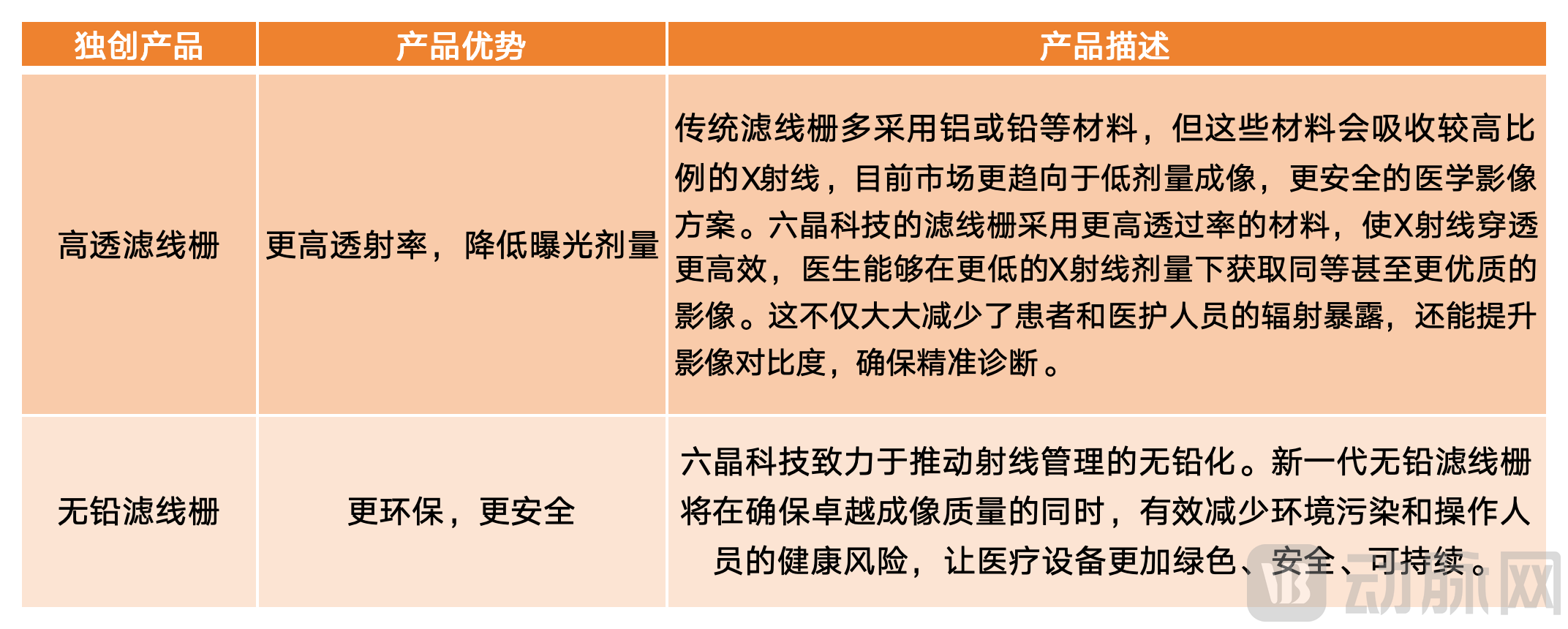
Shanghai Leading Technology Co., Ltd. Product Pipeline
Behind these technological breakthroughs lies the support of Shanghai Leading Technology Co., Ltd.’s composite team, which combines “academic depth × industrial practice.”
Professor Zhu Yubin, the founder, has devoted forty years to the field of materials science. He has presided over or participated in more than 20 scientific research projects, including the National Key Technologies R&D Program and the National High-Tech R&D Program (863 Program). He holds 13 invention patents and has published over 50 academic papers. Professor Zhu spent 18 years engaged in research and management at the Northwest Institute for Non-ferrous Metal Research and served as a senior executive at a listed company. In 2003, he was recruited as high-level talent to the School of Materials Science and Engineering at Shanghai University, where he has been engaged in scientific research and teaching ever since. The deep integration of his academic expertise with industrial practice has laid a solid foundation for Shanghai Leading Technology Co., Ltd. to overcome technical challenges and promote the commercialization of research achievements, serving as a key support for the team’s efforts to achieve the domestic production of core components.
The core team comprises senior engineers from industry leaders such as GE Healthcare, Philips Healthcare, and Siemens Healthineers, with R&D personnel accounting for over 30% of the workforce and a cumulative total of 36 invention patents granted. This team, characterized by deep integration of industry, academia, research, and application, has not only independently mastered core process parameters and material selection to achieve breakthroughs in domestic innovation, but also assembled an interdisciplinary team integrating mechanical design, electrical control, automation technology, and materials science for molding equipment R&D. This enables the company to possess full-chain technical capabilities spanning material system development, processing technology breakthroughs, and automated equipment development.
Supported by this foundation, Shanghai Leading Technology’s Grid-A series has achieved stable mass production and is available in multiple specifications, compatible with various medical imaging devices to meet the imaging needs of different clinical departments. Having undergone rigorous testing and market validation, the Grid-A series officially entered mass production in Q4 2024 and has been successfully deployed in numerous hospitals and among medical imaging equipment manufacturers across China.
Next, Shanghai Leading Technology Co., Ltd. will achieve complete substitution of existing imported anti-scatter grids based on market demand. By leveraging a fully automated production line to address the pain points of traditional manufacturing processes, the company will realize end-to-end automation spanning materials, lamination, forming, and inspection. This approach will not only improve product yield but also reduce labor costs, driving a significant leap in efficiency for mass production. Meanwhile, the company will accelerate its capacity expansion and further expand into both domestic and international markets, striving to secure a prominent position for Chinese-made anti-scatter grids in the global medical imaging sector.