

In Global For Global: JunLian Capital's Qi Fei Sees China as a Global CGT Innovation Hub
“CGT(CellandGeneEach technical pathway for treatment has its own inherent logic and development prospects. Although the maturity timelines of these approaches vary, all invariably require sustained exploration and long-term technological commitment from the industry. In the current industry cycle marked by significant uncertainty, investors and developers should focus on projects with a solid scientific foundation and steadily advance clinical validation.” InCSGCT(Co-Founder of the China Gene and Cell Therapy Conference),Legend CapitalIn the view of Executive Director Qi Fei, as a technology at the forefront with broad application prospects in the futureCGTThe industry requires support from multiple stakeholders, including the government, investors, industry associations, research institutions, and enterprises—indeed, many hands make light work!
At the “CGT Venture Capital and BD New Opportunities Forum,” part of the 2025 VBEF Top 100 Future Healthcare and Pharma Exhibition hosted by VCBeat on May 9–10, 2025, Qi Fei delivered an in-depth presentation covering the cyclical fluctuations of the CGT industry, the evolution of the global landscape, technological development trends, commercialization challenges, and the vision for building a collaborative ecosystem.
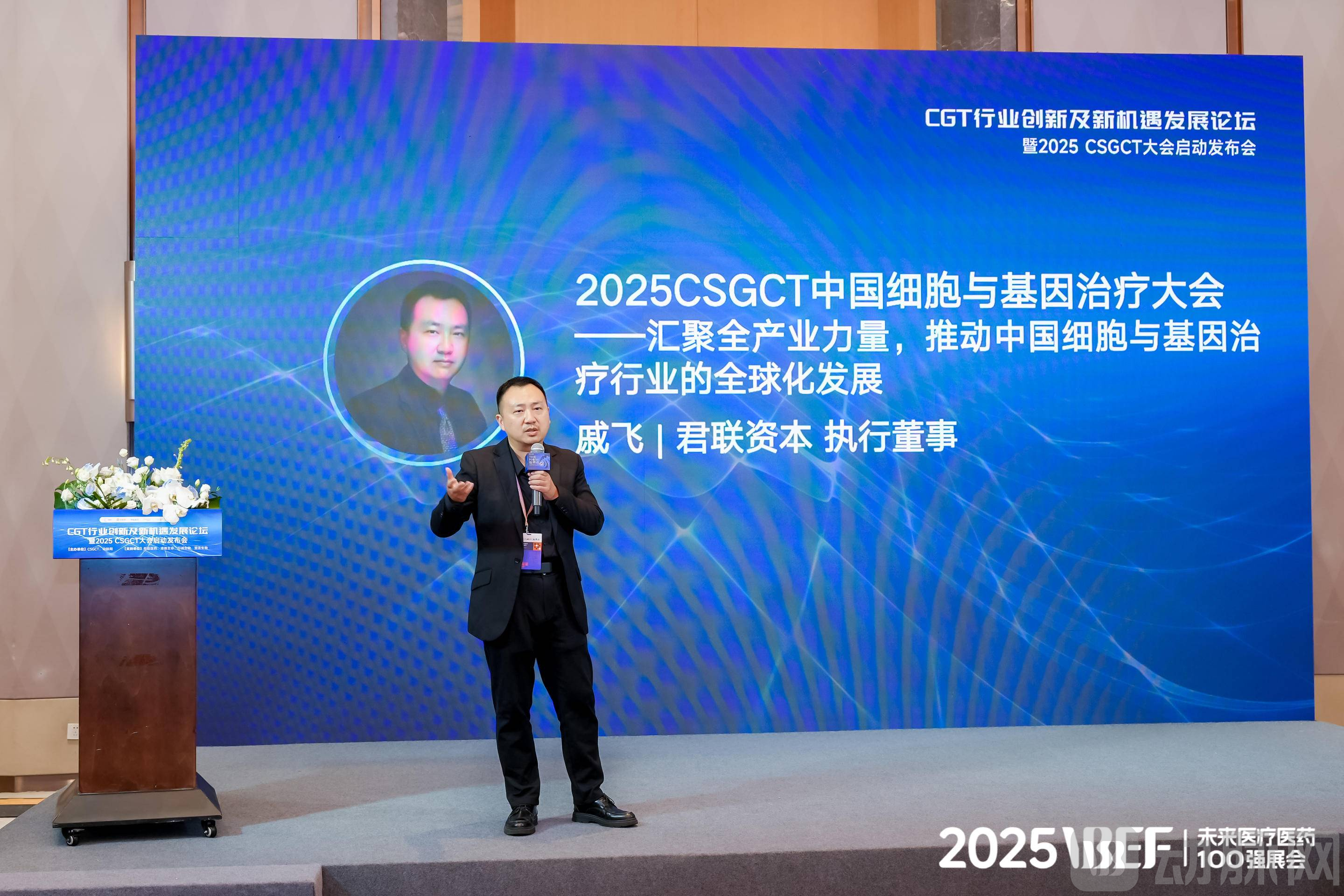
As one of the investment firms most focused on the development of the cell and gene therapy (CGT) industry, Legend Capital has been actively promoting industry growth and contemplating its future. In Qi Fei’s view, the development of the CGT sector requires a commitment to long-termism: “Over the past few years, biopharmaceutical entrepreneurship and investment have undergone significant changes, experiencing both peaks and troughs. The CGT industry, in particular, is currently facing a relatively challenging period globally. Entrepreneurs and investors must remain rational during periods of industry hype and stay committed during downturns.”
“The original intention behind establishing the CSGCT was to bring together a group of practitioners genuinely committed to focusing on products and technology during the industry’s dormant period, with an emphasis on science, technology, clinical applications, and international development. The goal is to collaboratively drive the emergence of breakthrough products with genuine clinical and commercial value over the next five to ten years, thereby supporting China in building a long-term, sustainable CGT industrial ecosystem,” emphasized Qi Fei. He noted that this reflects not only a belief in science itself but also a strategic judgment on the direction of industrial development.
Industry at a Turning Point
Despite a late start, China’s development in the cell and gene therapy (CGT) sector has been remarkable. In less than a decade, China has risen to the global forefront, matching the United States across multiple dimensions, including the number of clinical pipelines, the degree of target innovation, industrial manufacturing systems, and product review standards.
“I have always used one phrase to summarize the stage we are currently in: ‘In Global, For Global.’ After more than a decade of accumulation, China’s pharmaceutical industry has evolved from an initial follower to a new phase of running neck-and-neck with global peers, and even holds the potential to surpass and lead in the future. Our innovative products must step onto the international stage to serve patients worldwide.”
Today, China’s CGT technology is steadily advancing toward multi-pathway, multi-modal innovation.
Qi Fei has mapped out the development trajectories of several cutting-edge sectors. For instance, cell therapy is actively exploring pathways to transition CAR-T therapies into standardized pharmaceutical products, with investigations into universal CAR-T, iPSC-derived CAR-NK, and in vivo CAR-T technologies. In the field of gene therapy, AAV vectors are being utilized for delivery to a broader range of organs and tissues. Small nucleic acid drugs are expanding their reach beyond liver targeting to include additional organ systems. Meanwhile, gene editing technologies are advancing from ex vivo to in vivo applications.
However, China’s CGT industry is currently facing practical challenges that cannot be overlooked.
According to Qi Fei's analysis, one aspect is the severe challenges following the retreat of capital.
Driven by global macroeconomic headwinds, the overall tide of financing and investment in the biotech sector has receded. As the industry still needs to demonstrate its viability and both targets and indications require further expansion, cell and gene therapy (CGT) has become one of the first segments to cool down in the current capital market. “Globally, CGT projects account for less than 10% of business development (BD) transactions in the biopharmaceutical industry, significantly lagging behind other mature fields.”
On the other hand, commercialization challenges are emerging as another obstacle hindering the sustainable development of the CGT market.
Relatively high costs and a comparatively narrow market make the structural challenge of “high cost + small market” particularly pronounced. Qi Fei pointed out bluntly that, taking CAR-T therapy as an example, the cost per treatment in the United States reaches as high as $400,000–$500,000, while in China it remains around RMB 1.2 million. Its customized manufacturing process resembles a service more than a pharmaceutical product. Although AAV gene therapy is a standardized product, it is often used for rare diseases affecting extremely small patient populations, making it difficult to amortize costs.
As treatment options become increasingly diverse, the true test for cell and gene therapy (CGT) products may lie in their cost-effectiveness and real-world efficacy. Qi Fei vividly likens the current competitive landscape of CGT not to “students comparing grades,” but rather to “professionals competing on merit.” The previous investment logic resembled striving to “rank first” within each therapeutic track, whereas today, CGT products must compete head-to-head in the commercial arena with small molecules, antibodies, and antibody-drug conjugates (ADCs) targeting the same indications. The key to success hinges on whether these therapies can truly address unmet clinical needs, yielding marketable, profitable products that alter patients’ destinies.
The “Confidence” to Break the Globalization Deadlock
Despite the challenges, Qi Fei remains confident in the future of industrial development, believing that China possesses unique advantages and is poised to become one of the most promising countries for achieving global breakthroughs in the field of cell and gene therapy (CGT).
According to Qi Fei’s analysis, first, China’s complete and highly efficient industrial chain system has established a significant advantage. Currently, some domestic enterprises are able to provide products of comparable quality at one-fifth or even lower prices than those in Europe and the United States. This is because Chinese companies have promoted full-chain layout spanning from CROs and CDMOs to quality control and the supply of consumables and raw materials, focusing their efforts on multiple key links. This approach not only ensures comprehensive functionality and rapid response but also delivers cost competitiveness, which forms the foundation for the “high-quality, low-cost” potential of Chinese CGT products.
Second, abundant clinical resources and investigator-initiated trials (IITs) create multiple opportunities for innovative exploration. By leveraging IITs to drive proof-of-concept for innovative products, the total cost may be as low as one-tenth—or even less—of that associated with traditional pathways, while the validation timeline can be shortened by at least half. This offers the potential for rapid validation and resource savings for early-stage global cell and gene therapy (CGT) innovation projects.
Third, pilot policies represented by the Boao Lecheng International Medical Tourism Pilot Zone in Hainan have provided a “testing ground” for exploring the commercialization of innovative products. In February this year, as a national-level pilot zone, Boao Lecheng allowed specific treatment protocols to enter the commercialization phase ahead of schedule under regulated and controlled conditions. Leaders and experts from institutions such as the Lecheng Administration Bureau, Ruijin Hospital Hainan Branch, and West China Hospital Lecheng Branch are actively exploring implementation standards for this new model, creating valuable opportunities for CGT companies to proactively test real-world business models. This initiative is expected to attract outstanding CGT enterprises from China and around the world to establish their presence there, ultimately positioning the zone as a global hub for CGT therapies and patient care.
“It is also important to emphasize that innovation is not just a slogan; what we truly need are innovative targets and therapies grounded in scientific evidence, aimed at addressing more unmet clinical needs. We hope the CSGCT Alliance can serve as a key pillar of the industry ecosystem, continuing to voice the industry’s perspective even during downturns in the business cycle, and bringing together practitioners committed to long-term engagement. Together, we can drive the high-quality development of China’s CGT industry, ensuring that innovative achievements truly benefit patients in China and around the world,” said Qi Fei.
To this end, government agencies, industry companies, and investment institutions are currently striving to promote the development of the sector. To thoroughly implement the goals outlined in the “Three-Year Action Plan for Accelerating Innovative Development of the Cell and Gene Therapy Industry in Beijing”—namely, to seize the critical window of explosive growth in technological innovation and industrial development of cell and gene therapy, and to build a globally influential source of CGT innovation and an industrial hub—and to accelerate the implementation of policies such as achieving breakthroughs in original innovation, tackling key core technologies, improving the level and efficiency of clinical research, accelerating the R&D and market launch of innovative products, and building a cell and gene therapy industry cluster, thereby fostering a favorable environment for industrial development, the “2025 CSGCT China International Conference on Gene and Cell Therapy” will be held in Beijing from September 12–13, 2025. The event is strongly supported by relevant commissions and bureaus of the Beijing Municipal Government, the People’s Government of Haidian District, and the Administrative Committee of Zhongguancun Science City; organized by the China Society for Gene and Cell Therapy (CSGCT); and co-organized by HIEA and VCBeat.
This conference integrates top-tier international resources, bringing together domestic and foreign research institutions and scientists, clinical institutions and physicians, investors, leading enterprises and entrepreneurs, regulatory agencies, patient organizations, and outstanding supply chain companies. With a global perspective, it empowers the CGT industry ecosystem. Through strategic synergy among industry, academia, research, application, regulation, and investment, it breaks down barriers across the full lifecycle—from basic research, technology development, and clinical trials to industrial translation, market access, capital operations, and global expansion. The conference builds a platform for in-depth exchange and cooperation between China’s gene and cell therapy industry and the global industrial chain, enabling Chinese innovations to deeply participate in the construction of global CGT technical standard systems and jointly establish an internationally aligned mechanism for industrial chain collaboration.