

Hainan Releases China's First Digital Therapeutics Reimbursement Policy, Marking a Major Breakthrough
A Major Breakthrough in the Payment Hurdle That Has Long Plagued Digital Therapeutics in China!
On May 22, the Hainan Provincial Healthcare Security Administration and the Hainan Provincial Health Commission issued the “Notice of the Hainan Provincial Healthcare Security Administration and the Hainan Provincial Health Commission on Doing a Good Job in the Management of Digital Therapeutics Pricing” (hereinafter referred to as the “Notice”), which sets forth regulations and arrangements for the pricing of digital therapeutics.
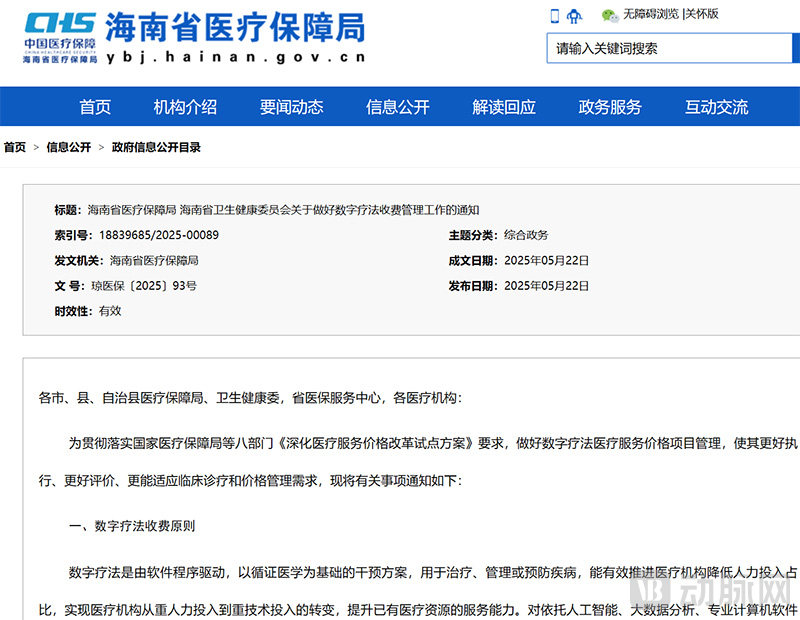
This is the first known reimbursement policy for digital therapeutics in China, representing a significant boon for the domestic digital therapeutics sector, which has long been constrained by payment challenges.
The "Notice" affirms the role of digital therapeutics, clarifying that their use in treating, managing, or preventing diseases can effectively reduce the proportion of labor input in medical institutions, facilitate a shift from labor-intensive to technology-intensive investment, and enhance the service capacity of existing medical resources.
Regarding charging principles, the Notice explicitly states that “for digital therapeutic medical services—such as digital examinations, diagnoses, and treatments—provided through traditional diagnostic and treatment technologies supported by artificial intelligence, big data analytics, and professional computer software, medical institutions may address their billing needs by applying for revisions compatible with existing price items, without the need to apply for new price items.”
This will greatly simplify the process for digital therapeutics companies and hospitals when applying for reimbursement.
The “Notice” also outlines three billing methods for digital therapeutics.
The first category involves patients providing and using digital therapeutics on their own. The "Notice" stipulates that medical institutions shall provide consultation and guidance services to such patients, which may be billed under outpatient consultation fees or general diagnosis and treatment fees, but are not covered by medical insurance reimbursement.
The second category stipulates scenarios in which medical institutions provide healthcare services to patients through the use of digital therapeutics (DTx) products. In such cases, medical institutions are granted a certain degree of flexibility: they may apply to establish add-on or extended items for digital therapeutics based on existing pricing items for medical services, and may temporarily implement charging standards under the “self-determined, filed for implementation” model, with fees charged on a per-person-per-month basis (CNY/person/month). The healthcare security administration will revise the relevant item contents in accordance with regulations, and these items will not be included in the scope of medical insurance reimbursement.
The “Notice” also considers a third provision, encouraging the inclusion of digital therapeutics (DTx) in the service scope of family doctor contract services. In this scenario, the charging methods for family doctor service packages involving DTx services will be separately formulated by the Hainan Provincial Health Commission in conjunction with the Hainan Provincial Healthcare Security Administration. For DTx service packages already incorporated into the content of family doctor contract services, costs incurred from delivering digital therapeutics will be covered through the family doctor contract service fees, with no additional charges applied.
As the first payment policy in China specifically targeting digital therapeutics, the “Notice” is of great significance. It further improves Hainan Province’s supporting policy framework for digital therapeutics and consolidates its position as a “highland for digital therapeutics.”
Achieving this policy has not been easy; relevant agencies in Hainan Province have made multiple efforts, demonstrating great sincerity.
Zhang Yuhui, Deputy Director of the Hainan Provincial Health Commission, stated: “General Secretary Xi Jinping has pointed out that ‘new quality productive forces have already taken shape in practice and demonstrated their strong driving and supporting power for high-quality development,’ that we must ‘timely apply scientific and technological innovations to specific industries and industrial chains,’ and that we should ‘establish new relations of production compatible with these forces.’ Digital therapeutics, based on digital and intelligent technologies such as artificial intelligence, constitute an important component of new quality productive forces in healthcare. They have already demonstrated revolutionary effects in the prevention and control of chronic diseases, the prevention and treatment of mental and psychological disorders, and rehabilitation in regions such as Hainan. For instance, after one year of digital therapeutic intervention, the rate of blood glucose control among diabetic patients increased by more than 20%.”
“However, as a frontier technological innovation, digital therapeutics has long lacked policy support for medical service items and pricing, preventing many highly effective innovative products from being promptly integrated into the healthcare delivery chain. The newly introduced policies on medical service items and pricing for digital therapeutics represent concrete measures to implement the central government’s directive on accelerating the development of new quality productive forces in the health sector. This initiative aims to refine new production relations compatible with the advancement of digital therapeutics through reform and innovation, leveraging the accelerated development and application of AI-driven digital therapeutics to drive the transformation, upgrading, and leapfrog development of Hainan Free Trade Port’s healthcare system,” he added.
Prior to the issuance of the Notice, digital therapeutics had already been implemented in certain regions and demonstrated corresponding clinical efficacy in practice. Taking Hainan Province as an example, it proposed the introduction of innovative application scenarios for digital therapeutics as early as 2023 and incorporated digital therapeutics enablement into government-led public welfare initiatives.
According to the pilot results of digital therapeutics for diabetes under the “2+3” Health Service Package released by Hainan Province in September 2024, Baoting County had 4,909 diabetic patients under management, with the fasting blood glucose target achievement rate increasing by 13.1%; Lingshui County had 10,297 patients under management, with the fasting blood glucose target achievement rate increasing by 14.17%. The mere few months of piloting fully demonstrated the significant impact of digital therapeutics in diabetes management.
However, digital therapeutics still face numerous challenges on the payment side. The most typical issue is how hospitals can charge for digital therapeutics. If they are not included in the fee schedule, hospitals cannot generate revenue by providing digital therapeutics, making it impossible for them to procure or use corresponding digital therapeutic products.
Under China’s current price review system, it is extremely difficult to obtain approval for new billing codes. Consequently, continuing to use existing billing codes has become a reluctant yet necessary choice; however, this practice lacks proper regulatory grounding and carries certain compliance risks. The Notice clarifies the legality of this approach, thereby alleviating the industry’s concerns.
This “compatibility with existing projects” model can accelerate the inclusion of products in the service catalogs of healthcare institutions, thereby speeding up the commercial implementation of digital therapeutics.
Meanwhile, the “Notice” also proposes corresponding charging pathways for different scenarios. For cases where patients bring their own digital therapeutics or use them but seek consultation and guidance services from medical institutions, fees shall be charged under the items of outpatient consultation fees and general diagnosis and treatment fees. This acknowledges the services provided by medical institutions and enhances their willingness to adopt digital therapeutics.
Notably, the “Notice” also grants medical institutions a certain degree of pricing authority and flexibility. It explicitly stipulates that, in cases where medical institutions provide healthcare services to patients through the use of digital therapeutics products, they may apply to establish additional or extended charge items for digital therapeutics on top of the corresponding medical service price items. The fee standards shall be handled in accordance with the principle of “independently formulated and implemented upon filing.”
Furthermore, the “Notice” also takes into account innovative scenarios for family doctors, thereby expanding the scope for the application of digital therapeutics. Currently, China is vigorously promoting contracted family doctor services to strengthen the functions of the primary healthcare service network, thus transforming the model of primary healthcare delivery.
Especially for chronic diseases such as diabetes, the combination of family physicians and digital therapeutics holds significant potential and room for development in clinical practice. The Notice encourages the inclusion of digital therapeutics within the scope of family physician contracted services, thereby providing support for innovative application scenarios of digital therapeutics.
Although the “Notice” explicitly excludes digital therapeutics from medical insurance coverage, its clear stance on allowing charges for digital therapeutics will attract the commercial insurance industry to explore and develop corresponding insurance products. In recent years, some commercial insurers have already launched insurance products related to digital therapeutics.
As the first payment policy in China specifically targeting digital therapeutics, the “Notice” is expected to significantly boost the digital therapeutics industry. According to VCBeat, the industry’s response to the “Notice” has been quite enthusiastic.
Chongqing Huiren Health Management Co., Ltd. has been actively advancing digital therapeutics for chronic liver diseases, such as fatty liver disease. Wu Xinfen, the company’s Chairman, spoke highly of the “Notice,” describing it as a milestone breakthrough in the industry’s development: “The ‘Notice’ not only removes core barriers to the clinical implementation of products but also lays a solid foundation for standardized industry growth through institutional design. The introduction of this policy will successfully bridge the ‘last mile’ for digital therapeutic products entering medical application scenarios, significantly accelerating their clinical adoption and providing strong impetus for future corporate R&D.”
She further stated that the issuance of the “Notice” will hold significant demonstrative value nationwide: “As industry participants, we warmly welcome the development opportunities brought by the policy and will actively cooperate with medical institutions to facilitate product integration, striving for market recognition through compliant pricing strategies and robust evidence-based medical data. Meanwhile, we also look forward to the relevant authorities accelerating the rollout of detailed implementation rules for pricing, policies for alignment with medical insurance, and supporting measures for family doctor contracted services, thereby building a healthy development ecosystem characterized by ‘policy guidance, market drive, and patient benefit.’ As these supporting measures are gradually implemented, digital therapeutics are expected to accelerate their integration into the mainstream healthcare system, playing a greater role in improving the efficiency of medical services and optimizing the allocation of medical resources.”
On the other hand, during communications with VCBeat, the digital therapeutics industry also noted that there is still room for optimization in the construction of pricing mechanisms and the refinement of implementation rules under the "Notice." For instance, while the policy allows hospitals to independently set charging standards for "additional items," specific criteria have not been clearly defined. Furthermore, the price declaration pathway for digital therapeutics products used autonomously by patients needs further clarification. According to feedback from relevant authorities in Hainan Province, these detailed rules will be improved shortly.
As the first region to formally propose a comprehensive promotion of digital therapeutics, Hainan has been striving to continuously build a systematic digital therapeutics ecosystem. From the initial “21 Measures” and the subsequent “Three-Year Plan” to the pioneering reimbursement policies introduced recently, these initiatives have significantly driven the development of China’s digital therapeutics industry, making Hainan a representative model of the “Chinese Practice” in digital therapeutics.
The issuance of the “Notice” has significantly addressed the most critical pain points facing digital therapeutics, thereby widening Hainan’s lead over other regions. As the regulatory and operational framework becomes more robust, it will further accelerate the realization of value in digital therapeutics and support Hainan in strengthening, optimizing, and expanding its digital economy. This will also solidify Hainan’s leading position in the development of digital therapeutics and, more broadly, in the competitive landscape of the digital health economy. Moreover, Hainan is poised to become a key pilot zone for nationwide healthcare reform, helping to enhance China’s global influence and voice in the field of digital health.
VCBeat will continue to closely monitor developments in digital therapeutics. Stay tuned.