

SinoTau Pharma Files for Hong Kong IPO with $400M+ Raised Pre-IPO and Over 5x Valuation Growth in Nine Years
On May 26, 2024, Beijing Xiantong International Technology Co., Ltd. (hereinafter referred to as “Xiantong Pharma”) formally filed a listing application with the Hong Kong Stock Exchange to further expand its global business operations, leveraging the exchange’s international platform to access overseas capital and attract a diverse base of foreign investors. CICC and CITIC Securities served as joint sponsors.
According to the Frost & Sullivan report, Xiantong Pharma is the first company in China to obtain marketing approval for an innovative radiopharmaceutical; the first company to obtain a production license for an innovative radiopharmaceutical as a Marketing Authorization Holder (“MAH”); and the first company to complete registrational clinical trials for therapeutic radioligands and have its New Drug Application (“NDA”) accepted by the National Medical Products Administration (“NMPA”).
As a new-generation leader in China’s radiopharmaceutical market, Xiantong Medicine has achieved rapid advancement in recent years through a multi-dimensional strategy encompassing independent R&D, mergers and acquisitions, and commercial collaborations. With its impending listing on the Hong Kong Stock Exchange and the gradual commercialization of its blockbuster products, Xiantong Medicine is poised to challenge the duopoly held by China Isotope & Radiation Corporation (CIRC) and Dongcheng Pharmaceutical in the Chinese radiopharmaceutical sector.
For its Hong Kong stock exchange listing, Xiantong Pharma plans to use the IPO proceeds for the research and development (R&D) and regulatory filing of core products such as XTR008, XTR006, XTR004, and XTR003; the R&D of candidate products including XTR015, XTR024, XTR010, XTR020, XTR021, XTR022, XTR016, XTR017, and XTR025; strengthening sales and marketing capabilities to enhance brand awareness of its products; constructing a new production base in the Beijing-Tianjin-Hebei-Shandong region to ensure timely delivery to customers in Northern China, thereby improving product accessibility and expanding market coverage; as well as for working capital and other general corporate purposes.
Cumulative financing of RMB 2.9 billion prior to IPO,
Valuation Grows More Than 5-Fold in Nine Years
Established in 2005, Xiantong Medicine initially focused on traditional drug research and development. In 2013, the company began actively exploring a strategic transition from generic drugs to innovative therapeutics, experimenting with various directions. Ultimately, in 2014, through a key collaboration, Xiantong Medicine formally entered the high-growth niche of innovative radiopharmaceuticals.
In June 2014, the U.S. nuclear medicine company Navidea’s novel receptor-targeted radiopharmaceutical, Lymphoseek® (Technetium Tc 99m Tilmanocept) injection, received FDA approval. Lymphoseek® was the only new 99mTc-labeled drug approved by the FDA in the preceding decade, indicated for sentinel lymph node localization during solid tumor surgery. Seeking to expand into the Chinese market, Navidea has been actively seeking partners in China.
In China, although the national drug regulatory authorities had previously approved approximately 40 nuclear medicine products for market launch, these were all legacy agents; only one new nuclear medicine product had been approved since 2008. At that time, few in the domestic market paid attention to the innovative nuclear medicine sector, and very few companies were engaged in the research and development of innovative nuclear medicines, leaving Navidea with limited options. Xiantong Pharma seized this opportunity by acquiring the Chinese rights to Technetium (99mTc) Tilmanocept, formally entering the nuclear medicine field and thereby securing a first-mover advantage in this sector.
Since its initial foray into radiopharmaceuticals in 2014, Beijing Xiantong International Technology Co., Ltd. (Xiantong Medicine) has gained increasingly in-depth insights into the field and keenly sensed that the sector was on the verge of a major upswing. By the end of 2019, Xiantong Medicine had completely divested its other traditional pharmaceutical business segments. In 2020, the company officially ushered in its first year of focused commitment to innovative radiopharmaceuticals, propelling its R&D efforts onto a fast track of development.
During the same period, the global radiopharmaceutical market entered a phase of explosive growth.Since 2021, more than 80 radiopharmaceutical deals have been concluded globally, involving leading multinational corporations (MNCs) such as Novartis, Merck, and Sanofi. The transaction values of the top three global business development deals reached approximately $2.06 billion, $1.63 billion, and $487 million, respectively.
According to the prospectus, the global market size for radiopharmaceuticals increased from $5 billion in 2018 to $9.7 billion in 2024, representing a compound annual growth rate (CAGR) of 11.7%. It is projected to reach $57.3 billion by 2035, with a CAGR of 17.5% from 2024 to 2035. In China, the market size grew from RMB 3.6 billion in 2018 to RMB 7.4 billion in 2024, at a CAGR of 13.0%. By 2035, it is expected to reach RMB 75.8 billion, with a CAGR of 23.5% from 2024 to 2035.
The radiopharmaceutical sector has attracted substantial investment due to its innovation potential and strong commercial prospects. Represented by Beijing Xiantong International Technology Co., Ltd., the company has completed nine rounds of financing from 2017 to present, raising a cumulative total of RMB 2.9 billion.Currently, Xiantong Medicine has secured support from numerous renowned investors, including prominent healthcare and biotechnology investment institutions such as Jinshi New Materials Fund, CICC Qide, Pharmaceutical Fund, Nanjing Zhengkai, Sinopharm CNBG, and Qiming Rongxin; state-owned funds such as the National Adjustment Fund Phase II, SDIC Venture Capital, and General Technology Venture Capital; insurance-backed investment institutions such as Jiangsu Jiequan; and the nuclear industry investment fund, Tongfu Fund.
It is worth noting that the two rounds of financing totaling RMB 1.1 billion completed by Xiantong Medicine in June 2023 set a record for the largest single financing deal in China’s nuclear medicine sector, fully reflecting the capital market’s high recognition of the company. Furthermore, based on its Series A financing in 2017 (RMB 130 million with a post-money valuation of RMB 1.03 billion) and its most recent pre-IPO financing rounds completed in November and December 2024 (totaling RMB 600 million with a post-money valuation of RMB 5.188 billion), Xiantong Medicine achieved more than a fivefold increase in valuation in less than nine years.
The platform covers the entire process of radiopharmaceutical discovery, development, and clinical trials.
Protected by Hundreds of Patents
Backed by robust financial resources, Xiantong Pharma’s current in-house R&D capabilities encompass all key functions across the entire radiopharmaceutical development process, including precursor design and optimization, radiochemical labeling, radionuclide selection, preclinical validation, clinical studies, medical imaging, integrated theranostics, and translational research.
In the discovery of radiopharmaceuticals,Xiantong Medicine’s precursor design and optimization platform enhances drug developability and clinical translation by integrating key parameters—such as pharmacokinetics, physicochemical properties, and tissue distribution—into compound design and optimization.
In the development of radiopharmaceuticals,Given the unique characteristics of radiopharmaceuticals and the highly interdisciplinary approach required for their development, Xiantong Pharma has established specialized technical platforms across all critical stages of radiopharmaceutical development.Key components include a medical radioisotope development platform and a radiochemical labeling technology platform.The former enables comprehensive radionuclide process and quality studies, facilitating the production of high-purity radionuclides while ensuring seamless regulatory compliance and addressing logistical and operational pain points in the radiopharmaceutical supply chain. The latter integrates optimized labeling process parameters, tailored formulation screening (e.g., radical scavengers), and rigorous material selection to ensure product stability and quality control even under high radioactivity levels.
In the clinical research of nuclear medicine,Xiantong Medicine has established multiple dedicated clinical research platforms for radiopharmaceuticals, including a radiation dosimetry platform, an imaging platform, and a translational medicine platform.
Radiation Dosimetry Platform: Radiation dosimetry studies are a fundamental component of radiopharmaceutical development, playing a crucial role in ensuring efficacy and safety. The radiation dosimetry platform systematically evaluates the efficacy and safety of radiopharmaceuticals by analyzing radioactivity levels in various organs at multiple time points, thereby providing a robust scientific basis for dose selection.
Imaging Platform: Designed in full compliance with the Good Clinical Practice (GCP) standards, this platform features robust image data management and quality control processes to ensure accuracy and reliability.
Translational Medicine Platform: Possesses mature capabilities in the design and execution of Investigator-Initiated Trials (IITs) and has established strategic partnerships with the nuclear medicine departments of top-tier hospitals in China. This model generates human data to directly support Investigational New Drug (IND) applications and optimize clinical trial protocols, thereby accelerating the translation of Preclinical Candidate Compounds (PCCs) into clinical validation.
In addition, Xiantong Pharma also possesses a theranostic development platform that integrates the development of diagnostic and therapeutic radioligands, enabling seamless integration of diagnosis and therapy and enhancing its R&D efficiency.
To date, Xiantong Medicine’s proprietary technologies and pipeline assets have secured protection under more than 100 patents, including 101 granted patents and 53 patent applications in China, 5 granted patents and 34 patent applications in other jurisdictions, as well as 9 pending patent applications filed under the Patent Cooperation Treaty (PCT). Among these, 33 granted patents and 26 patent applications are related to its core products.
15 Product Pipeline Candidates,
Covering Three Major Fields: Oncology, CNS, and Cardiovascular Diseases
Currently, Xiantong Pharma has one commercialized product, XTR005, four core products in development (XTR008, XTR006, XTR004, and XTR003), and ten candidate products at various stages of development, with indications spanning three major therapeutic areas: oncology, neurodegenerative diseases, and cardiovascular diseases. Notably, its pipeline includes four potential first-in-class or best-in-class assets, as well as four assets developed based on the top five global best-selling radiopharmaceuticals of 2024.
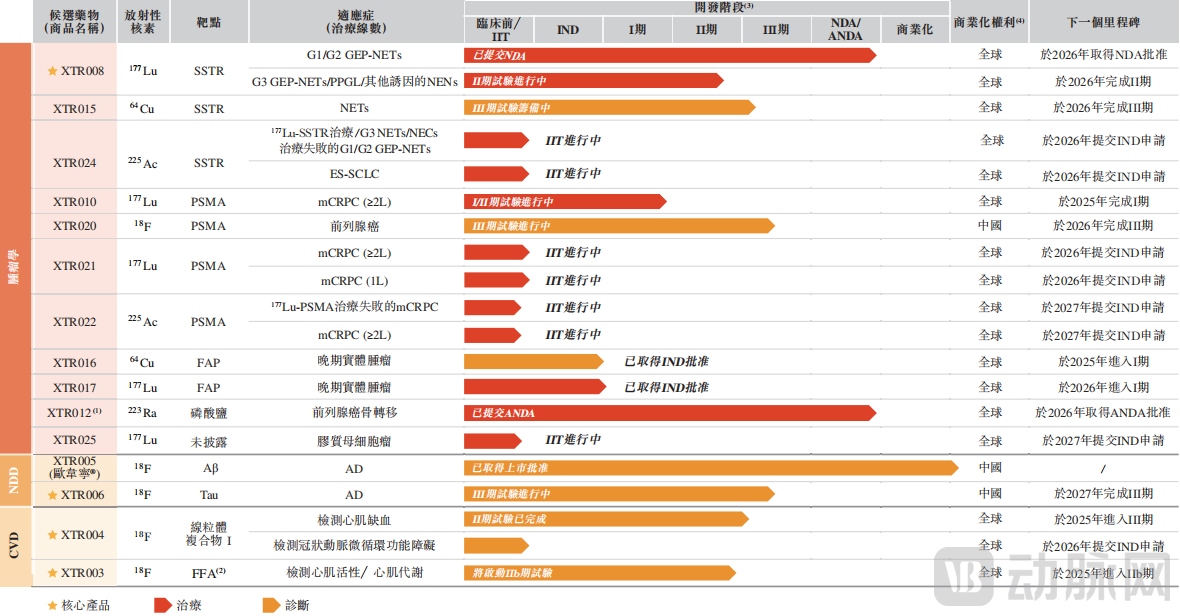
Xiantong Medicine’s Product Pipeline, Source: Prospectus
Commercialized Products:
XTR005 (Chinese brand name: Ouweining®): A PET radiotracer targeting Aβ, used to measure the level of Aβ plaques in the brains of adult patients through PET imaging, helping to assess AD and other causes of cognitive decline. This product is developed, produced, and commercialized by Xiantong Medicine in mainland China as a diagnostic radioligand for neurodegenerative diseases, through an agreement with Life Molecular Imaging Ltd. to obtain a license for its exclusive patented rights.
In September 2023, XTR005 received New Drug Application (NDA) approval from the National Medical Products Administration (NMPA) for the diagnosis of Alzheimer’s disease (AD). As the first anti-amyloid-beta (Aβ)-targeted PET tracer approved in China, XTR005 will serve as a critical tool for patient screening and for evaluating the therapeutic efficacy of Aβ-targeted treatments. In January 2025, Beijing Xiantong International Technology Co., Ltd. commenced commercial sales of XTR005. To date, the company has established partnerships with more than 50 medical institutions across the Beijing-Tianjin-Hebei-Shandong region and Guangdong Province for the distribution of XTR005.
Core Pipeline in Development:
XTR008:A 177Lu-labeled radioligand targeting somatostatin receptors (“SSTR”), currently in the registration phase, for the treatment of neuroendocrine tumors (“NENs”). Based on the interim analysis of the Phase III clinical trial of XTR008G1 or G2 in SSTR-positive gastroenteropancreatic neuroendocrine tumors (GEP-NETs), Beijing Xiantong International Technology Co., Ltd. submitted a New Drug Application (NDA) to the National Medical Products Administration in March 2025.
XTR006:A potential best-in-class 18F-labeled positron emission tomography (“PET”) diagnostic radioligand targeting microtubule-associated protein tau (“tau”), for the diagnosis of mild cognitive impairment (“MCI”) suspected to be caused by Alzheimer’s disease (“AD”) or AD dementia. There are currently no approved comparable products in China. The product is currently in Phase III clinical development for early diagnosis, screening, and assessment of disease progression in patients with suspected MCI due to AD or AD dementia, with trials expected to be completed in 2027.
XTR004:An 18F-labeled, mitochondria complex I-targeting diagnostic radioligand for PET myocardial perfusion imaging (“MPI”). According to the prospectus, XTR004 is the first and only PET-MPI tracer under clinical investigation in China. Currently, Beijing Xiantong International Technology Co., Ltd. has completed Phase II clinical trials for the diagnosis of myocardial ischemia and plans to initiate Phase III trials in the fourth quarter of 2025.
XTR003:A potential first-in-class 18F-labeled PET diagnostic radioligand for myocardial fatty acid metabolism imaging to detect myocardial viability. Xiantong Pharma has currently completed Phase I and Phase II clinical trials of XTR003, with Phase IIb clinical trials expected to commence in 2025. According to the prospectus, XTR003 is the world’s first and only PET myocardial fatty acid metabolism tracer under clinical investigation.
Furthermore, Xiantong Medicine is developing other innovative radioligand drug candidates, including XTR022, XTR016, XTR017, XTR024, and XTR025. These candidates are currently undergoing preclinical studies or investigator-initiated trials (IITs) in China. The prospectus indicates that all of the aforementioned pipeline assets have the potential to be the first to market in China, as well as first-in-class or best-in-class therapies.
With two operational production bases,
2024 Revenue: 44.1 Million
To ensure cost-effectiveness and address pain points in the radiopharmaceutical supply chain, Xiantong Medicine has established and commenced operations at two proprietary manufacturing facilities. These sites are utilized for the production of its own products, product candidates, and radioisotopes, while also providing Contract Development and Manufacturing Organization (CDMO) services. One facility is located in Wuxi, Jiangsu Province, and the other in Zhongshan, Guangdong Province. The total built-up area of these manufacturing bases exceeds 20,000 square meters, housing a total of 12 commercial-scale production lines, three of which have obtained production licenses and passed Good Manufacturing Practice (GMP) compliance inspections.
In addition, Xiantong Medicine has established another self-owned production base in Mianyang City, Sichuan Province. Construction has been completed, and the company is currently processing the applications for relevant licenses and permits. The base is expected to commence operations in the third quarter of 2025.
Leveraging its aforementioned technology platforms, core pipeline, and production facilities, Xiantong Medicine has generated revenue from multiple streams, including product sales, radioisotopes, licensing income, CRO/CDMO services, and marketing and promotion services. According to the prospectus, Xiantong Medicine recorded revenues of RMB 10.2 million and RMB 44.1 million in 2023 and 2024, respectively, with net losses of RMB 309.2 million and RMB 156.1 million for the same periods. It is foreseeable that the company’s revenue will grow rapidly in the near term, driven by three products that have either entered the commercialization stage or are approaching it.
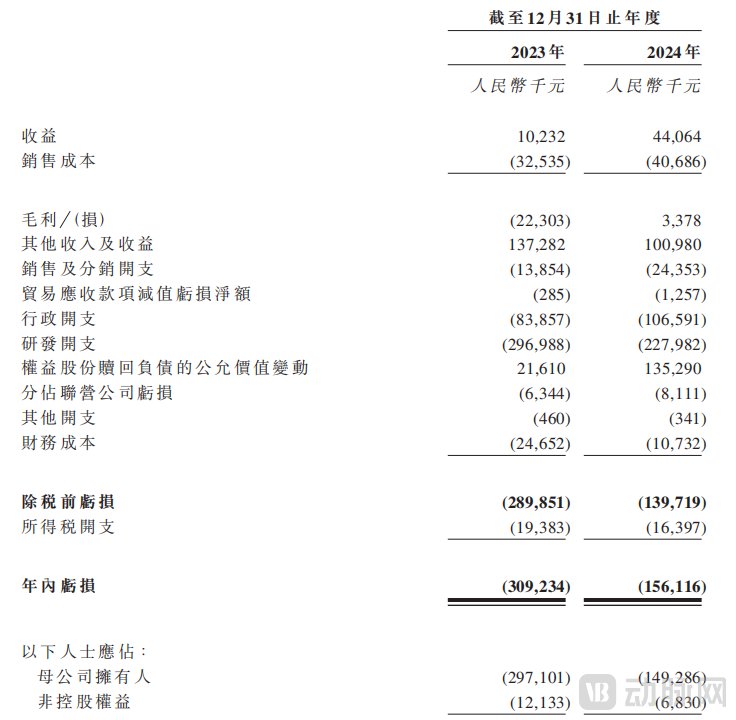
Xiantong Medicine Revenue, Source: Prospectus
As one of the earliest enterprises to enter the field of innovative radiopharmaceuticals in China, Xiantong Medicine has been engaged in the radiopharmaceutical industry for 11 years. Although the domestic radiopharmaceutical sector has seen a surge in popularity in recent years, its foundation remains weak, with immature supporting infrastructure across the industry. It faces challenges such as long-term reliance on imported medical isotopes, lagging regulatory policies, and a lack of CRO services. Over the years, addressing industry pain points and demands, Xiantong Medicine has continuously extended its industrial chain, covering both upstream and downstream segments. Seizing opportunities amidst challenges and gaining an early advantage at the industry’s nascent stage, Xiantong Medicine has built an integrated platform encompassing research, production, education, and sales. This not only facilitates its own R&D of innovative radiopharmaceuticals but also drives the development of the industry.
Currently, radiopharmaceuticals have demonstrated their advantages in the market, including precise targeting, potent cytotoxicity, limited off-target damage, and integrated theranostic capabilities, gradually emerging as the next significant wave of innovation in oncology treatment. It is foreseeable that initial public offerings (IPOs), mergers and acquisitions, and collaborations within the radiopharmaceutical industry will become increasingly frequent. We look forward to Beijing Xiantong International Technology Co., Ltd. leveraging capital market support to accelerate the empowerment of the radiopharmaceutical industry, thereby delivering superior and more accessible radiopharmaceutical products to clinical patients at a faster pace.