

Mass Production of Novel Synthetic Bone Grafts Hits Market: Is Allograft Bone on the Way Out?
Bone Defect Repair Materials Are an Important Niche Market in the Orthopedics Industry.
In orthopedic surgeries involving trauma, spine, and joints, conditions such as comminuted fractures, spinal fusion, and revision arthroplasty frequently result in bone destruction or defects. This necessitates the use of bone defect repair materials alongside trauma, spinal, and joint implants to facilitate the self-healing and restoration of damaged bone tissue.
Currently, bone repair materials can be broadly categorized into three types: autologous bone, natural bone repair materials, and synthetic bone repair materials. Among these, autologous bone is harvested from the patient’s own bone tissue; natural bone repair materials are derived from the bone tissue of other humans or animals; and synthetic bone repair materials are fabricated using metals, polymers, inorganic non-metallic materials, and other substances.
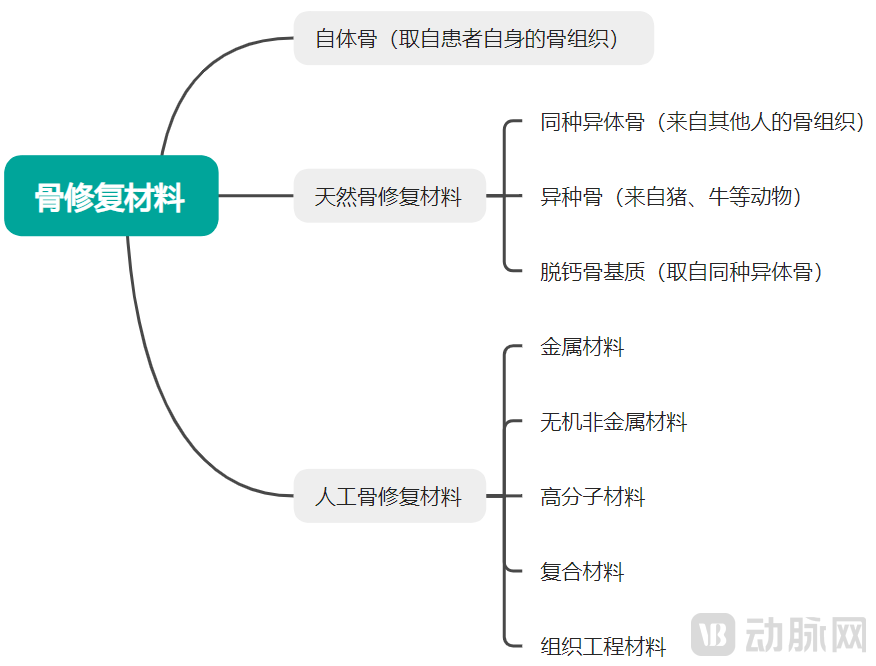
(Classification of Bone Repair Materials)
Autologous bone is the "gold standard" for clinical applications. However, harvesting autologous bone requires an additional surgical procedure to extract it from the patient, causing secondary trauma and increasing the risk of complications. Therefore,The proportion of autologous bone applications in the bone repair market gradually decreased from 62% in 2017 to approximately 50% in 2023.。
Natural bone repair materials include allogeneic bone, xenogeneic bone, and demineralized bone matrix. Among these, allogeneic bone, harvested from deceased or amputated human donors, exhibits excellent osteoconductivity and demonstrates favorable clinical efficacy. Due to its clinical advantages and abundant availability, allogeneic bone has rapidly become the mainstream product in the market, while the application of xenogeneic bone and demineralized bone matrix remains limited.
Allogeneic bone is derived from cadavers or amputated human limbs, and its sourcing raises legal and ethical concerns. For instance, Aorui Biotechnology, a company that once held a certain market share, was involved in the theft and illegal sale of corpses across multiple regions in China between 2015 and 2023 to secure large quantities of raw materials for “allogeneic bone.”
Driven by the “illicit sale of cadavers” case and other factors, the market share of allogeneic bone is also declining. In its 2024 survey response, Allgens Medical stated: “Currently, in clinical bone grafting procedures for the treatment of bone defects in China,”The market share of allogeneic bone products stands at approximately 30%, slightly higher than that of synthetic bone.。
Artificial bone repair materials can be classified into metallic materials, inorganic non-metallic materials, polymeric materials, composite materials, and tissue engineering materials, based on their material properties. Among these, inorganic non-metallic materials (bioceramics) and composite materials are relatively mainstream products in the artificial bone market, while tissue engineering materials (bioactive artificial bone) are experiencing rapid growth.
Despite the currently low market share,The proportion of autologous and allogeneic bone use continues to decline, while the proportion of synthetic bone use continues to rise.. Given advantages such as a wide range of sources, the continuous emergence of new materials, and ongoing product iterations, synthetic bone is considered the mainstream product of the future in the bone repair materials industry.
At present, the market for artificial bone repair materials in China is characterized by diverse technological approaches, a fragmented competitive landscape, low market concentration, and significant growth potential.
Ideal artificial bone repair materials should possess good biocompatibility, surface activity, and degradability; excellent osteoconductivity and osteoinductivity; appropriate pore size and porosity; as well as adequate mechanical strength and plasticity.
In the past, researchers used materials such as calcium sulfate, hydroxyapatite, β-tricalcium phosphate, and bioactive glass to fabricate artificial bone repair materials that mimic the three-dimensional porous structure of natural bone. However, these synthetic bone materials exhibited inferior performance and lacked osteoinductivity, making it difficult for them to gain clinical acceptance.
However, with technological breakthroughs and material innovations, the industry has seen the emergence of composite artificial bone and tissue-engineered artificial bone materials (bioactive artificial bone) that possess osteoinductive and osteoconductive properties, as well as good biocompatibility. In particular, the artificial bone market has experienced a significant boom in the past two years.
First, domestic innovative enterprises have broken through technical barriers to apply magnesium ions in artificial bone.
In the past, numerous studies have confirmed that magnesium ions effectively promote the proliferation and differentiation of osteoblasts. Consequently, many research teams worldwide have attempted to develop magnesium metal into bone implant materials to facilitate bone tissue regeneration and healing. However, the application of magnesium metal in bone repair is limited by its low mechanical strength, uneven degradation, and excessively rapid degradation rate.
In May 2025, the magnesium-containing degradable polymer bone repair material independently developed by Jingcheng Medical was approved for market launch. This is China’s first magnesium-containing artificial bone repair product.
According to reports, Jingcheng Medical utilizes ultra-low temperature 3D printing technology to incorporate magnesium into poly(lactic-co-glycolic acid) (PLGA) and beta-tricalcium phosphate (β-TCP), forming a ternary composite material. This material is suitable for the filling and repair of limb bone defects that do not compromise structural stability.
The product features an internal three-dimensional biomimetic structure with high porosity, facilitating bone tissue and vascular ingrowth. It undergoes complete degradation within 6–9 months, with a degradation rate matched to the rate of bone regeneration. The product exhibits excellent biocompatibility, helping to suppress inflammatory responses, and demonstrates superior osteogenic activity and osseointegration.
Not only Jingcheng Medical, but also Zhenghai Biotech has successfully incorporated magnesium into artificial bone repair materials. In November 2024, Zhenghai Biotech’s calcium-silicon bioceramic bone repair material received acceptance for registration by the National Medical Products Administration (NMPA). This product is primarily used for filling and repairing jawbone defects (or insufficient bone volume) and is China’s first 3D-printed calcium-silicon bioceramic bone repair product.
Compared with traditional printing materials, Zhenghai Biotechnology has introduced bone-beneficial elements on the basis of calcium phosphate-based bone repair materials.Silicon, MagnesiumElements. Based on magnesium, this product can effectively promote the proliferation and differentiation of osteoblasts and the process of vascularization after being implanted at the bone defect site, achieving rapid repair. Meanwhile, as bone tissue regenerates, the product will gradually degrade.
Furthermore, Sanyou Medical is also exploring the use of magnesium metal in artificial bone. Previously, Sanyou Medical jointly applied with Xinhua Hospital for a key Shanghai project titled "Bone Defects in Osteoporotic Fractures of the Proximal Humerus"Magnesium-Based Artificial BoneResearch and Development and Application》, developing magnesium-based artificial bone graft materials and internal implants.
Second, breakthroughs have been achieved in tissue engineering materials, includingrhBMP-2Accelerated Application of Artificial Bone. Tissue engineering is an emerging discipline that combines cell biology and materials science to construct tissues or organs in vitro or in vivo. Compared with bone repair material products such as polymers and composite materials, tissue engineering materials exhibit superior guided bone regeneration capabilities.
rhBMP-2 is an osteoinductive protein,Promotes the differentiation of mesenchymal stem cells into osteoblasts and chondroblasts, thereby facilitating the growth, development, and repair of bone and cartilage. ContainsBone repair materials containing rhBMP-2 are considered tissue-engineered bone repair materials (bioactive artificial bone).
Currently, there are four rhBMP-2-containing bone repair materials available in China. Among them, Guyoudao, under Jiuyuan Gene, is the first rhBMP-2-containing bone repair material approved for sale in China.
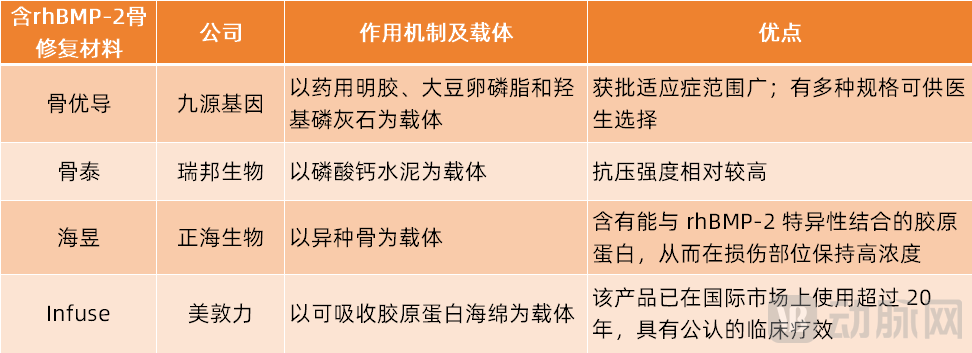
(The Four rhBMP-2-Containing Bone Repair Materials Approved in China)
It is understood that, compared with other types of bone repair materials, rhBMP-2-containing bone repair materialsWith a higher postoperative healing rate and faster bone formation speed. Therefore, the use ofPatients treated with rhBMP-2 bone repair materials exhibit faster bone tissue regeneration and shorter hospital stays.
Additional clinical studies have shown that bone repair materials containing rhBMP-2 demonstrate efficacy and safety in clinical practiceSuperior to allogeneic bone grafts: Among patients with persistent bone injuries treated with rhBMP-2-containing bone repair materials, 26.1% required further surgical revision; among those who received allogeneic bone grafts, 47.4% required surgical revision. The median time to bone healing was 217 days for patients treated with rhBMP-2-containing bone repair materials and 416 days for those who received allogeneic bone grafts.
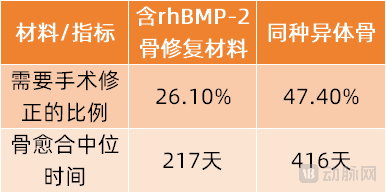
(Comparison of Clinical Efficacy Between rhBMP-2 Bone Repair Materials and Allogeneic Bone)
In terms of source, compared with the source risks and legal and ethical restrictions of allogeneic bone and autologous bone, rhBMP-2-containing bone repair materials can be mass-produced in a laboratory environment.
Based on the aforementioned advantages, although the price of bone repair materials containing rhBMP-2 is higher thanAllogeneic bone and other bone repair materials, yet their sales volume and penetration rate have shown an upward trend. For instance, the sales revenue of Jiuyuan Gene’s Gu Youdao product was RMB 350 million, RMB 440 million, and RMB 710 million in 2021, 2022, and 2023, respectively; representing year-on-year growth in 2022 and 2023 of25.1%、59.5%。
In addition to rhBMP-2,Other bioactive agents within the recombinant human bone morphogenetic protein (rhBMP) family, such as rhBMP-4 and rhBMP-7, also possess osteoinductive properties. Consequently, innovative companies are currently exploring the application of these bioactive agents in synthetic bone grafts.
Third, composite materials continue to achieve breakthroughs, with composite artificial bone approved for market launch.Composite materials are formed by combining two or more distinct materials, typically referring to composites of inorganic materials and polymeric materials. Compared with single-component materials, composite materials exhibit superior properties in terms of microstructure, biodegradability, and bioactivity.
For example, Giant Biogene has developed an “organic–inorganic” composite bone repair material. Its inorganic component consists of hydroxyapatite particles, which are identical to the primary inorganic constituents of human bone, while its organic component comprises macromolecular polysaccharides. By constructing macro- and micropores within the hydroxyapatite particles and applying specific surface modifications to form a three-dimensional structure, this material provides a scaffold and a compatible microenvironment for new bone formation. Leveraging the advantages of the composite material, it can be rapidly shaped to provide structural support, guide bone regeneration, and accelerate the healing process.
For another example, Lixin Science has launched a moldable, absorbable bone repair material (absorbable regenerative bone). This product utilizes a composite of polylactic acid (PLA) and hydroxyapatite (HA). While PLA exhibits strong hydrophobicity, its osteogenic performance is suboptimal, and its acidic degradation products can easily induce aseptic inflammation in vivo. In contrast, HA demonstrates excellent biocompatibility and osteoconductivity, releasing calcium ions during degradation to promote bone tissue regeneration; however, it suffers from poor mechanical properties and low osteoinductive efficiency.
Based on these two materials, Lixin Science has developed a composite material with moderate stiffness and reduced the content of carboxyl groups formed after material degradation to control environmental acidity. Furthermore, through ultra-dispersion technology, fine hydroxyapatite particles are uniformly dispersed within the polylactic acid matrix. This not only efficiently neutralizes acidic substances but also enables the sustained release of calcium ions during hydroxyapatite degradation, ultimately maintaining a relatively balanced calcium ion concentration in the surrounding tissue fluid, which is conducive to osteogenesis.
In addition to the composite of organic and inorganic materials,Composite Natural Bone Repair Materials with Other Materials Have Also Emerged in the Market, such as xenogeneic bone combined with hyaluronic acid, and animal-derived acellular matrix combined with calcium-phosphate inorganic salts.This approach not only preserves the excellent properties of natural bone repair materials but also addresses the sourcing limitations associated with autologous and allogeneic bone grafts.。
Specifically, BioRegen has launched China’s first xenogeneic bovine-derived composite hyaluronic acid bone graft material. This product combines hyaluronic acid with bovine-derived bone particles. By preserving the favorable bone structure of the bovine-derived particles and leveraging the bioactivity of hyaluronic acid, it enhances the material’s biocompatibility and osteogenic efficacy, stimulates the expression of osteogenic factors, and imparts higher hydrophilicity, thereby significantly promoting early osteogenesis. Additionally, hyaluronic acid facilitates wound healing and exhibits certain anti-inflammatory properties.
Huamai Medical has launched China’s first composite artificial bone based on acellular matrix. The product is composed of animal-derived acellular matrix and calcium-phosphate inorganic salts, featuring excellent bioactivity, biocompatibility, safe and controllable immunogenicity, and complete biodegradability. It mimics the composition and structure of autologous bone, offering superior mechanical properties and degradability, and can repair large-scale defects without the addition of any growth factors or stem cells.
In addition, companies such as Allgens Medical, Pinglan Biotechnology, Weida Biotechnology, Mailun Medical, Fuxiang Medical, Susheng Biotechnology, and Nuope Regenerative Medicine have also launched innovative artificial bone repair materials.
To date, no single artificial bone product has emerged to dominate the market; instead, the landscape is characterized by a fragmentation of multiple technological approaches and diverse materials.
However, the industry widely recognizes tissue-engineered bone repair materials (bioactive artificial bone) as a key R&D direction. Consequently, companies are strengthening their R&D investment and strategic layout in this area. With breakthroughs in new materials and technologies, bioactive artificial bone is expected to become the mainstream market product in the future.
Over the past two years, the artificial bone market, which was already experiencing rapid growth, has hit the accelerator once again, entering a phase of “explosive expansion.”
In November 2023, synthetic bone graft materials were included in the national centralized procurement program. According to the bidding results, the average price reduction across the board was approximately 70%. With the implementation of the centralized procurement, prices for synthetic bone graft materials dropped significantly, leading to a rapid surge in volume and a swift increase in shipments from relevant manufacturers. Meanwhile, the market share of products such as autografts and allografts continued to decline.
For example, supported by centralized procurement, Aojing Medical developed over 900 new hospital clients in 2024, more than 800 of which were related to centralized procurement. To accelerate product promotion, the company organized and participated in over 100 industry exhibitions, academic salons, and investment promotion conferences in 2024, covering nearly 30 provinces, autonomous regions, and municipalities across China, with more than 10,000 attendees or visitors.
It is undeniable that the revenues and profits of companies involved in synthetic bone products will be significantly affected following the implementation of centralized volume-based procurement. In response, companies such as Allgens Medical have begun to explore new growth curves.
Among these, global expansion has become a key focus for companies. For instance, in 2024, Jiuyuan Gene signed the key terms of a product licensing agreement with Shanghai Fosun Pharmaceutical (Group) Co., Ltd., granting Fosun Pharma exclusive rights for clinical development, registration, and commercialization of semaglutide, OsteoGuide, and JY-23 in all countries across the Middle East and North Africa, Sub-Saharan Africa, and selected ASEAN nations. This partnership leverages Fosun Pharma’s distribution channels to accelerate international market entry.
Allgens MedTech Prioritizes Expansion in the Southeast Asian Market. In August 2024, its Bongold product successfully entered the Malaysian market; in February 2025, its three major products—BonGold, OssaNova, and SkuHeal—received regulatory approval in Indonesia, further expanding its presence in Southeast Asia. Additionally, Allgens MedTech acquired the German company HumanTech Dental, which has obtained market access qualifications in the European Union, Egypt, Malaysia, Mexico, and other regions, providing significant support for its future overseas expansion.
Beyond global expansion, expanding application scenarios is another strategic direction for artificial bone companies. For instance, Allgens Medical has entered the dental implant market by acquiring Germany’s HumanTech Dental. Allgens Medical believes that this acquisition will help diversify its product portfolio and optimize its product structure. It will also promote the development of its existing oral bone repair materials business, creating synergies and economies of scale, establishing a second growth curve, and further enhancing profitability.
The impact of centralized volume-based procurement is undeniably powerful. However, from the patient’s perspective, returning to the essence of commerce and healthcare by allowing innovative enterprises sufficient profit margins—rather than adhering strictly to a “lowest-price-only” doctrine—may better enable these companies to focus on advancing innovations in various artificial bone materials, instead of struggling to identify a second growth curve. This approach may also prove more beneficial to patients when viewed through a long-term and macroscopic lens.