

How Tencent Achieved AI Deployment in 10,000 Medical Institutions

Tencent
Internet Comprehensive Service Provider
Never before has an innovative technology penetrated the healthcare system as rapidly as large language models, which, within mere months, have prompted hospitals, enterprises, and government agencies to deploy foundation models at scale, proactively seeking AI-driven improvements in quality and efficiency.
However, it is difficult for a single medical institution to complete the entire chain—from model deployment and training to practical application and ultimately generating production value—while balancing economic efficiency and effectiveness.Even in the era of large language models, the mining and development of medical data value still require efficient division of labor.
To facilitate the deep application and value conversion of large models in the medical field, Tencent established a foundational model tailored to China’s healthcare needs several years ago, and upgraded it this year to the “Dual AI Large Model” architecture combining DeepSeek and Tencent Hunyuan.
Leveraging this foundation, Tencent aims to use AI on one handBridging the Supply Gap in China’s Healthcare Services and Enhancing Patient Care Experience; on the other hand, it is also necessary toEmpowering enterprises and hospitals to develop AI applications by providing infrastructure, enabling researchers to focus more on medicine itself and tackle deep-seated clinical challenges.
At the Tencent Cloud AI Industry Application Summit held on May 21, Tencent Health unveiled a new AI agent designed to help users intelligently identify potential health risks and develop personalized health plans. Additionally, it fully launched its self-developed AI model repository on the omics platform, providing large-scale models for proteins, single cells, DNA, and more to research institutions.
Wu Wenda, President of Tencent Health, also elaborated on Tencent Health’s vision for medical AI at the conference. Tencent will comprehensively accelerate innovation in medical AI across four key areas: large model innovation, agent-based applications, knowledge base development, and infrastructure upgrades. With a developmental and rational approach, and centered on genuine societal needs, Tencent will collaborate with industry partners to build impactful AI solutions.
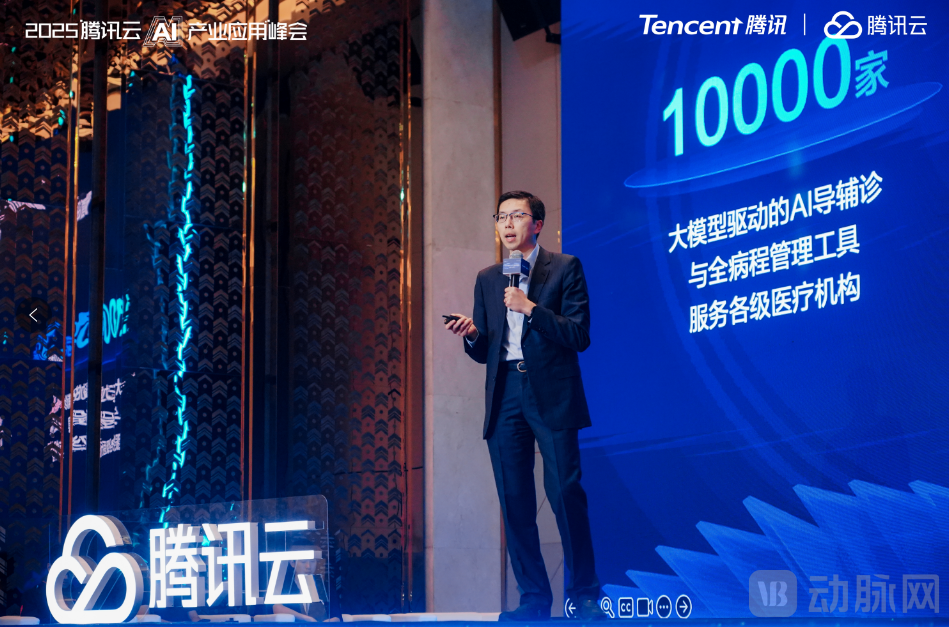
In terms of user base, Tencent holds a dominant position in the Chinese market. While it is spared from the customer acquisition challenges commonly faced by many internet healthcare companies, it still encounters significant practical challenges in meeting users’ diverse health needs and comprehensively improving the nation’s overall health standards.
According to Wu Wenda, “Tencent has been striving to leverage AI to address various user challenges over the years, accumulating substantial digital and intelligent capabilities in the process. However, the healthcare sector possesses unique characteristics; many issues are highly specialized, resembling an ‘alien language.’ Patients often struggle to comprehend authoritative and professional responses, thereby hindering the delivery of further services.”
To overcome patients’ cognitive limitations, the most direct approach is to provide them with concise and easy-to-understand popular science content. Therefore, around 2020, Tencent devoted substantial efforts to building Tencent Medical Dictionary, which not only offers users authoritative and effective medical Q&A but also establishes a high-quality knowledge graph in the process.
With a solid foundation in place, the next step is to build specific applications on top of it that align with patient needs. Prior to the era of large language models (LLMs), Tencent Health had already established an AI ecosystem in consumer-facing health scenarios, including pre-consultation, follow-up care, and medication management. With the widespread adoption of LLMs, these scenarios have been empowered by AI agents, resulting in leapfrog improvements in both scope of application and user experience. This has enabled Tencent to achieve deep integration of internet technologies and AI within healthcare settings.
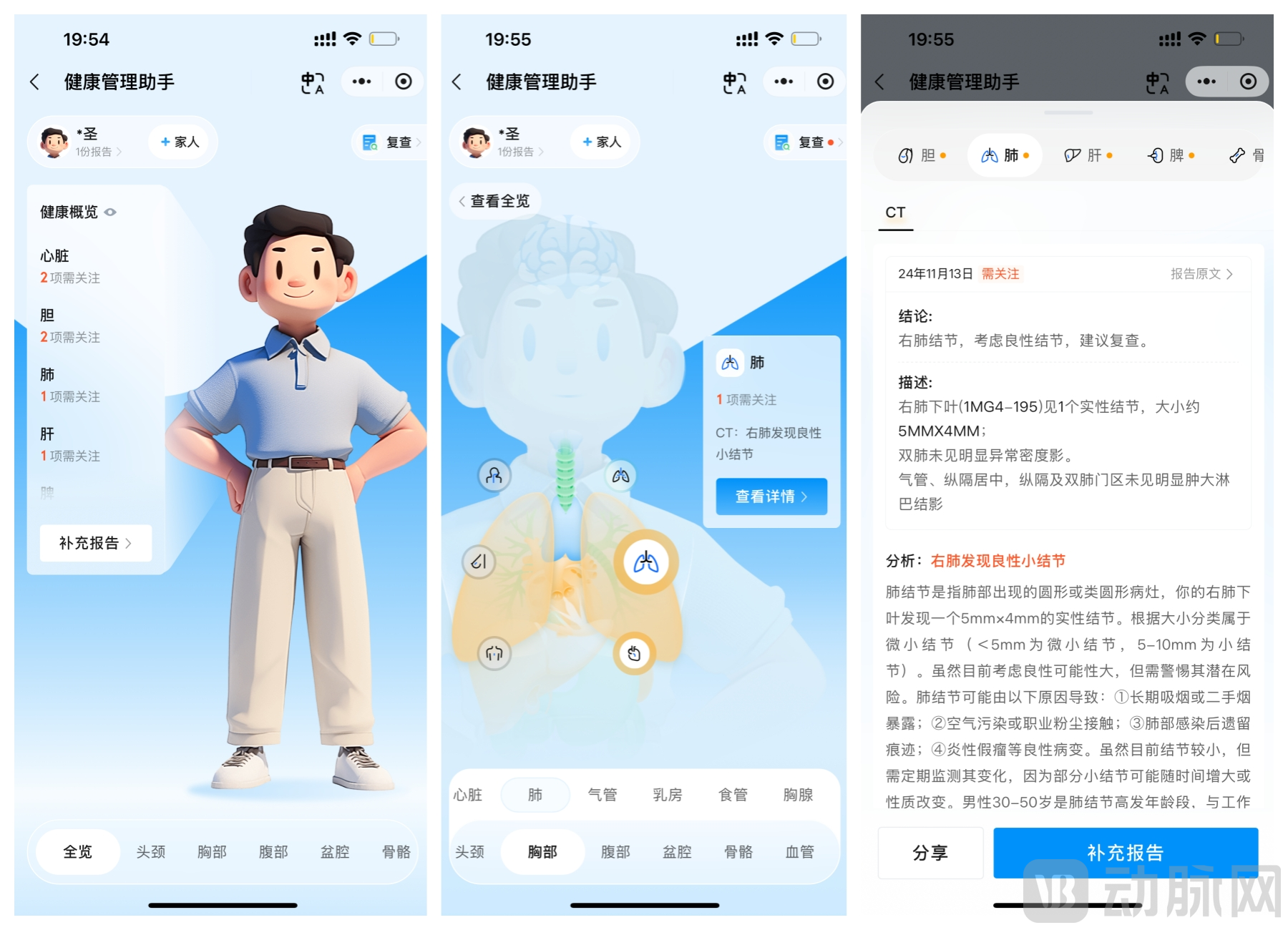
The “Health Management Assistant” released at the Tencent Cloud AI Industry Application Summit represents Tencent’s latest in-depth exploration of consumer-facing health services. Previously, users only sought medical services through entry points such as WeChat and Mini Programs when experiencing physical discomfort, a low-frequency, passive usage pattern that fails to achieve the goal of disease prevention.
The “Health Management Assistant,” a visual AI agent, fundamentally transforms this model by establishing high-frequency, long-term relationships with users.
In simple terms, it can serve as a “health sentinel,” intelligently interpreting physical examination and laboratory test reports to help users dynamically analyze their health status, identify potential risks, and provide targeted health management plans; it can also act as an “action coach,” helping users effectively and promptly detect potential health risks through long-term intelligent tracking of health indicators, thereby overcoming the challenge of sustaining long-term health management.
For consumer-facing applications, AI’s value lies in increasing the supply of medical services and improving patients’ healthcare experiences. For business-facing applications, AI empowers researchers to accelerate breakthroughs beyond the current limits of medical service capabilities, unlocking new possibilities for life sciences.
At the Tencent Cloud AI Industry Application Summit, Tencent Health unveiled a major update to its omics platform. Leveraging research achievements from the Tencent Life Sciences Laboratory, the platform has launched a proprietary AI model repository, providing researchers with models for proteins, single cells, DNA, and more. This initiative aims to facilitate key life science research endeavors, including the prediction and screening of antigen and antibody structures, cell classification, and back-translation.
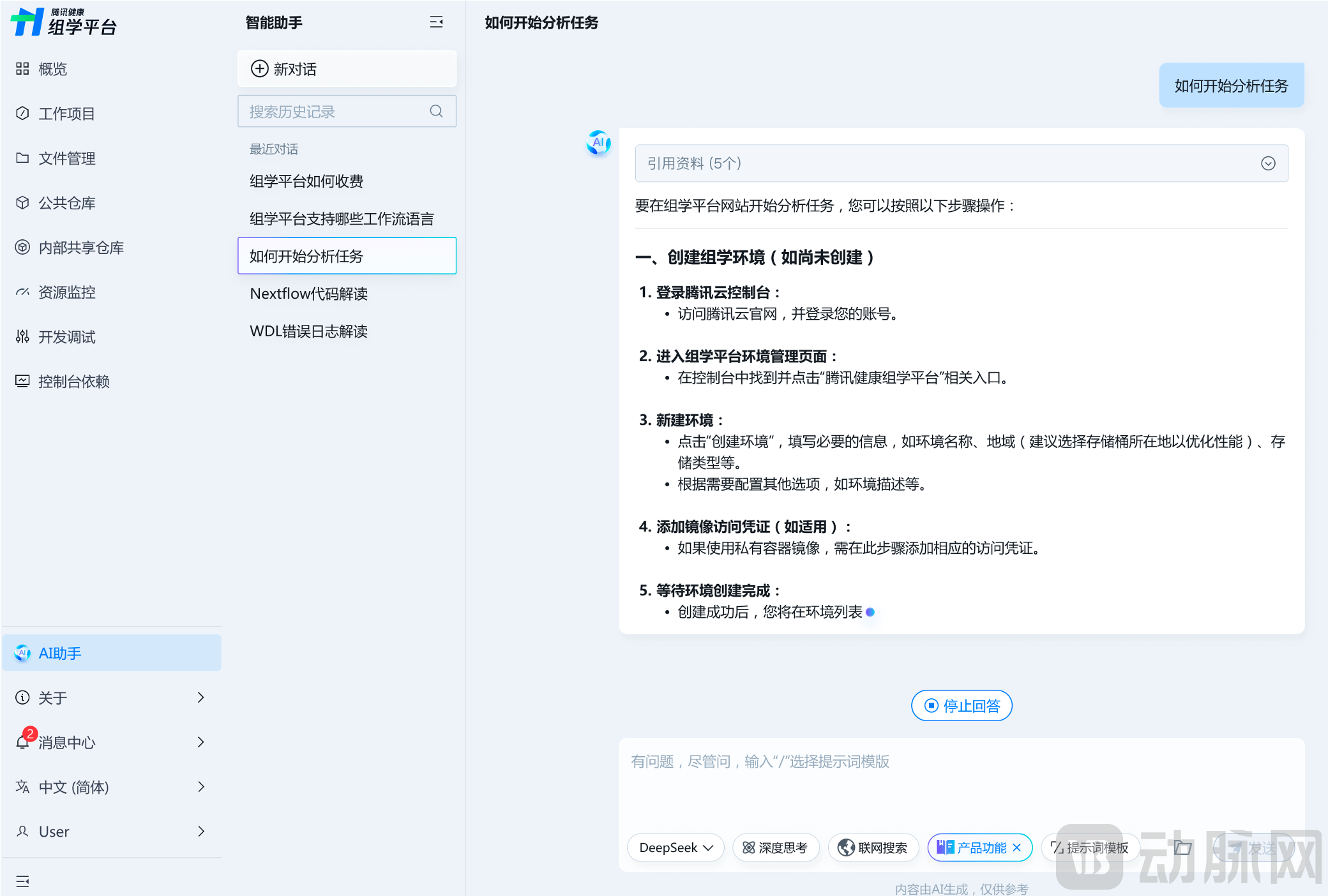
Meanwhile, the Tencent Health Omics Platform also integrates an AI-powered intelligent assistant that deeply combines a bioinformatics analysis workflow development framework with the platform’s knowledge base. It provides services such as intelligent parsing of debugging information, assistance in workflow authoring, and Q&A on product features, delivering end-to-end intelligent support for bioinformatics analysis.
In addition to accelerating genomics data analysis, Tencent Cloud’s AI capabilities are also extensively empowering the healthcare industry, providing more comprehensive, systematic, and in-depth solutions to practical challenges within the sector.
At Peking Union Medical College Hospital, Chinese Academy of Medical Sciences, Tencent Cloud’s large AI models are comprehensively upgrading medical services. Built on the Tencent Hunyuan large model, the AI-powered intelligent Q&A service integrates 15 patient-friendly features, including electronic invoicing, report retrieval, and physical examination appointment scheduling. It also facilitates end-to-end patient lifecycle management, enhancing the healthcare experience in scenarios such as inpatient record creation, pre- and post-operative doctor-patient communication, and full-cycle diagnosis and treatment for oncology patients.
Tencent Cloud’s large AI models also provide comprehensive security protection for the newly launched internet hospital mini-program at Peking Union Medical College Hospital, identifying 1.2 billion malicious requests within one week and blocking nearly 24 million scalper attacks within a month, effectively preventing the malicious snagging of appointment slots. Tencent Sogou Input Method has also become a lightweight AI application platform for physicians, integrating various AI-powered smart applications based on large models—such as in-hospital medication assistants, comprehensive medical intelligent agents, and consultation advisory services—to enhance clinicians’ workflow efficiency.
At Shenzhen Luohu Hospital Group, the first tightly integrated urban medical consortium in Shenzhen, Tencent Health’s “AI Clinical Assistant,” powered by the dual large AI models DeepSeek and Tencent Hunyuan, provides decision support for clinicians. By facilitating processes such as medical history collection, disease prediction, treatment plan recommendation, and medication safety monitoring, it strengthens quality control over clinical diagnostic risks and enhances the quality of medical services.
Currently, the five district-affiliated hospitals and 46 community health centers under the Luohu Hospital Group have adopted diverse AI applications. Intelligent triage and smart pre-consultation have streamlined patients’ healthcare journeys, while mini-tools such as physical examination report interpretation, self-diagnosis and self-check, and medication information lookup via pill box scanning provide patients with smarter tools for health management.
In the field of critical care medicine, the world’s first large language model for intensive care to enter clinical practice—jointly developed by Mindray and Tencent—has been implemented at The First Affiliated Hospital, Zhejiang University School of Medicine, and Peking University Shenzhen Hospital.
“Qiyuan Critical Care Large Model” reconstructs patients’ digital profiles from data, then performs in-depth analysis using critical care reasoning as input to the large model. It enables healthcare professionals to retrospectively integrate patient conditions within 5 seconds, predict trends and provide recommendations based on patients’ digital profiles, generate clinical-reasoning-oriented medical records within one minute, and deliver critical care knowledge query results with an accuracy rate of up to 95%, thereby comprehensively enhancing the precision and quality of clinical diagnosis and treatment.
In the field of third-party medical laboratory testing, KingMed Diagnostics leverages Tencent Cloud’s computing power platform and large model integration capabilities to continuously build and iterate its “YuJian YiYan” large language model, while developing the AI agent application “Xiao Yu Yi” to broadly serve primary healthcare institutions. Meanwhile, Tencent Cloud’s medical AI product capabilities are fully integrated with “Xiao Yu Yi” in scenarios such as intelligent Q&A, smart reporting, and safe medication use, providing more comprehensive solutions for primary healthcare institutions and facilitating the implementation of tiered diagnosis and treatment.
At the 2024 Tencent Digital Ecosystem Conference, Wu Wenda stated, “There are numerous scenarios suitable for large language models, and we will carefully consider whether to develop them in-house. For some deeply clinical and particularly complex scenarios, while we have the capability to address them, we believe they should be left to enterprises with greater comparative advantages.”
After all, Tencent's greatest advantage still lies in its 'connectivity' capabilities.
As of May 2025, Tencent’s medical AI capability matrix has been deployed nationwide across China.
For instance, the large model-driven Tencent Health AI triage and diagnostic assistance service has been deployed in nearly 10,000 medical institutions of all levels across 34 provinces, autonomous regions, and municipalities directly under the Central Government in China. Tencent Miying’s medical imaging AI has been adopted by over 500 medical institutions nationwide, cumulatively assisting healthcare professionals in conducting various medical examinations for nearly 10 million patient visits. Tencent Cloud’s diverse “out-of-the-box” medical AI solutions serve more than 1,300 organizations, including hospitals, pharmaceutical and medical device companies, research and academic institutions, and health technology enterprises.
In this process, the value Tencent brings extends beyond providing AI applications or AI infrastructure to various institutions; it also collaborates with them to leap into the era of large language models, integrating knowledge hidden within medical data and encapsulating it into intelligent agents.
Looking ahead, Tencent and its partners will undoubtedly continue their joint exploration of the medical AI landscape. As quantitative changes culminate in a qualitative leap, we may witness, within a finite timeframe, the dawn of a new era in healthcare characterized by intelligence, precision, and inclusivity.