

Billion-Dollar Medical Imaging Market at a Turning Point: Industry Leader Rimag Group Poised to Break Through

Rimag
Third-Party Chain Medical Imaging Service Provider

RadNet
Outpatient Imaging Service Provider
RadNet (RDNT) has demonstrated remarkable market performance in recent years. From 2020 to 2024, this leading U.S. third-party imaging center operator pursued an aggressive M&A strategy, achieving a counter-trend compound annual growth rate (CAGR) of 14.83% in total revenue, which has surpassed the RMB 10 billion mark.
As the beacon of third-party imaging centers in the United States, it has attracted a series of enterprises, including Ping An and TCL, to enter the field over the past decade, with more than 10 billion yuan in capital rushing into this sector.
However, China and the United States have different national conditions.The U.S. healthcare system is dominated by private practices and private hospitals, with residents accustomed to the third-party model; non-public healthcare in China has developed relatively late, so third-party imaging centers must identify supply gaps within the healthcare system to effectively complement public hospitals.。
RIMAG is one of the few companies in China capable of identifying discrepancies during the trial-and-error phase and successfully executing a transition to a “localized” business model. In June 2024, it listed on the Hong Kong Stock Exchange as China’s “leading medical imaging services stock,” having turned profitable the previous year with a net profit of RMB 36.57 million.
However, the confluence of an economic downturn and comprehensive reforms in China’s healthcare system necessitates that every medical service provider seek new models to balance the next-generation demands of hospitals, patients, and payers.
RIMAG must do the same. Standing at the tipping point of transformation for China’s third-party medical imaging centers, it needs to find its own path as soon as possible.
Prior to 2024, RIMAG primarily served business (B-end) and consumer (C-end) clients, with its core operations centered on medical imaging. On one hand, it targeted healthcare institutions by establishing self-owned third-party imaging centers to directly fulfill their diagnostic imaging needs through models such as regional resource sharing and operational trusteeship, or by providing departmental management solutions. On the other hand, it catered to a select segment of health management clients by offering them direct access to medical imaging services.
As early as 2013, the “Several Opinions of the State Council on Promoting the Development of the Health Service Industry” issued by the State Council proposed guiding the development of specialized medical laboratory centers and imaging centers. Over the following decade, multiple documents were subsequently introduced to encourage medical imaging diagnostic centers to adopt chain-based and group-oriented operational models, and to establish standardized and normalized management and service frameworks.
After all, within China’s current healthcare system,The capabilities of any hospital’s radiology department have their limitations. Some lack equipment, others are short on technologists, and still others are unable or unwilling to provide patients with a seamless “examination plus treatment” service due to constraints in clinical workflows.。
Taking a Grade A tertiary hospital specializing in the diagnosis and treatment of neurological disorders as an example, it possesses the technical capability to provide all types of neurological examinations available in current medical practice. However, to enable magnetic resonance imaging (MRI) for as many patients across the hospital as possible and ensure the smooth flow of hospital-wide services, the Department of Radiology strives to limit the MRI scan time per patient to approximately ten minutes.
When encountering pediatric epilepsy patients, for whom a single MRI scan requires 40 minutes, clinicians inevitably reduce the number of imaging sequences employed, substituting optimal protocols with more conventional scanning approaches. This compromise precludes multimodal diagnostic assessment, forcing clinicians to rely on tentative therapeutic trials for definitive diagnosis.
Therefore, the most direct value of third-party imaging centers to tertiary hospitals lies in their ability to address specific clinical needs, ensuring that hospital radiology departments can leverage their comparative advantages while meeting the requirements of patients and clinicians for imaging quality.
In contrast, third-party imaging centers can play a more substantial role in county-level and primary care settings.
Although price wars among imaging equipment manufacturers in recent years have lowered the acquisition costs of such devices, and medical institutions have, to varying degrees, deployed CT, MRI, and other medical equipment, they still face challenges in actual operations. These include insufficient equipment capabilities or a lack of specialized technicians when managing complex and rare cases or establishing distinctive specialty departments.
To address these differentiated needs, RIMAG has developed three localized models: domain-shared imaging centers, specialty-focused medical consortiums for imaging, and operationally managed imaging centers, thereby creating complementary service models and offerings.
For medical institutions that own equipment but have left it idle for extended periods, RIMAG can leverage its cloud capabilities and equipment operation expertise to take over these assets, enabling more efficient utilization.
For medical institutions lacking imaging equipment, RIMAG’s fleet of over 220 high-end and ultra-high-end imaging devices—including PET-CT, superconducting MRI, and multi-slice spiral CT scanners—can fully leverage their value.
Equipped with these devices, it can easily provide partner secondary hospitals with imaging department configurations comparable to those of tertiary hospitals, directly raising the ceiling of clinical discipline capabilities; meanwhile, leveraging cloud capabilities and equipment operational expertise, it can take over underutilized equipment at certain institutions, enabling more efficient operations.
This model has delivered highly tangible results for RIMAG’s business expansion. From 2021 to 2023, RIMAG’s total revenue surged from RMB 592 million to RMB 929 million, representing a CAGR of 25.27%.
At first glance, RIMAG’s business appears somewhat narrow, revolving solely around medical imaging diagnostic services. In reality, however, no private healthcare enterprise that operates hundreds of medical entities and connects with more than 500 healthcare institutions would limit itself to a specific set of services. This is particularly true in the field of medical imaging, where immense, hard-to-quantify value remains to be unlocked by companies.
At RIMAG’s 2025 Investor Open Day held recently, Chen Chaoyang, Chairman and Executive President, discussed the newly releasedThird-Party Imaging Services 2.0 StrategyA complete analysis was conducted.
Under the new strategy, RIMAG has outlined two core objectives. First, to rapidly increase market penetration by achieving the target of adding 1,000 partners annually; second, to explore the hidden value of medical imaging while maintaining existing operations, thereby establishing new revenue growth drivers.
The essence of increasing market penetration lies in expanding into medical institutions that RIMAG has previously failed to reach.
For instance, some primary healthcare institutions have relatively simple needs, such as establishing basic IT infrastructure or requiring training services for specific equipment. Some county-level medical facilities only need specialized training for particular diseases or require RIMAG to supplement certain remote consultation services.
These modular business areas were not previously covered within RIMAG’s ecosystem. Now, RIMAG is leveraging its accumulated capabilities to develop standardized “hook products.” While the delivery of these “hook products” is relatively straightforward, they enable the establishment of collaborative relationships with healthcare institutions. As these institutions enter new stages of development in the future, RIMAG will be better positioned to secure additional orders.
Under RIMAG’s previous asset-heavy business expansion model, the annual addition of 30–50 new facilities was approaching its limit. However, bolstered by its “hook product,” RIMAG is poised to cover 1,000 medical institution clients in 2025 and surpass 10,000 users within three years.
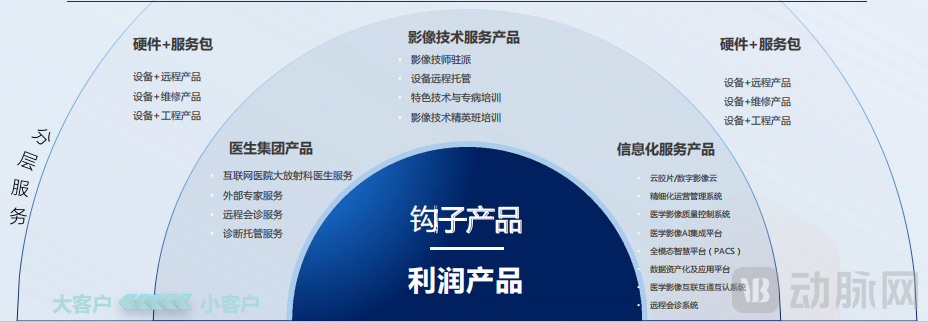
If the implementation of “hook products” aims to achieve a multiplicative increase in revenue over the long term, then the upgrade of RIMAG’s “CDH” model is designed to generate greater profits in the short term.
Based on Chen Chaoyang’s description, the core of RIMAG’s new “2H, 2D” strategy is to“Stepping out of the imaging department to more directly help hospitals generate incremental revenue.”With the implementation of DRG and centralized procurement of pharmaceuticals and medical devices, healthcare revenue generation is returning to the core of medical services. Therefore, RIMAG must enhance the quality of hospital services and expand its service scope.
Taking tertiary hospitals at the county level as an example, they face significant operational pressures under the new policy. In response, RIMAG’s strategy leverages medical imaging as a key entry point by establishing an interconnected imaging platform and deploying it within surrounding small and medium-sized medical institutions, thereby helping hospitals build tightly integrated healthcare consortia.
For empowered regions, this is a multi-party win-win strategy. Leveraging technologies such as AI and cloud platforms, RIMAG extends its imaging capabilities to grassroots levels, enabling primary healthcare institutions to screen patients with abnormal results for timely intervention. If the abnormal findings exceed the diagnostic and treatment capacity of primary care, patients can be rapidly referred upward to receive early treatment.Establishing a sustainable operational relationship between hospitals and third-party imaging centers through this model is more durable and sticky than a pure trusteeship model.。
The updated D-side is also a key focus of the new strategy. Leveraging its flagship centers, RIMAG has begun assisting hospitals in establishing and expanding comprehensive outpatient departments, thereby building sustainable operational relationships.
Supported by cutting-edge equipment such as PET/CT and superconducting MRI at the flagship center, these outpatient clinics can introduce many services previously beyond the hospital’s capacity, including health screenings, rehabilitation, and chronic disease management. By collaborating with specialists to establish closed-loop care pathways for specific conditions such as cardiac rehabilitation and oncology, the hospital achieves revenue growth grounded in the discipline of efficiency upon completing the entire process.
Revisiting the Upgraded C-End Model: RIMAG’s Innovation Lies in Capturing Diagnostic Imaging Demand Following Light Online Medical Consultations
From Chen Chaoyang’s perspective, internet-based healthcare services in public hospitals currently suffer from procedural gaps. While there is an aspiration to establish a closed-loop online diagnosis and treatment system, the diagnostic testing component remains heavily dependent on offline operations. For patients residing outside the hospital’s locality, the requirement for in-person medical imaging examinations hinders their ability to fully benefit from the convenience offered by internet healthcare.
Based on the aforementioned requirements, West China Hospital of Sichuan University has entered into a collaboration with RIMAG,The latter shall be responsible for providing standardized post-consultation examination services, ensuring that the service quality meets the same standards as those of West China Hospital.。
Specifically, when a patient completes an initial consultation and requires diagnostic imaging at West China Hospital’s Internet Hospital, if the patient is not located in Chengdu, they may request the hospital to issue an imaging requisition. They can then seek out nearby RIMAG-affiliated medical institutions capable of delivering equivalent imaging services. After completing the examination, the patient can follow up via the Internet Hospital. In this process, RIMAG generates additional business by providing technical training on delivery standards to these affiliated institutions, distributing orders to them only after they meet West China Hospital’s service delivery requirements.
It is worth noting that RIMAG currently connects to only a small fraction of the internet healthcare sector; the overall market is sufficiently large and offers substantial growth potential.
After all, apart from some common diseases,Internet healthcare is also seeing the emergence of new demands in consumer-oriented medical sectors, such as medical aesthetics and dentistry, which similarly require third-party imaging centers to deliver high-level, high-quality services.
Therefore, RIMAG’s model innovation holds exceptional reference value for the entire industry. The asset-heavy model of third-party imaging centers, long criticized in the past, has now been empowered by internet healthcare to transform into an impregnable and irreplaceable competitive barrier.
In addition to leveraging the “CDH model” to unlock the potential value of over 100 imaging centers and 500 partner hospitals, RIMAG is also exploring the unique value of imaging data held by third-party imaging centers.
In the era of large language models, every hospital is developing its own specialized vertical models. However, due to the limited diversity of imaging data sources, these efforts often focus on a single disease type, resulting in medical imaging AI applications with restricted scope.
In contrast,RIMAG’s competitive advantage lies in its role as a direct producer of medical imaging data. The data it generates spans across provinces and cities, diverse equipment brands, and various models, thereby meeting the demand for data diversity in AI model training. Consequently, RIMAG is not only capable of developing highly robust AI applications but also achieves rapid scalability, establishing China’s most extensive ecosystem for AI-assisted imaging diagnosis.
Currently, Yinghe Medical, incubated by RIMAG, is integrating the aforementioned AI capabilities. In January this year, Yinghe Medical announced that its Yinghe Yimai foundational model for medical imaging had successfully achieved convergence through self-supervised training on multiple anatomical medical imaging datasets.
Relevant data show that the L0-level model generated by Yinghe Medical through unlabeled, unsupervised learning achieves accuracy, sensitivity, and specificity all exceeding 90% in assisted diagnosis for target diseases. When relevant standard data are incorporated to build an L1-level model on this basis, all performance metrics exceed 95%, outperforming the majority of single-disease models currently available on the market.
Given RIMAG’s business scale, the company generates over 10 million new imaging cases annually. By devoting greater resources to data standardization and model training, Yinghe Medical possesses full potential to become China’s largest imaging AI vendor.
After validating the feasibility of localized third-party imaging centers, RIMAG set its sights on the international market, aiming to establish new revenue pillars through overseas expansion.
However, due to vast cultural differences across countries and regions, it is difficult for Chinese enterprises to establish a firm foothold overseas solely through their own capabilities. In existing successful cases, the international expansion of medical services has relied either on mergers and acquisitions or on building communities of shared interests through partnerships.
In the early stages of its global expansion, RIMAG’s core strategy was primarily based on a partnership model. Chen Chaoyang stated: “The exceptional cost-effectiveness of China’s medical services industry is highly competitive in overseas markets. With lower costs for equipment and consumables, as well as more mature data and software services, RIMAG can rapidly replicate its operational model and capture market share once a partner is secured to establish the framework.”
Currently, RIMAG has established a solid foothold in Hong Kong and Macao, undertaking medical imaging services for multiple private healthcare institutions, including EC Healthcare. It has also successively established joint ventures in countries such as Singapore and Malaysia, with plans to set up benchmark sites within this year.
In Chen Chaoyang’s vision, RIMAG aims to increase its overseas revenue to 30% of total revenue within the next five years. As the third-party imaging center market in most countries remains a blue ocean, RIMAG’s early strategic positioning positions it well to achieve large-scale global expansion.
Transitioning from the asset-heavy 1.0 model of third-party imaging centers to a “Services + Data + Overseas” 2.0 model, RIMAG’s current strategy has captured the majority of value creation pathways in third-party medical imaging services.
If RIMAG can translate the aforementioned opportunities into tangible results, it is poised to elevate its revenue scale from the hundreds of millions to the billions.
Given RIMAG’s existing competitive advantages, it still has ample room for trial and error.
As the imaging AI ecosystem flourishes and overseas market penetration accelerates, RIMAG, having crossed its tipping point, may usher in a new era of globalization for Chinese healthcare services.