

Attovia Therapeutics Files for IPO Following $90 Million Series C Financing Led by Former Zai Lab Executives
Attovia Therapeutics
Biological Treatment Pipeline Developer

Deep Track Capital
Life Sciences Investment Firm

Vida Ventures
A Life Sciences Investment Fund

Sanofi Ventures
Venture Capital Firms
From a $60 million Series A round to a $90 million Series C round, Attovia Therapeutics (“Attovia”) has been continuously breaking its own fundraising ceilings.
As a clinical-stage biotherapeutics company, Attovia is dedicated to building a pipeline of biotherapeutic candidates in the fields of immune-mediated diseases and oncology. In its Series C financing round, prominent investors including Deep Track Capital, Vida Ventures, and Sanofi Ventures participated, betting on Attovia’s future growth.
To date, Attovia has completed three rounds of financing, raising a total of $255 million. More notably, within just two years, Attovia achieved the leap from acquiring technology licenses to advancing multiple projects into clinical stages. Such rapid development is rare in the highly competitive field of pharmaceutical R&D.
What Is It About This Young Biotech Company That Continues to Attract the Attention of Investors?
1Zai Lab Team Leads in Acquiring Nanobody Platform via Licensing
In 1989, Belgian scientists discovered a unique single-domain antibody fragment in camel blood. Derived from heavy-chain-only antibodies (HcAbs) that naturally lack light chains, this fragment consists solely of the variable region of the heavy chain (VHH). With a molecular weight of approximately 15 kDa—only one-tenth that of conventional antibodies—it is the smallest known antigen-binding unit and was thus named “nanobody.” Its compact three-dimensional structure, featuring a long and flexible CDR3 loop, enables it to penetrate deep into antigenic clefts, achieving high-affinity and specific binding.
With the advancement of biotechnology, the advantages of nanobodies have become increasingly prominent, making them a focal point in pharmaceutical research and development. Their small size enables strong penetration in animal bodies and tissues, allowing them to even cross the blood-brain barrier to reach the interior of tumors. They exhibit broad antigen-binding capabilities, facilitating genetic engineering to target various pathogens. Comprising only a single domain, nanobodies demonstrate higher stability, prolonged retention time in vivo, and strong adaptability to environmental changes such as temperature and pH fluctuations, thereby ensuring sustained therapeutic efficacy.
Therefore, as a superior new form of antibody-based therapeutics, nanobodies have attracted significant attention for their potential. Currently, the research, development, and commercialization of the nanobody industry remain in an early stage. Since the global first nanobody drug, Caplacizumab, was approved for marketing in the European Union in 2018, nanobodies have been explored for treating a wide range of diseases, from viral infections to cancer, continuously empowering the strategic development of innovative pharmaceutical companies.
Seizing this opportunity, Alamar Biosciences and Frazier Life Sciences jointly established Attovia, securing the intellectual property rights to the ATTOBODY nanobody technology platform through an exclusive global license. Attovia is leveraging this platform to focus on developing a pipeline of therapies for immune-mediated diseases and cancer.
Attovia’s management team has deep roots in the Chinese pharmaceutical industry and boasts substantial strength. CEO Tao Fu, Chief Scientific Officer Petter Veiby, and David Bellovin, Vice President of Early Discovery and Translational Medicine, all hail from Zai Lab, an innovative biopharmaceutical company. The team has long been deeply engaged in biological R&D, having played key roles in the global development and commercialization of innovative drugs for oncology, autoimmune diseases, and neurological disorders at Zai Lab, thereby accumulating extensive industry experience and professional expertise.
Since its establishment in 2023, Attovia has focused on immune-mediated diseases and oncology. Its initial $60 million financing round was allocated to optimizing the ATTOBODY platform technology and planning early-stage projects. In 2024, a $105 million Series B financing round advanced its key pipeline candidates, ATTO-1310 and ATTO-002, into clinical preparation stages, while the company also expanded its R&D team.In 2025, bolstered by a $90 million Series C financing round, ATTO-1310 entered Phase I clinical trials, while ATTO-3712 is scheduled to initiate its Phase I clinical study in the second half of the year.
2Empowered by Dual-Epitope Binding: Five Key Advantages of Proprietary Nanobodies
Attovia’s core technology is the ATTOBODY platform, which leverages the advantageous properties of nanobodies—such as low molecular weight, high stability, superior tissue penetration, and ease of genetic engineering—to link two nanobodies targeting distinct epitopes on the same antigen, thereby forming a bispecific structure.
Its design connects two binding arms via a proprietary spatial positioning technology, forming a unique molecular structure. The core objective of this technology is to optimize the spatial arrangement of the two binding arms, enabling them to bind to target molecules such as antigens and receptors in an optimal conformation, thereby enhancing the drug’s targeting capability and biological activity.
Specifically, the binding arms of ATTOBODY adopt VHH domains. Through proprietary linkage technology, two VHH nanobodies are arranged in a specific orientation to simultaneously bind two distinct epitopes on the target molecule, forming a dual-epitope binding mode. This design enables targeting of difficult-to-drug targets and offers adjustable half-life:
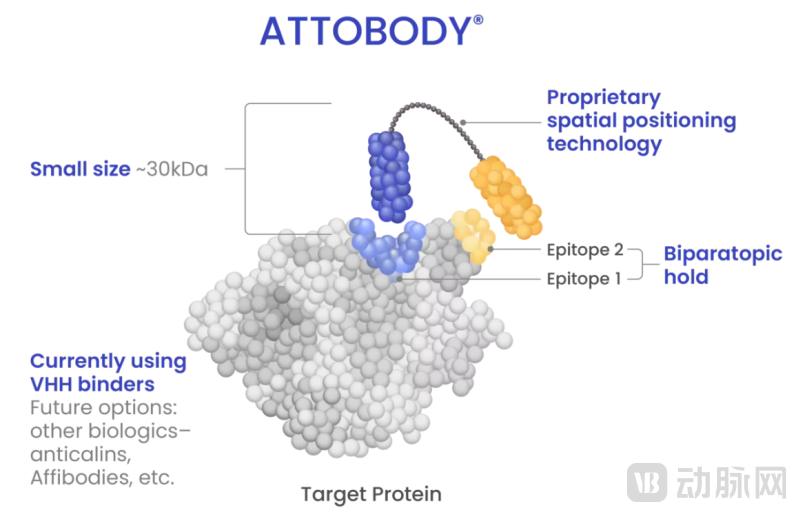
Overview of ATTOBODY Technology Source: Attovia Official Website
Ultra-High Affinity:Traditional antibodies typically bind to a single epitope and exhibit relatively weak affinity. ATTOBODY employs a dual-epitope binding mode, achieving picomolar (pM) affinity. This significantly enhances the binding tightness to the target, features a slow dissociation rate, enables prolonged target engagement, and thereby improves therapeutic efficacy.
Precise Specificity:By interacting with two epitopes on the target molecule, it enables precise target recognition and can distinguish between similar molecules that are difficult to differentiate using conventional methods, such as G protein-coupled receptors, ion channels, or tumor-specific variants. This approach reduces off-target effects on non-target tissues, thereby enhancing the precision and safety of therapy.
Efficient Internalization:Compared with traditional antibodies or nanobodies, its dual-epitope binding mode promotes more efficient internalization of the target molecule into cells, making it an ideal delivery vehicle for antibody–drug conjugates (ADCs) or radionuclide–drug conjugates (RDCs). This enables more effective intracellular delivery of therapeutic agents, thereby exerting a stronger therapeutic effect.
Rapid Tissue Penetration:With a small molecular size, single-domain nanobodies are approximately 15 kDa, and bispecific nanobodies are approximately 30 kDa, significantly smaller than conventional antibodies (150 kDa). This allows for rapid tissue penetration and swift action at disease sites, achieving faster and deeper therapeutic effects. They are particularly suitable for treating conditions that require drugs to reach the lesion site quickly, such as inflammatory skin diseases.
Modular Structure:ATTOBODY features a modular structural advantage, enabling the construction of multispecific biologics through flexible combination of different modules. For instance, by combining various formats, this structure can simultaneously target multiple distinct antigens or different epitopes on the same antigen, thereby achieving more precise and efficient therapeutic outcomes. Furthermore, fusion with half-life extension moieties can extend the dosing interval to two to three months, significantly reducing the frequency of administration and improving patient compliance.
Based on this, the ATTOBODY platform significantly accelerates the drug development process through a dual-epitope binding mode. It not only provides a diverse array of drug candidates and expands the range of targetable diseases, but also reduces R&D risks, facilitating the launch of therapeutic agents with leading potential.
3Dual-Core Pipeline Poised to Enter Clinical Stage, Targeting the “Star” IL-31
Currently, leveraging its ATTOBODY technology platform, Attovia has successfully developed five drug candidates, with some projects having entered clinical stages. Among these, IL-31 is the core target of the company’s R&D efforts. Attovia has strategically deployed two key pipelines around this target: ATTO-1310 and ATTO-3712. Both products have the potential to become best-in-class (BIC) therapeutics for various immune-mediated diseases.
Its flagship investigational product, ATTO-1310, is aLong-half-life anti-IL-31 monoclonal antibody, primarily indicated for the treatment of chronic pruritus. In patients with chronic pruritus, IL-31 is often abnormally overexpressed, continuously stimulating nerve endings to induce the sensation of itch. The drug’s mechanism of action lies in its precise targeting of the IL-31 cytokine; by specifically binding to IL-31, it blocks the interaction between IL-31 and its receptor, thereby inhibiting the activation of downstream itch-related signaling pathways. Attovia has currently announced that the first patient has completed dosing in the Phase I first-in-human clinical trial of ATTO-1310 for the treatment of chronic pruritus.
Another product in development, ATTO-3712, is a long-half-life bispecific antibody targeting IL-13 and IL-31, simultaneously acting on these two key cytokines. In diseases such as atopic dermatitis and chronic spontaneous urticaria, both IL-13 and IL-31 are involved in inflammatory responses and immune imbalance. IL-13 promotes the infiltration of inflammatory cells and induces epithelial cells to produce inflammatory mediators, while IL-31 is closely associated with pruritus. By simultaneously blocking the signaling pathways of these two cytokines, ATTO-3712 more comprehensively modulates the immune response, thereby reducing inflammation and alleviating itching symptoms. The drug is currently at the stage of filing an Investigational New Drug (IND) application, with Phase I clinical trials planned for the second half of 2025.
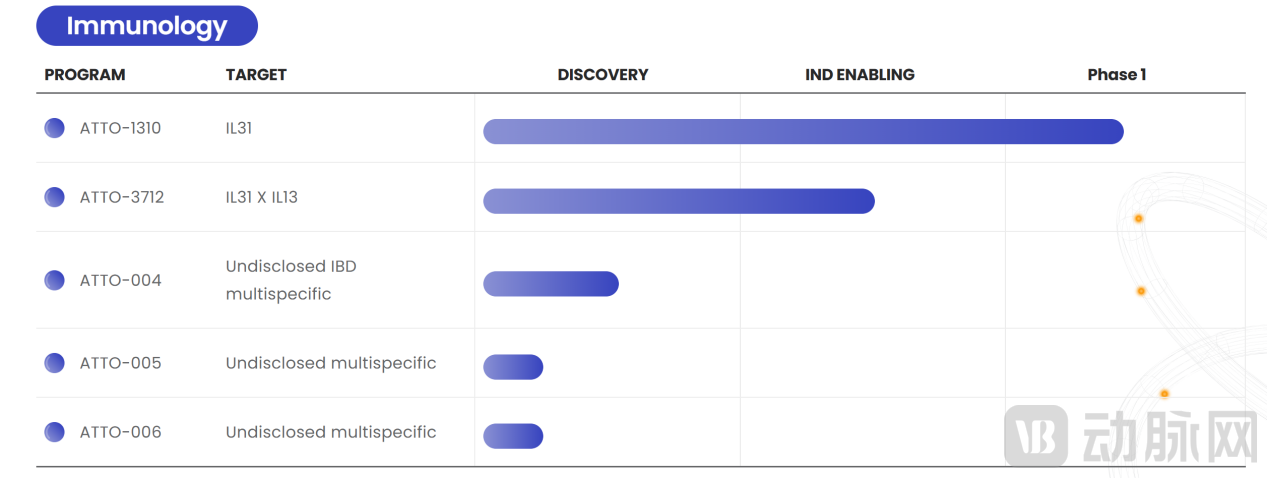
Attovia’s Current Pipeline Portfolio Source: Attovia Official Website
Notably, competition in the IL-31 target space is intensifying. Nemluvio (nemolizumab-ilto), developed by Galderma, has been approved for marketing, becoming the first monoclonal antibody approved to inhibit IL-31 signaling. Its approved indications in the United States include prurigo nodularis and moderate-to-severe atopic dermatitis in adults. In addition, several targeted therapies are under development: Johnson & Johnson’s bispecific antibody NM26, which targets IL-31 and IL-4Rα, is about to enter Phase II clinical trials; Zai Lab’s IL-13/IL-31 bispecific antibody ZL-1503, which simultaneously targets inflammatory and pruritogenic signaling pathways, is expected to submit an Investigational New Drug (IND) application in 2025.
4China’s Nanobody Industry Begins to Take Shape
The nanobody market has become one of the major markets in life sciences-related fields. In terms of market size, according to data from Bizwit Research & Consulting LLP, the global nanobody market is projected to grow at a compound annual growth rate (CAGR) of 24.2% from 2024 to 2029, with its scale expected to reach $1.23 billion by 2029. This booming market trend also provides ample room for development for companies like Attovia Therapeutics that specialize in nanobody technology.
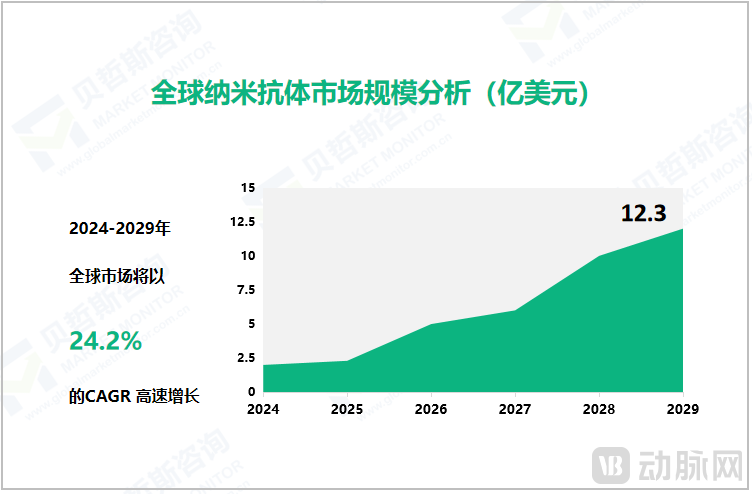
Global Nanobody Market Size Data Source: BizWits Consulting
Driven by continuous advancements in nanotechnology, global demand for the nanobody market is surging. In diagnostics, nanobodies are widely utilized in immunoassays, biosensors, and molecular imaging technologies, enabling precise identification of tumor-specific antigens or infectious disease markers to facilitate early and accurate diagnosis of complex conditions such as cancer and AIDS. In therapeutics, their ability to effectively penetrate tissues and cells makes nanobodies ideal candidates for delivering therapeutic payloads directly to diseased sites, thereby minimizing systemic side effects and enhancing treatment efficacy.
According to data from the U.S. market research firm Wise Guy Reports, global nanobody market revenue across North America, Europe, Asia-Pacific, South America, the Middle East, and Africa is projected to reach $2.2 billion in 2024 and $9.2 billion by 2032, representing a compound annual growth rate (CAGR) of 19.58%.
In overseas markets, Sanofi’s former subsidiary Ablynx, a pioneer in nanobodies, launched the world’s first nanobody drug, Caplacizumab, in 2018 for the treatment of acquired thrombotic thrombocytopenic purpura. Since then, multiple nanobody drugs based on its NANOBODY® technology platform have entered Phase I clinical trials. LAVA Therapeutics focuses on the development of γδ T-cell-engaging bispecific antibodies. Its proprietary Gammabody platform is distinctive; although LAVA-1223, an EGFR-targeting agent for solid tumors developed on this platform, remains in preclinical development, it has already attracted a collaborative licensing agreement with Seagen.
The field of nanobodies in China is also developing rapidly. Companies such as Alphamab Oncology, Innovent Biologics, TAAJ Biopharmaceuticals, YZY Biopharma, iSmAb Therapeutics, Promiscuous Bioscience, Kewang Medicine, Puregen Biotech, Jingzhun Biology, Lokon Bio, and Banko Biology are actively engaged in the research and development of nanobody drugs; while companies like GenScript Biotech, Sino Biological, Tech-Bio, Camide Biology, Baiying Biology, Legend Biotech, and Yaohai Biology focus more on providing R&D services, process development, or reagent supply for nanobodies.
Envafolimab (brand name: Envuida), independently developed by Alphamab Oncology, is a monospecific antibody composed of a nanobody and an Fc fragment, marking the world’s first approved subcutaneously injected PD-(L)1 antibody. According to Alphamab Oncology’s financial reports, Envafolimab generated revenues of RMB 196 million and RMB 159 million for the company in 2023 and 2024, respectively, highlighting the market potential of nanobody-based therapeutics.
Overall, China’s nanobody industry has established a preliminary value chain spanning from research and development to application. As an emerging force in the field of biologics, nanobodies hold significant promise in terms of both cost-effectiveness and intrinsic development value.