

Behind the PEEK Boom: Beyond Industrial Frenzy, China's Breakthrough in Medical Applications
Six Days, Four Limit-Ups: Merely the Beginning of PEEK Material’s Market Conquest.
Recently, PEEK material’s role in enabling the “lightweighting” of humanoid robots has sparked strong market enthusiasm, with some companies even recording four daily limit-ups within six trading days. As of May 27, Xinhan New Materials’ share price had risen more than 80% over the past year, while Zhongxin Fluoride Material also saw gains exceeding 75%. Owing to its excellent mechanical properties, high heat resistance, and corrosion resistance, PEEK is often referred to as the “high-end engineering plastic at the pinnacle of the pyramid.”
Beneath this seemingly ordinary investment frenzy lies a stark reality: the era of foreign blockades on high-end specialty engineering plastics is over.
There was a time when foreign companies monopolized the core technologies of polyether ether ketone (PEEK) materials, controlling the lifelines of aerospace and certain high-end medical devices as if by throttling their throats. The market for medical-grade PEEK materials, particularly implant-grade PEEK, has long been dominated by foreign products, leading to issues such as exorbitant prices, stringent procurement conditions, and even “selective” supply.
Today, with the comprehensive breakthrough of the domestic PEEK industrial chain in the industrial sector, medical-grade PEEK materials have also overcome critical bottlenecks, marking a turning point in the development of PEEK products.
Purity is the key factor distinguishing industrial-grade from medical-grade PEEK materials.
Although PEEK materials have been available since the 1970s, their preparation technologies were strictly controlled from the outset due to their early applications in national defense and military industries. It took more than 30 years of effort by Jilin University to break through the foreign technological blockade on PEEK, achieve mass production capabilities, and lay the foundation for the development of China’s domestic PEEK industry chain. Currently, most domestic PEEK material production is linked to Jilin University in various ways, and medical-grade PEEK materials are no exception.
Compared with industrial-grade PEEK materials, medical-grade PEEK has higher purity, making efficient purification a key challenge.
During the synthesis of PEEK, raw materials such as fluoroketones and phenolic monomers, along with catalysts like diphenyl sulfone, are required. Consequently, the resulting PEEK material contains significant amounts of residual monomers, toxic additives, and various by-products. Unless these issues are addressed, PEEK cannot be applied in the medical field. This has been a major bottleneck for the domestic substitution of medical-grade PEEK in China. However, with advancing research, various companies have identified breakthroughs to overcome this challenge.
For instance, Zhongyan Shares modified the formulation and feeding method by mixing strong acids and slow-release agents into a PEEK-containing aqueous suspension. This approach allows the pH to rise rapidly after the reaction between the strong acid and PEEK, effectively reducing impurity levels and enhancing purity while protecting equipment such as water-washing kettles from strong acid corrosion. Meanwhile, it avoids the poor purification efficacy associated with traditional weak-acid water washing methods.
Another domestic enterprise, Constar, uses 4,4′-difluorobenzophenone and hydroquinone as raw materials and employs nucleophilic reactions to achieve the production and refined purification of high-purity implant-grade PEEK material. Meanwhile, Jiangsu Junhua initially entered the field through PEEK processing and later gradually shifted towards material modification, synthesis, and production. Its project, “Key Technology Research and Industrialization of Medical Implant-Grade PEEK Materials,” was awarded the Second Prize of the Jiangsu Provincial Science and Technology Award.
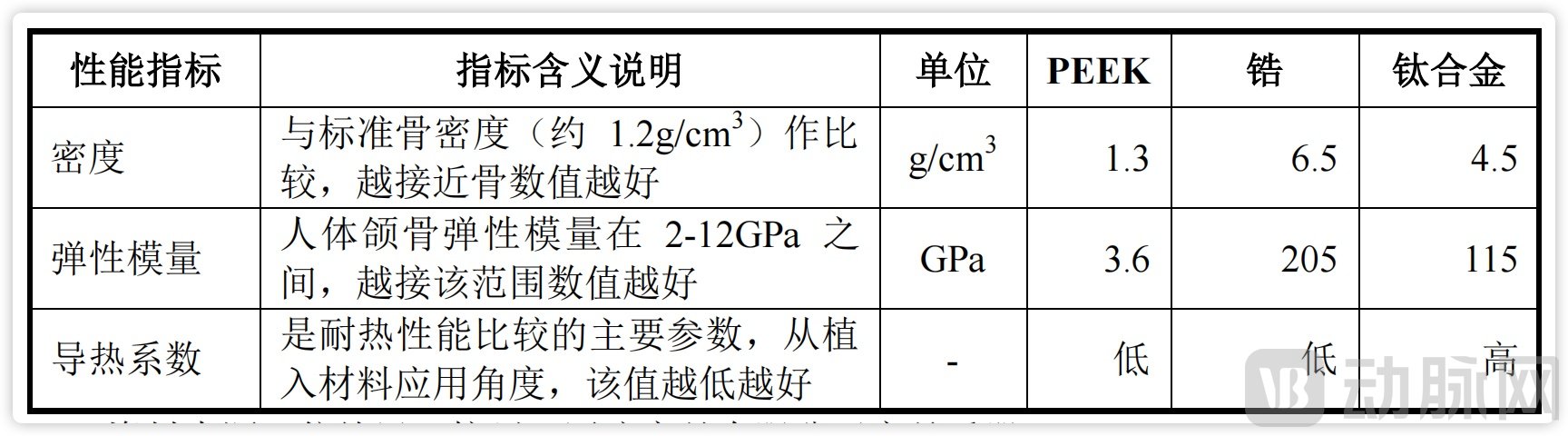
Comparison of Performance Indicators Between PEEK and Medical-Grade Metals (Zirconium and Titanium Alloys); Source: Prospectus of Zhongyan Shares
It is precisely due to the relentless investments by these domestic enterprises that China’s medical-grade PEEK market has broken free from the dominance of three companies—Victrex (UK), Solvay (US), and Evonik (Germany)—and has basically achieved localization. Compared with zirconium and titanium alloys, PEEK material is more suitable as a medical implantable material. With the assurance of raw material supply, domestic exploration of PEEK in the medical field can finally advance to the next stage.
However, there is still a long way to go between raw material substitution and product commercialization.
“Crossing the river by feeling the stones” in industrial applications is a true reflection of PEEK’s adoption in the medical field.
In the medical field, applications of PEEK are divided into two major categories: non-implantable and implantable. Relatively speaking, the development of implantable products holds greater value; therefore, this article focuses on the applications and current status of PEEK materials in implantable products.
Currently, orthopedic implants and repair materials are predominantly metallic, such as titanium alloys. However, these materials present several drawbacks, including high elastic modulus, susceptibility to corrosion by bodily fluids, and the long-term release of metal ions within the body. Consequently, there has been a sustained industry effort to replace them with inorganic non-metallic materials, polymers, or composites. Among these alternatives, polyether ether ketone (PEEK), a synthetic semi-crystalline thermoplastic, has emerged as a promising candidate due to its radiation resistance, stable electrical insulation, hydrolysis resistance, compressive strength, and corrosion resistance.
This process is still in its early stages.
“Currently, domestic shipments of implant-grade PEEK materials amount to just over two tons, but the industry projects that future volumes will reach the hundred-ton scale. Where will this incremental market come from? It will stem from the replacement of various implantable products, although this process will take some time,” Wu Weidong, General Manager of Constellium, told VCBeat.
Currently, the application of PEEK materials in the human body remains relatively limited. For instance, in spinal surgery, it is used as part of the connectors between vertebrae, or partially employed in cranial repair; overall consumption is not substantial. Hailed as the "king of plastics," PEEK ranks among the top in terms of strength, stiffness, and heat resistance across various plastic categories. While it is technically capable of replacing most bones in the human body, such widespread adoption has not been realized primarily due to safety considerations.
In healthcare, risk control is the top priority; therefore, starting with small-scale applications serves to thoroughly validate safety. In orthopedic scenarios, such as fracture repair of the limbs, bone plates are currently predominantly made of titanium alloys. However, PEEK materials are fully capable of replacing metals. This segment represents the future incremental market for PEEK.
The development path of PEEK replacing titanium alloys also follows the industrial logic of material substitution.
Taking race cars as an example, the specific gravity of materials has continuously decreased—from early metals to various plastics and then to carbon fiber—with the aim of minimizing weight while maintaining strength. The development trajectory of orthopedic implants follows a similar path: early stainless steel had a specific gravity of 8, titanium alloys have a specific gravity of 4, and PEEK material has a specific gravity of approximately 1.3, demonstrating strong potential as a substitute. Many domestic enterprises are also making numerous attempts in this area.
For instance, Kangtuo Medical is accelerating the clinical replacement of traditional titanium products with PEEK material products, focusing on applications in neurosurgery and cardiothoracic surgery. The company has launched its “4D Bioactive Plate” and an all-PEEK cranial repair solution. Its “Polyetheretherketone Cranial Fixation System” and “Personalized Polyetheretherketone Cranial Defect Repair Prosthesis” obtained Class III medical device registration certificates in 2024.
Medprin’s craniomaxillofacial repair products are among the few domestically available solutions based on PEEK material for the reconstruction of craniomaxillofacial defects. By leveraging digital design and precision manufacturing technologies, these products achieve a high degree of conformity to bone defects. Its product portfolio, including Bonali, Antailu, and Weilu, collectively provides comprehensive repair and fixation solutions covering both craniofacial and maxillofacial regions for patients ranging from children to adults.
Not only Kangtuo Medical and Medprin, but even Konstard, located upstream in the industrial chain, has chosen the field of skull repair as its breakthrough point.
Acquired skull defects are a common clinical condition, primarily occurring in patients who have undergone decompressive craniectomy. These patients often present with neurological deficits following the procedure; however, cranioplasty can effectively improve clinical symptoms, with particularly significant improvements observed in motor and cognitive functions.
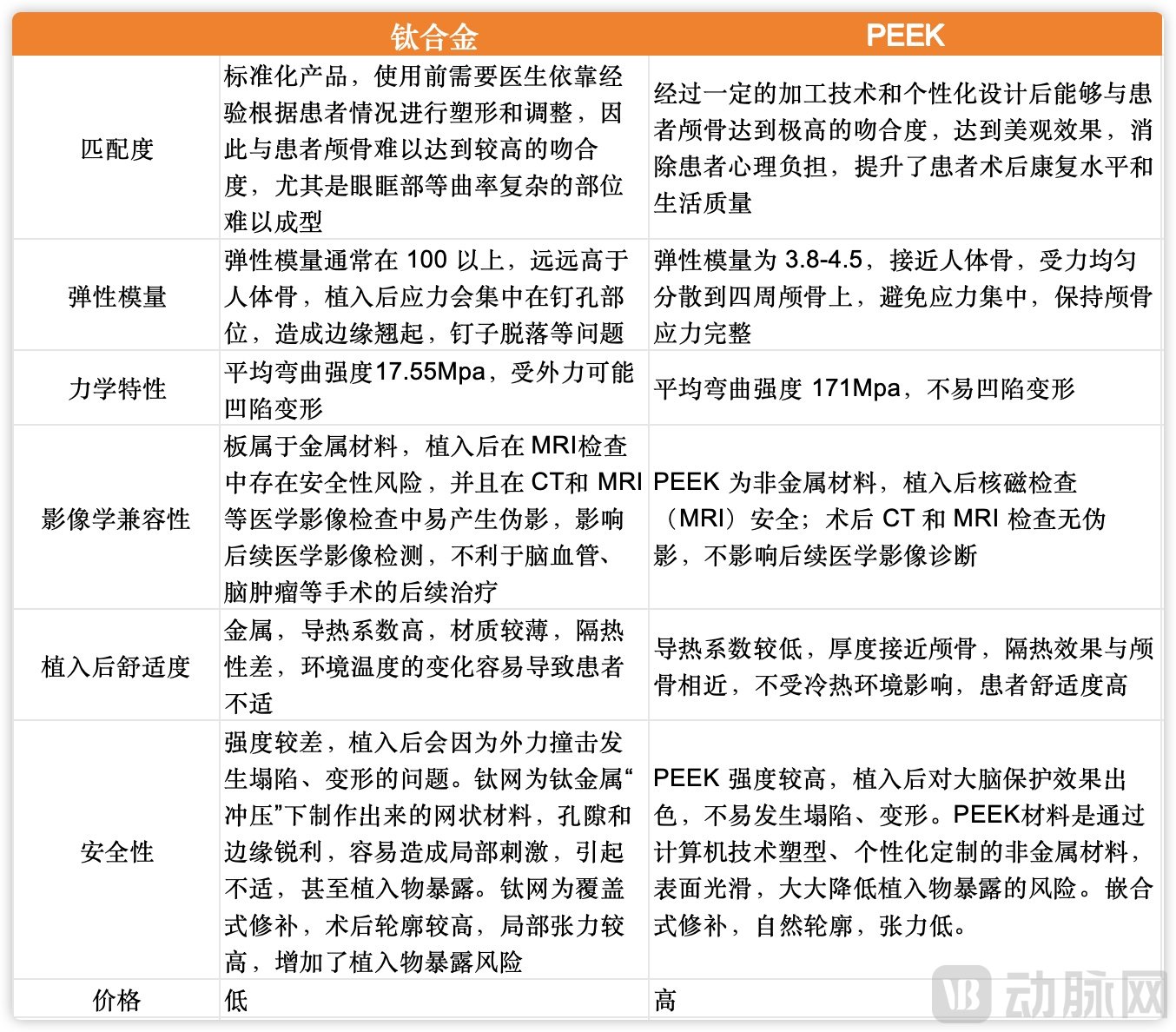
Differences Between Titanium and PEEK Materials for Cranioplasty, Image Source: Kangtuo Medical Prospectus
Although cranioplasty is technically relatively simple, it is associated with a high incidence of complications. Commonly used repair materials, such as polymethyl methacrylate (PMMA) and hydroxyapatite, have postoperative infection rates of 10.47% and 7.3%, respectively, both of which are higher than those observed with polyether ether ketone (PEEK). Compared with another material, titanium mesh, PEEK better restores the physiological anatomical structure of the skull and intracranial pressure status, providing more favorable conditions for improving cerebral blood flow and cerebrospinal fluid dynamics, and thus holds potential advantages in promoting postoperative neurological and cognitive functional recovery. Meanwhile, as a hydrophobic material, PEEK does not actively adhere to surrounding tissues.
Overall, PEEK materials offer numerous advantages over titanium alloys, with price being the only notable drawback. As PEEK applications scale up, a reduction in cost is merely a matter of time. Notably, given that it took nearly a decade for titanium alloys to replace stainless steel, industry experts anticipate that the substitution of titanium alloys by PEEK materials will follow a similar timeline.
Substitution is not an overnight process; it requires strengthening one’s own capabilities.
Compared to the substitution of stainless steel by titanium alloys, the current pace at which PEEK is replacing titanium alloys is somewhat slower. In addition to the aforementioned issues, there are still some engineering challenges associated with PEEK materials that remain to be resolved.
Taking limb bone repair as an example, although PEEK is hailed as the "king of plastics," its strength is still somewhat insufficient for applications in the limbs. The solution is straightforward: much like constructing a building, where neither steel rebar nor concrete alone can support a high-rise structure, their combination in reinforced concrete makes it possible.
PEEK material is now akin to concrete; while it possesses excellent properties, the fabrication of finished frameworks requires reinforcement, with carbon fiber being the preferred choice. However, this process is not straightforward. To achieve better integration between PEEK and carbon fiber, new chemical additives are required, and the safety of these materials necessitates extensive validation. Through years of continuous research, the current composite materials have demonstrated excellent biocompatibility, preliminarily addressing safety concerns.
Shaping carbon fiber is another challenge. Unlike rigid materials such as steel rebar, which are used to construct frameworks, carbon fiber has a diameter only about one-tenth that of a human hair. Multiple strands of carbon fiber must first be bundled into a single tow, and then multiple tows are shaped through a weaving-like process. Subsequently, PEEK material is infused into the structure, melted at high temperature, and uniformly compressed to form the final shape.
Short carbon fiber-reinforced PEEK products exhibit an elastic modulus similar to that of human cortical bone (approximately 23.47 GPa), which can reduce the stress shielding effect. Their tensile strength reaches 230.4 ± 2.3 MPa, approximately three times that of pure PEEK products.
Currently, this weaving technique can only address approximately 50% of scenario requirements, as it is challenging to weave and shape certain irregular structures. A R&D specialist told VCBeat that the industry currently relies on traditional machining approaches to address these challenges; however, interdisciplinary integration may yield novel solutions. Several new solutions are currently under validation, with potential breakthroughs expected within the next two years.
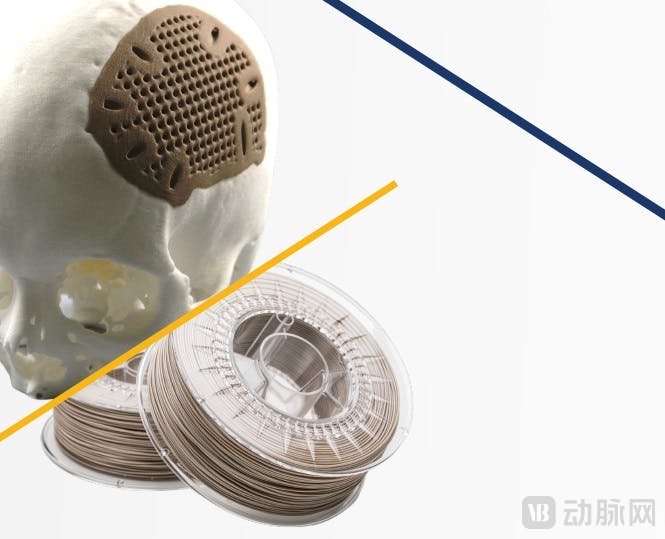
3D-Printed PEEK Is an Effective Supplement to Personalized Customization; Image Source: Company Website
Furthermore, shaping PEEK materials using 3D printing technology serves as a complementary solution. For components with irregular geometries and lower strength requirements, additive manufacturing via 3D printing offers an effective approach to personalized product customization.
Pioneered by carbon fiber, the composite application of materials has become a major direction in PEEK research and development.
If the incorporation of carbon fiber addresses the strength limitations of PEEK, then the hydrophobicity and bioinertness of the PEEK surface can weaken cell adhesion and proliferation, thereby affecting the long-term stability of implants in vivo. Overcoming this drawback has become another key R&D trend in the industry. For instance, by incorporating β-tricalcium phosphate or hydroxyapatite, modified products can significantly enhance the biocompatibility of PEEK.
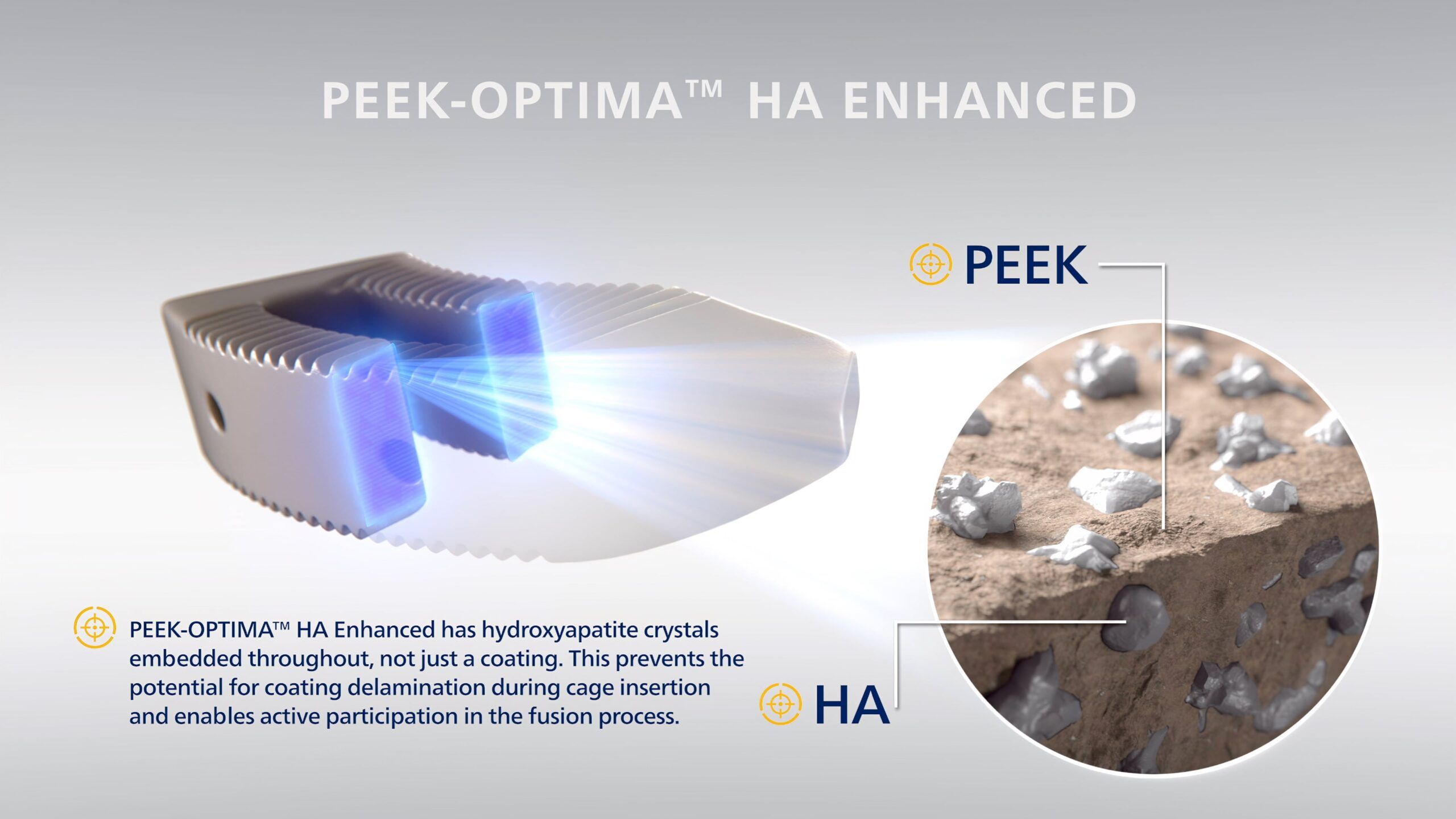
Composite Application of PEEK and Hydroxyapatite Can Accelerate the Recovery Process. Image Source: Company Official Website
In clinical applications, in addition to pursuing osteocompatibility after implantation, there has been a growing emphasis in recent years on achieving myogenic effects, whereby muscle fibers can grow into the implant and ultimately attach to the target bone sites.
For instance, in tendon repair, a microscopic view reveals that the distal ends of human tendons grow into the micropores of bone, forming a dense, interwoven connection. In the event of a tendon rupture, the current standard of care involves securing the tendon with an anchor suture, allowing it to heal via scar tissue formation. While this approach yields certain therapeutic benefits, it carries a significant risk of re-tear. True natural anchoring, akin to tree roots penetrating soil, can only be achieved by establishing channels that facilitate the ingrowth of tenocytes into the bone, thereby creating a stable structural integration.
In the future, these composite PEEK materials will be more conducive to tendon ingrowth into the modified connection sites through design improvements, thereby eliminating the need for suture anchors. In the long term, they will integrate with the body’s own structures, representing a major direction for future development.
Although initial progress has been made in R&D, broader participation from manufacturers is still needed to accelerate the commercialization and market deployment of related products.
Upstream Companies Enter the Fray, Driving PEEK Product Iteration.
The development of China’s medical PEEK industry started relatively late, with a lack of upstream and downstream supporting enterprises, as well as insufficient testing methods and industry standards. Against this backdrop, domestic upstream companies represented by Zhongyan Shares, Konstaide, Jiangsu Junhua, and Pengfulong have not only addressed the issue of domestic substitution for raw materials but also driven industry progress in areas such as the development of supporting industries, expansion of application fields, and establishment of standards.
For instance, the establishment of product lines with multiple grades and specifications, corresponding to the selection of different products, has effectively reduced the R&D difficulty of medical PEEK products. Zhongyan Shares, for example, has strengthened its exploration of cutting-edge industry research by establishing an innovation and technology R&D center as well as the Shanghai Carbon Fiber Polyether Ether Ketone Composite Materials R&D Center project, aiming to enhance the performance of implant-grade PEEK materials.
Some companies also choose to collaborate through empowerment.
After completing the preparation of PEEK raw materials in multiple specifications and models, as well as refining the processing technology for composite materials, Konstaed chose to collaborate with customers through an ODM-like model. For instance, customers would provide their requirements, and Konstaed would offer solutions.
“The advantage of this model lies in lowering the barrier to entry for the industry,” Wu Weidong, General Manager of Konstaid, told VCBeat. “Companies in the bone repair sector that wish to use PEEK cannot bypass the steps of synthesis, purification, processing, and safety validation. Even if they do not conduct research starting from raw materials, they must still begin with production processes and establish manufacturing lines, which significantly extends the overall development cycle. This approach is far from optimal, whether viewed from the perspective of cost reduction and efficiency improvement for enterprises or from the standpoint of the development of the medical-grade PEEK market.”
With the precedent of titanium alloys replacing stainless steel, Constellix aims to open up its accumulated expertise in the PEEK industry chain to more enterprises, adopting a B2C model to jointly promote the development of domestic medical-grade PEEK products.
The domestic substitution of PEEK materials is not only of immense significance in industrial applications; it also marks a revolutionary turning point in the medical field, particularly in the realm of implantable materials.
When the wave of capital meets breakthroughs in hard-core technology, we see not only investment opportunities but also a magnificent transformation from “Made in China” to “Created in China,” a vivid practice of achieving autonomy and controllability across the industrial chain, and, most importantly, the most powerful response by Chinese medical professionals through practical action to the predicament of being “strangled” by critical technological bottlenecks!