

What Does a Practical Medical Large Model Look Like? Insights from Five Founders and Investors at 2025 VBEF
From May 9 to 10, VCBeat and Probe Capital jointly hosted the “Leapfrog Reconstruction: Forum on Innovation in Large Medical AI Model Applications,” where participants explored the latest practical application trends of AI across dimensions such as pharmaceutical R&D, clinical applications, optimization of healthcare service experiences, and empowerment of payment systems.
As a co-organizer of the forum, Probes Capital, leveraging its self-developed “Shennong No. 1” industrial data platform, is also actively exploring the application of AI and large language model technologies in innovative enterprise services and industrial empowerment. Yan Jingjing, Founding Partner of Probes Capital, proposed a new service paradigm—“cognitive empowerment + information hub + transaction catalysis”—tailored for industries and innovative enterprises, under its role as a boutique investment bank.
Meanwhile, Yan Jingjing also shared her observations on the implementation of large medical models—market-oriented investment institutions, state-owned capital and local government guidance funds, industry players, and listed companies are accelerating their layout in the medical AI large model sector, demonstrating strong confidence in the industry. The industry is at a critical stage of rapid development; driven by capital, the continuous expansion of application scenarios, and the gradual overcoming of challenges, the sector is flourishing.
At the conference, five founders deeply engaged in the frontline of medical AI—from SenseTime Medical, Jianhai Technology, Quanzhen Medicine, Lingxi Medical, and Olive Branch Health—presented their latest explorations centered on the “product + scenario” innovation pathway. Their presentations not only showcased diverse routes for technology implementation but also illustrated the practical evolution of medical AI from being “technology-driven” to achieving a “value closed loop.”
Among them, at the forum on May 9, byModerated by Liang Qiao, Investment Director at Danlu Capital; featuring Wang Jian, Founder of Jianhai Technology; Xue Chong, Founder of Quanzhen Medicine; Wang Zeyuan, Founder of Lingxi Medical; and Shen Jiong, Managing Partner at FreeS Fund.Engaged in a brilliant discussion on the selection of implementation pathways for large language models, underlying data acquisition, and commercialization.
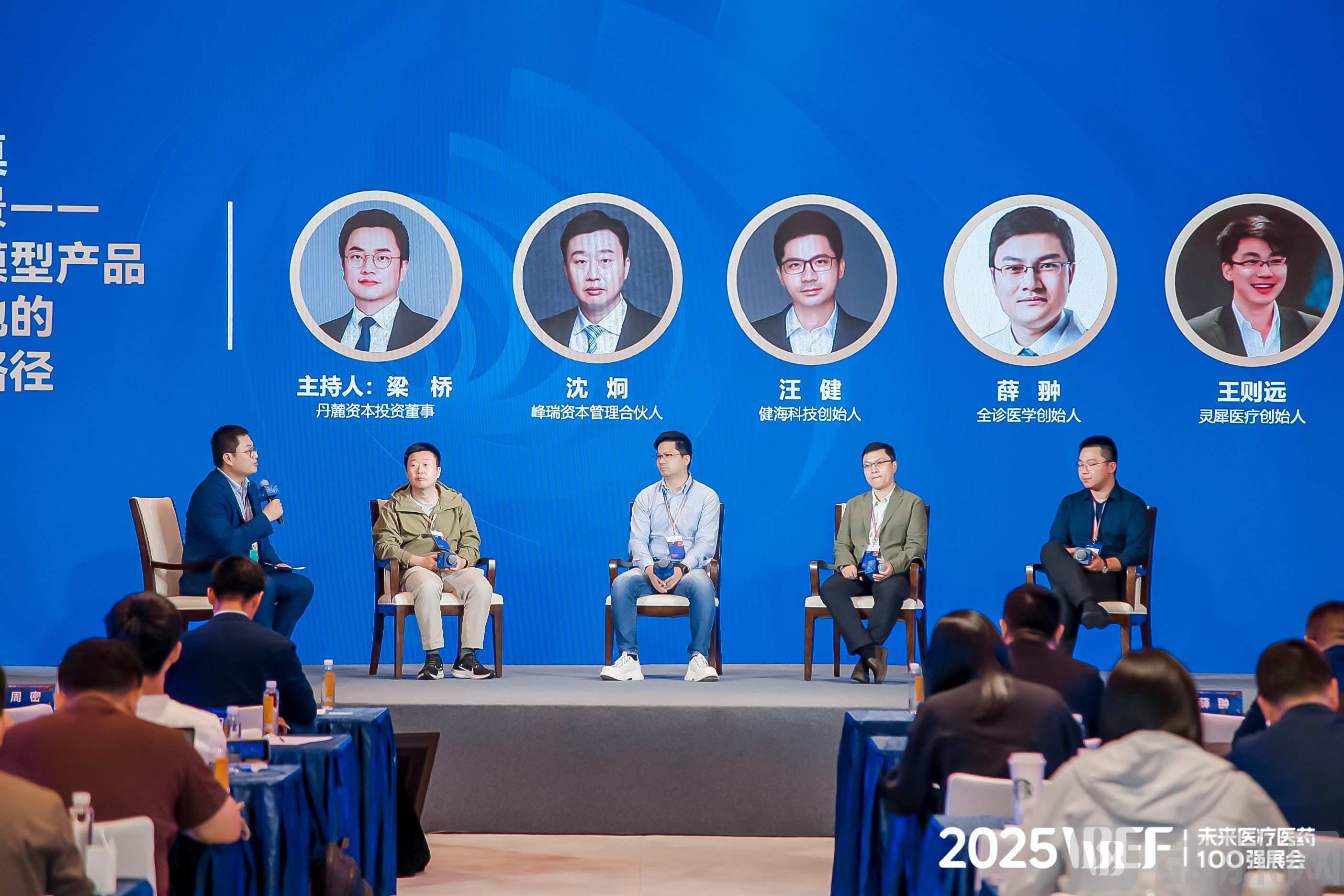
Large language models represent a productivity revolution, but they must ultimately return to real-world scenarios to solve practical problems. So, how should one select these scenarios? What characteristics define a good scenario?
Wang Zeyuan of Lingxi Medical stated that the first step in healthcare entrepreneurship is to determine whether the business direction involves the clinical diagnosis and treatment process. For products that do not intervene in this process, the focus should be on enhancing usability and ease of operation, while facing relatively lower regulatory pressure.
Leveraging the team’s background and technological expertise, Wang Zeyuan ventured into research domains beyond conventional clinical workflows. He proposed a model-driven approach that originates from clinical observations to automatically generate research hypotheses, study designs, synthetic data, and validating evidence, thereby establishing a “dynamic evidence-based pathway.” Currently, Lingxi Medical’s proprietary platform integrates 350 million pieces of global medical evidence, empowering physicians to rapidly produce research protocols, nutritional prescriptions, and other outputs.
Xue Chong of Whole-Clinic Medicine, who previously worked in clinical medicine, adheres to the principles of “pain points, rigid demand, and high frequency,” delving deeply into the actual needs within medical scenarios. He points out that “the most significant transformation brought by large language models is the liberation of physicians’ cognitive labor, allowing clinical practice to focus on judgment and treatment.””
Physicians face heavy diagnostic and treatment workloads along with extensive documentation in their daily practice, leaving room for improvement in healthcare service efficiency. In response, Quanzhen Medicine has developed an AI physician assistant that covers the entire workflow of “consultation–documentation–decision-making–follow-up.” This solution has been deployed in multiple hospitals across China, enabling applications such as automated medical record generation and intelligent outpatient triage, with over 70,000 daily API calls.
Wang Jian of Jianhai Technology focuses more on improving the quality of medical services, concentrating on the consumer-side health management market and striving to enhance the value of healthcare through 24/7 companion-style services.
As public health awareness continues to rise, there is a growing demand for personalized and comprehensive health management. Wang Jian emphasizes that the core of service lies in “understanding patients” rather than “managing patients.” Jianhai Technology aims to build the “most patient-centric proactive health service platform” by introducing the concept of an “AI Health Coach.” This approach leverages AI to create a closed-loop process spanning data collection, risk identification, and behavioral intervention, thereby continuously improving adherence and satisfaction among patients with chronic diseases and those in obstetric care.
Shen Jiong, Managing Partner at FreeS Fund, stated from an investment perspective that the application prospects of large language models depend on whether they can address the scarcity of medical supply.
Shen Jiong pointed out that the healthcare industry is characterized by a scarcity of high-quality supply. Internet-based healthcare creates value and improves efficiency by optimizing the allocation of existing resources. Large language models, equipped with linguistic capabilities, knowledge bases, and reasoning abilities, can substitute for some primary care general practitioners in conducting initial consultations and triage. He believes that if this capability can be realized, large models will play a significant role in the healthcare sector.
The importance of medical data goes without saying. As an industry with stringent privacy protection requirements, how do entrepreneurs obtain medical data in a compliant and efficient manner?
Lingxi Medical’s Wang Zeyuan shared two approaches to data acquisition. The first is through data distillation technology, extract a refined dataset from the original dataset of the foundation large model that is high-quality, low-redundancy, and highly relevant to the core tasks of the medical model;2. Data Synthesis, by simulating the data distribution and characteristics of the real world through computer algorithms, and by leveraging mathematical models and generative techniques to construct new datasets.
Synthetic data can address issues of data scarcity and limited data variety at a lower cost, while mitigating risks related to data privacy, security, and regulatory compliance, thus holding significant development potential. However, it is important to emphasize that if the generative model itself has flaws or the training data is biased, the resulting synthetic data may also be inaccurate.
Currently, enterprises and laboratories both domestically and internationally are engaged in the development of synthetic data to provide data sources for AI model training. For instance, in 2025, the research team at the Shanghai Artificial Intelligence Laboratory developed GraphGen, a knowledge graph-guided framework for synthetic data generation, which is designed to produce high-quality question-answering datasets for knowledge-intensive tasks and has been open-sourced.
Xue Chong, Quanzhen MedicineAnalogizing data to energy resources, the medical data accumulated within hospitals is akin to “crude oil and other chemical energy sources,” which require refining before use; synthetic data generated based on models serves as a “renewable resource,” capable of continuously supporting model training. HeIt is emphasized that the key to the future lies in establishing a rolling data mechanism: data trains models, models generate data, and this data is then used to optimize the models, thereby achieving a self-sustaining data loop.
To implement this mechanism, it is necessary to integrate with application scenarios and capture previously unrecorded data. Currently, the two scarcest types of data are: first, real-world data undocumented in medical settings, such as initial doctor-patient dialogues and laboratory test reports from external hospitals, which can reconstruct authentic clinical scenarios; second, AI-generated data that has been refined by humans, referred to as “output data.” If enterprises can simultaneously master both types of data and continuously optimize them, they can create a “data flywheel,” thereby reinforcing AI models within application scenarios and ultimately achieving performance that surpasses human experts.
Wang Jian of Jianhai Technology believes that the requirements for medical data vary depending on its intended use. While other data sources may serve as substitutes for foundational training of large models, Jianhai’s data is precisely tailored to serve specific individuals; in this context, ensuring compliance in acquiring both in-hospital and out-of-hospital data for these individuals is paramount.Jianhai’s competitive advantage in business scenarios lies in the fact that, when hospitals entrust it with patient management, they must authorize Jianhai to access patient data based on actual management needs, thereby enabling compliant data accumulation.
Furthermore, it is essential to ensure that scenario-specific data can support continuous model training. In the course of patient management, Jianhai continuously accumulates individualized patient data and leverages it to train personalized service models. In the future, the richness of individual data and the depth of understanding of each individual will become key determinants of the quality of enterprise-to-individual services. Therefore, Jianhai places greater emphasis on the acquisition of individual-level data, particularly on strategies for obtaining continuous longitudinal data from individuals.
Shen Jiong concisely stated,After more than two decades of development, China's healthcare informatization industry has accumulated a vast amount of medical data.Greater Attention Should Be Paid to Data Quality at Present,When computing power and algorithms are no longer bottlenecks, data quality will directly determine the ceiling of AI physicians’ development.
Amid the commercialization wave of large medical AI models, guests have leveraged their respective strengths, relying on their technological advantages and strategic positioning to explore diverse development paths.
Frees Fund’s Shen Jiong Advocates Building Business Models with a Focus on Increasing Healthcare Supply, arguing that the physician-assistance model struggles to generate profits from health insurance reimbursements and physician income;
Jianhai Technology’s Wang Jian emphasizes a consumer-facing model targeting C-end patients, with costs borne by the patients themselves.. Its core lies in leveraging large language model products to genuinely transform patients’ health behaviors, enhance patient experience, and drive patients to pay for services based on their recognition of the value of disease management;
Holistic Diagnostic MedicineXue Chong shared his validation results regarding business models in the healthcare industry, namelyThrough private deployment and SaaS-based paid services, as well as a B2B model that embeds models into enterprise workflows。
Wang Zeyuan of Lingxi Medical believesThe business models of large language models can be categorized into two types: first, the foundational platform model, which relies on pay-per-use pricing based on API call volume; second, a model akin to AI+CRO, which leverages large language model technology to deliver services, with an emphasis on service quality and delivery efficiency.