

Recombinant Collagen Industry Advances Toward a 'More Precise Ruler': Significance Behind the Push for Standardized Detection Methods
On May 30, the seminar on “Analytical Methods for Recombinant Collagen in Complex Matrices,” jointly organized by the Science and Technology Innovation China Working Committee of the Chinese Society for Biotechnology and the Changping Center for Accelerating the Translation of Synthetic Biology Manufacturing, was held in Beijing. At the event, experts from various fields—including biopharmaceuticals, analytical testing, and materials science—engaged in in-depth discussions and provided recommendations on topics such as technical challenges, detection methodologies, the establishment of standardized testing systems, and regulatory requirements for recombinant collagen in complex matrices.

Figure: Seminar on “Detection Methods for Recombinant Collagen in Complex Matrices”
"Absence of Standards for Recombinant Collagen Testing Methods"
Currently, China’s cosmetics industry is accelerating its development, with numerous companies vying to enter the market. In this process, technological prowess has become a core driver of industry growth. As new consumer demands continue to emerge, ingredient innovation has become a focal point for consumers. Notably, recombinant collagen from the field of synthetic biology has injected new vitality into the innovation of cosmetic raw materials. Recombinant collagen products remain highly popular in the market, offering consumers more choices while also sparking intense competition among enterprises.
Behind the industry’s accelerated growth, safety concerns have garnered increasing attention. To verify product safety and efficacy, ingredient testing has become a critical tool for quality supervision. Notably, China has not yet established unified national standards for testing recombinant collagen. Consequently, how to conduct authoritative, scientific, precise, and accurate testing of recombinant collagen ingredients has become a topic of widespread discussion within the industry.
Experts state that the detection of recombinant collagen in cosmetics is more complex than that in dressing-type medical devices and biological samples. Jia Chenxi, a researcher at the National Center for Protein Sciences, noted that cosmetics contain various ingredients such as plant extracts, proteins, polysaccharides, lipids, surfactants, and colorants, which significantly interfere with collagen signals, resulting in weak signals during detection. Meanwhile, the amount of collagen added to cosmetics is typically low, making quantitative detection of low-concentration substances challenging.
“Complex and Diverse” Detection Methods for Recombinant Collagen
Zhang Guifeng, a researcher at the Institute of Process Engineering, Chinese Academy of Sciences, introduced that the main methods for protein detection include the Kjeldahl method, Biuret method, Coomassie Brilliant Blue method, Folin–Ciocalteu method, BCA method, and characteristic peptide method.
Regarding different detection methods, the attendees unanimously expressed that each method has its own characteristics and suitable application scenarios. The key is not whether a method is new or old, but rather to establish sample pretreatment procedures tailored to different matrices to effectively eliminate matrix interference, and to select and develop detection methods specifically for complex matrices. Furthermore, it is essential to validate these methods by assessing their limit of detection (LOD), limit of quantification (LOQ), linearity, precision, accuracy, and recovery rate.
Professor Li Jinghong, a member of the Chinese Academy of Sciences and a professor in the Department of Chemistry at Tsinghua University, explained that molecular detection of recombinant collagen in complex matrices faces challenges such as complex degradation processes. Therefore, a single detection method is not suitable; instead, appropriate methods should be selected based on the differences among various proteins. Furthermore, research and validation must be conducted on the distinct amino acid sequences and structures of different types of recombinant collagen, including their dynamic changes and interactions.
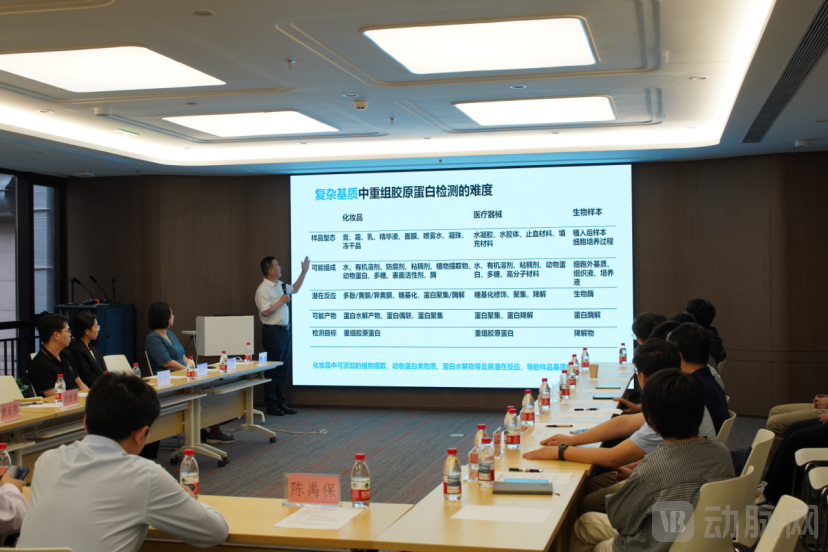
Figure: Professor Zhang Guifeng delivers a keynote report on “Detection Methods for Recombinant Collagen in Complex Matrix Samples”
Xu Liming, a researcher at the National Institutes for Food and Drug Control (NIFDC), stated that complex matrices in recombinant collagen products are a significant factor affecting component detection. Current standardized testing methods are primarily designed for pure protein samples; when applying these methods to complex matrices, it is essential to account for matrix effects and to conduct thorough research and validation of sample pretreatment procedures. “When complex matrices hinder the extraction of recombinant collagen components, pretreatment methods under matrix-present conditions must be investigated. It is crucial to ensure that the reference standards used for quantification and the test samples are subjected to identical testing conditions (i.e., the same matrix environment), such as through matrix spiking, and mutual validation using multiple methods is required.”
Yan Dongpeng, a professor at the College of Chemistry, Beijing Normal University, pointed out that to eliminate interference and improve detection accuracy, it is necessary to provide pretreatment methods for recombinant collagen products, employing different approaches to leverage their complementary advantages based on varying application scenarios and research systems.
Regarding detection methods for recombinant collagen in complex matrices, Xu Liming suggests that multiple approaches can be evaluated, such as the biuret method and the amino acid analysis method; however, thorough validation is required. “The biuret method is listed in industry standards, but its application in complex matrices necessitates comprehensive methodological validation. The amino acid analysis method involves hydrolyzing recombinant collagen into amino acids, which presents challenges related to hydrolysis efficiency and detector sensitivity, thus also requiring methodological validation. Additionally, strategies to mitigate interference from complex matrices must be considered.”
She emphasized that only by establishing technical standards following methodological validation can the credibility of test results be ensured.
All Parties Advance the Industry Standard for Testing Recombinant Collagen
To date, China has established multiple standards related to collagen, including pharmaceutical industry standards and standards pertaining to agriculture and trade. Zhang Guifeng stated that the aforementioned testing standards cover aspects such as manufacturing processes, raw material specifications, product standards, and product evaluation; however, there is a lack of unified testing standards in the cosmetics sector.
According to Zhang Guifeng, the difficulty in establishing standards for detecting recombinant collagen in complex matrices stems from the influence of various factors—including product formulation, matrix form, matrix composition, potential reactants, possible products, and the stability of the analyte—which make it challenging to standardize testing methods.
Zhang Guifeng stated that, prior to the establishment of national unified standards, detection methods for recombinant collagen in complex matrices may refer to standards such as YY/T 1849-2022 "Recombinant Collagen" and YY/T 1947-2025 "Recombinant Collagen Dressings," and methodological validation for complex matrix processing should be conducted.
It is worth noting that while the development of standards for testing methods related to recombinant collagen is steadily progressing, the state has consistently maintained strict regulatory oversight over the production of recombinant collagen products. Therefore, to obtain marketing authorization, a product must undergo a series of rigorous and standardized review processes.
It is foreseeable that, driven by the combined forces of stringent market regulation, advancing research into testing technologies, and the gradual establishment of a standardized testing framework, the recombinant collagen market will enter a more regulated and orderly development trajectory.
Note: Data sourced from the expert consensus reported by Xinhua News Agency at the seminar.