

Once-Unsellable Smoking Cessation Drugs Now Selling Rapidly via New Channels
On the Occasion of the 38th World No Tobacco Day, the National Health Commission Released Data: The Smoking Rate Among People Aged 15 and Above in China Dropped from 24.1% in 2022 to 23.2% in 2024. The Initial Effects of the Healthy China Tobacco Control Action Are Becoming Evident, with More Smokers Visiting Smoking Cessation Clinics for Professional Help, and a Clear Trend Toward Younger Individuals Proactively Quitting Smoking.
Meanwhile,Social media and e-commerce platforms are emerging as new frontiers for smoking cessation education and medical consultation.On May 30, data from the First JD Health Smoking Cessation Industry Forum showed that the user base for smoking cessation-related medications on JD Health has grown year by year over the past four years, with a compound annual growth rate (CAGR) exceeding 246%.
Factors such as user demand, channel innovation, and policy guidance are driving an explosive growth in the smoking cessation market.
According to data from the National Bureau of Statistics, by the end of 2024, the number of adult smokers in China reached 350 million. Each year, nearly one million people die from smoking-related diseases, and over 100,000 deaths are attributed to secondhand smoke exposure. In light of this severe situation, there is an urgent need to prevent and manage the harms caused by tobacco.
However, quitting smoking is no easy feat. At the smoking cessation industry forum hosted by JD Health, He Qinghua, Executive Vice President and Secretary-General of the Chinese Association on Tobacco Control, noted that although the proportion of smokers in China attempting to quit has gradually increased in recent years, the success rate remains below 10%.
In reality, many smokers rely primarily on willpower to quit smoking, while awareness and utilization of scientifically supported, medically assisted cessation methods remain very low.
In 2024, the World Health Organization’s Clinical Practice Guidelines for Treating Tobacco Dependence in Adults stated that combining pharmacotherapy with behavioral interventions can significantly improve smoking cessation success rates. WHO-recommended effective pharmacotherapies for smoking cessation include varenicline tartrate, nicotine replacement therapy, bupropion, and cytisine. The guidelines also recommend behavioral interventions, such as brief smoking cessation counseling, intensive behavioral support, and digital health interventions.
Pharmacotherapies approved in China for smoking cessation include varenicline tartrate tablets and nicotine chewing gum; however, the utilization rate of these medications remains below 5%. Currently, hundreds of smoking cessation clinics have been established across medical institutions nationwide, yet they generally suffer from low patient volumes and underutilization. Furthermore, some medical facilities do not stock smoking cessation medications.
Some smokers who have attempted in-hospital consultations and pharmacological smoking cessation have also failed due to various reasons.Tongji Hospital, affiliated with Tongji Medical College of Huazhong University of Science and Technology, conducted a study on patients with chronic obstructive pulmonary disease (COPD) who had repeatedly failed to quit smoking, aiming to uncover the reasons behind their unsuccessful cessation attempts. Interviews conducted during the study intuitively highlighted several pain points associated with pharmacological smoking cessation therapies, such as:
“Quitting smoking went smoothly during hospitalization, but it felt much more difficult after discharge; cessation medications were also sometimes unavailable at the hospital.”
“Quitting smoking makes me feel inexplicably anxious and hard to control; smoking cessation medications are difficult to obtain.”
“I used smoking cessation medication for two weeks, which had some effect, but I did not continue with it.”
Overall, smokers must overcome several critical hurdles in their journey from forming the intention to quit, to initiating cessation, and ultimately achieving success. First, they need to establish a comprehensive understanding of evidence-based smoking cessation methods and pharmacotherapies. Second, even with some awareness of smoking cessation clinics and medications, individuals may abandon their efforts due to barriers such as limited accessibility to these treatments. Third, even after consulting at a smoking cessation clinic and using prescribed medications, long-term adherence is not guaranteed if patients struggle to manage cessation-related challenges on their own and cannot obtain timely professional support.
From an industry perspective, sales performance has been lackluster for both imported drugs that have been withdrawn from the market and several domestically produced alternatives launched subsequently. This is largely due to factors such as the consumer-oriented nature of smoking cessation medications and their exclusion from national medical insurance coverage. Topics like “Smoking Cessation Drugs Are Not Selling” and “350 Million Smokers Cannot Sustain a Smoking Cessation Drug Market” have periodically sparked heated discussions within the industry.
On one hand, individuals seeking to quit smoking face difficulties in accessing professional services and medications; on the other, market channels for first-line pharmacotherapies remain inadequate. This increasingly prominent contradiction urgently needs to be resolved.
In recent years, the Internet has played a positive role in smoking cessation and tobacco control by connecting service providers and bridging information gaps.
Taking the “China Smoking Cessation Platform” mini-program, jointly developed by the Chinese Center for Disease Control and Prevention (China CDC) and the World Health Organization (WHO) Representative Office in China, as an example, this platform has made it more convenient for the public to access information on smoking cessation clinics and other service resources across various regions since its launch in 2021.
Smoking Cessation Clinics in Major Cities See an Increase in Individuals Seeking to Quit Voluntarily. For instance, the Smoking Cessation Clinic at Beijing Chaoyang Hospital, affiliated with Capital Medical University, has experienced a steady rise in patient visits, with a notable trend toward younger individuals among those proactively seeking to quit smoking.
More smokers quitting have also become aware of and chosen to use smoking cessation medications. From 2021 to 2024, the user base for smoking cessation-related medications on JD Health grew year by year, with a compound annual growth rate exceeding 246%.
With the advent of the era of digital intelligence, the value of internet healthcare platforms in tobacco control extends far beyond simple information queries and reducing information asymmetry.
First, in response to the current situation characterized by a limited number of smoking cessation clinics and service coverage, as well as insufficient availability of smoking cessation medications in medical institutions, internet healthcare platforms can not only enhance the accessibility of smoking cessation treatment and medications through online consultations and drug purchases but also establish more efficient out-of-hospital market channels for pharmaceutical companies.
In 2024, JD Health partnered with the Beijing Association on Smoking Control to launch an online “Smoking Cessation Clinic,” collaborating with numerous experts in the field of respiratory medicine to provide consultation services for individuals seeking to quit smoking. To date, the clinic has served over 10,000 users.
When users have medication needs, they can purchase varenicline tartrate tablets from brands such as Ailechang, Parico, and Weili Jie on the JD Health platform with a prescription, or conveniently buy over-the-counter (OTC) products like Nicorette nicotine chewing gum. Through JD Health’s omnichannel pharmaceutical retail layout, users in county-level areas and below, as well as patients in remote regions, can also easily access medications.
Secondly, smoking cessation is a long-term process. Internet healthcare platforms can provide continuous management services and integrate operational and technological measures with professional care to enhance patient adherence, thereby achieving higher smoking cessation success rates and lower relapse rates.
Whether online or offline, clinical consultations and prescription issuance constitute only a small part of the smoking cessation process. During daily management, how should medications be taken properly? When is it necessary to adjust drug dosages? How can one cope with post-cessation anxiety or other symptoms? How can one resist the “temptation” posed by smokers in one’s surroundings? These questions all require timely guidance from healthcare professionals, such as physicians and pharmacists.
To address the long-term needs of smoking cessation management, JD Health has developed a one-stop tobacco control management platform—the Tobacco Control Health Center—featuring an integrated “Education-Prevention-Diagnosis-Management” framework. The center employs the “EMP User Management Model,” a patient-centered, pharmacist-led approach, to achieve long-term closed-loop management for individuals seeking to quit smoking. This is accomplished through pharmacist-led outbound follow-up calls, SMS outreach, and private-domain community management.
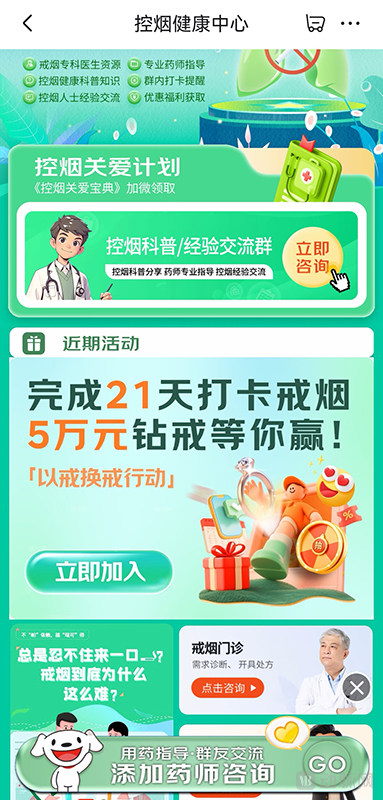
JD Health "Tobacco Control Health Center"
From an operational perspective, user incentives are an effective means of improving adherence. The app interface shows that JD Health recently launched the “Quit-for-Quit” campaign, which encourages users to complete a 21-day smoking cessation check-in challenge. On the technical front, JD Health has integrated AI into multiple aspects of smoking cessation management, including AI-assisted physicians and pharmacists who provide personalized guidance. The JD Kangkang intelligent agent efficiently connects users with services such as smart Q&A, appointment scheduling, report interpretation, and rehabilitation care in response to their inquiries.
From an industry perspective, internet healthcare platforms have indeed opened up out-of-hospital market channels for smoking cessation medications. Taking JD Health as an example, sales of its varenicline tartrate tablets and nicotine chewing gum have grown rapidly.At the First Smoking Cessation Industry Forum, a representative from JD Health’s Respiratory and Anti-Infective Division revealed that the transaction volume of smoking cessation medications on its platform doubled in 2024.
Tobacco control is showing positive momentum, but the road ahead remains long and arduous.
In 2024, the smoking prevalence among individuals aged 15 and above in China decreased to 23.2%, whereas the target set by the Healthy China Tobacco Control Action is to reduce it to below 20% by 2030, indicating a substantial gap between the current status and the goal.
As scientifically grounded smoking cessation management becomes more accessible to those actively seeking to quit, tobacco control efforts must also extend to smokers who have not yet developed an intention to quit. By leveraging authoritative, broad-reaching public education campaigns aligned with contemporary media dissemination patterns, we can strengthen the public’s concrete understanding of the harms associated with tobacco use.
The “2025 White Paper on Scientific Smoking Cessation,” released at the First JD Health Smoking Cessation Industry Forum, shows that social media, e-commerce platforms, hospitals, and pharmacies have become the primary channels through which individuals seeking to quit smoking learn about smoking cessation medications, with social media and e-commerce platforms demonstrating significant channel value.
These data indicate that, in addition to traditional channels such as hospitals and pharmacies, social media platforms and e-commerce sites are emerging as new frontiers for smoking cessation education.
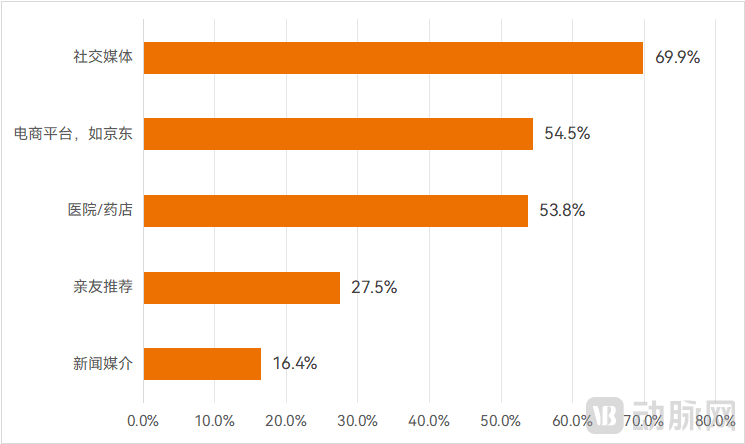
Primary Channels Through Which Individuals Quitting Smoking Learn About Varenicline Tartrate (a Smoking Cessation Medication), Data Source: "2025 White Paper on Scientific Smoking Cessation"
Meanwhile, professional public health education requires support from stakeholders such as medical institutions, enterprises, and industry associations. Since smoking can cause diseases affecting multiple systems, including the respiratory and cardiovascular systems, and may even lead to various malignant tumors, smoking cessation education also necessitates the involvement of relevant healthcare professionals.It is imperative to build a tobacco control ecosystem characterized by multi-stakeholder co-construction and systematic collaboration.
During the aforementioned forum, JD Health, in collaboration with partners such as Qianyuan Pharmaceutical, Hansoh Pharmaceutical, and Kenvue China, launched an industry initiative to build a scientific ecosystem for tobacco control management. The initiative calls for integrating multidisciplinary expertise from respiratory medicine, psychology, nutrition, and other fields to jointly develop and promote scientific, systematic clinical guidelines for smoking cessation diagnosis and treatment. It also urges social forces, including tobacco control associations and public welfare organizations, to leverage their respective strengths to conduct in-depth work in tobacco control publicity, education, research, and advocacy.
Leveraging its platform attributes, JD Health has integrated patient education into its core business operations and consolidated industry resources to further enhance the “Smoking Cessation Health Center.” This comprehensive hub combines disease education, cutting-edge updates, patient guidance, and self-assessment tools. By utilizing on-site search, strategic placement for traffic redirection, and omnichannel content marketing off-site, JD Health precisely reaches target users, helping them strengthen their understanding of scientific smoking cessation methods.
Furthermore, numerous investigational new drugs for smoking cessation are currently under development, holding promise to provide more options for individuals seeking to quit. JD Health has established a mature solution for the initial market launch of new drugs, which can effectively drive the expansion and widespread adoption of novel smoking cessation therapies, enabling users to access cutting-edge, globally synchronized treatment regimens in a timely manner.
Strengthening societal awareness of the harms of tobacco and the science of smoking cessation will likewise have spillover effects on the industry side.If enhancing the accessibility of smoking cessation diagnosis, treatment, and medications, as well as establishing out-of-hospital channels for smoking cessation drugs, constitutes optimizing the existing market, then further strengthening awareness of smoking cessation to motivate more smokers to develop the intention to quit and take action represents tapping into incremental market growth.
Whether in terms of the social value of reducing smoking rates or the industrial value of optimizing the existing market for smoking cessation and exploring new growth opportunities, platforms like JD Health will leverage their competitive advantages to continuously innovate service models, upgrade technological capabilities, and expand ecosystem partnerships, thereby accelerating the penetration of scientific awareness on smoking cessation and control as well as full-cycle services.
References:
Xiang Q, Xu Suqin. A qualitative study on the experiences of repeated smoking cessation failure in patients with chronic obstructive pulmonary disease [J]. General Practice Nursing, 2025, 23(9): 1715-1719.