

Opportunities and Challenges of Nanopore Sequencing Technology: A Comprehensive Analysis [2025 VBEF]
Gene sequencing is evolving into one of the fastest-growing subsectors within precision medicine and molecular diagnostics. According to Frost & Sullivan data, the market size of genetic testing in China will further grow from RMB 48.7 billion in 2025 toof 2030RMB 153.6 billion, with a compound annual growth rate (CAGR) of 25.8% over the next five years.
In the future, with the iterative advancement of gene sequencing technologies and products, coupled with the continuous expansion of their application scale, next-generation sequencing technology—specifically nanopore sequencing—is poised to become the “new leading force” in the industry. As a novel sequencing approach, nanopore sequencing differs fundamentally in principle from previous generations of sequencing technologies. It is particularly well-suited for rapid, long-read sequencing, thereby opening new avenues for pathogen detection, genetic disease screening, cancer diagnosis and treatment, and infectious disease source tracing, while providing valuable tools for precision medicine.
At the Precision Medicine and Molecular Diagnostics Industry Development Forum, part of the 2025 VBEF Future Healthcare & Pharma Top 100 Exhibition, Dr. Huang Yihua, a tenured researcher at the Institute of Biophysics, Chinese Academy of Sciences, a recipient of the National Science Fund for Distinguished Young Scholars, and a leading talent under the National Special Support Program for High-Level Personnel, delivered an in-depth presentation. Starting with the historical evolution of gene sequencing technologies, he explored the opportunities and challenges associated with nanopore sequencing, elucidating the underlying principles and development trends of sequencing technologies and instruments.
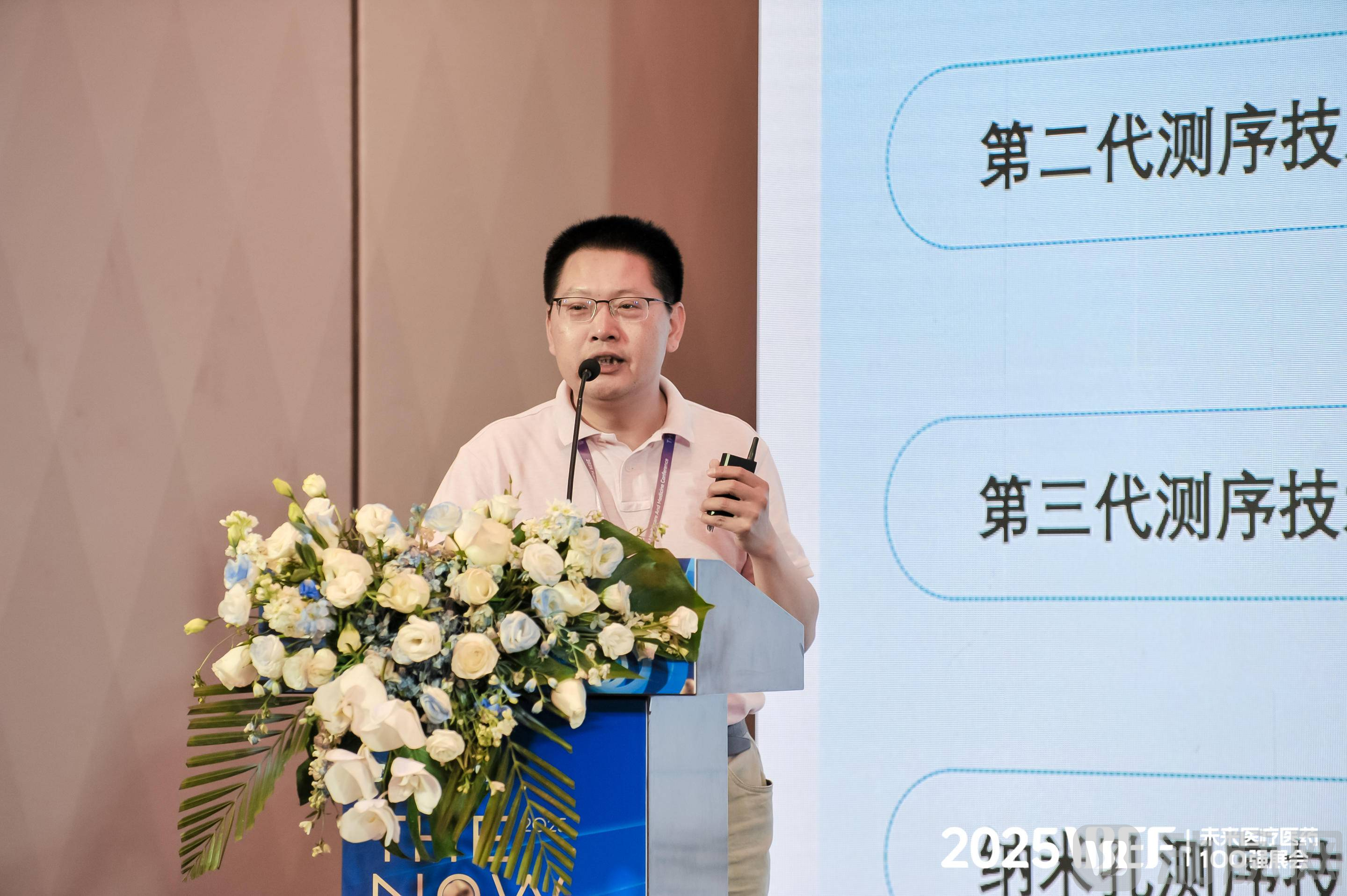
Dr. Yihua Huang, Tenured Investigator at the Institute of Biophysics, Chinese Academy of Sciences; Recipient of the National Science Fund for Distinguished Young Scholars; Leading Talent under the National High-Level Personnel Special Support Program
Nanopore sequencing technology is currently the only
DNA Polymerase-Independent Sequencing Technology
Huang Yihua stated that gene sequencing technology has been continuously evolving and iterating over the years, advancing to its fourth generation to date. The first generation is represented by Life Technologies’ “Sanger sequencing technology”; the second generation is represented by Illumina’s “Next-Generation Sequencing (NGS) technology”; the third generation is represented by PacBio’s “Single-Molecule Real-Time (SMRT) sequencing technology”; and the fourth generation is the rapidly developing “nanopore sequencing technology.”
Huang Yihua pointed out that the classification of nanopore sequencing technology yields different conclusions when analyzed from different perspectives.
From a technical standpoint, nanopore sequencing technology has optimized third-generation sequencing by achieving breakthroughs such as eliminating the need for optical systems and significantly reducing both equipment costs and sequencer footprint. With unique advantages including long read lengths, real-time sequencing, direct detection, and portability, it is widely applicable to nucleic acid and protein sequencing across diverse scenarios. Therefore, it is classified as fourth-generation sequencing technology.
However, based on its technical principles and characteristics, nanopore sequencing technology can also be classified as a third-generation sequencing technology.It does not require PCR amplification of samples and can directly sequence single-stranded nucleic acid molecules, which aligns with the characteristics of single-molecule sequencing in third-generation sequencing technologies. Furthermore, nanopore sequencing technology enables long-read sequencing, effectively addressing complex regions in genome assembly, such as repetitive sequences and structural variations. This is also one of the significant advantages of third-generation sequencing technologies.
Notably, unlike other sequencing technologies that identify bases via optical signals, nanopore single-molecule sequencing is an electrical signal-based technique. In this approach, motor proteins unwind double-stranded DNA into single strands and guide them sequentially through a biological nanopore; the nucleotide sequence is then identified by detecting characteristic variations in the translocation current. Its sample preparation is extremely simple,It is currently the only sequencing technology that does not rely on DNA polymerase.
Certainly, including nanopore sequencing technology,Different sequencing technologies have different advantages and disadvantages.
Overall, first-generation sequencing technology can be regarded as the industry gold standard; however, it suffers from low throughput and high sequencing costs. The most prominent advantages of second-generation sequencing technology are its high throughput and low cost, but it is limited by short read lengths and complex genome assembly. Third-generation sequencing technology offers longer read lengths, yet it has drawbacks such as high sequencing costs, expensive instrumentation, and complex workflows. Fourth-generation sequencing technology features ultra-long read lengths, portability, the ability to directly detect epigenetic modifications, potential for protein sequencing, and low environmental dependency. As nanopore sequencing technology is still in the phase of technical R&D and iteration, its sequencing costs need to be further reduced, and there remains room for improvement in sequencing accuracy.
Nanopore Sequencing Is on the Verge of Widespread Adoption:
The Comprehensive Advantages in Accuracy, Sensitivity, Throughput, and Cost Are Becoming Increasingly Evident
The principles of nanopore sequencing technology confer differentiated advantages that are not available with other sequencing technologies.
First, nanopore sequencing technology has broken through the limitations of sequencing read length,It can detect all nucleic acid sequences passing through nanopores, with the sequencing length limited only by the length of the single-stranded DNA being sequenced; therefore, theoretically, its sequencing read length can be infinitely long. In practical applications, nanopore sequencers have already achieved read lengths ranging from tens to millions of bases.
Secondly, compared with traditional RNA sequencing methods that rely on reverse transcribing RNA into DNA, nanopore direct RNA sequencing technology eliminates the need for reverse transcription, enabling direct sequencing of various native RNAs and their epigenetic modification information.This technology fully preserves original sequence information and modification features, avoids biases introduced by PCR amplification, and thereby provides a more authentic gene expression profile.
Furthermore, nanopore sequencing technology offers the advantage of rapid sequencing.Using this sequencing technology, DNA can pass through nanopores at a rate of hundreds of bases per second.Nanopore sequencing remains the only sequencing technology that does not require labeling of the substrate. It offers lower sequencing costs compared to third-generation sequencing, features portable instruments, and has minimal environmental dependencies, enabling sequencing in laboratories, field settings, and even space capsules or marine vessels.
Researcher Huang Yihua analyzed that, although nanopore sequencing technology theoretically possesses the aforementioned advantages, its market share remains low. Achieving widespread adoption will require sustained efforts and continuous breakthroughs across multiple areas to propel nanopore sequencing comprehensively toward greater accuracy, higher sensitivity, faster speed, and lower cost.
Continuously improving sequencing accuracy is a critical challenge that nanopore sequencing technology urgently needs to overcome.The magnitude of pore current noise and the amplitude of base-translocation current signals affect accuracy; meanwhile, nanopore sequencing struggles to accurately resolve longer homopolymer sequences, which remains one of the key challenges to be addressed. To improve sequencing accuracy, protein engineering of both the nanopore protein and the processivity-control protein is required to optimize their properties and enhance their compatibility. By simulating the interactions between the nanopore protein and the processivity-control protein to stabilize them in specific interaction modes, it is possible to further reduce noise and improve the uniformity of sequencing signals, thereby enhancing sequencing accuracy.
Furthermore, the widespread adoption of nanopore sequencing technology requires continuous optimization in terms of sequencing sensitivity, throughput, cost, and operational complexity.
To address the aforementioned challenges, Researcher Huang Yihua and his research team at Puyi Bio, building on years of dedicated expertise in nanopore sequencing technology, have developed a proprietary sequencing chemistry system. This system is grounded in the principles of nanopore gene sequencing and based on their independently resolved novel biological nanopore structures at the atomic level, integrating disciplines such as nucleic acid chemistry and protein engineering. Furthermore, they have constructed a high-performance sequencing platform leveraging integrated circuit chips, software engineering, and deep learning algorithms. The team has successfully developed high-accuracy, high-throughput, long-read, and cost-effective nanopore sequencers along with compatible reagents and consumables. This innovation has democratized nanopore sequencing—once considered an elite technology—making it accessible across multiple fields, including genomic research, pathogen detection, clinical diagnostics, pharmaceutical testing, and scientific research, thereby benefiting the general public.