

FDA Issues 'Yellow Cards': 62 New Drugs Delayed, GCT Products Face Critical CMC Hurdles
Recently, a product from a well-known domestic pharmaceutical company received a Complete Response Letter (CRL) from the FDA, indicating that further responses are required regarding the inspection of the relevant manufacturing site.
This is not an isolated case. In June 2024, the marketing application for a product from a well-known multinational pharmaceutical company also received a Complete Response Letter (CRL) from the U.S. Food and Drug Administration (FDA) due to issues with third-party manufacturing facilities.
In October 2023, another multinational pharmaceutical company also received a Complete Response Letter (CRL), primarily due to issues identified with a third-party contract manufacturing organization during an inspection.
All three are CMC (Chemistry, Manufacturing and Controls)-related product quality control issues.
According to relevant statistics, the FDA issued a total of 62 Complete Response Letters (CRLs) in 2023 and 2024, among which 29 were related to Chemistry, Manufacturing, and Controls (CMC) issues, accounting for 46.8%.
A Complete Response Letter (CRL) does not constitute a final rejection by the FDA of the drug’s market approval. The CRL outlines potential deficiencies and risks; if the applicant addresses these issues within the specified timeframe, it will not preclude ultimate approval, although it will delay the product’s market launch.
Particularly for GCT products, according to reports from Cell & Gene Therapy Insights and Guangda Securities, CMC-related issues cause an average delay of 9 months in the market launch of GCT drugs, with some cases exceeding one year.
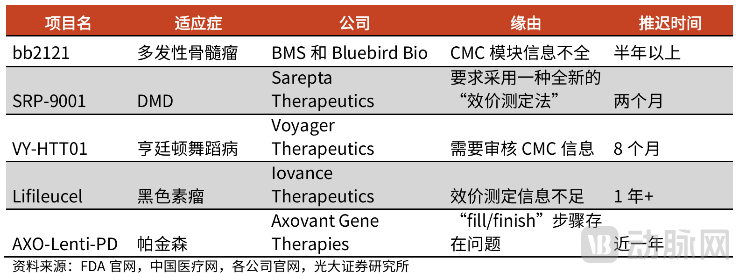
Image source: Everbright Securities research report
Although CMC issues are relevant to all pharmaceutical products, they are particularly prominent in the field of gene and cell therapy (GCT).
According to a research report by Everbright Securities, regulatory authorities have mandated that enterprises implement full-process oversight of drug production and conduct drug activity testing, which has, to some extent, constrained the rapid market launch of GCT drugs.
Dr. Scott Gottlieb, former FDA Commissioner, stated that approximately 80% of the review time for cell and gene therapy (CGT) drugs is devoted to assessing manufacturing and quality issues. Non-compliant manufacturing processes can lead to the failure of marketing applications for CGT drugs, resulting in significant financial losses for pharmaceutical companies.
CMC cannot be simply attributed to issues within the company itself, but is determined by the inherent characteristics of GCT drugs.
From the perspective of gene therapy products, as an increasing number of products enter clinical trials or reach the market, potential safety risks are gradually being revealed, with viral safety, genotoxicity (tumorigenicity), and immunotoxicity receiving widespread attention.
According to the Overview of Quality Control for Gene Therapy Products compiled by the National Institutes for Food and Drug Control (NIFDC), the production and quality control costs of gene therapy products are exceptionally high, necessitating guided technical strategies for quality control throughout the entire process. Currently, quality control of gene therapy products faces numerous challenges, such as limitations in manufacturing processes; insufficiently in-depth structural characterization and analysis of other attributes; and incomplete testing items and specification limits, with many items lacking effective analytical methods.
Cell therapy is similar. Taking stem cells as an example, according to the Journal of Pharmaceutical Analysis, stem cell products are complex in terms of source, composition, mechanism of action, and manufacturing process. Quality control requirements for stem cell products are more stringent than those for chemical drugs. Furthermore, following infusion into the body, stem cells may undergo proliferation and differentiation; they lack well-defined pharmacokinetic/pharmacodynamic (PK/PD) characteristics, and in vitro experiments cannot fully replicate the in vivo microenvironment.
In the research and development, as well as large-scale production, of stem cell products, controlling product quality to ensure their safety and efficacy is key to their successful application.
Therefore, in addition to the capital winter and commercialization challenges, CMC issues have consistently been a major concern for GCT companies both domestically and internationally. For the vast majority of R&D enterprises, beyond overcoming technical barriers during drug development, complex quality control processes represent a key bottleneck restricting the smooth entry of products into clinical stages.
In light of this, VCBeat has specially curated the Seminar on Quality Control of Cell and Gene Therapy Products, coinciding with the 23rd China Pharm Ingredients (CPHI China 2025). This event aims to bring together CGT drug developers, clinical enterprises, third-party testing service providers, academic institutions, and research organizations. Through academic and technical exchanges, participants will work collaboratively to overcome technical challenges in the R&D of cell and gene therapy drugs. During the seminar, renowned scholars, clinical experts, corporate executives, and regulatory authorities will engage in in-depth discussions on the latest advancements in cell and gene therapy technologies, key issues in drug development, and innovative applications of life science instruments.
Professor Cai Rong, former Senior Engineer at the Shanghai Institute of Food and Drug Packaging Material Testing, willSharing on “Testing Methods and Standards for Packaging Materials and Excipients Related to Laboratory-Stage Drug Products”Professor Rao Chunming, Former Director of the Recombinant Drug Division at the Institute for Biological Product Control, National Institutes for Food and Drug Control (NIFDC), and Level-2 ResearcherWill share insights on “Quality Control Research and Related Regulatory Requirements for Biotech Drugs.”

Event Duration:June 24, 13:30-17:00 (Afternoon of Day 1 of CPHI)
Event Venue:Conference Room B51, Hall W11, Shanghai New International Expo Centre
Limited-Time Registration: Unlock Exclusive VIP Privileges!
Direct Access to the Conference!Free access to the two-day business tickets (worth 1,600 yuan, including lunch for both days) for the CSGCT Conference (September 12-13, Beijing);
Limited Seats!Win a VIP seat (valued at RMB 1,800 per person) for the CSGCT Welcome Dinner or Exclusive Cocktail Reception; limited spots available.
Global Insights!Join the CSGCT International Elite Community to stay ahead with cutting-edge insights;
VBInsight Experience!Get a free 7-day premium trial of VBInsight.

Scan the QR Code to Register

Scan the QR code to add the organizing committee on WeChat