National 'Challenge-and-Appointment' Initiative Unveiled: New Opportunities Emerge for Domestic Bioreactor Industry
On June 4, the General Office of the Ministry of Industry and Information Technology (MIIT) and the General Office of the Chinese Academy of Sciences (CAS) jointly issued the “Notice of the General Office of the Ministry of Industry and Information Technology and the General Office of the Chinese Academy of Sciences on Launching the ‘Open Competition’ Mechanism to Select Teams for Innovative Tasks in High-Performance Bioreactors” (hereinafter referred to as the “Notice”).
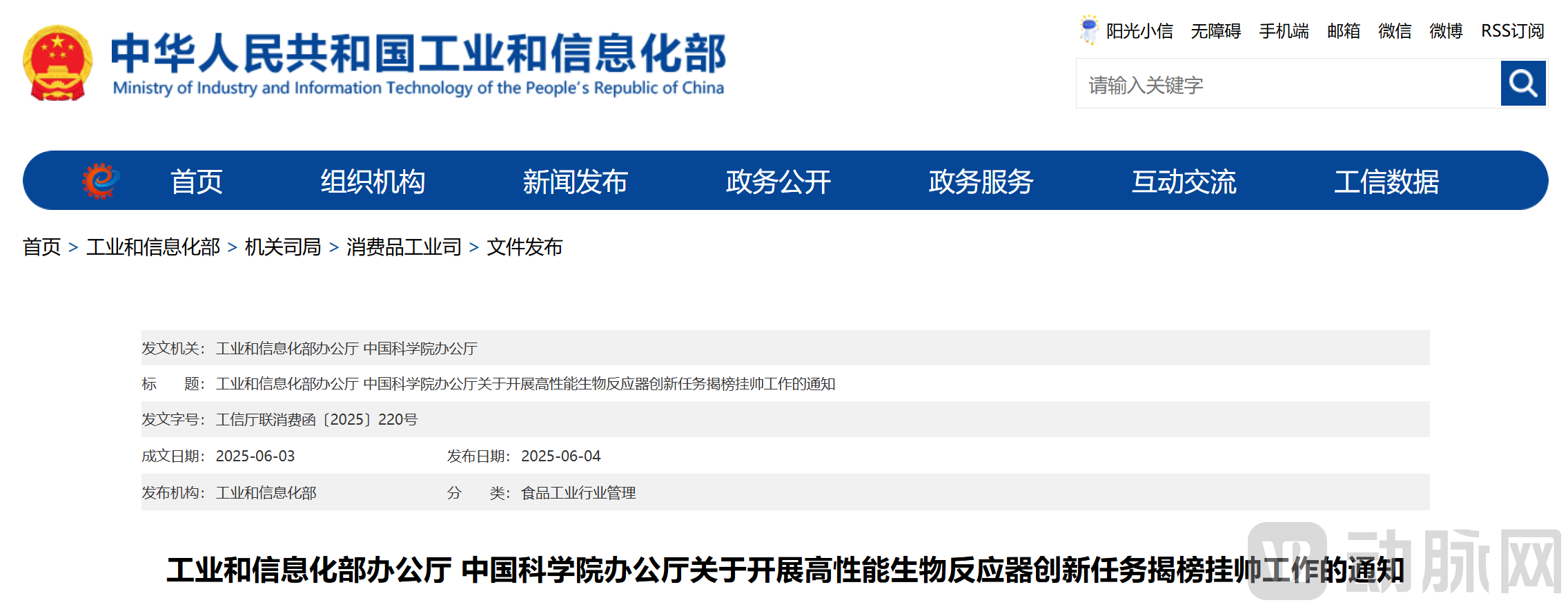
The “Notice” indicates that the “open competition” mechanism will be implemented for three categories comprising nine specific tasks, focusing on reactor systems, key components and consumables, and industrial operating systems. These tasks specifically include:
1. Reactor Systems: Microbial Parallel Bioreactors, Cell Parallel Bioreactors, Large-Scale Cell Bioreactor Systems;
2. Key components and consumables: scalable preparation of cell culture microcarriers, in-situ monitoring sensors for core physicochemical parameters, core mass transfer components, and key components for online monitoring of biological exhaust gas composition;
3. Key Industrial Operating Systems: Intelligent Industrial Operating System for Bioreactors, Alternating Tangential Flow Perfusion System.
The launch of this “open competition” mechanism is expected to further promote the development of domestic enterprises. An Lijun, Chairman of Xin’annuo, stated in an interview with VCBeat that import substitution represents a broader industry trend, and since 2022, domestically produced bioreactors have been gradually assuming a dominant position.
In the view of another expert in the bioreactor field, this “open competition” initiative is less about promoting domestic substitution and more about driving Chinese enterprises to align with international leading standards, with many performance indicators benchmarked against the most advanced products globally.
Targeting Bioreactors: Adding Value to Enterprises
When it comes to biomanufacturing, various types of bioreactors are indispensable.
Bioreactors are devices widely used for the in vitro culture of microorganisms and cells, enabling product acquisition through biochemical reactions or fermentation processes; they represent one of the key pieces of equipment in biopharmaceutical manufacturing. Based on application areas and production technologies, bioreactors can be classified into microbial bioreactors, mammalian cell suspension culture bioreactors, mammalian cell adherent culture bioreactors, photobioreactors, and other types of bioreactors.
For the open competition mechanism applied to high-performance bioreactors, applicants must meet the following requirements as stipulated in the Notice:
Must be an enterprise or institution registered in China with independent legal person status.
Encourage multiple entities to form consortia through the integration of industry, academia, research, and application for joint applications, and support research institutes affiliated with the Chinese Academy of Sciences in forming application consortia with enterprises, universities, and other institutions.
One lead institution shall be clearly designated within the consortium, with no more than four other joint applicant institutions.
The same applicant may simultaneously participate in the open competition for multiple tasks.
Consortia applying for the “open competition” tasks related to key components, consumables, and industrial operating systems must include at least one component or system user enterprise; consortia applying for the “open competition” tasks related to reactor systems must include at least one reactor user enterprise.
The applicant entity or consortium is required to possess a solid foundation in innovative work and key technological breakthrough capabilities related to high-performance bioreactors, maintain sound management and operational systems, and have had no major safety or environmental pollution incidents in the past three years.
Completed preliminary pre-industrialization validation, with basically finalized products and owned intellectual property rights; capable of completing relevant tasks within the timeframes specified for each sub-task in the open competition and achieving the expected objectives.
The "Notice" also provides detailed planning for the list tasks and expected targets of nine products.
For example, in the case of parallel microbial bioreactors, key tasks include achieving baseline parallelism between reactors through process control; developing micro-scale continuous feeding control strategies to enable high-precision feed regulation; implementing an automated tank pressure control system for bioreactors to enhance dissolved oxygen levels and reduce the risk of contamination; and optimizing impeller and aeration systems to achieve high oxygen transfer rates under high-cell-density fermentation conditions.
The expected goal is to complete the development of parallel bioreactors by 2027, achieving a throughput of at least 12 bioreactors with one-click operation; the system error between devices shall be <5%; the industrial control unit software system shall support user-defined reaction processes and other functions; the bioreactor vessels shall be pressure-resistant, and the control system shall stably maintain the vessel pressure below 0.03–0.07 MPa, with pressure fluctuations within 1 hour ≤5%.
An Lijun told VCBeat that if a company can successfully undertake the “open competition” mechanism, it will fully demonstrate the quality of its technology and products, which is highly beneficial for enhancing its brand reputation. “Moreover, we have already been collaborating with leading domestic research institutions and universities on this project under the open competition framework, making steady progress. We are confident in our technology and are willing to invest the necessary funds to participate.”
The aforementioned professionals also told VCBeat, “For enterprises, the release of this ‘Notice’ is timely. Many of the products and technologies mentioned therein are areas we have strategically positioned in years ago; the current launch of the ‘open competition mechanism to select the best candidates’ serves as an added advantage for companies.”
“Moreover, judging from the content of the Notice, it will also have a long-term promoting effect on establishing unified standards for the industry. Currently, the bioreactor field lacks unified standards at the software and data levels, resulting in data silos among enterprises, which hinders the development of artificial intelligence and large models. However, in the bioreactor sector, the quantity and quality of data are paramount to industrial development,” pointed out the professional.
Aiming for Global Leadership, Domestic Production Rate of Some Products May Exceed 80%
From the perspective of many industry insiders, the issuance of this “Notice” is, to some extent, aimed at increasing the domestic production rate of bioreactors.
After all, in February 2022, the U.S. Department of Commerce added 33 Chinese entities, including WuXi Biologics, to the “Unverified List” (UVL), subjecting these companies to import reviews on a range of production equipment, including single-use bioreactors, which triggered significant upheaval in the industry.
However, in recent years, bioreactors appear to be accelerating the pace of import substitution with domestically produced alternatives.
Based on 2022 data, according to research reports from Pacific Securities and Guorong Securities, importers held absolute dominance at that time, with domestic substitution in its early stages. Among these, stainless steel bioreactors were more capable of achieving larger volumes. Companies such as Sartorius, Thermo Fisher Scientific, GE, and Merck nearly monopolized the market, capturing the vast majority of market share, with an estimated domestic production rate of approximately 30%.
However, An Lijun told VCBeat that the domestic share of large-scale cell bioreactor systems (stainless steel) has now exceeded 50%, while for small-scale parallel bioreactors, the overall market share of domestically produced products has reached at least 70%.
“Domestic substitution is an overarching industry trend. Since 2022, domestically produced products have gradually taken a dominant position. In previous years, many enterprises and organizations faced economic pressures and limited budgets. Meanwhile, foreign companies struggled to provide timely after-sales services for bioreactors, and delivery lead times continued to lengthen. As a result, an increasing number of customers began trying domestically produced alternatives. Chinese companies seized this opportunity; after adoption, customers found that domestic bioreactors faced virtually no technological bottlenecks imposed by foreign countries at the hardware level, while the gap in software capabilities was narrowing. Consequently, the market share of domestic products rose rapidly,” said An Lijun.
According to our analysis, domestic bioreactor manufacturers—including Xin’annuo, Dibio, Bailun, Manson, Womei Biotech, and Anjiyi—are all experiencing rapid growth and establishing their own unique competitive advantages in a highly contested market.
Another expert in the bioreactor field also told VCBeat that domestic companies are rapidly achieving import substitution in this sector. The localization rate for large-scale cell bioreactor systems is likely above 60%, while for microbial parallel bioreactors, it has probably exceeded 80% in the past two years. Although there is still a slight gap in cell parallel bioreactors, the market share of domestically produced products should be around 40%.
“The state’s ‘open competition’ initiative for high-performance bioreactors is less about promoting domestic substitution and more about encouraging Chinese enterprises to align with internationally leading technologies and brands, with many benchmarks tied to the most advanced global products. For instance, parallel cell culture bioreactors are expected to achieve a single-unit channel count of ≥24 by 2027—a standard that may even surpass those of premium foreign brands—while also imposing stricter requirements on control parameter deviations,” said the industry expert.

Dr. Fang and VCBeat are jointly launching a new session of the “Training on Registration and Market Access for Biomanufacturing Products.” This training will bring together authoritative industry experts to provide an in-depth analysis of key registration points and case studies for biomanufacturing products across various application areas. Scheduled to take place on June 27–28 in Yizhuang, Beijing, the program aims to help enterprises:
Master the key challenges and pain points in the registration and market access of biomanufacturing products, along with their solutions, to enhance enterprises’ capability to address regulatory hurdles and accelerate product time-to-market.
Gain an in-depth understanding of relevant domestic and international regulatory policies to ensure that product R&D and registration activities are conducted in compliance with regulations, thereby minimizing compliance risks.
Learn from industry success stories, draw on advanced experience, optimize corporate registration strategies, and improve the success rate of registrations.
Establish a communication platform among enterprises, regulatory authorities, and experts to facilitate dialogue and collaboration, jointly promoting the healthy development of the biomanufacturing industry.
We welcome participation from heads of enterprises, R&D personnel, registration managers, regulatory affairs managers, quality management personnel, and other relevant professionals from biomanufacturing, pharmaceutical, veterinary drug, feed, cosmetics, and food companies.
Long-press the image below to scan the QR code and add our staff on WeChat to join the new session of biomanufacturing training.