

Tranexamic Acid: The Rising Star in Skin Brightening Backed by P&G and Shiseido
The Previously Uneventful Race for Skin-Whitening Ingredients Welcomes a Disruptor.
Today, the ingredients in most skin-whitening products remain familiar classics such as niacinamide, SymWhite 377, arbutin, and fruit acids. Meanwhile, tranexamic acid, another traditional ingredient, seemed to have been overlooked by the market in recent years. This ingredient, which has crossed over from the medical field of hemostasis into the skincare arena, is now making a strong comeback.
Tranexamic acid did not emerge as a sudden newcomer. As a whitening ingredient widely recognized by the medical community, its efficacy was initially promoted through extensive use by various brands under Shiseido. After Shiseido’s patent expired and the company gradually phased out its use, tranexamic acid was adopted by numerous affordable brands, which saddled it with a “budget” label, leading to its gradual fade from the market.
In recent years, with the deepening of research, the multiple benefits of tranexamic acid in skincare have been gradually confirmed. Its primary effects include: effectively reducing pigmentation caused by UV radiation and free radicals; possessing significant anti-inflammatory properties that help prevent post-inflammatory hyperpigmentation; alleviating skin redness by inhibiting the activity of serine proteases; and preventing UV-induced damage to the dermal-epidermal junction (basement membrane zone), thereby delaying inflammatory aging of the skin. Based on these findings, an increasing number of skincare products are incorporating tranexamic acid as an active ingredient. In the first quarter of this year, tranexamic acid ranked among the Top 10 beauty ingredients, highlighting its broad application prospects and growing market recognition in the skincare industry.
To cater to the new generation’s pursuit of “ingredients first,” the beauty industry has set off a frenzy of “ingredient-based naming.”
In recent years, product names featuring specific ingredients, such as “Niacinamide Serum” and “Hyaluronic Acid Cream,” have become a prevalent naming convention among skincare brands. It appears difficult for brands to demonstrate their professional expertise in the skincare sector without incorporating such proprietary ingredient names. According to statistical data from the Beauty Evolution big data platform as of May 2025, the number of products with “Niacinamide” in their names has reached 16,000, those containing “Pro-Xylane” have approached 16,000, and products with “Collagen” in their names have exceeded 13,900. Notably, over the past few years, these three ingredients have accounted for the vast majority of market share within this naming category.
Starting in 2024, tranexamic acid has gradually emerged as a new market hotspot, garnering strong enthusiasm from brands.
From 2022 to the present, the overall performance of the top 10 claimed ingredients in products has remained stable. Ingredients such as sodium hyaluronate, tocopherol, and niacinamide have consistently ranked within the top five. However, in Q1 of this year, a “new face” emerged on the top 10 list: tranexamic acid broke into the top 10 driven by its high number of new product launches, whereas it ranked only 15th during the same period last year.
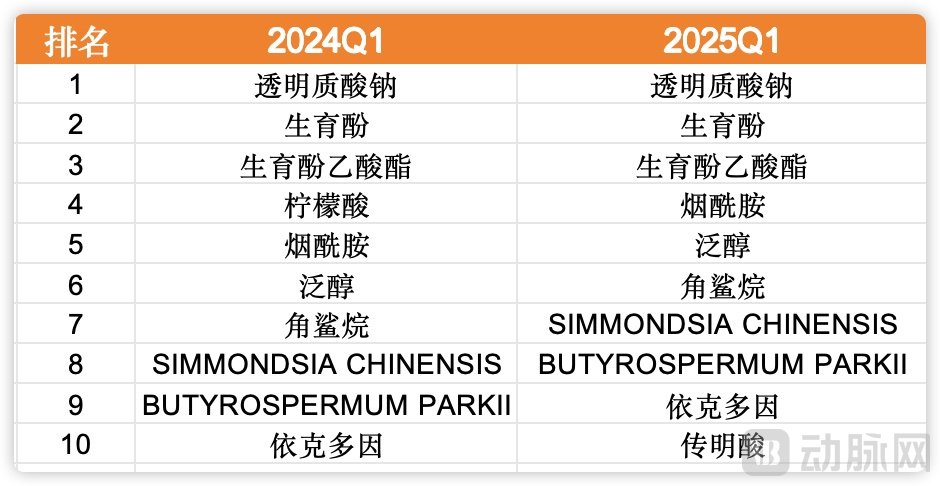
Top Ingredients in Cosmetics: Data Sourced from Meili Xiuxing Big Data
According to big data from Meili Xiuxing, in 2024, a total of 918 new products with “Tranexamic Acid” in their names were registered and filed in China, representing a compound annual growth rate (CAGR) of over 80% in the past three years. As of May 2025, the number of such products exceeded 3,000, marking a year-on-year increase of more than 100%. The number of brands offering these named products and the number of factories producing tranexamic acid-containing products also maintained double-digit growth, reaching 63% and 70%, respectively.
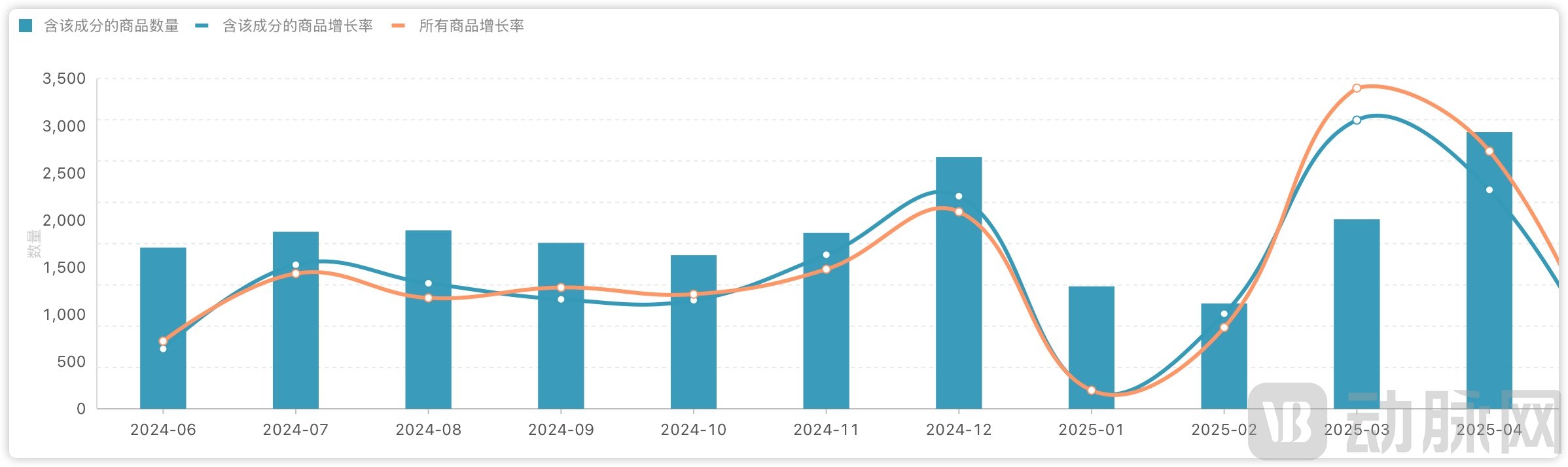
Trends in New Product Launches Containing Tranexamic Acid, Source: Meili Xiuxing Big Data
Cosmetics containing tranexamic acid are experiencing an explosive surge. Since the beginning of this year, over 7,000 new products listing tranexamic acid in their ingredient decks have been launched, with a compound annual growth rate exceeding 60% over the past three years. After years of being sidelined, tranexamic acid is finally seeing a turning point; however, it still has a long way to go before it can claim the center stage in the skin-whitening market.
The Story of Nicotinamide Is Unfolding Once Again.
When it comes to skin-whitening ingredients, niacinamide is indispensable, and Procter & Gamble’s (P&G) strategic management of this ingredient serves as a classic case study. Since 1994, P&G has conducted in-depth research on niacinamide over a span of 30 years, publishing dozens of core academic papers and various research reports, while securing multiple international patents. Building on this foundation of basic research, P&G subsequently incorporated niacinamide into its product portfolio.
Subsequently, Procter & Gamble’s Olay brand incorporated niacinamide into a wide range of products. Following the remarkable success of Olay’s Niacinamide Brightening Serum (commonly known as the “Small Green Bottle”), P&G introduced niacinamide across nearly its entire product portfolio. This includes blockbuster items such as Olay Luminous White Bottle, Olay Dark Spot Correcting White Bottle, and SK-II GenOptics Aura Essence (“Little Light Bulb”). These products not only cater to diverse consumer needs but also further expand the market influence of niacinamide, setting a new industry benchmark for science-based skincare. Meanwhile, P&G continues to research the synergistic effects of niacinamide with other ingredients, such as combining niacinamide with hyaluronic acid to develop Olay Nourishing and Elastic Body Wash.
An overview of Procter & Gamble’s strategic approach to niacinamide reveals four key phases: foundational research, publishing papers to build influence, in-depth research for continuous product commercialization, and leading the industry with a product matrix that drives competitor follow-up. A similar scenario is now unfolding with tranexamic acid.
In 2023, Procter & Gamble published a paper titled “The Role of IL-6 and ET-1 Receptors in the Increased Dendricity of Melanocytes in Facial Hyperpigmentation and the Inhibitory Effects of Niacinamide and Tranexamic Acid” in the Journal of the European Academy of Dermatology and Venereology (JEADV), announcing new progress in its research on the skin-whitening effects of tranexamic acid.
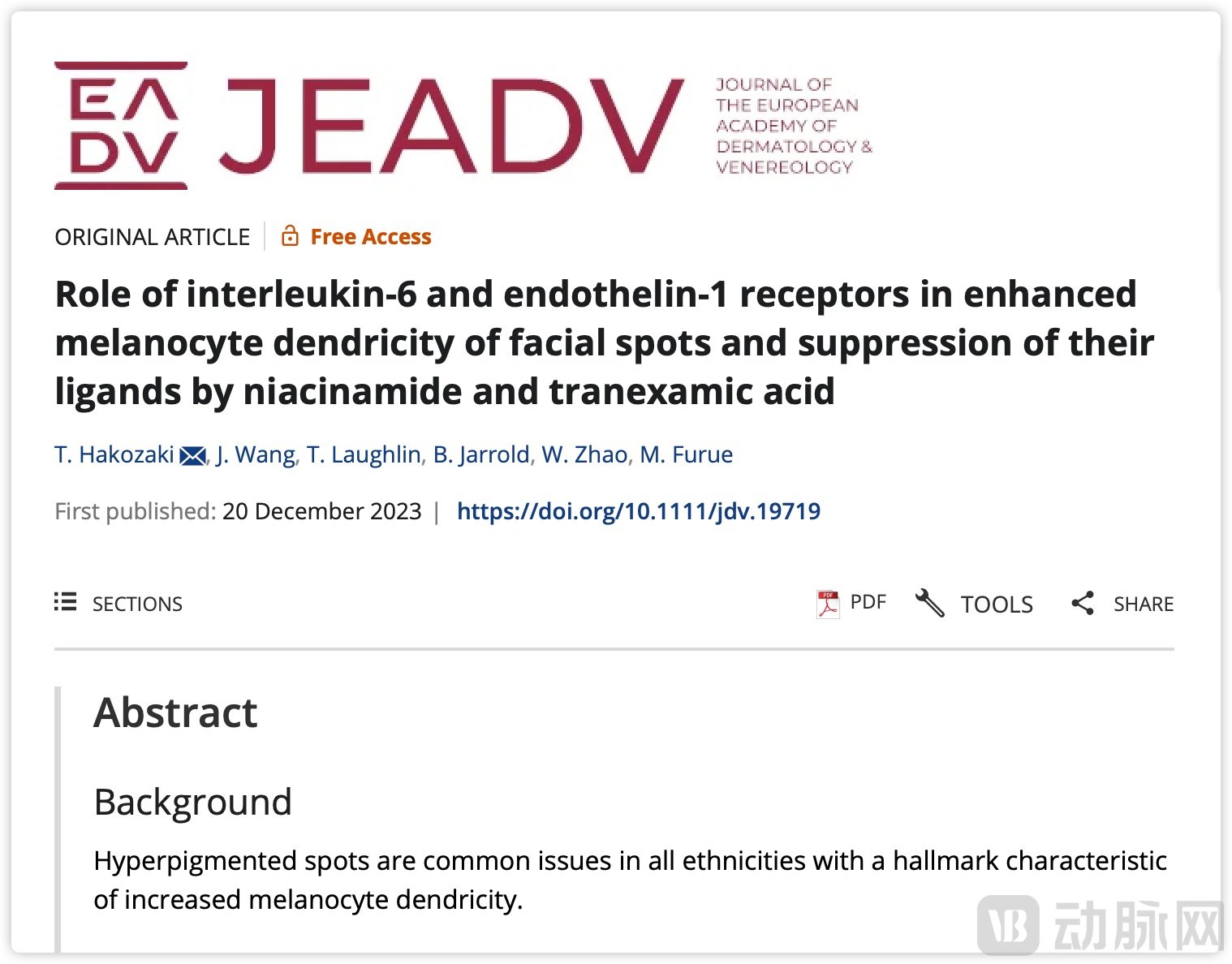
P&G: Academic Research Paves the Way, Products Follow Suit. Image source: JEADV
P&G’s research has found that tranexamic acid is associated with the activity of melanocyte precursors, namely melanocytes. The elongation of melanocytic dendrites promotes the transfer of melanin to keratinocytes, leading to skin darkening. Tranexamic acid acts by stabilizing melanocyte precursors and preventing their overactivity, thereby inhibiting melanin production and transport at the source, ultimately achieving a skin-whitening effect.
Notably, this study is not an isolated theoretical exploration by Procter & Gamble (P&G), but is closely tied to the third generation of its OLAY brand’s Anti-Spot White Bottle product. This product marks the first incorporation of tranexamic acid into its existing whitening formulation, where it works synergistically with ingredients such as niacinamide and SDL Sepiwhite to enhance the product’s skin-whitening and spot-fading efficacy. By leveraging the opportunity to publish findings in a prestigious journal, P&G has provided scientific endorsement for this new product, aiming to bolster consumer confidence in its whitening benefits and thereby facilitate market promotion.
P&G’s recent research on tranexamic acid focuses on exploring its novel mechanism of action in inhibiting the activation signals of melanocyte precursors, providing new theoretical support for the application of tranexamic acid in skin whitening. Unlike previous uses, where tranexamic acid was primarily employed to prevent post-procedure hyperpigmentation and improve melasma following medical aesthetic treatments, this study further expands its scope of application and elucidates its mechanisms in whitening skincare.
Although this study is based on further research and improvement of the ingredients of existing products, and through in-depth exploration of the mechanism of action of tranexamic acid, it has deepened and expanded the known whitening function of tranexamic acid to a certain extent. However, the depth of research cannot yet be compared with that of niacinamide, but this operational path is exactly the same as that of niacinamide.
Procter & Gamble’s latest research and product applications of tranexamic acid have provided new perspectives and directions for the field of skin whitening, potentially prompting other brands in the industry to renew their attention and research on tranexamic acid, thereby fostering in-depth discussions on its whitening efficacy and driving product innovation within the sector.
The participation of numerous brands has fueled the resurgence of tranexamic acid.
In the current skin-whitening market, leading brands each have their own flagship core ingredients, such as Olay’s niacinamide, Osmanthus’ Zhenbaiyin Pro, Guyu’s glabridin, and 377 (phenylethyl resorcinol) from Jiwei Weilai. However, whether it is various botanical extracts or classic whitening agents like niacinamide and vitamin C, these ingredients have been on the market for many years. The market has long entered a stage of “consumer fatigue,” and growth trends are showing signs of slowing down as the sector matures.
On the other hand, due to fierce competition in the beauty market and widespread product homogenization, the whitening segment has long become a "red ocean," making it difficult for brands to break through without innovative storytelling. As an emerging popular ingredient, tranexamic acid is still in the market development stage, with consumer education and awareness just beginning, and its efficacy potential not yet fully explored. This provides brands with ample room for innovation and marketing opportunities; early strategic positioning can help them seize the first-mover advantage.
In terms of product formulation, tranexamic acid has driven diverse innovations. It can be widely applied in common whitening products such as serums, lotions, and creams, and can also be incorporated into diversified categories like facial masks and sprays. Even Shiseido has reintroduced tranexamic acid into its HAKU Whitening Essence, combining high-concentration tranexamic acid with potassium 4-methoxysalicylate and ethyl ascorbic acid to create a precise spot-fading and whitening product.
Daiichi Sankyo’s TRANSINO brand focuses on enhancing the anti-inflammatory and soothing properties of tranexamic acid, offering a product matrix tailored for whitening care suitable for sensitive skin. The lineup includes whitening masks, repair creams, whitening lotions, sunscreens, and serums. By providing precise and personalized whitening solutions for consumers with different skin types and whitening needs, the brand has comprehensively strengthened its competitiveness in the niche whitening market.
Not only multinational brands, but also numerous domestic brands have begun to incorporate tranexamic acid into their product portfolios.
For instance, Proya, a leading domestic beauty brand in China, has long lacked a benchmark whitening product. After several years, it finally launched the Hengguang Jingtou Serum. This product utilizes tranexamic acid, complemented by 3,3,5-trimethylcyclohexyl succinoyl diethylamide, to degrade tyrosinase at its source via the ubiquitin-proteasome system. Externally, it degrades melanosomes in keratinocytes through the autophagy pathway, thereby inhibiting melanin production and achieving a skin-whitening effect.
From a product form perspective, the rise of tranexamic acid has also provided new narrative angles for traditional categories such as facial masks. FuErJia, positioned as a professional skincare brand, has continuously innovated its core category of medical-grade facial masks. Its product line has evolved from sodium hyaluronate repair patches and recombinant type III humanized collagen patches to formulations incorporating astaxanthin and tranexamic acid. The addition of these new ingredients not only meets consumers’ diverse efficacy demands but also diversifies its own product portfolio. In addition, brands such as PMPM, Comfy, Runzhi Zhenhuo, and Yiyan have also launched facial mask products containing tranexamic acid.
In addition, there are brands that feature tranexamic acid as their primary whitening ingredient, such as Uface. Since its establishment in 2009, Uface has been dedicated to the research and development of tranexamic acid, providing medical-grade efficacy skincare products to users of aesthetic medicine. Its product portfolio includes serums, facial masks, daily care items, and professional in-clinic infusion series. To precisely address consumer needs, its tranexamic acid products are available in two concentrations: 3%, suitable for sensitive skin, and 5%, appropriate for most skin types. Furthermore, by combining tranexamic acid with various other ingredients, the brand has created a diversified product matrix, with more than ten serum variants alone. The in-clinic infusion series also enables consumers to receive professional care at aesthetic medical institutions, complementing procedures such as mesotherapy (skin boosters), microneedling, and intense pulsed light (IPL) therapy, thereby meeting the needs of different customer groups.
Thanks to the participation of these brands, tranexamic acid has gained increasing market acceptance, sparking heated discussions on platforms such as Xiaohongshu and Douyin.
To ignite the tranexamic acid market, one more blockbuster product is needed.
Although multinational and domestic brands continue to enter the market, no blockbuster product has yet emerged. Even established players like OLAY and Proya have failed to generate significant buzz. Some industry observers attribute the rise of tranexamic acid to the growing influence of “ingredient-savvy” consumers, yet this same group is also hindering its further development. Poor transdermal penetration remains a key challenge limiting tranexamic acid’s efficacy. Ingredient-savvy consumers clearly understand its whitening mechanism as well as its limitations in transdermal absorption. Unless brands achieve breakthroughs in this area, they will naturally struggle to win over these discerning customers.
Fortunately, manufacturers have begun to investigate microneedle-based tranexamic acid therapies. Unlike topical tranexamic acid, which offers only superficial and limited efficacy, microneedles effectively establish a direct pathway for tranexamic acid to reach the dermis, thereby enhancing delivery efficiency while minimizing side effects. Previously, the application of microneedles was constrained by adverse effects associated with their materials. However, with the adoption of synthetic biodegradable materials, such as polylactic acid, in microneedle fabrication, the transdermal delivery of tranexamic acid is poised to become safer and more efficient in the future.
Furthermore, from a product perspective, taking serums as an example, products from brands such as Science & Technology, Biohyalux, Uface, and Skin Future contain classic whitening ingredients like niacinamide in addition to tranexamic acid. After years of market education, consumers have developed high awareness of these classic ingredients, which naturally occupy the central position in their perception. Consequently, the efficacy of the products is primarily attributed to these well-known ingredients, posing certain obstacles to building consumer recognition for tranexamic acid.
Brands must also leverage technological innovation to further enhance the whitening efficacy and product stability of tranexamic acid. This includes improving the purity and activity of tranexamic acid, developing more advanced encapsulation technologies to address its stability issues, and exploring its synergistic effects with other whitening ingredients to create more effective formulations. Additionally, introducing innovative product formats such as sprays and gels can help meet the diverse needs of consumers.
Finally, the widespread adoption of tranexamic acid is inseparable from cost factors. Benefiting from its long-standing application in medical hemostasis, domestically produced medical-grade tranexamic acid not only fully meets domestic demand but is also exported in large quantities overseas. Currently, the price of tranexamic acid in China is nearly 500 yuan per kilogram, several times higher than that of niacinamide, which costs over 100 yuan per kilogram. This price disparity is also a factor hindering the further proliferation of tranexamic acid-related products.
Overall, the recent surge in tranexamic acid’s popularity is the result of synergy between ingredient-driven advantages and brand strategy. From technological upgrades and category innovation to breaking into new application scenarios, brands are leveraging this ingredient as a fulcrum to drive transformation in the skin-brightening market. In the future, the combination of high-efficacy tranexamic acid formulations, full-cycle solutions, and cross-industry applications may become the triple engine for brands to create blockbuster products. Given its “versatile” nature, tranexamic acid is destined to be a core variable in this transformation.