

Plasma Product Leader Pilin Bio, Valued at RMB 16.1 Billion, Halts Trading Amid Imminent Change of Control
On the evening of June 5, Pacific Shuanglin Bio-pharmacy Co., Ltd. (“Pailin Bio”) issued an announcement on trading suspension regarding the planning of a change in control. The announcement stated that the Company recently received notice from its controlling shareholder, Gongqingcheng Shengbang Yinghao Investment Partnership (Limited Partnership) (“Shengbang Yinghao”), which is currently planning matters involving a change in control of Pailin Bio.
The aforementioned matters are still under planning, with no agreements signed yet, entailing significant uncertainty. To ensure fair information disclosure, safeguard investors’ interests, and prevent abnormal fluctuations in the Company’s stock price, Pailin Biotech has applied to the Shenzhen Stock Exchange, in accordance with relevant regulations, for a trading suspension of its shares (stock abbreviation: Pailin Biotech; stock code: 000403) effective from the market opening on June 6, 2025. The suspension is expected to last no more than two trading days.
As of the market close on June 5, Pailin Bio's stock price was RMB 16.96 per share, with a total market capitalization of RMB 16.12 billion.
Pailin Bio’s core business involves the research, development, production, and sales of blood products. As a specialized segment within the biologics industry, blood products are biologically active preparations derived primarily from healthy human plasma using biological processes or separation and purification technologies. They play an irreplaceable role in emergency medical care and in the prevention and treatment of certain specific diseases, constituting essential national strategic reserves and critical medications for emergency treatment of severe conditions.
According to statistics from market research firms, the global blood products market exceeded USD 50 billion in 2024 and is projected to surpass USD 90 billion by 2030. In China, the blood products market reached RMB 60 billion in 2024 and is expected to reach RMB 95 billion by 2030, indicating substantial growth potential for the industry in the coming years.
Blood products originated in the 1940s during World War II. After years of rapid development, the product portfolio has expanded from initial human serum albumin to more than 20 varieties, including immunoglobulins and coagulation factors, with global plasma collection exceeding 60,000 tons. Currently, the number of overseas blood product companies has decreased from over 100 at the end of the 20th century to fewer than 20 today. The global blood products industry is becoming increasingly concentrated through mergers and acquisitions, with major players such as CSL Behring, Grifols, Takeda, and Octapharma accounting for approximately 80% of the market share, resulting in an overall oligopolistic market structure.
China’s blood products industry originated in the 1960s and has a history of over 60 years. Since 2001, no new blood products manufacturers have been approved for establishment. China implements a cap on the total number of blood products manufacturing enterprises, with strict state supervision over the industry. As a result, the Chinese blood products sector has long been characterized by a relative supply shortage, with China’s annual plasma collection volume accounting for only approximately 18% of the global total.
Drawing on the development trends of mature markets in Europe and the United States, China’s blood products industry is also embarking on a path of industry consolidation driven by policy guidance and market competition. The advantages of large companies—in terms of resources, capital, and scale—are becoming increasingly pronounced, the divergence between leading enterprises and ordinary ones is intensifying, and industry concentration will continue to rise. In recent years, Chinese blood products companies have increased industry concentration through mergers and acquisitions, forming a competitive landscape dominated by thousand-ton-level major players: Tiantan Biological, Shanghai RAAS, Taibang Biological Group, Hualan Biological Engineering, and Pailin Biological.
Among them, Pailin Bio ranks among the industry leaders in both product variety and production scale.Currently, Guangdong Shuanglin, a subsidiary of Pailin Biotech, offers 18 specifications across 8 product varieties in 3 major categories, while its subsidiary Pasfike offers 31 specifications across 9 product varieties in 3 major categories, bringing the total number of product varieties to 11. The maximum number of product varieties offered by any domestic blood products enterprise in China is 14.The company currently ranks third in the industry by product variety.Furthermore, Pacific Shuanglin has more than 10 products in its pipeline with accelerated development progress. The number of products is expected to continue growing, positioning the company among the industry leaders in terms of product portfolio size.
In terms of the number of plasma collection stations, Guangdong Shuanglin, a subsidiary of Pailin Biopharma and recognized as a national-level “Specialized, Refined, Differential, and Innovative” Little Giant enterprise as well as Guangdong Province’s largest high-tech enterprise in blood products, operates 19 plasmapheresis stations. Among these, 17 are currently collecting plasma, while 2 have completed construction and are awaiting acceptance inspection. Pasifeike, the only high-tech blood products enterprise in the three northeastern provinces with a complete portfolio of three major product categories and a provincial-level “Specialized, Refined, Differential, and Innovative” enterprise, owns 19 plasmapheresis stations, all of which have passed acceptance inspections and commenced plasma collection.The company operates a total of 38 plasma collection stations, ranking among the top three in the industry. In 2024, its plasma collection volume exceeded 1,400 tons, firmly placing it in the first tier of blood product manufacturers with annual collections surpassing 1,000 tons.
In 2024, Pacific Shuanglin Bio-pharmacy achieved operating revenue of RMB 2.655 billion, a year-on-year increase of 14.00%; net profit attributable to shareholders of the parent company amounted to RMB 745 million, representing a year-on-year growth of 21.76%. Furthermore, in response to expanding industry demand, the Company is currently expanding the Phase II production capacity of its Pasfiko facility. With the subsequent release of this additional capacity, Pacific Shuanglin Bio-pharmacy anticipates that its annual production capacity will exceed 3,000 tons, effectively ensuring continued robust performance growth in 2025.
Pailin Biopharma is primarily composed of two major subsidiaries: Guangdong Shuanglin and Pasifik Bio. Shuanglin Bio was established in 1995, formerly known as the Navy Haiyao Biological Products Research Institute; in 1998, Sanjiu Group took control, and in 2004, following the restructuring of Sanjiu Group, Zhenxing Group became the controlling shareholder of Sanjiu Biochemistry, which was renamed Zhenxing Biochemistry and re-listed in 2013; from 2017 to 2018, Zhejiang Min Tou and Kaisa Group became the two largest shareholders of the company, which was subsequently renamed Shuanglin Bio; in 2020, Shuanglin Bio initiated the acquisition of Harbin Pasifik, and after completing the acquisition in 2021, it was renamed Pailin Biopharma.
It is evident that since its establishment, Pacific Shuanglin Bio-pharmacy has undergone multiple name changes, reflecting corresponding changes in its controlling shareholders. According to the company’s 2024 annual report, its controlling shareholder was changed to Sanjiu Enterprise Group in 1998; to Sanjiu Pharmaceutical Co., Ltd. in 2002; to Zhenxing Group Co., Ltd. in 2007; to Hangzhou Zhemin Tou Tianhong Investment Partnership (Limited Partnership) in 2018; and to the current Gongqingcheng Shengbang Yinghao Investment Partnership (Limited Partnership) in 2023.
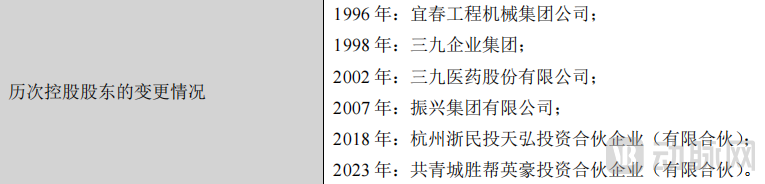
Historical Controlling Shareholders of Pacific Shuanglin Bio-pharmacy, Source: 2024 Annual Report
As of December 31, 2024, the total share capital of Pailin Bio amounted to 731,074,913.00 shares. Shengbang Yinghao held a total of 153,752,812.00 shares, accounting for 21.03% of the total shares; Tibet Zheyan Investment Management Co., Ltd. held a total of 14,793,727.00 shares, accounting for 2.02% of the total shares, and has delegated the corresponding voting rights to Shengbang Yinghao; Shen Heping, a party acting in concert with Shengbang Yinghao, held 815,100.00 shares, accounting for 0.11% of the total shares. Consequently, Shengbang Yinghao effectively controls the voting rights attached to 23.16% of the shares of Pailin Bio, becoming the company’s largest shareholder.
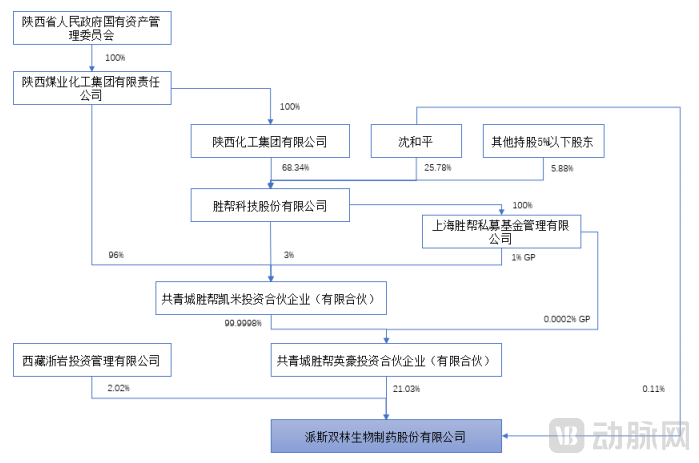
Ownership and Control Structure of Pailin Biotech, Source: 2024 Annual Report
Shengbang Yinghao was established in March 2023, with a registered capital of RMB 5 billion. It is backed by Shaanxi Coal and Chemical Industry Group Co., Ltd. (hereinafter referred to as “Shaanmei Group”). Shaanmei Group is an energy and chemical enterprise wholly owned by the State-owned Assets Supervision and Administration Commission of Shaanxi Province. As one of the largest state-owned enterprises in Shaanxi Province, it boasts total assets exceeding RMB 600 billion. In 2023, the group achieved operating revenue of RMB 395.2 billion and net profit of RMB 37.2 billion.
Based on its establishment timeline, Shengbang Yinghao appears to have been set up specifically for the acquisition of equity in Pailin Biological. In March 2023, the same month it was founded, Shengbang Yinghao announced the acquisition of a 20.99% stake in Pailin Biological from Zhemin Tou Tianhong and Zhemin Tou for a consideration of RMB 3.844 billion. Subsequently, in October of the same year, it completed the restructuring of the board of directors, securing a majority of the seats and formally taking full control of Pailin Biological. As a result, Pailin Biological transformed from a privately controlled enterprise into one with state-owned background.
Backed by state-owned capital, Pacific Shuanglin Bio-pharmacy has gained support in management, funding, strategy, and resources, fueling its rapid growth.
For example, Shaanxi Province has 7 county-level cities and 69 county towns, boasting abundant potential resources for plasma collection stations. However, there are currently only four such stations in the province, indicating significant room for development. It is expected that ten new plasma collection stations will be added during Shaanxi Province’s 14th Five-Year Plan period. As the largest state-owned enterprise in Shaanxi, Shaanxi Coal and Chemical Industry Group holds a stake in Pailin Bio, which is well-positioned to secure approvals for more of these new stations. Furthermore, Shaanxi Coal and Chemical Industry Group has made capital investments in Gansu, Ningxia, Qinghai, and other regions, and is poised to leverage its financial strengths and government partnerships to further expand its network of new plasma collection stations.
In fact, in recent years, central state-owned enterprises (SOEs) or local state-owned assets have increasingly participated in the acquisition of blood product companies. Leading blood product enterprises such as Tiantan Biological Products, Boya Bio-pharmaceutical, Pacific Shuanglin Bio-pharmacy, and Weiguang Biological Products all have state-owned backgrounds, and their actual controllers have undergone changes one after another. State-owned enterprises can provide support and empowerment to blood product companies in many aspects, such as establishing new plasma collection stations. After parting ways with Shaanxi Coal Group, a former controlling shareholder with strong backing, it is anticipated that Pacific Shuanglin Bio-pharmacy will welcome a mysterious new controlling shareholder.
Reference: “2024 Research Report on Pailin Bio: State-owned Capital at the Helm Continues to Empower, Ushering the Company into a New Stage of Development”