

Digital Health IPO Freeze Ends with Back-to-Back Listings: Omada Health Joins Hinge Health on Public Markets

Omada Health
Digital Health Management Platform
Half a month later, the digital health sector welcomes another major IPO.
Recently, in the fields of chronic disease management such as MSK, diabetes, and hypertension,Prominent Digital Therapeutics Company Omada Health (hereinafter referred to as “Omada”) Lists on NASDAQ, with an offering price of $19 per share, raising approximately $150 million and achieving a valuation of nearly $1.3 billion, higher than the pre-IPO valuation of $1.1 billion, which is relatively rare among healthcare companies that have gone public in recent years.
This isAnother Major Digital Health IPO Within Just Half a Month——In late May, Hinge Health (hereinafter referred to as “Hinge”), a leader in digital therapeutics for musculoskeletal (MSK) rehabilitation, successfully completed its initial public offering (IPO). After nearly a year of quiet, the U.S. stock market has witnessed a series of digital health IPOs, sending clear signals of a rebound.
Compared to the earlier-listed Hinge Health, what competitive advantages does Omada Health hold, and what are the key differences? VCBeat provides an analysis of its prospectus.
Omada was founded in 2011 by Sean Duffy, Adrian James, and Andrew DiMichele. Its initial business focus was on prediabetes and weight management. Launched in 2012, the program named “Omada for Prevention & Weight Health” aimed to help users maintain a healthy weight and prevent prediabetes through physical exercise.
Users participating in this program must first submit an application to complete the assessment; upon approval, they can download the app. Their accounts are pre-loaded with customized, regularly updated training plans based on the assessment results, covering areas such as food selection, exercise methods, and risk education. Users will also receive hardware devices capable of syncing data with the app (currently primarily smart scales and glucose meters) to facilitate the upload of physiological metrics.
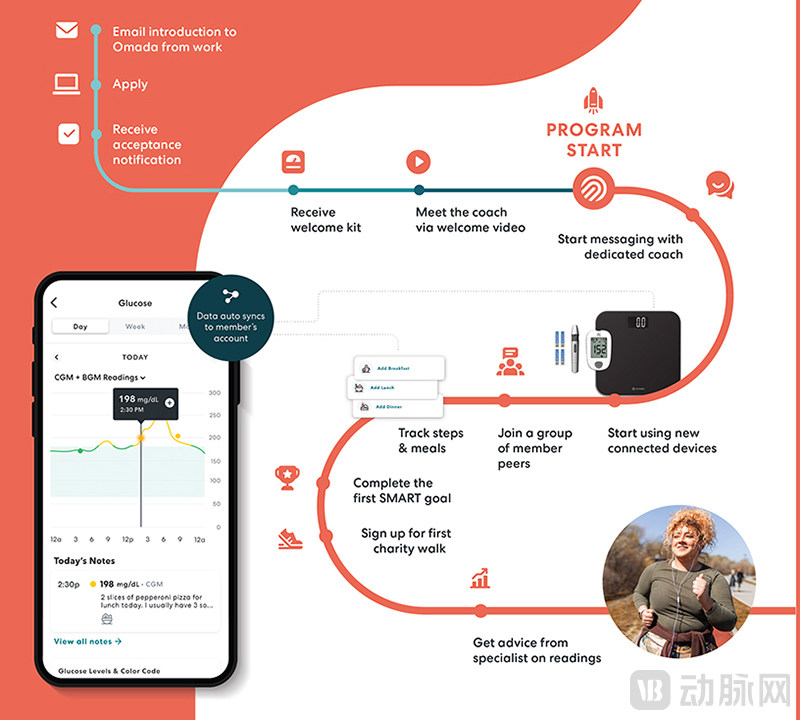
General Process for Users Participating in the Omada Health Training Program
Omada assigns each user a dedicated health coach who provides one-on-one counseling and interactive sessions over a 16-week program to motivate adherence to the training plan. This hybrid human-digital model for chronic disease management has received widespread acclaim, was subsequently emulated across the industry, and has become a standard approach in the digitalization of chronic care.
Since patients with diabetes and obesity often also suffer from common chronic conditions such as hypertension, and given the significant overlap in the management of various common chronic diseases, Omada has begun to expand its offerings to cover a broader range of disease types.
In 2018, Omada launched Omada for Diabetes, Omada for Hypertension, and the combined Omada for Diabetes and Hypertension program all at once. These new offerings, together with the existing Omada for Prevention & Weight Health, constitute its Heart & Metabolic business line.
The management models for these newly added services differ little from previous ones. All adopt customized hardware and software management solutions, supplemented by guidance from dedicated professional health managers (certified diabetes care and education specialists or hypertension experts), to assist users in managing and preventing chronic diseases.
In 2020, Omada acquired the MSK digital health company Physera for $30 million and promptly launched Omada for MSK (musculoskeletal), becoming one of Hinge Health’s competitors.
The project continues to adopt the “customized app + dedicated physical therapist coaching” model to assist MSK patients. However, unlike before, physical therapists now conduct morphological analysis of patients via video and leverage computer vision technology similar to Hinge’s to analyze patients’ range of motion and patient-reported outcomes, thereby assessing progress and updating training protocols.
In 2023, Omada capitalized on emerging trends by launching Omada GLP-1 Care Tracks and integrating them into its heart and metabolic health business. The company does not prescribe GLP-1 medications itself; rather, it enhances the efficacy of pharmacological treatment through digital therapeutics used in conjunction with GLP-1 drug therapy. In addition to the integrated version, Omada also introduced a standalone, more robust enhanced program available for separate purchase by clients and partners.
To date, Omada’s product portfolio covers major chronic conditions, including obesity, diabetes, hypertension, and musculoskeletal (MSK) disorders, serving an extensive population. According to its prospectus, as of the end of March 2025, Omada had more than 2,000 clients and over 679,000 members, having cumulatively provided services to more than 1 million members.
Omada’s products have received widespread acclaim, with average customer satisfaction exceeding 90% in 2024. User engagement has also been robust: in 2024, members enrolled in the Heart & Metabolic program engaged an average of more than 30 times per month during their first year. Over 55% of members continued to engage at least once a month after one year in the program, and more than 50% maintained this level of monthly engagement even after two years.
It is not difficult to find that,Omada has identified a natural growth pathway by leveraging weight—a common factor in chronic diseases—enabling low-cost expansion of disease coverage, which stands in stark contrast to Hinge Health’s focus on the musculoskeletal (MSK) sector.。
On one hand, Omada covers common chronic diseases, resulting in a broader potential customer base. Its membership has maintained strong growth in recent years. As of March 2025, Omada had over 679,000 members. In comparison, Hinge’s membership of approximately 530,000 still lags behind Omada by a considerable margin.
On the other hand, patients with chronic diseases often suffer from multiple conditions, making them more likely to participate in multiple programs as members.
According to data cited in the prospectus, approximately 40% of adults in the United States suffered from two or more chronic diseases in 2022. A study published in the Journal of Back and Musculoskeletal Rehabilitation in 2019 found that 58% of patients with diabetes also had musculoskeletal (MSK) conditions; meanwhile, a study published in Endotext in 2021 showed that approximately 74% of adults with diabetes also had hypertension.
The prospectus also mentioned that by the end of 2024, the number of customers providing multiple subscription plans to members nearly doubled compared to the previous year, accounting for approximately 31%, with significant untapped potential.
Omada also places particular emphasis on the evidence-based foundation of its digital therapeutics. First, Omada collaborated with official organizations such as the U.S. Centers for Disease Control and Prevention (CDC) or the American Diabetes Association from the outset of its digital therapeutics design, developing scalable digital health solutions based on established public health programs to achieve broad patient coverage.
Subsequently, Omada Health spared no effort in demonstrating the clinical and health economic effectiveness of its digital therapeutics. By the end of 2024,Omada Has Published 29 Peer-Reviewed Studies, Providing Strong Endorsement for Product Development and Marketing。
Taking its highly anticipated Omada GLP-1 Care Tracks as an example, Omada has demonstrated the efficacy of hybrid regimens through clinical trials. For instance,Members participating in the enhanced Omada GLP-1 Care Tracks program achieved a statistically significant 28% greater average weight loss at Week 16 compared to patients using GLP-1 medications alone. Members who discontinued GLP-1 medications and adopted Omada GLP-1 Care Tracks also demonstrated better control of weight regain after cessation, maintaining their weight loss for an average of 16 weeks.。
Furthermore, Omada has actively obtained official accreditations; its products have been officially recognized by the Centers for Disease Control and Prevention’s Diabetes Prevention Recognition Program, the Association of Diabetes Care & Education Specialists, the National Committee for Quality Assurance, and URAC.
In terms of technological innovation, Omada has also made significant efforts by establishing the Omada Insights Lab. This cross-industry team, composed of experienced clinicians, product managers, designers, engineers, and care specialists, has achieved notable results in AI-enabled solutions.
For instance, leveraging third-party large language models alongside doctor-patient interaction data can generate context summaries tailored to each member’s actual situation, thereby assisting care providers in delivering personalized services. Additionally, intelligent recommendation algorithms can build a content recommendation engine based on member interaction data and a content library, helping members access the most suitable health-related content and resources from the library.
Of course, Omada is by no means a mere “tech enthusiast.” In itsIn its reflection on the shortcomings of current digital platforms for chronic disease management, the team’s first point was that the industry has underestimated the value of trusted, human-led relationships.. For instance, the lack of dedicated personnel means that each patient interaction is handled by a different caregiver; alternatively, all human elements are entirely eliminated and replaced by digital technologies.
It is precisely for this reason that Omada’s solutions all feature dedicated personnel providing one-on-one service to clients, making them more “human-centric.”
All of these factors collectively constitute Omada’s moat.
Similar to Hinge, Omada adopts a B2B2C model, targeting employers, healthcare systems, and any entities responsible for reimbursing services for the insured population. Health plans and PBMs are somewhat unique in that they can either provide Omada’s products directly to their members or act as channel partners to resell these offerings to their clients, such as employers.
Cigna, a globally renowned insurer, is its most significant client—Omada’s top five customers are all affiliates of Cigna, accounting for as much as two-thirds of its revenue. To mitigate risk, Omada is also expanding its customer base and has partnered with Caremark, a subsidiary of CVS Health.
Regarding its pricing model, Omada offers different plans. The MSK program typically includes a fixed upfront consultation fee, with additional charges applied only if members subsequently opt for a treatment plan guided by physical therapists.
The Heart & Metabolism Program offers two pricing models. The traditional pricing model includes a fixed upfront enrollment fee and charges variable monthly fees based on specific outcomes or milestones achieved by members during the service period.
The latest pricing model is based on the activity level of corresponding members. Fees are charged only to members who complete a minimum number of qualified activities (typically three specified actions, such as logging in or using the app, recording weight, blood pressure, and blood glucose levels, and seeking consultations) within an agreed-upon lookback assessment period (generally 3–6 months).
It is not difficult to see that this pay-for-user-engagement model aligns the company’s own interests with the long-term interests of its clients. The more active the users, the greater Omada’s revenue; conversely, active users are also more likely to adhere to their training programs and benefit from them. This further demonstrates Omada’s “customer-centric” philosophy.
According to the prospectus,Omada’s core data has grown rapidly over the recent period。
In 2024, Omada Health achieved revenues of $169.8 million, representing a year-over-year increase of 38% from $122.8 million in 2023. Of this total, service-generated revenue amounted to $157.8 million, accounting for over 93%. A small portion of revenue was derived from hardware sales. This revenue composition remains largely consistent with prior periods, showing minimal change.
Revenue in the first quarter of 2025 was even more encouraging, reaching $55 million, a 57% year-over-year increase from $35.1 million in the first quarter of 2024, demonstrating strong growth momentum.
It is worth noting that Omada’s hardware business costs have consistently far exceeded its hardware revenue over the years. In 2024, its hardware revenue was only $12 million, while costs exceeded $24 million. The same pattern held in 2023, with costs approximately double the revenue. This clearly indicates that Omada’s hardware operations serve as a close adjunct to its core services, and the resulting losses are strategic and anticipated.
The hardware cost of revenue listed in the prospectus includes equipment costs, transportation and logistics costs, and provisions for excess and obsolete inventory. These costs are unlikely to undergo significant changes; therefore, unless the methodology for calculating these costs is altered, there is virtually no possibility of the hardware business turning profitable.
In contrast, Omada Health explicitly noted that most of its hardware devices are manufactured in China, and their costs may rise due to U.S.-China tariffs, potentially leading to future adjustments in the manufacturing locations for its hardware.
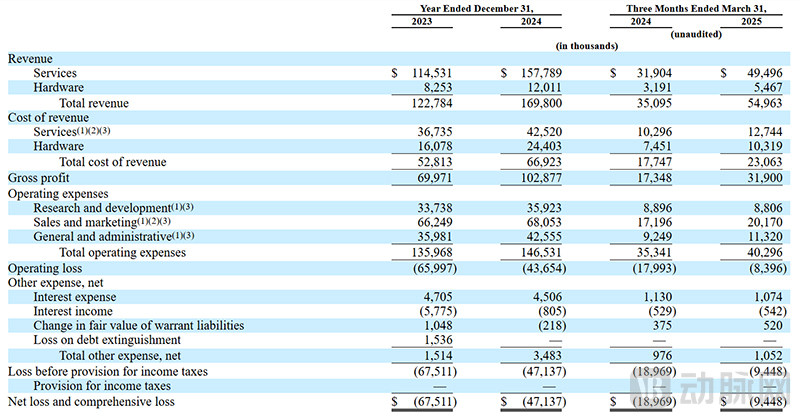
After excluding costs, Omada reported a net loss of $47.1 million in 2024, a significant narrowing from the $67.5 million loss in 2023. Furthermore, the net loss of $9.4 million in the first quarter of 2025 was substantially lower than the $19 million net loss in the same period of 2024, indicating a favorable trend.
Omada’s revenue has maintained rapid growth since the fourth quarter of 2022.。
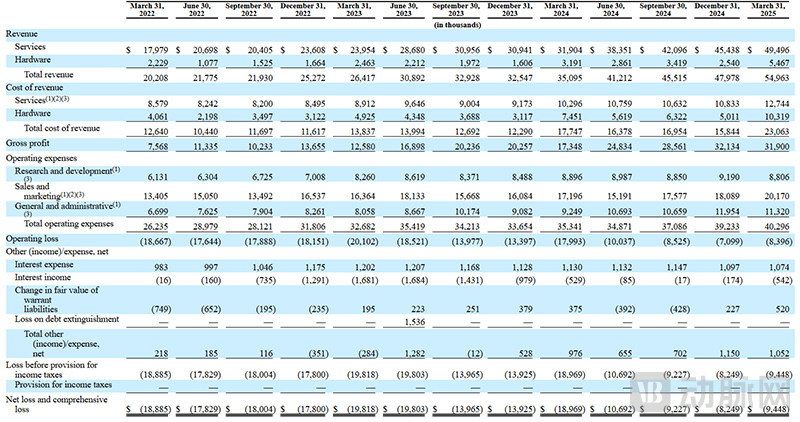
Of course, Omada’s revenue figures are clearly less impressive when compared to Hinge, which recently went public and achieved approximately $390 million in revenue and a net loss of $12 million in 2024. This also seems to explain the gap between the two companies in terms of valuation and cumulative financing: although Hinge’s valuation has dropped significantly, it still stands at $2.4 billion, with cumulative pre-IPO financing of $828 million; Omada’s valuation is $1.3 billion, with cumulative pre-IPO financing of $530 million.
However, Omada covers a wide range of chronic diseases, indicating substantial growth potential. In terms of membership, the number stood at nearly 300,000 in 2022; by the end of 2024, it had surpassed 570,000; and in the first quarter of this year, the figure reached a new high of 679,000. This demonstrates significant growth momentum.

In addition,Omada Health still has significant room for business growth.According to estimates in the prospectus, approximately 20 million people have directly or indirectly benefited from at least one Omada program. This represents only 14% of the self-insured market, 9% of the fully insured market, 1% of the Medicare Advantage market, and 1% of the PBM market.
Undoubtedly, in addition to further expanding its membership base, increasing multi-product penetration will be Omada’s next key strategic priority.
Omada, with a 13-year history since its founding, is undoubtedly a pioneer in digital health. Having navigated multiple market cycles, it has finally gone public. This milestone is not only significant for the company itself but also holds substantial importance for the digital health industry.
Within just half a month, Hinge Health and Omada Health, the leaders in digital therapeutics and the broader digital health industry, have successively completed their IPOs, undoubtedly signaling a thaw in the digital health market after a prolonged freeze.
Unlike Hinge’s focus on musculoskeletal (MSK) care, Omada Health has a broader presence across mainstream chronic diseases. This will provide the industry with a comparative model for evaluating which approach holds greater promise—“specialization” versus “diversification”—making it a compelling topic of discussion.
VCBeat will continue to monitor this development.