

Eli Lilly to Acquire Verve Therapeutics for Up to $1.3 Billion, Offering 113% Premium
On June 17, 2025, local time, Eli Lilly and Company officially announced a definitive agreement to acquire Verve Therapeutics, Inc. (NASDAQ: VERV), a clinical-stage company headquartered in Boston (hereinafter referred to as “Verve”).
Eli Lilly will initiate the acquisition by paying $10.50 per share in cash (totaling approximately $1 billion) for all outstanding shares of Verve, with each share accompanied by a non-tradable contingent value right (CVR). The CVR entitles holders to an additional $3.00, bringing the total consideration to $13.50 per share and the maximum aggregate transaction value to $1.3 billion (over RMB 9.3 billion).
The payment condition for the CVR is: the first patient is dosed in the Phase III clinical trial of VERVE-102 for the treatment of atherosclerotic cardiovascular disease (ASCVD), and this milestone must be achieved before the tenth anniversary of the transaction closing.
It is reported that, as news of Eli Lilly’s acquisition had already circulated within the industry and the transaction value was approximately twice Verve’s current share price, the company’s market capitalization stood at slightly below $559 million after Monday’s close. In after-hours trading on the U.S. stock market, Verve’s share price surged 75%, bringing its latest market capitalization to approximately $900 million. The acquisition price represents a premium of approximately 113% over the 30-day volume-weighted average trading price (VWAP) of Verve’s ordinary shares up to June 16, 2025 (the last trading day prior to the transaction announcement). Furthermore, the gene-editing sector also rallied in response: Intellia Therapeutics’ share price rose 12% in pre-market trading, Beam Therapeutics increased by nearly 7%, and Editas Medicine gained more than 4%.
Notably, the partnership between Eli Lilly and Verve dates back to 2023, when Eli Lilly paid Verve a $60 million upfront fee to secure rights to its preclinical in vivo gene-editing therapy targeting Lp(a). Subsequently, Eli Lilly also paid Beam Therapeutics $250 million to obtain options for Verve’s gene-editing programs targeting PCSK9, ANGPTL3, and another undisclosed target.
Breaking Free from the Rare Disease Dilemma: Pipeline Completes Technological Iteration
Verve was founded in 2018 and is headquartered in Boston, Massachusetts, USA. It was initially co-founded by Dr. Sekar Kathiresan, a leading authority in the genetics of heart disease, and Dr. Kiran Musunuru, an expert in gene editing, with the aim of revolutionizing the treatment paradigm for cardiovascular diseases through single-course gene editing therapies. While traditional medications for cardiovascular conditions require long-term administration (such as statins), Verve’s goal is to develop “one-shot cure” therapies that provide lifelong efficacy.
Verve focuses on leveraging base editing technology to develop gene therapies for cardiovascular diseases, with its core technologies being the GalNAc-LNP delivery system and adenine base editors (ABEs). In 2023, Verve’s pipeline candidate, VERVE-101, became the first in vivo base editing therapy to receive FDA approval for clinical trials.
VERVE-101 utilizes base editing technology (BEs), which enables the substitution of specific nucleotides, such as replacing cytosine (C) with thymine (T). By leveraging this technology, VERVE-101 successfully inactivates the PCSK9 gene, thereby reducing levels of PCSK9 protein and LDL-C in the blood.
Phase I clinical data showed that 28 days after administration of VERVE-101, PCSK protein levels in the blood decreased by 47%, 59%, and 84% respectively in three subjects across the 0.45 mg/kg and 0.6 mg/kg dose groups. Regarding LDL-C levels, 28 days after VERVE-101 administration, LDL-C levels decreased by 39% and 48% respectively in two subjects in the 0.45 mg/kg group, and by 55% in subjects in the 0.6 mg/kg group. In the 0.6 mg/kg group, the 55% reduction in LDL-C remained stable at 180 days. This suggests that long-acting or permanent lipid-lowering effects are highly likely to be achieved.
However, VERVE-101 also revealed serious hepatotoxic side effects in Phase I clinical trials. Additionally, insufficient LDLR expression in some patients (such as those with familial hypercholesterolemia) limited delivery efficiency, leading to a subsequent clinical hold that was never lifted, and no further clinical trials have been resumed.
In response, Verve pointed out that lipid nanoparticles (LNPs) were a likely cause of the adverse events and immediately shifted its R&D focus to VERVE-102, which has since become the company’s core pipeline asset.
To address the limitations of VERVE-101, VERVE-102 incorporates GalNAc-modified lipid nanoparticles (GalNAc-LNPs) that achieve targeted delivery by binding to the asialoglycoprotein receptor (ASGPR) on hepatocyte surfaces, thereby reducing dependence on LDLR and enhancing liver specificity. Furthermore, VERVE-102 optimizes the lipid composition of its delivery system to improve both delivery efficiency and safety.
VERVE-102, which targets the PCSK9 gene to permanently lower “bad cholesterol” (LDL-C), is currently in Phase Ib clinical trials. On April 14, 2025, preliminary clinical trial data released by the company showed that VERVE-102 was well tolerated, with no treatment-related serious adverse events observed. Following a single infusion of VERVE-102, participants exhibited dose-dependent reductions in blood PCSK9 and LDL-C levels.
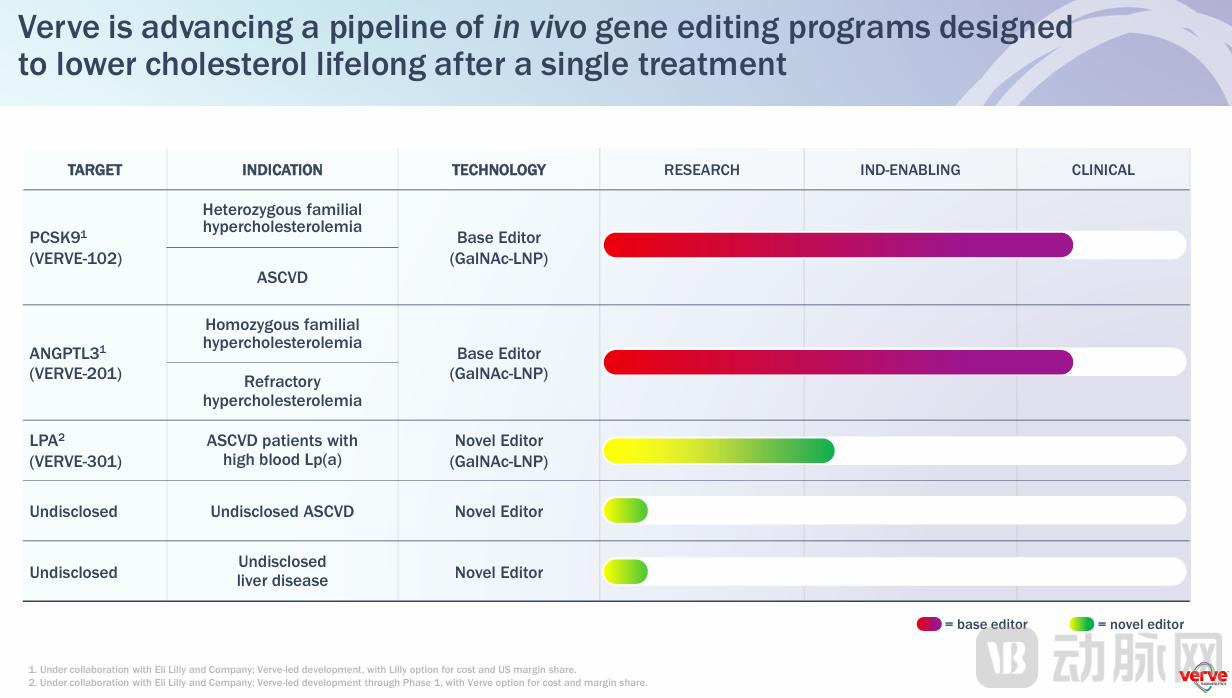
Returning to the question of indications, unlike many gene therapy developers that focus on rare diseases, Verve is targeting cardiovascular disease—the leading cause of death globally. In 2023, it claimed 18.6 million lives, accounting for 32% of all deaths worldwide, and was also the top cause of death in China.
Cardiovascular diseases are frequently diagnosed as atherosclerotic cardiovascular disease (ASCVD) or cardiomyopathy. Globally, there are over 523 million patients with ASCVD, including more than 1.4 billion individuals with hypercholesterolemia (Lp(a) ≥ 125 nmol/L). Meanwhile, the current landscape of global cardiovascular treatment remains severe, as illustrated by the following data: 80% of high-risk patients fail to achieve LDL-C targets (<70 mg/dL) with statin therapy. Existing PCSK9 inhibitors (e.g., evolocumab) entail an annual treatment cost of $5,400, require lifelong administration, and are associated with only 50% patient adherence (discontinuation rate after one year).
MNCs Exit, Verve’s Counter-Trend Breakout
Even so, Eli Lilly’s acquisition of Verve is still viewed as an unfavorable deal.
In fact, the gene therapy sector in which Verve operates got off to a rocky start in 2025. Bluebird Bio, a unicorn with a market capitalization that once reached $30 billion, was acquired by the private equity firm The Carlyle Group in February 2025 for a final price of $100 million. Prior to this, Bluebird Bio had been plagued by commercialization challenges and safety concerns.
This was followed by the exit of multinational corporations (MNCs). Also in February, Pfizer announced the termination of global development and commercialization of its hemophilia B gene therapy, Beqvez, streamlining its once robust gene therapy pipeline; in March, Roche announced a restructuring of its gene therapy subsidiary, Spark Therapeutics; and in May, Vertex announced the discontinuation of its research on AAV vectors.
Vertex’s concerns regarding AAV vectors are particularly representative; indeed, this is a technical limitation that many gene therapy pipelines must address. AAV vectors face challenges such as limited packaging capacity and high immunogenicity, which compromise drug efficacy and safety. Furthermore, the high production costs and purification difficulties associated with AAV-based gene therapies hinder large-scale commercialization. In addition, there are issues with gene editing platforms. Traditional CRISPR technology relies on DNA double-strand breaks (DSBs), carrying a high risk of carcinogenesis (e.g., chromosomal translocations).
Another major challenge lies in the commercialization of gene therapies. Ironically, this commercialization dilemma is closely tied to the field’s most celebrated milestones. Gene therapy’s hallmark achievements have all been in rare diseases: Casgevy for sickle cell disease and transfusion-dependent β-thalassemia, Roctavian for severe hemophilia A, and Lenmeldy for early-onset metachromatic leukodystrophy, among others.
Currently, gene therapy products are primarily targeting rare diseases as their entry point, as most rare diseases are monogenic disorders with clearer etiologies. However, drugs for rare diseases invariably face challenges related to payment models. Bluebird Bio once sought to have the German government cover the costs of Zynteglo and Skysona, but Germany was only willing to reimburse at half price, ultimately leading Bluebird Bio to withdraw from the European market.
By working backward from key pain points, Verve’s differentiation becomes apparent. Verve’s base editing technology platform directly replaces single nucleotides, avoiding DNA double-strand breaks and reducing off-target effects by 90%. Improvements to its delivery system are primarily reflected in its core pipeline candidate, VERVE-102: the updated formulation employs GalNAc-LNPs that target the ASGPR receptor on hepatocytes, tripling delivery efficiency and significantly lowering the risk of hepatotoxicity.
Furthermore, by focusing from the outset on the three major cholesterol-driven factors of atherosclerotic cardiovascular disease (ASCVD), Verve is poised to access a significantly larger market upon commercializing its pipeline compared to that of rare diseases. Additionally, the administration of VERVE-102 via infusion distinguishes it from other pipelines in the same class, which often involve complex dosing regimens.
This may be why VERVE-102’s investigational “one-and-done” therapy remains attractive, despite competition from oral drugs developed by companies such as Merck and AstraZeneca, as well as approved siRNA therapies.
Lilly Writes Another Check
Some industry observers believe that Eli Lilly may have secured a bargain. Given Lilly’s investment in Verve’s disclosed pipeline, the transaction is reasonable, and Verve’s shareholders may see returns from the Contingent Value Rights (CVRs) in the coming years. Based on the current clinical timeline, the Phase III trials triggering the CVRs are expected to commence in the first half of 2027.
It is worth noting that, unlike other multinational corporations (MNCs), Eli Lilly does not face the threat of declining revenue due to impending patent expirations, as its diabetes and obesity drugs, Mounjaro and Zepbound, have generated substantial profits. Analysts estimate that sales of these two drugs will reach $30.2 billion this year. Through this acquisition, Eli Lilly can secure assets in cutting-edge technological fields beyond blockbuster weight-loss medications, while maintaining its focus on the treatment of cardiometabolic diseases.
In fact, pharmaceutical giants including Merck & Co. and AstraZeneca have recently released data on their investigational cholesterol-lowering drugs, with both companies’ oral PCSK9 lipid-lowering agents demonstrating the ability to reduce low-density lipoprotein cholesterol (LDL-C) levels by more than 50%. In a recent report, Goldman Sachs analysts stated that oral therapies could drive sales of PCSK9-targeting drugs from approximately $4 billion currently to around $12 billion by 2034.
For Verve, beyond financial returns, Eli Lilly’s involvement has also helped further explore commercialization pathways for gene therapies targeting chronic diseases. As Ruth Gimeno, Vice President of Diabetes and Metabolism Research and Development at Eli Lilly and Company, stated, VERVE-102 has the potential to become the first in vivo gene-editing therapy for a broad patient population, potentially shifting the treatment paradigm for cardiovascular disease from chronic management to a one-time curative approach.